AI Development Project Timeline: What to Expect
Planning an AI initiative starts with understanding how long it will take and what happens at each stage. This guide explains the complete AI development project timeline, from discovery and data preparation to model development, testing, deployment, and ongoing maintenance. It also explores the factors that influence project duration, common reasons for delays, and practical ways to speed up delivery. Whether you're building a chatbot, predictive analytics solution, AI agent, or generative AI application, this article offers a realistic roadmap to help you plan your project with confidence.


 ChatGPT
  Perplexity
 Integrating machine learning and automation into business operations is a major milestone for any modern enterprise. Many business leaders wonder about the actual schedule of bringing an intelligent product to life. Understanding the AI Development Project Timeline is essential for setting realistic business milestones and managing team expectations. This guide will provide a structured look at what happens during each phase of development.
How Long Does an AI Development Project Take?
The total duration of an intelligent software initiative varies widely based on scope and goals. Business leaders often ask how long AI development takes when planning their annual budgets. On average, a standard deployment can take anywhere from three months to over a year.
To build an accurate AI development timeline for enterprise AI development services, stakeholders must evaluate the overall readiness of their corporate data. The AI implementation process and timeline rely heavily on whether you use pre-built systems or custom-engineered models. Simple integrations can be completed quickly, while massive corporate frameworks require a multi-month commitment.
A pretty realistic timeline for building a commercial-grade machine learning system is like 6 to 12 months.
— Andrew Ng, AI Pioneer & Founder of DeepLearning.AI
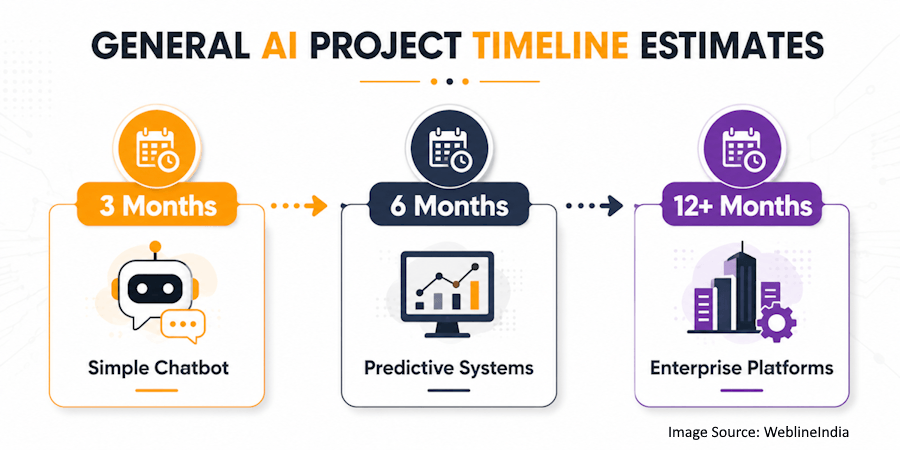
When planning these initiatives, you must establish realistic AI deployment timeline expectations to prevent internal frustration. An accurate AI project timeline serves as a vital tool for keeping engineering teams and corporate executives aligned.
Not sure how long your AI project will take from planning to successful launch?
Factors That Influence AI Project Timelines
Several critical variables dictate the speed of your deployment. No two engineering initiatives are identical, and understanding these factors helps clarify the AI implementation timeline for your specific business.
Project Complexity
The inherent complexity of the mathematical models dictates the overall schedule. Simple text processing tools require less validation than deep learning models built for medical imaging. As algorithmic complexity increases, the development cycles naturally expand to ensure system reliability.
Data Availability
An accurate AI project implementation timeline depends on the accessibility of clean information. If your business has structured databases ready for processing, the project will move swiftly. When data is siloed across legacy platforms, engineers must spend weeks extracting and compiling it.
Integration Requirements
Connecting new intelligent systems to old enterprise software can introduce significant technical delays. A smooth AI project timeline for businesses depends on modern software connectors. If your legacy databases lack proper interfaces, developers must write custom middleware to bridge the systems.
Compliance and Security Needs
Industries like healthcare and finance require deep security audits before launching software. Meeting regulatory standards adds a necessary layer of protection to your enterprise AI development project roadmap. These safety checks extend the validation phase but protect your firm from future legal issues.
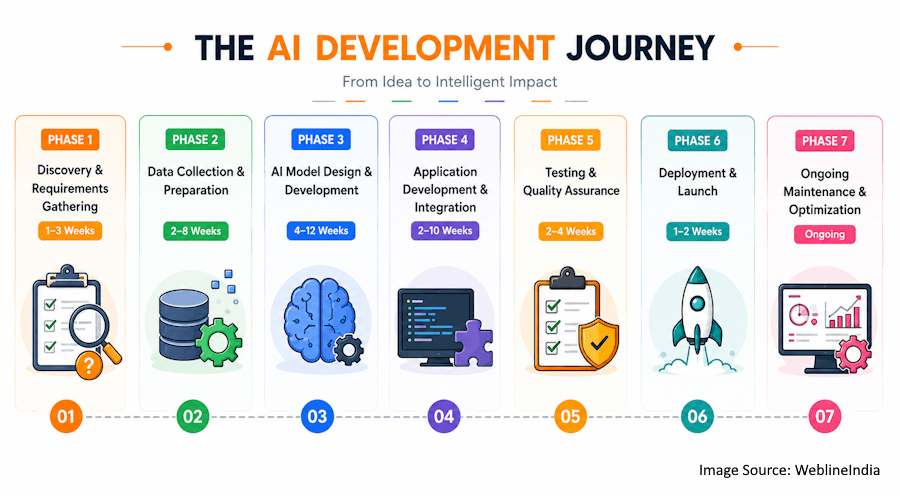
Phase 1: Discovery and Requirements Gathering (1–3 Weeks)
The first step of the AI software development process does not involve writing code. Instead, the focus remains on strategic alignment and understanding the target user. This period represents the foundation of all future AI software development project stages.
Business Goals
Project managers must clearly define what success looks like for the organization. They outline key performance indicators such as reduced operational costs or faster customer response times. Having clear goals prevents scope creep during the later stages of development.
Use Case Identification
The engineering team works to pinpoint the exact tasks that require automation. For a detailed AI development lifecycle explained, identifying specific bottlenecks is critical. This focus ensures that you do not waste engineering resources on features that do not add value.
Feasibility Assessment
Technical leaders may use ai consulting services to review existing infrastructure and confirm that the proposed ideas are actually possible. They analyze server capacities, software architectures, and available budgets to create a realistic plan. This assessment protects the business from investing in impractical technologies.
Phase 2: Data Collection and Preparation (2–8 Weeks)
Data is the fundamental fuel for any machine learning system. This stage of the AI project roadmap often requires the most intensive effort from your data engineering team.
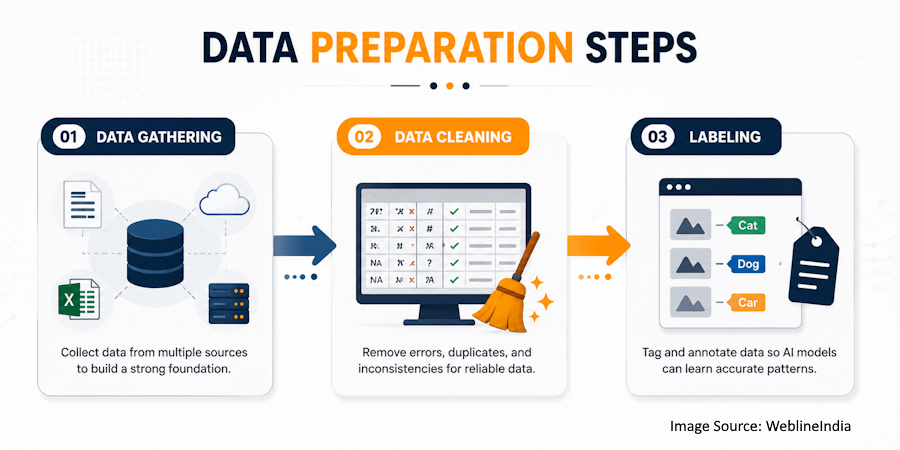
Data Gathering
Engineers extract information from various sources like customer databases, sensor logs, and public repositories, while data analytics services can help prepare this information for downstream analysis and model development. This process requires secure data transfer protocols to protect company secrets. The volume of information collected directly impacts the future accuracy of your models.
Data Cleaning
Raw data is rarely perfect and often contains formatting errors or duplicate entries. Analysts filter out useless information and fix missing values to prevent system bias. Clean data ensures that the machine learning models learn correct patterns during training.
Data Labeling
For supervised learning models, humans must tag the data so the system understands it. This process might involve labeling images or categorizing customer service emails by sentiment. Accurate labeling is crucial because incorrect tags will severely damage model performance.
Phase 3: AI Model Design and Development (4–12 Weeks)
During this phase, data scientists begin the actual mathematical work within the AI development lifecycle. This is where your concept transforms into a functioning intellectual asset.
Model Selection
As part of machine learning development services, data scientists evaluate various algorithmic architectures to find the best fit for your data. They choose between classic machine learning algorithms and advanced deep learning frameworks. The chosen architecture dictates how much computing power the training process will require.
Model Training
The engineering team feeds the prepared datasets into the selected mathematical models. This process involves massive server infrastructure and can take hours or even weeks to complete. The system slowly learns to recognize patterns and make predictions based on the inputs.
Performance Optimization
After initial training, engineers fine-tune the system parameters to increase prediction accuracy. They adjust variables to eliminate errors and reduce computational overhead. This optimization ensures the software runs efficiently when deployed to production.
Phase 4: Application Development and Integration (2–10 Weeks)
An intelligent model must be wrapped in user-friendly software to be useful. This phase often combines AI engineering with custom software development services to bridge the gap between data science and traditional software engineering.
API Development
Engineers build secure application programming interfaces to connect the model to other programs. These APIs act as digital bridges that send user queries to the model and return answers. Well-designed APIs are essential for system speed and future scalability.
System Integrations
The development team embeds the new technology into your existing corporate software ecosystem. This step ensures that your CRM, ERP, or web platforms can talk to the model. Seamless connection across systems is vital for automating daily business workflows.
User Interface Development
Designers create intuitive dashboards that help employees or customers interact with the intelligence engine. A clean user interface ensures that non-technical users can leverage the system without extensive training. Good design ultimately drives higher adoption rates within the organization.
Phase 5: Testing and Quality Assurance (2–4 Weeks)
Before releasing the software, comprehensive software testing services can evaluate its behavior across various AI development stages and real-world operating conditions. Testing ensures that the application behaves predictably under real-world conditions.
Performance Testing
Quality assurance teams test how quickly the system responds when thousands of users access it simultaneously. They identify database bottlenecks and optimize server configurations to handle peak traffic. This step ensures consistent user experiences after the public launch.
Security Testing
Security experts conduct penetration testing to ensure that hackers cannot compromise your data. They verify encryption standards and check for vulnerabilities in the application code. Protecting user privacy is a primary concern for any enterprise application.
User Acceptance Testing
Real business users test the application in their daily environments to find workflow issues. This feedback helps developers make minor adjustments before the official launch. User acceptance testing confirms that the software actually solves the target business problem.
Phase 6: Deployment and Launch (1–2 Weeks)
Deploying the system marks the transition from development to live operations. This is a critical milestone in the enterprise AI implementation journey.
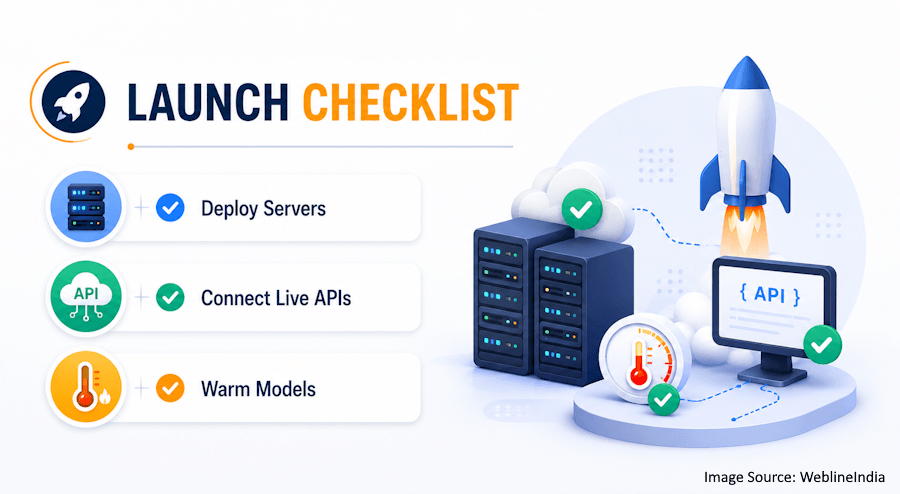
Production Setup
During production setup, cloud and devops services help teams configure the live environments where the software will run. They set up automated scaling tools to manage server resources dynamically. This preparation keeps operating costs low while maintaining high performance.
Monitoring Configuration
The team installs monitoring tools to track the health of the model in real time. These dashboards alert engineers if the system experiences errors or sudden performance drops. Proactive monitoring helps resolve technical glitches before they impact your customers.
Go-Live Checklist
Managers review a final checklist to ensure all security, technical, and operational systems are ready. They slowly route a small percentage of user traffic to the new system to test stability. Once verified, the platform opens to the entire user base.
Phase 7: Ongoing Maintenance and Optimization
An intelligent application requires continuous care even after a successful launch, making software maintenance services relevant to its long-term operational lifecycle. Successful AI solution development demands a long-term operational strategy to keep the software effective.
Model Retraining
As market trends change, the real-world data will begin to differ from the training data. This shift is known as model drift, and it causes prediction accuracy to decay over time. Regularly retraining the system with fresh data ensures that your software remains accurate.
Performance Monitoring
Operations teams continuously watch the system’s computing costs and response times. They optimize database queries and server distributions to keep hosting bills manageable. Constant oversight keeps the software fast and financially sustainable.
Feature Enhancements
Based on feedback from users, your development team will plan future software updates. They design new tools and refine existing features to increase corporate productivity. Continuous updates ensure that the software evolves alongside your business.
Typical AI Project Timelines by Project Type
Different applications have highly varied schedules due to their scope. Understanding the unique AI deployment timeline for your specific project type helps in planning resource allocation.
AI Chatbots
A customer service chatbot usually takes between 4 and 12 weeks to configure. These systems rely heavily on pre-trained language models and predefined conversational paths. The development focus remains on integrating the chat widget with your website.
AI Agents
Intelligent AI agents that can execute complex workflows autonomously require 12 to 24 weeks. Developers must design decision trees and connect the agents to internal database APIs. Testing these systems takes longer because they act independently within your network.
Predictive Analytics Solutions
Building a system to forecast sales or inventory demands usually takes 16 to 32 weeks. This process relies heavily on custom data pipelines and intensive model training. The custom AI development timeline for analytics is highly dependent on historical data quality.
Computer Vision Systems
Visual recognition software for quality control or security takes about 20 to 40 weeks. Engineers must collect and label thousands of images to train neural networks accurately. These systems also require specialized hardware integration to process live video feeds.
Generative AI Applications
Depending on scope, generative ai development services for custom content engines or design tools can involve development timelines of 12 to 26 weeks. Developers often customize large foundation models to align with corporate brand guidelines. The generative AI development timeline depends on how much AI fine-tuning is required for your specific output.
Want a clear roadmap for building, testing, and deploying your AI solution successfully?
Common Reasons AI Projects Get Delayed
Even with careful preparation, unexpected challenges can stretch your development schedule. Recognizing these common roadblocks helps managers proactively mitigate risks.
- Underestimating Data Preparation: Many teams assume their databases are ready for training when they are not. Cleaning and labeling always take longer than estimated, causing cascading delays down the line.
- Changing Project Scope: Adding new features midway through development disrupts the entire schedule. Stick to your initial minimum viable product plan to ensure a timely launch.
- Lack of Skilled Talent: Machine learning engineering requires highly specialized mathematical knowledge. Teams without experienced developers often spend weeks troubleshooting basic model errors.
- Integration Roadblocks: Connecting modern cloud models to legacy on-premise databases can present unforeseen security hurdles. These issues require custom network configurations that delay the launch.
How to Accelerate AI Development Timelines
If your organization is on a tight deadline, you can use several strategies to speed up your deployment. Using a structured AI development project planning guide keeps your team focused on rapid delivery.
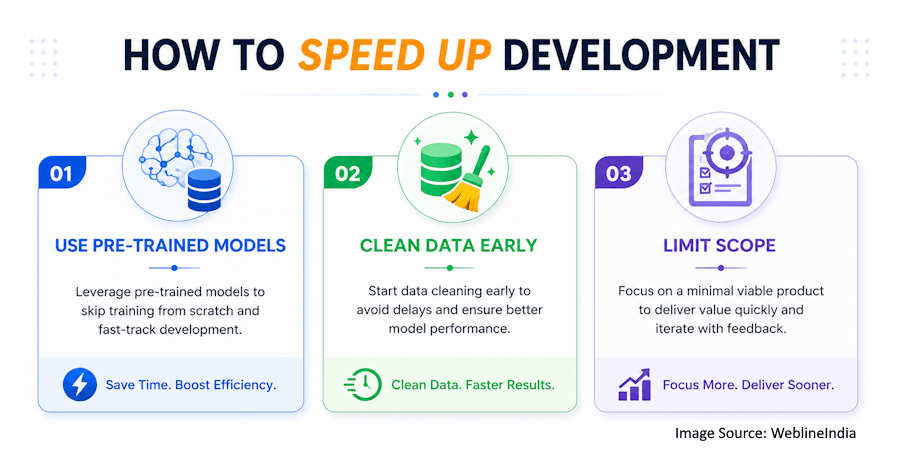
First, utilize pre-trained foundation models instead of building neural networks from scratch. This approach bypasses weeks of computational training and lets you focus on custom integration.
Second, start cleaning your operational databases before you even hire AI development team. Having structured data ready on day one can shave months off your timeline.
Finally, narrow your project scope to focus on a single, high-impact business problem. Launching a simpler system quickly allows you to gather user feedback and iterate faster.
Choosing the Right AI Development Partner
Building intelligent systems internally requires a massive investment in recruitment and server infrastructure. For many businesses, outsourcing to experienced professionals is the most efficient path forward. Selecting the right vendor for AI development services determines whether your project succeeds or fails.
When evaluating external development agencies, look for partners with a proven track record in your industry. They should possess deep expertise in modern machine learning frameworks and cloud architectures. A great partner does not just write code; they help you refine your business strategy and manage project risks. They will provide a transparent roadmap and help you navigate the complexities of data security.
Final Thoughts
Embarking on an artificial intelligence journey is an exciting step that can completely optimize your business workflows. While the development lifecycle requires patience and careful planning, the long-term operational returns are immense.
If you are looking for an experienced partner to guide you through this journey, consider collaborating with WeblineIndia. With over two decades of offshore software development experience, WeblineIndia helps businesses build custom machine learning systems. Their team of expert engineers can streamline your transition, helping you deploy robust automation tools on time and within budget.
Social Hashtags
#ArtificialIntelligence #AIDevelopment #AIProjectManagement #MachineLearning #GenerativeAI #SoftwareDevelopment #DigitalTransformation #EnterpriseAI #AIImplementation #BusinessAutomation
Need help avoiding costly delays across every stage of your AI development journey?
Frequently Asked Questions
Globally Recognized for Unmatched Quality and Reliability




Testimonials: Hear It Straight From Our Global Clients
Our development processes delivers dynamic solutions to tackle business challenges, optimize costs, and drive digital transformation. Expert-backed solutions enhance client retention and online presence, with proven success stories highlighting real-world problem-solving through innovative applications. Our esteemed Worldwide clients just experienced it.
Awards and Recognitions
While delighted clients are our greatest motivation, industry recognition holds significant value. WeblineIndia has consistently led in technology, with awards and accolades reaffirming our excellence.

OA500 Global Outsourcing Firms 2025, by Outsource Accelerator

Top Software Development Company, by GoodFirms

BEST FINTECH PRODUCT SOLUTION COMPANY - 2022, by GESIA

Awarded as - TOP APP DEVELOPMENT COMPANY IN INDIA of the YEAR 2020, by SoftwareSuggest