What is a Forward Deployed Engineer (FDE)? How Remote Engineering Teams Can Deliver the Same Model
What is a Forward Deployed Engineer, and why is the FDE model gaining attention? Learn how FDEs bridge engineering and business needs, and how remote engineering teams can deliver a similar model for AI, software deployment, and ongoing product development.


 ChatGPT
  Perplexity
 There is no denying that the landscape of technology is changing almost every hour, and as a result, businesses today need more than just developers writing code in silos. Businesses today require software engineers who understand the business context and can solve immediate customer problems. Engineers today need to bridge the complex software that they develop and the real-world outcomes that customers are looking for.
This is what Forward Deployed Engineers do. Note that they were originally conceived by Palantir for very complex deployments, but the Forward Deployed Engineer model actually has lots of applicability to any software organization.
What Is a Forward Deployed Engineer?
Forward Deployed Engineers (FDEs) are typically Software Engineers in a hybrid role of Product Management and Customer Success. While they can be located anywhere, they are best to operate in or near the customer environment. Therefore, the typical Forward Deployed Engineer does not operate in isolation as a single feature developer but instead solves immediate problems that affect real customers and therefore delivers immediate business value.
A Forward Deployed Engineer is the connection point between the technology provider and the end user. This type of engineer has a deep understanding of the technical constraints that he/she is working under as well as the business objectives that the software he/she is implementing is trying to meet. Therefore, the Forward Deployed Engineer’s primary goal is to implement software that delivers tangible business outcomes, much like custom software development services that align technology with specific business requirements.
The role of an FDE is highly visible, so it requires high technical skill as well as strong communication skills.
Need an FDE-Style Remote Engineering Team That Takes More Ownership?
What Does a Forward Deployed Engineer Actually Do?
Forward Deployed Engineer can have a wide range of tasks and can change from time to time. This type of engineer typically spends a lot of time doing software development and also working on business strategy.
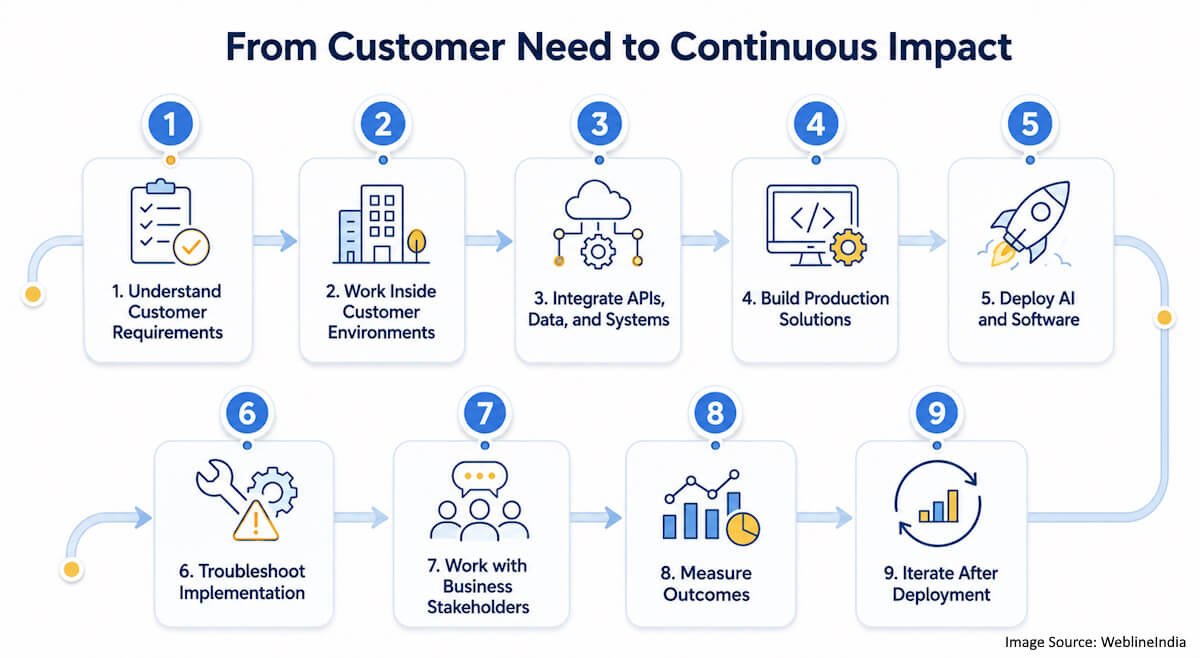
Understand Customer Requirements
An FDE first and foremost understands the needs of a customer. They identify pain points a business is facing and seek to understand the daily workings of a customer. This enables the engineer to best design a solution for the customer’s business.
Work Inside Customer Environments
This Forward Deployed Engineer will have to learn the current environment of the client and be able to start building solutions within that current environment (e.g. within current databases, legacy systems, or even proprietary networks).
Integrate APIs, Data, and Systems
This engineer also builds production solutions (not just prototypes) that can talk to old systems and also ensures that new software can also talk to old systems without any problems. They integrate APIs, data, and systems, which requires writing necessary scripts for building of data pipelines.
Build Production Solutions
This code will be production-ready. That means it will not be a throwaway prototype, but real software built through software development services that can support the business over the long term.
Deploy AI and Software
In summary, Forward Deployed Engineer for AI deploy production-ready solutions that they have Forward Deployed in their customers’ environments. They are responsible for deploying software, and they test the software after it has been deployed to ensure that it is functioning properly in the customers’ environments.
Troubleshoot Implementation
Forward Deployed Engineers encounter many bugs while deploying software. These types of errors are typically the first point of contact for a Forward Deployed Engineer. They are on the spot to resolve any errors that have occurred. In addition, they can ensure that the software is running at the optimal level of performance and is working as required.
Work with Business Stakeholders
Forward Deployed Engineers (FDEs) work with business stakeholders to understand their needs and to explain the work of the engineers to them in terms of the progress of the completion of the tasks assigned to them. The purpose of their work is to support the business goals of their clients.
Measure Outcomes
Verifying that the value promised by the AI/Software created by you is actually being delivered. Measuring and tracking key metrics and usage data (e.g., log files) to ensure that everything is working as promised. If not, then you, the FDE, will know why.
Iterate After Deployment
Nothing in engineering is ever finished. In fact, Forward Deployed Engineers are not done with the production of software; they are just beginning the continued improvement of released software. This can involve software maintenance services, but in reality, the work goes further as the system as a whole is continuously improved and modernized.
Then, new functionality is being added, and the system is being enhanced based on feedback from end users. Subsequent enhancements are being based on real-world usage.
Why Forward Deployed Engineers Are Becoming Important for AI
Forward Deployed Engineers (FDEs) are playing an increasingly important role as organizations deliver software solutions that incorporate AI. While in the past organizations delivered software following a set of defined rules, today’s software solutions are delivered using AI and thus are unpredictable and always probabilistic. FDEs are thus playing an increasingly important role as organizations deliver software solutions that incorporate AI.
The Forward Deployed AI Engineer for AI models is critical because for any given model, it will work well for one company but not as well for another because of the differences in the underlying data.
A Forward Deployed AI Engineer ensures that the appropriate data is used for model training, an important consideration in machine learning development services where model performance depends heavily on the underlying data. They also optimize prompt engineering. They integrate the output of AI into currently existing user interfaces. And most importantly, they validate the accuracy of a model in production. Therefore, someone with a lot of experience in Forward Deployed work needs to continuously monitor an AI model in order to achieve value.
Looking for Engineers Who Can Build, Deploy, and Work With Your Stakeholders?
Forward Deployed Engineer vs Software Engineer vs Solutions Architect vs Consultant
It is easy to confuse these roles. However, they serve different purposes within a project. The following table explains the primary differences.
| Role | Primary Responsibility |
| Software Engineer | Build software features and maintain core codebases. |
| Solutions Architect | Design the technical structure and choose the stack. |
| Consultant | Provide expert advice and identify business opportunities. |
| FDE | Understand customer needs, build solutions, deploy code, and optimize outcomes. |
A software engineer focuses on the code. A solutions architect focuses on the design. A consultant focuses on the strategy. An FDE brings these concerns closer to software product engineering by focusing on the actual delivery of value inside the client’s own ecosystem.
Can a Remote Developer Work as a Forward Deployed Engineer?
Many people think an FDE must be physically present in a customer’s office. This is a common misconception. In our current digital world, a senior remote developer can absolutely fulfill the role of a Forward Deployed Engineer.
Digital tools have replaced physical desks. Modern remote engineers are highly effective. A senior remote developer can achieve the following results:
- Join the customer’s Slack or Microsoft Teams channels for instant communication.
- Participate in daily standups to align on priorities.
- Access secure repositories and development environments.
- Work directly with product managers and customer stakeholders.
- Attend virtual client meetings to capture requirements.
- Integrate APIs and use devops services to support the deployment of production code from anywhere.
- Provide coverage during overlapping US or EU working hours.
In summary, Forward Deployed Engineers equipped with the proper mindset, tools, and support can achieve the same results from anywhere in the world. Our senior remote developers can establish a remote team of engineers that act as an extension to your current team of Forward Deployed Engineers and other stakeholders.
FDE vs Remote Dedicated Developer
A remote dedicated developer will typically work on one project/task and be the expert for that piece of code in the remote development team.
An FDE-style engineer (or team) acts as if they were internal employees of your company (working remotely). They would be able to push back against bad requirements, suggest a better technical way to complete a task, and ensure the result is a great customer experience.
Hiring dedicated developers is great for adding capacity to your current development team, but hiring an FDE-style team is better for ensuring the success of your product and overall business integration.
When Should You Hire an FDE vs a Remote Development Team?
Choosing between these models depends on your business needs. You must evaluate your stage of growth and your technical requirements.
Hire an individual FDE when:
- You need one highly specialized person to solve a complex deployment challenge.
- The role requires a high degree of customer-facing communication and empathy.
- You already have an established engineering organization and just need someone to help with deployment or integration.
Consider a remote dedicated engineering team when:
- You need a group of 2 to 10 engineers to build an entire product.
- You need a mix of skill sets like frontend, backend, AI, and DevOps.
- You need continuous development and maintenance after the initial deployment.
- You want to scale your capacity quickly through a software development outsourcing company without taking on the overhead of local hiring.
- Hiring an FDE locally is too expensive or takes too much time to recruit.
A full team allows for better synergy. You get faster development cycles. You have access to a broader range of expertise. You can ensure that your product evolves as the market demands.
How WeblineIndia Can Help You Build an FDE-Style Remote Engineering Team
A software product for AI, data analytics, or process automation needs to be developed and supported by an engineering team that understands the product and the customer’s business needs.
WeblineIndia’s remote dedicated engineering team of seasoned engineers acts as an integrated extension to your Engineering Team. You’ll often find them saying:
- We are not order takers; we are proactive engineers
- We engage with your stakeholders
- We understand your business requirements
- We take complete responsibility to deliver production-ready solutions for you.
The offshore software development models offered by WeblineIndia are designed to give you maximum control and transparency. Our team of top talent will help you find the right AI specialists, full-stack engineers, or even a complete product team to work on your project.
We have experienced remote dedicated developers who can work as an extension of your team and deliver production-ready solutions. Our software development outsourcing and offshore development models are designed to give you greater control and transparency. Learn more about our remote dedicated developers and explore the offshore development model that fits your business needs.
Contact us today to learn more about how we can help you scale your engineering capacity.
Want to Scale Engineering Capacity Without the Cost of Local Hiring?
Frequently Asked Questions
What is a Forward Deployed Engineer (FDE)?
Forward Deployed Engineers (FDEs) – Technical Sales & Customer Support Engineers that can work with customers to set up, support, and troubleshoot production software in their environment to deliver the best possible outcome for them.
Forward Deployed Engineers and Software Engineers: What’s the Difference?
For example, a Forward Deployed Engineer for an AI company can focus on deploying, configuring, and integrating software into external client environments. In this role, a software engineer writes code, configures systems, deploys software, integrates APIs, troubleshoots and fixes problems, and delivers results to clients of an AI company.
Why are Forward Deployed Engineers important for AI companies?
AI models must run reliably, safely, and accurately in production workflows. This means that the AI Forward Deployed Engineer is required to custom-tune an AI model, optimize prompts, and perform data integration for each client.
Can a remote developer work as a Forward Deployed Engineer?
Yes. Remote collaboration has become very mainstream with tools like Slack, video conferencing, and secure cloud repositories. So now a remote developer can act as an FDE, attend stand-ups and meetings with clients and business stakeholders all over the world.
Is an FDE the same as a solutions architect?
For information on Solutions Architects, please see the following article: Solutions Architects: Salary, Skills, Hiring, And More.
What skills are required to become an FDE?
FDEs have good full-stack coding skills and also have knowledge of system integration. Communication skills are also a must, as the FDE has to interact with various stakeholders, including the client and business stakeholders. The individual also must have high emotional intelligence.
When to hire an individual FDE instead of an agency?
The one expert needed for Forward Deployed Engineering to a small number of very complex, high-stakes clients. They will be integrated into your current engineering team.
What is the main difference between an FDE-style remote team and a standard remote development team?
Contrast with work assigned by a manager/CEO in a remote development team where employees only complete assigned work. Here, an FDE-style remote team can actually take complete and utter ownership of issues to make sure results are of the highest quality that will lead to user adoption (i.e., the results actually being used by end users of software). And actually challenge suboptimal technical and business methods in place today at a company that locally-based employees wouldn’t even challenge, let alone try to implement alternative work methods to achieve results.
How do offshore teams deliver the FDE model effectively?
Offshore providers like WeblineIndia can offer senior remote developers who communicate with clients during the hours of availability when both parties are present and can work effectively. The remote developers are integrated into the clients’ current workflows and are able to deploy software to deliver outcomes. In addition, the remote developers gain an understanding of the business and the technical and business logic behind it.
When to go for a remote dedicated engineering team versus hiring locally?
A remote dedicated engineering team can also be a good solution for companies that require a number of specialized technical skills to be deployed (e.g., frontend, backend, AI, DevOps) but don’t have the time and funds to recruit for local positions.
Globally Recognized for Unmatched Quality and Reliability




Testimonials: Hear It Straight From Our Global Clients
Our development processes delivers dynamic solutions to tackle business challenges, optimize costs, and drive digital transformation. Expert-backed solutions enhance client retention and online presence, with proven success stories highlighting real-world problem-solving through innovative applications. Our esteemed Worldwide clients just experienced it.
Awards and Recognitions
While delighted clients are our greatest motivation, industry recognition holds significant value. WeblineIndia has consistently led in technology, with awards and accolades reaffirming our excellence.

OA500 Global Outsourcing Firms 2025, by Outsource Accelerator

Top Software Development Company, by GoodFirms

BEST FINTECH PRODUCT SOLUTION COMPANY - 2022, by GESIA

Awarded as - TOP APP DEVELOPMENT COMPANY IN INDIA of the YEAR 2020, by SoftwareSuggest