Generative AI in Healthcare: Use Cases, Benefits, and Challenges
Generative AI in healthcare is transforming clinical workflows, patient care, medical research, diagnostics, and hospital operations. Explore its most important use cases, benefits, implementation challenges, security considerations, and emerging trends shaping the future of healthcare and life sciences.


 ChatGPT
  Perplexity
 The healthcare sector is witnessing an age of unprecedented transformation. As a result of a shortage of healthcare providers, an increase in healthcare costs, and challenges in providing quality care in remote areas are a few factors that pushed healthcare informatics experts walk an extra mile and building generative AI in healthcare.
Generative AI in healthcare has many use cases, benefits, and challenges. Overall, machine learning models process and generate information in order to support and assist with clinical decision-making. Here are a number of different use cases for generative AI in healthcare.
But let’s begin with a generic question.
What is Generative AI in Healthcare, and How is it Transforming Patient Care?
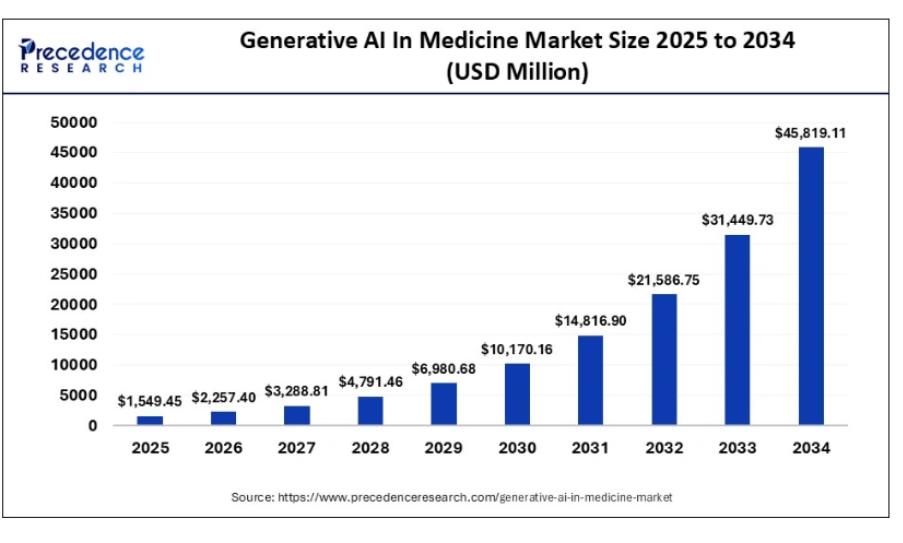
According to Precedence Research, the market is likely to shoot from $1.55 billion in 2025 to approximately $45.82 billion by 2034. This highlights a compound annual growth rate of roughly 45–46% over the prediction period.
In the intermediate years, the healthcare industry is expected to reach $2.26 billion in 2026, $3.29 billion in 2027, $4.79 billion in 2028, $6.98 billion in 2029, and $10.17 billion by 2030, before rushing to $14.82 billion in 2031, $21.59 billion in 2032, and $31.45 billion in 2033.
Modern clinics deal with massive data loads. Generative AI in healthcare introduces advanced machine learning models that synthesize new data. These networks analyze medical histories. They draft diagnostic notes. They model new molecular structures.
Medical AI systems interpret physician notes quickly. Healthcare AI solutions streamline hospital routines. Practitioners use AI healthcare solutions to reduce burnout. Patient interactions change entirely. AI patient care relies on precise data inputs. The technology formats unstructured medical files into readable charts. Speed matters in critical care.
Ready to build generative AI solutions tailored to your healthcare workflows?
Why Healthcare Organizations Are Investing in Generative AI Solutions
Healthcare organizations are investing in Generative AI solutions in order to allow their hospitals to cut costs and deliver better healthcare in times of staff shortages and an increasing number of patients.
Growing Demand for AI-Powered Healthcare
- Hospitals face rising patient volumes daily.
- Staff shortages stress emergency units.
- Clinics need automation to survive.
Digital Transformation in Healthcare
- Legacy systems hinder data sharing.
- Healthcare digital transformation requires smart tools and well-planned digital transformation services to modernize fragmented systems and workflows.
- Cloud adoption paves the way for machine learning.
Improving Clinical and Administrative Efficiency
- Staff spend hours on paperwork.
- Clinical AI reduces manual entry tasks.
- Automated workflows free up expert time.
Top Generative AI Use Cases in Healthcare Across Hospitals, Clinics, and Life Sciences
Clinics and hospitals use machine learning to automate their administrative work, while also to optimize patient management. Life Science research institutes use neural networks in order to calculate the bonds of molecules and to predict the results of drug trials.
AI-Powered Clinical Documentation and Medical Scribing
Physicians dictate patient symptoms into smart microphones. Natural language models transcribe audio instantly. The software structures the text into standard electronic formats. Doctors review the draft and sign off. This cuts charting time by half.
Medical Imaging Analysis and Diagnostic Support
Radiologists review hundreds of scans daily. Computer vision tools highlight microscopic tissue anomalies. AI diagnosis tools flag early-stage tumors. Physicians combine visual outputs with patient data. AI in medical diagnosis lowers false-negative rates.
Drug Discovery and Clinical Research
Molecules take years to test. AI drug discovery platforms simulate chemical interactions. Researchers test thousands of compounds virtually. AI drug discovery solutions slash laboratory expenses. Successful candidates move faster to clinical trials.
Personalized Treatment and Precision Medicine
Genomic data contains complex clues. Custom algorithms parse genetic sequences. Doctors design targeted cancer therapies. AI applications in hospitals match rare diseases with historic treatment success.
Virtual Healthcare Assistants and AI Chatbots
Outside of the clinical environment, patients can use intelligent healthcare Virtual Healthcare Assistants and AI Chatbots to receive answers to billing questions, triage of less serious health problems and even book a follow-up appointment with their Doctor.
Remote Patient Monitoring and Telemedicine
Wearable health sensors in the home enable continuous patient monitoring and edge-based algorithms to detect abnormal heart rhythms and issue alerts as necessary to nursing staff. Healthcare automation enables monitoring of patients in the home to be joined up with hospital-based care.
Healthcare Revenue Cycle Management
Smart algorithms can audit and check all outgoing bills for any errors, as codes for medical billing are updated very frequently.
Medical Coding and Claims Processing
The thousands of numerical tags that make up the medical billing codes for a patient’s clinical chart can be assigned by the coders to the correct part of the read clinical chart by natural language models. The correct billing codes can then be suggested for the outgoing claims, and these in turn will be processed by the insurance companies as quickly as possible.
Healthcare Knowledge Management
Hospitals store vast policy libraries. Staff search guidelines using conversational queries. The system retrieves exact safety protocols. Training new nurses becomes efficient.
Need expert guidance to plan and implement generative AI in healthcare?
Key Benefits of Generative AI in Healthcare for Providers, Patients, and Administrators
In the Journal of Medical Systems, 2025, published on PubMed Central under the article titled ‘Opportunities for Clinical Excellence and Administrative Efficiency’, integrating Gen AI in medical education, healthcare marketing, and revenue cycle management illustrates its potential to revolutionize learning experiences, optimize financial operations, and enhance patient engagement strategies.
It has been proven in many research studies and surveys that generative AI in healthcare improves patient outcomes, enables faster clinical decision-making, and reduces administrative workloads for healthcare providers and administrators while improving patient care for patients.
Improved Patient Outcomes
- Diagnoses occur earlier: Advanced algorithms scan digital pathology slides and early medical records to detect subtle anomalies before physical symptoms worsen, giving physicians a crucial window for timely medical intervention.
- Treatment plans fit individual physiologies: Custom predictive tools analyze unique genetic sequences and historic health metrics, allowing clinical teams to tailor precise pharmaceutical dosages and therapies for every patient.
- Monitoring prevents emergency readmissions: Wearable medical sensors track vital signs continuously from home, alerting nurses instantly to sudden physiological changes and stopping critical health regressions before hospitalization becomes necessary.
Faster Clinical Decision-Making
- Doctors query vast medical journals instantly: Natural language tools search through millions of peer-reviewed clinical studies in seconds, providing immediate evidence-based treatment guidelines directly to physicians during active consultations.
- Algorithms summarize complex lab results: Machine learning models ingest dense multi-page diagnostic reports, extracting key metric shifts and presenting concise visual summaries that speed up physician review processes.
- Critical care choices happen without delay: Real-time data synthesis aggregates emergency room telemetry data immediately, helping medical teams make split-second life-support decisions without waiting for manual chart analysis.
Reduced Administrative Workload
- Billing paperwork finishes automatically: Smart coding assistants scan clinical notes to generate accurate insurance claims instantly, eliminating tedious manual data entry tasks for front-desk hospital workers.
- Scribing tools eliminate midnight documentation: Ambient speech recognition software records patient consultations natively, transcribing physician conversations directly into structured electronic health records before the next appointment begins.
- Staff focus entirely on human care: Automated routine scheduling and paperwork removal free up hours of nursing time, allowing clinical staff to direct their attention toward direct bedside patient interactions.
Lower Healthcare Operational Costs
- Hospitals reduce repetitive overhead tasks: Intelligent software automates appointment reminders, billing audits, and supply inventory tracking, cutting the labor expenses associated with routine administrative office duties.
- Drug research budgets shrink: Virtual molecule simulation models replace expensive physical laboratory trials, lowering the financial investment required to test candidate pharmaceutical compounds prior to human studies.
- Staff allocation matches actual patient volume: Predictive workforce algorithms analyze historical admissions data accurately, helping hospital managers schedule nurse shifts precisely according to expected patient inflow rates.
Enhanced Patient Engagement and Experience
- Portals offer clear explanations of lab results: Patient-facing applications translate complex medical terminology into plain language, helping individuals understand their blood test metrics and diagnostic scans clearly.
- Chatbots answer routine questions anytime: Intelligent virtual assistants operate twenty-four hours a day to resolve billing inquiries, medication refill requests, and appointment scheduling tasks without human wait times.
- Wait times drop significantly: Streamlined digital registration processes and automated triage flows reduce physical bottlenecks in waiting rooms, shortening the duration patients spend at clinic facilities.
Better Healthcare Data Utilization
- Siloed records merge into unified profiles: Integration software pulls fragmented patient data from separate hospital departments together, constructing a comprehensive longitudinal health record for every individual.
- Predictive tools forecast seasonal illness surges: Predictive tools and data analytics solutions can analyze regional climate trends and historical admission records to forecast localized illness surges, helping facility directors prepare resource inventories.
- Research departments mine clean longitudinal datasets: Anonymized historical databases provide clinical scientists with high-quality, standardized multi-year data pools that accelerate epidemiological research and clinical trial recruitment.
Challenges of Implementing Generative AI in Healthcare and How to Overcome Them
First, there are privacy threats from machine learning systems in healthcare, and model hallucinations when they are used for decisions related to patients. Therefore, it is required to implement robust encryption for health-related data and to use healthcare AI systems under strict human oversight for decisions related to patients.
It is also required to implement structured governance frameworks that can protect individual health information as well as avoid any bias in algorithms that may affect different patient groups.
Patient Data Privacy and Security
Medical records require strict shielding. Data breaches trigger severe fines. Encryption standards must remain airtight.
AI Hallucinations and Clinical Accuracy
Models occasionally invent false medical facts. A wrong dosage recommendation threatens lives. Strict human oversight remains mandatory.
Regulatory Compliance and Governance
Health laws change across regions. Algorithms must pass strict audits. Documentation standards stay rigorous.
Integration with Electronic Health Records (EHR)
Old database architectures reject modern APIs, and data pipelines can break during handoffs, making custom software development services valuable when organizations need purpose-built middleware for EHR integration.
Ethical Concerns and Responsible AI
Training data may contain bias. Minority populations risk misdiagnosis. Developers audit datasets for fairness.
Healthcare Workforce Adoption
Nurses resist unfamiliar software interfaces. Training programs require careful design. Change management needs steady leadership.
Healthcare Data Security, HIPAA Compliance, and Responsible AI Best Practices
Healthcare data security protects sensitive medical information and is strictly governed by federal data privacy laws. To prevent health information breaches, healthcare organizations use advanced zero-trust architectures and encryption methods. Audits of Responsible AI governance protocols are completed in order to ensure that the AI is used in an unbiased, transparent, and legal manner.
HIPAA Compliance
Information about patients in healthcare needs to be protected. This can include information handled through cloud services, which may require a business associate agreement with the cloud vendor and access logs to track queries involving protected health information.
GDPR for Healthcare Organizations
Healthcare data for European patients will have to be treated with strict consent rules, and it will have to be possible for patients to delete their data from all healthcare providers across borders. Also, cross-border transfers of data are subject to rules.
FDA Regulations for AI in Healthcare
Software acting as a medical device needs clearance from the FDA. The clinical validation of such software needs to prove its safety in a clinical trial. Post-market surveillance of such software needs to track errors in real-world use of the software.
Secure AI Model Development
The developer isolates a training environment. In the zero-trust network, external data is prevented from leaking. Penetration testing is conducted on a regular basis to search for system vulnerabilities and to test for errors.
How to Successfully Implement Generative AI in Healthcare Organizations
Smart healthcare algorithms need to be implemented by healthcare organizations in order to help them prioritize the highest impact of administrative bottlenecks. To do this, healthcare organizations need to prepare the data required for training their AI in the best possible way, select the right technology to remain secure, and then train their clinical staff and continuously measure the performance of their software to ensure it is meeting patient safety goals.
Identify High-Impact Healthcare Use Cases
- Pinpoint the biggest administrative bottleneck.
- Choose pilot programs with clear metrics.
- Measure baseline performance before launch.
Prepare and Govern Healthcare Data
- Clean duplicate patient records.
- Anonymize sensitive identifiers completely.
- Establish continuous data quality checks.
Select the Right AI Models and Technology Stack
- Evaluate open-source versus proprietary options.
- Scale infrastructure for heavy compute loads.
- Partner with an expert custom AI development company.
Train Healthcare Professionals
- Run interactive software workshops.
- Publish clear standard operating procedures.
- Reward staff for adopting new tools.
Measure AI Performance and Clinical Outcomes
- Track error rates closely.
- Survey clinical staff regarding usability.
- Adjust model weights based on feedback.
Real-World Examples of Generative AI in Healthcare and Medical Innovation
Health Systems (Hospital Networks, Large Medical Centers, Telehealth Providers, Health Insurance Providers, Pharmaceutical and Biotechnology Companies, Medical Device and Diagnostics Manufacturers) can use Generative AI in Healthcare for triaging patient inquiries, predicting patient flow, automating claim verification, automating claim processing, automating generation of patient instructions after visit, automating translation of chat for patients speaking different languages.
Hospitals
Large medical centers deploy conversational assistants. Emergency rooms predict patient influx. Triage flows speed up noticeably.
Health Insurance Providers
Payers automate claim verification. Fraud detection algorithms flag suspicious billings. Customer service queues drop.
Pharmaceutical Companies
Labs use generative models to synthesize proteins. Drug design cycles shorten from years to months. Clinical trial matching improves.
Medical Device Manufacturers
Implantable sensors use edge AI. Devices adjust insulin delivery dynamically. Diagnostic hardware analyzes scans on the device.
Telehealth Platforms
Virtual visit software summarizes calls automatically. Post-visit instructions generate in seconds. Multilingual tools translate chats for diverse populations.
Future Trends in Generative AI for Healthcare and Life Sciences
Future trends for Generative AI for Healthcare and Life Sciences will be focused on building the next generation of Clinical Decision Support Systems (CDSS) that can work with multi-modal data, including genetic data and lifestyle information of a patient, to predict and prevent disease before it causes symptoms.
Autonomous AI will manage and run the complex Healthcare system, including Research, logistics, etc. Digital Twin models of human organs will be created to test and evaluate potential treatments in a safe virtual environment.
AI-Powered Clinical Decision Support
Early treatment of rare diseases can be suggested by a combination of a patient’s genetic information and their lifestyle.
Multimodal AI for Medical Imaging
Models read X-rays, MRIs, and lab values simultaneously. Diagnostic accuracy reaches new heights.
Autonomous AI Agents in Healthcare
Agentic AI development services can support self-directed systems designed to manage hospital supply-chain workflows and schedule equipment maintenance with greater autonomy.
Digital Twins for Personalized Medicine
Computers simulate virtual patient organs. Doctors test drug reactions safely inside digital models.
Private Healthcare LLMs
Hospitals host language models on local servers. Data never leaves secure institutional perimeters.
How to Choose the Right Generative AI Development Partner for Healthcare Solutions
Selecting a capable technical collaborator requires verifying deep domain knowledge in medical data standards. Organizations must evaluate engineering portfolios for proven machine learning expertise, strict compliance protocols, and seamless electronic health record integration capabilities to ensure secure, long-term deployment success.
Healthcare Domain Expertise
- Partners must understand clinical workflows.
- Teams should know medical terminology well.
- Experience with hospital systems matters.
AI and Machine Learning Capabilities
- Engineers build robust neural networks.
- Fine-tuning large language models requires skill.
- Custom AI software development demands rigorous testing.
Compliance and Security Standards
- Vendors follow medical data laws.
- Encryption protocols protect transit and storage.
- Regular audits ensure ongoing safety.
Healthcare System Integration Experience
- Developers connect AI to legacy EHR software.
- APIs function without disrupting hospital uptime.
- Maintenance plans support long-term stability.
Final Thoughts on the Future of Generative AI in Healthcare
Medical systems face mounting operational pressures. Intelligent automation offers a viable path forward. Efficiency gains redefine daily hospital routines. Patient outcomes improve through faster diagnostics.
Adopting these technologies requires strategic execution. Organizations need dependable engineering partners to build secure applications. For tailored implementation, healthcare AI software development requires deep technical mastery. Organizations seeking reliable transformation should explore specialized generative AI consulting services and generative AI development services.
Industry leaders like WeblineIndia deliver robust enterprise solutions. As a trusted custom AI development company, WeblineIndia builds secure applications that streamline medical workflows and protect patient data. Modernizing clinical infrastructure starts with expert guidance. The future of medicine belongs to smart, scalable, and secure technology integration.
Social Hashtags
#GenerativeAI #AIinHealthcare #HealthcareAI #DigitalHealth #HealthTech #ClinicalAI #MedicalAI #HealthcareInnovation #PatientCare #ResponsibleAI #HealthcareAutomation #PrecisionMedicine #DrugDiscovery #AgenticAI #FutureOfHealthcare
Ready to transform healthcare workflows with secure, scalable generative AI?
Frequently Asked Questions
How is generative AI used in healthcare?
Generative models analyze complex medical histories, draft clinical notes, and simulate molecular interactions. Hospitals deploy these systems to automate administrative filing and synthesize medical imaging records.
What are the best healthcare use cases for generative AI?
Top applications include ambient clinical documentation, automated medical coding, and early diagnostic support. Pharmaceutical researchers also use these models to accelerate drug discovery pipelines significantly.
Can AI improve patient care?
Algorithms process massive health datasets to design targeted treatment plans. These tools reduce administrative delays so clinicians dedicate more attention to direct patient interactions.
How does AI help doctors and hospitals?
Smart automation reduces midnight charting burdens and lowers facility overhead costs. Physicians leverage automated scribing tools to cut down document preparation time and avoid professional burnout.
What are the benefits of AI in healthcare?
Key advantages involve faster clinical decision-making, fewer billing errors, and optimized resource allocation. Patients experience shorter wait times alongside enhanced accuracy during routine health checks.
What are the risks of generative AI in healthcare?
Primary hazards include algorithmic bias, data privacy breaches, and potential model hallucinations. Incorrect medical outputs threaten patient safety if human oversight fails during clinical reviews.
Is generative AI HIPAA compliant?
Technology platforms achieve compliance only through rigorous encryption and signed business associate agreements. Vendors must isolate local hosting environments to shield sensitive patient information from unauthorized exposure.
Can AI assist in medical diagnosis?
Computer vision models examine X-rays or MRIs to highlight microscopic tissue abnormalities instantly. Radiologists combine these visual outputs with patient files to lower diagnostic error rates.
How does AI support drug discovery?
Machine learning networks simulate chemical reactions and test thousands of compounds virtually. This digital screening cuts laboratory expenses and shortens the timeline for clinical trial phases.
What healthcare organizations are using AI?
Major hospital networks, health insurance providers, and global pharmaceutical laboratories adopt intelligent automation. Telehealth platforms also integrate conversational assistants to manage scheduling tasks smoothly.
Is AI safe for healthcare applications?
Safety depends on strict validation protocols, continuous data governance, and mandatory clinician supervision. Unchecked algorithms risk generating errors that require strict human verification steps.
What is the future of generative AI in healthcare?
The sector moves toward multimodal diagnostics, autonomous hospital agents, and private institutional language models. These innovations promise deeper precision medicine integration across global medical systems.
Globally Recognized for Unmatched Quality and Reliability




Testimonials: Hear It Straight From Our Global Clients
Our development processes delivers dynamic solutions to tackle business challenges, optimize costs, and drive digital transformation. Expert-backed solutions enhance client retention and online presence, with proven success stories highlighting real-world problem-solving through innovative applications. Our esteemed Worldwide clients just experienced it.
Awards and Recognitions
While delighted clients are our greatest motivation, industry recognition holds significant value. WeblineIndia has consistently led in technology, with awards and accolades reaffirming our excellence.

OA500 Global Outsourcing Firms 2025, by Outsource Accelerator

Top Software Development Company, by GoodFirms

BEST FINTECH PRODUCT SOLUTION COMPANY - 2022, by GESIA

Awarded as - TOP APP DEVELOPMENT COMPANY IN INDIA of the YEAR 2020, by SoftwareSuggest