PHP2Shell and Node.js Exploits: What Enterprise Leaders Should Know and How WeblineIndia Fixes It for You
PHP2Shell and Node.js Security vulnerabilities can expose enterprise applications to remote code execution, data breaches and operational disruptions. Discover common attack risks, critical security updates and how WeblineIndia helps businesses secure runtimes, dependencies and infrastructure.


 ChatGPT
 Perplexity
A web application may seem completely normal, but include a significant security flaw lurking in its runtime. Customers sign in. Payments flow through the checkout procedure. Business teams view reports without obvious disruption.
Then one carefully worded request alters everything.
PHP2Shell has reminded everyone of the dangers of having weak PHP setups. Runtime defects and dangerous application logic introduce their own security problems for Node.js apps. Both technologies are driving essential business functions. Both can expose sensitive systems in the event of failed security procedures.
For company leaders, the problem is more than just technological upkeep. A successful exploit can reveal client records and disrupt revenue-generating services. It may also impose regulatory burdens and erode customer confidence.
WeblineIndia can assist businesses in reducing these risks through secure application development and ongoing software maintenance services. Making changes is only part of the job. That means knowing where you are exposed and fixing your weaknesses before the attackers can transform them into business incidents.
Is Your PHP or Node.js Application at Risk?
Hidden vulnerabilities can put your business data at risk. Let WeblineIndia help identify security gaps and strengthen your applications.
What is PHP2Shell? What’s Its Significance?
In October 2026, two major remote code execution vulnerabilities were announced and were named PHP2Shell. They impact PHP runtimes and can let attackers to execute arbitrary code on affected servers without authentication.
The vulnerabilities are known as CVE-2026-109618 and CVE-2026-109619. Both earned a CVSS v4.0 score of 9.2, according to published security warnings. The PHP project has published fixed versions to fix the vulnerabilities. Security agencies have also recommended organizations prioritize updating internet-facing systems.
Details count. Technical details.
One issue is memory corruption in managing out-of-memory conditions. The other is stale internal state that may refer to memory after it has been freed by the runtime. Crafted requests may take advantage of these situations and potentially run attacker-controlled code.
That’s a major breakdown of boundaries. The PHP process should be able to finish the requests within the required execution constraints. A successful exploit can tear down that wall.
What PHP Environments Should Be Looked After?
This is not a risk with one application framework only. PHP also drives custom enterprise applications, content management systems and ecommerce platforms.
Environments that may be exposed include:
- PHP apps running on Apache with mod_php.
- Applications served using PHP-FPM or CGI setups.
- Content management systems such as WordPress and Drupal when they are running on vulnerable PHP runtimes.
- Ecommerce sites and client portals hosted on compromised PHP installations.
- Older branches of PHP for legacy applications.
The actual vulnerability depends on the runtime version and the deployment settings. A website doesn’t have to have a visibly vulnerable page to warrant attention to its underlying PHP runtime.
This is important for enterprise IT teams. Updating an application plugin does not update the PHP engine behind it automatically.
So, what happens if the exploit works?
Consider an online store with a PHP-based order management system. The attacker leverages a vulnerability in the runtime to execute code when using the web worker account.
The attacker may then try to read any config files that are accessible. These files can include database credentials or API tokens. Too many server permissions could provide the attacker access to more resources.
Possible outcomes are:
- Unauthorized access to consumer or transaction information.
- The theft of passwords saved in application configuration files.
- Deployment of harmful programs/persistence methods.
- Attempts to transfer from the infected server to connected computers.
- High cost of incident response and service disruption.
Remote code execution does not necessarily equate to full control of a whole company network. Depends on OS permissions and network boundaries. The first foothold, though, might be a huge escalation risk.
Node.js Exploits: Different Runtime, Same Business Consequences
Node.js enables real-time apps and API services. Businesses using node.js development services for payment integrations and internal business tools must also account for runtime and application security risks. It has an event-driven architecture that can handle large numbers of concurrent connections.
Speed and scalability do not reduce security obligations.
Node.js applications are dependent upon the runtime itself and large third-party ecosystems of packages. Vulnerabilities may exist in either layer. Developers may introduce further holes in the application code when they trust user input or mishandle sensitive operations.
The official Node.js security updates on October 21, 2026 demonstrate the need for maintenance in runtime. Those releases fixed several bugs in the 22.x, 24.x and 26.x release lines.
Difficulties identified included DNS resolution difficulties and weaknesses in TLS certificate checking. They also had a Brotli decoder memory corruption vulnerability that may harm applications processing malicious compressed input.
The point is plain. Testing the application alone cannot ensure security in Node.js.
How Frequently Node.js Vulnerabilities Are Exploited
There are several attack patterns that should be considered in the corporate security review.
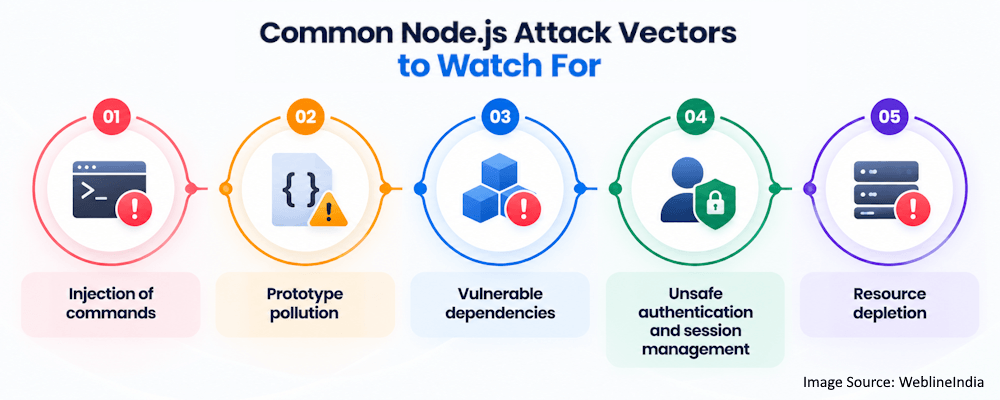
1. Injection of Commands
An application may invoke an operating system utility to process a document or generate a report. If untrusted input is placed in a shell command without proper treatment, the attacker can modify the expected behavior of the command.
A document processing service might take a filename from an API request, for example. Faulty formulation of instructions may turn a standard file action into a method of executing unauthorized commands.
Developers should use APIs that do not use shell interpretation. If command execution is required, the program should validate inputs and limit what activities can be performed.
2. Prototype Pollution
JavaScript objects are based on prototypes. Some hazardous patterns of object merging or property assignment permit attacker-controlled keys to modify inherited properties.
This issue can impact application logic in unanticipated ways. Depending on the programs consuming the polluted attributes, it may lead to authorization failures or other security issues.
The vulnerability is generally in the processing of requests and utility methods that merge nested JSON objects. OWASP advocates defensive object handling and thorough validation of property names.
“Security is a process, not a product.”
— Bruce Schneier, renowned security technologist and author
3. Vulnerable Dependencies
A Node.js application can have hundreds of direct and indirect dependencies. Even a package that seems unrelated to authentication or payment processing can still affect a critical operation.
An old HTTP client may incorrectly handle responses. A vulnerable parsing library could expose a service to a denial-of-service attack. A vulnerable reliance could introduce bad behavior into the software supply chain.
But just installing the package does not make it safe.
4. Unsafe Authentication and Session Management
An API might implement authentication and authorization controls but still fail to verify whether a user has permission to access a specific record. Another may allow an attacker to bypass a security check due to a token verification mistake.
These flaws are particularly serious in multi-tenant SaaS applications. A weakness in tenant isolation could let one customer view another’s records.
5. Resource Depletion
Attackers can do damage to Node.js services by sending expensive queries or by exploiting weaknesses in input processing. Too much decompression and ineffective regular expressions can hang up resources and delay valid queries.
The service may still be technically available, but response times may become intolerable. For a business that runs a customer-facing API, that delay might directly affect revenue.
PHP2Shell vs. Node.js Exploits: What Enterprise Leaders Need to Know
At the technical level, the threats are different. The business ramifications are the same.
| Security Concern | PHP2Shell | Node.js Exploits |
|---|---|---|
| Primary exposure | Vulnerable PHP runtime | Vulnerable runtime dependencies or application code |
| Common entry point | Crafted HTTP requests | Malicious requests or crafted input processed by vulnerable code |
| Potential impact | Remote code execution and data exposure | Depending on the flaw, this may include code execution or data exposure |
| Immediate priority | Identify affected PHP installations and patch | Apply relevant runtime and dependency security updates |
| Longer-term response | Harden hosting and monitor server activity | Secure API logic and control dependency risk |
Both technologies are intrinsically safe. Both require supported software releases and rigorous engineering.
Enterprise executives also need to differentiate between a vulnerability and a verified compromise. A vulnerable server is an attacker’s opportunity. Evidence of malicious execution suggests a possibly separate incident to investigate.
That distinction makes the answer.
Don’t Let Runtime Vulnerabilities Disrupt Your Business
Outdated PHP runtimes and vulnerable Node.js dependencies can expose critical systems. Get expert support for patching, upgrades and secure development.
Red Flags That Should Immediately Raise Concern
Security personnel need to investigate odd activities, not wait for a consumer complaint.
An innocent explanation could be one suspicious log entry. An incident in development will have several linked signs.
Important signs to watch out for include:
- Child processes generated by PHP or Node.js services unexpectedly.
- Repeated worker crashes or strange memory issues.
- Unexpected outbound connections from the application server
- New executable files or scripts that you don’t recognize in application directories.
- Then authentication failures, then odd successful logins.
- Sudden changes in API response behavior or server resource usage.
- Unexpected changes in scheduled tasks or service configurations
In the case of PHP2Shell, the analysis should involve web server logs and PHP logs. Teams should watch for anomalous worker behavior and suspicious multipart requests.
For services written in Node.js, the review should cover modifications to dependencies and application logs. Network telemetry and endpoint monitoring can detect anomalous activities.
But logs alone may not uncover all attacks. A capable invader may try to avoid obvious process creation or to eliminate traces. Security monitoring should therefore mix telemetry from hosts and networks with evidence from applications.
How WeblineIndia Can Reduce These Risks?
Effective remediation must start with the actual application environment. A basic security checklist can’t tell you what systems are exposed or if an attacker has already acquired access.
WeblineIndia can assist with a systematic security improvement program with application assessment and secure engineering services. The scope should be determined by the client’s tech stack and findings confirmed.
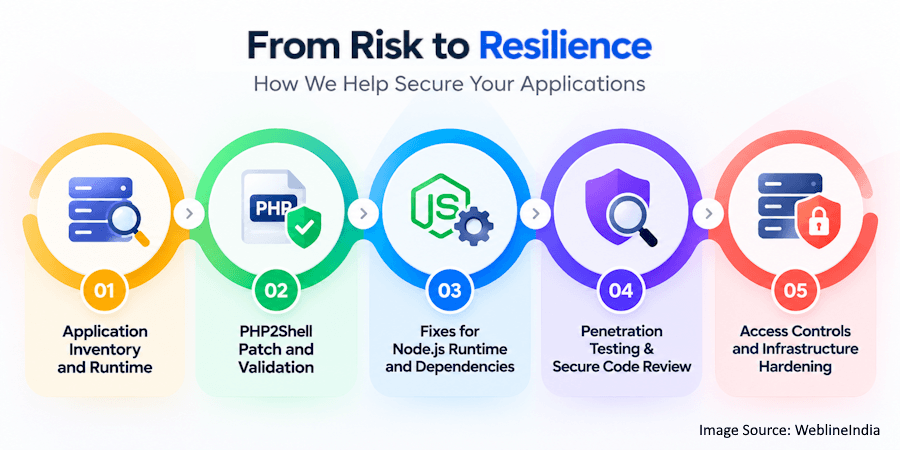
1. Application Inventory and Runtime
First task is to see where PHP and Node.js are running.
All the production sites, staging servers and internal applications are generally in the same enterprise environment. Old containers and abandoned virtual machines can stay exposed long after a project team believes they are retired.
A technical inventory should identify:
- PHP & Node.js versions on production environments.
- Web server and runtime configurations.
- Transitive and direct application dependencies.
- Internet-facing endpoints and links to internal services.
- Applications that use unsupported software branches.
The remediation is the first priority in this inventory. It also helps ensure ignored systems don’t stay susceptible.
2. PHP2Shell Patch and Validation
For impacted PHP installations, the priority is to install the respective security fix. PHP 8.3.36 and PHP 8.2.35 security releases are part of the October 2026 PHP security releases together with PHP 8.5.12 and PHP 8.4.27.
The correct one depends on the deployed branch and the vendor packaging. Organizations should consult the relevant official guidance before upgrading. Legacy installations need special attention, since an unsupported branch may need a supported migration path or a security backport provided by the manufacturer.
WeblineIndia can help design and implement this work when it forms part of the engagement. A responsible patching method goes beyond installing a package and may involve devops services to support controlled deployments, environment consistency and release validation. It should have:
- Testing for compatibility with application code and extensions.
- Updating the runtime that’s really serving production traffic.
- Restarting required services is necessary to load the patched runtime.
- Running regression tests against key business workflows.
- Verify the version that was deployed and describe the outcome.
A successful deployment is merely one component of the response. If exploitation may have happened, an incident investigation is also needed while patching the server.
3. Fixes for Node.js Runtime and Dependencies
Node.js apps require constant version review and dependency analysis.
Package manifests and lock files can be assessed for outdated or vulnerable dependencies with the help of WeblineIndia. Remediation efforts ought to prioritize vulnerabilities based on exploitability and commercial impact, rather than treating every scanner finding as equal in urgency.
The usual engineering actions are:
- Upgrade affected Node.js release lines to supported security releases.
- Replacing vulnerable packages or installing vendor patches as suggested.
- Eliminating unneeded dependencies that enhance the attack surface.
- Reviewing functions of file processing and execution of commands.
- Testing API authentication and authorization on a tenant level.
- Automating Dependency Checks in Continuous Integration Pipelines.
These actions fix identified flaws and help prevent similar faults from recurring in future releases.
4. Penetration Testing & Secure Code Review
Patching patches known paths to vulnerabilities. It does not show that the application is free from other exploitable flaws.
Secure code review looks at how input is handled and how permissions are enforced in the program, while complementary software testing services help validate application behavior and identify functional regressions after remediation. Penetration testing examines whether those controls may be bypassed through realistic attack scenarios.
You can include the following testing:
- Injection vulnerabilities in API endpoints and background jobs.
- Customer and admin functions have broken access controls.
- Unsafe file upload and archive processing.
- Session & token validation handling.
- Server-side request forgery and unsafe outbound requests.
- Error handling and resource consumption in the case of malicious input.
Testing should be done in an authorized environment and within a well-defined scope. Production testing requires extra protections to avoid service interruptions.
5. Access Controls and Infrastructure Hardening
Part of the security of an application is dependent on the application’s environment.
System files shouldn’t be freely accessible to a web worker. “The default should be that application servers cannot reach all internal services. Secrets should never be kept in public folders or source repositories.
As part of an approved security engagement, WeblineIndia can help assess these controls.
The relevant enhancements are:
- Running services as least-privilege operating system accounts.
- Limiting outbound network access if applicable.
- Separation of application workloads from sensitive databases.
- Keeping secrets in an appropriate secret management system.
- Configuring web application firewalls and rate limitations where appropriate.
- Centralized security logs and warnings on anomalous activity.
These restrictions limit the damage if an application flaw makes it to production.
Secure Your Applications Beyond Just Patching
Security requires more than quick fixes. WeblineIndia helps improve code quality, dependency security, access controls and infrastructure resilience.
Practical Response Plan for Business Teams
Security work must be clearly owned. For organizations coordinating complex remediation efforts, IT consulting can help clarify technical priorities and responsibilities across development and infrastructure teams.
A good response plan should include tasks and deadlines.
For instance,
<Writing Block id=”58322″ variant=”document”> ### Instant Reaction
- Determine if vulnerable versions are still in use; identify internet-facing PHP installations.
- Apply the relevant PHP2Shell security patches with high priority.
- Review the Node.js runtime versions and check the official advisories for applicable fixes.
- Investigate any unusual server activity and retain any relevant logs.
- Isolate systems if there is evidence of an active compromise.
Remediation in the Short Term
- Perform full dependency and configuration review.
- Test essential business workflows following the upgrade.
- Verify access rights and secret storage.
- Conduct focused security testing on high-risk endpoints.
- Document findings to owners with remedy due dates.
Undergoing Security Maintenance
- Automate the scanning of software inventory and dependencies.
- Develop a formal patch management process.
- Regularly review access privileges and network boundaries.
- Embed security testing into your development workflows.
- Reassess exposure after a new runtime advisory is published.
The order is important. The actively exploited critical vulnerability should be patched immediately. Cosmetic code improvements can be postponed.
Measuring The Impact of Security Improvements
Enterprise leaders need proof that remediation has decreased risk.
The number of tickets closed only tells part of the story. Better measures include whether the organization has reduced exposure and increased its ability to identify future threats.
Some useful markers are:
- Percentage of internet-facing computers running supported and patched runtimes.
- How long it takes to fix critical vulnerabilities.
- The number of open high-risk dependency findings.
- The percentage of important apps tested for security.
- The time to examine questionable activity.
- The number of recurring security flaws detected in later reviews.
These metrics should guide company decisions. For example, a long repair window may highlight the need for greater deployment automation, complementary qa automation services to accelerate regression testing or clearer ownership between application and infrastructure teams.
WeblineIndia can assist in establishing technical baselines and remediation reporting where such efforts are part of the agreed engagement.
Why Security Has To Go Beyond The Patch
A patch fixes a known problem. It will not get rid of an attacker who already got into the system before the upgrade.
This distinction is particularly crucial for PHP2Shell, as an attack may lead to code execution with the PHP worker’s privileges. That access could be used by an attacker to establish persistence or extract secrets available to him.
If compromise is detected, the reaction should consist of:
- Maintaining relevant evidence before harmful clean-up.
- Auditing server files and process activity for unauthorized modifications.
- Rotating any credentials and tokens that may have been exposed.
- Checking for indicators of lateral movement in connected services.
- Rebuild compromised systems from known-good media, as necessary.
- Confirming that the original entry point is closed.
The same may be said for Node.js incidents. Updating a vulnerable package does not imply that backdoored code or stolen credentials have been removed.
The incident response should address the vulnerability and any impacts of exploiting the vulnerability.
WeblineIndia for Security Findings to Business Protection
PHP2Shell shows that even if the application code seems to be carefully maintained, a vulnerability in a popular runtime can put applications at risk. A related problem can be seen in Node.js security advisories. A correctly built service can be exposed by runtime behavior and application dependencies.
Enterprise leaders don’t have to deal with every memory corruption detail themselves. They do need visibility into impacted systems and confidence that technical teams can react fast.
WeblineIndia can help with that endeavor with runtime upgrades, dependency cleanup, secure code reviews and infrastructure hardening. The most acceptable strategy begins with a comprehensive assessment of the deployed environment and a prioritized plan based on real exposure.
The goal is realistic. Shrink the assault surface. Safeguard business data. Ensure necessary services are provided.
Security becomes successful when teams are able to verify each improvement instead of reporting that a task has been performed.
Social Hashtags
#PHP2Shell #NodeJS #CyberSecurity #ApplicationSecurity #PHPDevelopment #NodeJSDevelopment #RemoteCodeExecution #VulnerabilityManagement #EnterpriseSecurity #SecureCoding #WebApplicationSecurity #DevSecOps #SecurityPatching #SoftwareSecurity #WeblineIndia
Turn Application Security Risks into Business Confidence
Protect your PHP and Node.js applications with proactive security improvements, runtime upgrades and expert engineering support from WeblineIndia.
Frequently Asked Questions
What is the PHP2Shell vulnerability and why does it matter?
PHP2Shell comprises critical remote code execution flaws (CVE-2026-109618 and CVE-2026-109619) with a 9.2 CVSS score. They allow unauthenticated attackers to execute arbitrary code via memory corruption, risking massive data breaches and system-wide downtime for enterprises.
Do plugin updates automatically fix runtime security issues?
No. Updating application plugins or themes only patches the top layer. If your underlying PHP engine or Node.js runtime remains outdated, your entire infrastructure stays dangerously exposed to low-level exploits.
What are the primary security threats facing Node.js apps?
Node.js applications frequently battle command injections, prototype pollution, bloated and vulnerable third-party dependencies, improper session management and resource depletion attacks that can severely degrade performance or compromise data.
How can organizations detect hidden server compromises?
Teams must watch for red flags like unexpected child processes, bizarre outbound connections, unknown files and sudden resource spikes. Combining application logs with robust network telemetry ensures attackers cannot easily hide their traces.
How does WeblineIndia protect enterprise web applications?
WeblineIndia delivers end-to-end security services, covering complete runtime inventories, safe emergency patching, dependency cleanups, secure code reviews and infrastructure hardening to eliminate blind spots and protect critical business data.
Globally Recognized for Unmatched Quality and Reliability


Testimonials: Hear It Straight From Our Global Clients
Our development processes delivers dynamic solutions to tackle business challenges, optimize costs, and drive digital transformation. Expert-backed solutions enhance client retention and online presence, with proven success stories highlighting real-world problem-solving through innovative applications. Our esteemed Worldwide clients just experienced it.
Awards and Recognitions
While delighted clients are our greatest motivation, industry recognition holds significant value. WeblineIndia has consistently led in technology, with awards and accolades reaffirming our excellence.

OA500 Global Outsourcing Firms 2025, by Outsource Accelerator

Top Software Development Company, by GoodFirms

BEST FINTECH PRODUCT SOLUTION COMPANY - 2022, by GESIA

Awarded as - TOP APP DEVELOPMENT COMPANY IN INDIA of the YEAR 2020, by SoftwareSuggest