Why South American CIOs Are Looking Beyond Local Hiring
South American CIOs are looking beyond local hiring as engineering talent shortages, rising costs, and slow recruitment affect digital initiatives. This blog explores why software development outsourcing to India is becoming a practical option for accessing specialized skills, scaling engineering teams, optimizing delivery costs, and supporting enterprise modernization.


 ChatGPT
  Perplexity
 Regional business environments across South America demand immediate modernization that existing domestic labor markets cannot support. Technology leaders frequently encounter empty applicant queues when attempting to staff essential engineering roles. Local institutions graduate far fewer technical professionals than expanding corporations require for ambitious digital roadmaps.
According to GrandView Research report, the Latin America IT services outsourcing market is on a robust growth trajectory, driven by surging demand for digital solutions across the region. Key performance and segment highlights include:
- Market Valuation & Growth: Generated USD 42,525.8 million in revenue in 2025 and is projected to expand at a 9.39% CAGR from 2026 to 2033.
- Top Revenue Segment: Application services dominated the market as the largest revenue generator in 2025.
- Fastest-Growing Segment: Emerging technology services represent the most lucrative area, registering the quickest growth over the forecast period.
- Regional Leader: Brazil is anticipated to achieve the highest country-specific CAGR between 2026 and 2033.
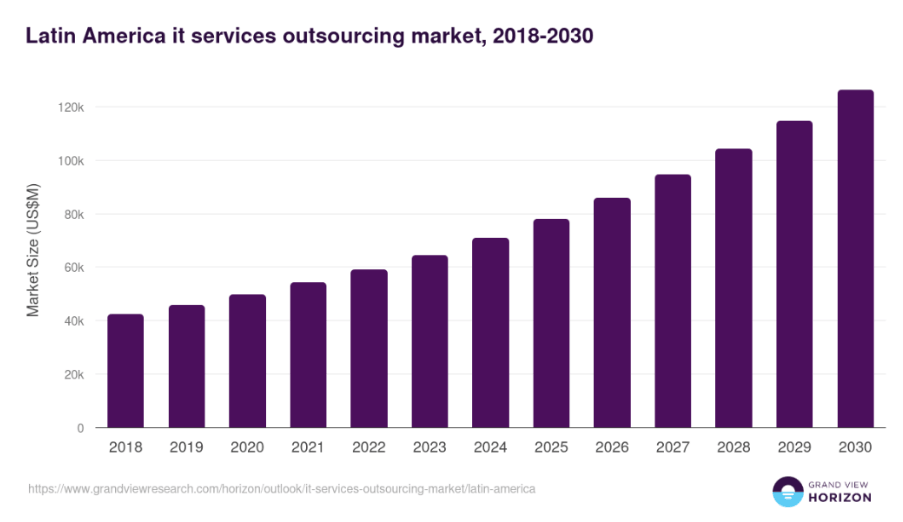
Source: GVR
On the other hand, enterprises watch operational costs climb because fierce competition for senior developers inflates regional salary expectations. Organizations bypass these domestic hiring bottlenecks by looking toward international talent networks to sustain product momentum.
Let’s see why South American CIOs are looking beyond local hiring:
The Growing Engineering Talent Gap
South American technology leaders face a severe shortage of skilled tech professionals across major markets like Brazil and Argentina. Universities in the region graduate fewer computer science degree holders than local enterprises demand for their digital projects. Organizations struggle to fill open positions for senior developers and cloud architects.
Such a scarcity drives up local salaries and forces technology executives to seek talent outside their home countries. Many businesses find that relying solely on local talent pools slows down product delivery timelines significantly.
The scarcity we talked about drives up local salaries and forces technology executives to seek talent outside their home countries. Many businesses find that relying solely on local talent pools slows down product delivery timelines.
- Local universities produce fewer computer science graduates than regional enterprises require.
- High demand for senior engineering talent drives up local payroll expenses significantly.
- Prolonged hiring cycles delay crucial product launches across competitive technology sectors.
AI Is Changing Software Delivery
Artificial intelligence tools now automate basic coding tasks and reshape how engineering departments operate. Developers use automated coding assistants to write routine scripts faster than before. Executives expect higher output from their technical teams because modern tools increase individual productivity.
Yet technology leaders realize that writing basic code is only a small part of building enterprise systems. Complex architecture design and system integration require human judgment that basic automation cannot replace.
The Need for Faster Digital Transformation
Boardrooms across South America demand rapid digital transformation to stay competitive against global competitors. Traditional companies must update their legacy systems quickly to launch mobile applications and cloud platforms.
Local hiring processes take months to complete and delay these critical business initiatives. Technology leaders need immediate access to skilled engineers who can start building products right away. Speed matters most when companies want to capture new market opportunities before rivals do.
Need to Scale Your Engineering Team Beyond Local Talent Limits?
Software Delivery Models Available to South American Enterprises
South American enterprises evaluate multiple operational frameworks when structuring their technical departments to handle modern digital workloads. Choosing the right mechanism dictates how fast applications reach the market and how much capital organizations spend on recruitment. Local executives weigh traditional internal setups against regional nearshore providers and distant international powerhouses before committing resources.
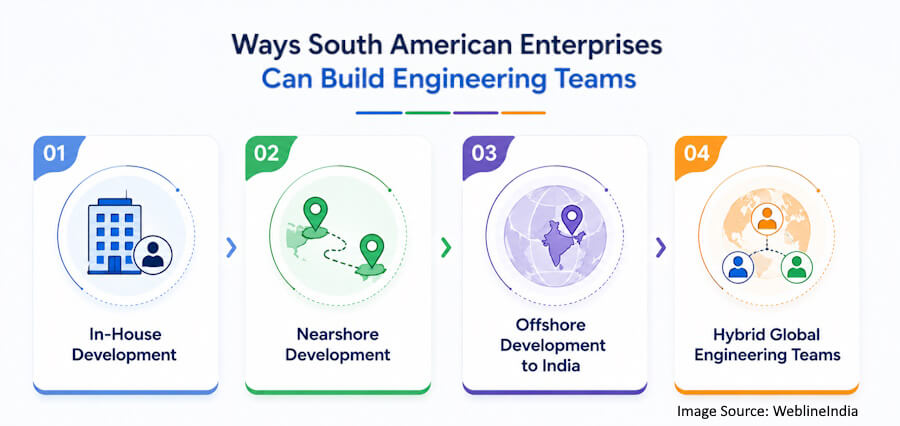
In-House Development
Building an internal engineering department gives leaders direct control over their staff members. Employees work inside company offices and focus entirely on internal products and long-term goals. However, recruitment takes significant time and requires high payroll investments. Maintaining full-time staff also creates fixed overhead costs during slow business periods.
Nearshore Development
Nearshore partnerships involve hiring software teams located in neighboring countries within similar time zones. This model allows real-time communication during regular working hours without major schedule disruptions. Cultural alignment between nearby nations often makes collaboration smoother for project managers. Yet nearshore talent pools in Latin America face the same overall skill shortages that affect local markets.
Offshore Development to India
Outsourcing technical work to South Asia provides access to a massive population of trained computer engineers. Companies use software development outsourcing to India to bypass local talent limitations entirely. Offshore software development allows businesses to scale their technical workforce up or down based on current project demands. Organizations achieve significant budget savings while working with established vendors.
Hybrid Global Engineering Teams
Hybrid models combine local management teams with overseas technical staff members for round-the-clock productivity. Local architects handle client communication while overseas professionals write and test code overnight. This strategy balances the need for direct oversight with the benefits of global resource distribution. Companies building global software development teams often use this blended approach to maintain continuous progress.
When Does Outsourcing Software Development to India Make Business Sense?
South American companies choose overseas technical partnerships when local talent pools fail to satisfy rapid enterprise growth. Financial advantages emerge because Asian engineering rates reduce overall project expenditure without sacrificing output quality. Organizations also deploy this strategy to acquire rare programming expertise quickly.
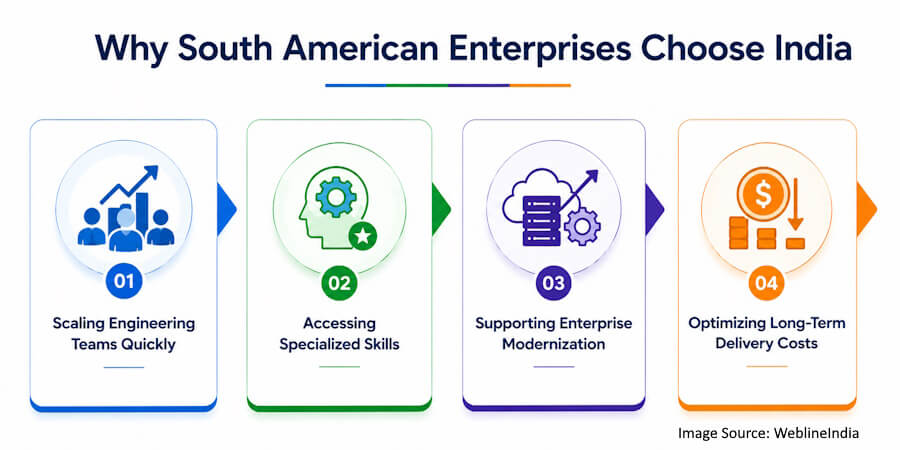
Scaling Engineering Teams Quickly
Enterprises often win large contracts that require doubling their technical workforce within a few weeks. Local hiring cannot support such rapid expansion without compromising candidate quality standards. Partnering with a provider of software development services can help executives expand engineering capacity more quickly when project demands increase. This rapid scaling capability helps businesses launch new digital products on schedule.
Accessing Specialized Skills
Niche technical domains like artificial intelligence and blockchain require rare expertise that local markets rarely supply. Organizations use offshore development services to find engineers who specialize in these advanced technologies. Software development outsourcing bridges the gap when internal teams lack specific domain knowledge. Technical leaders gain instant access to certified professionals without spending months on specialized recruitment.
- Advanced technology domains demand rare certifications that local applicants rarely possess.
- Specialized overseas providers fill knowledge gaps quickly without lengthy training periods.
- Niche expertise accelerates the deployment of complex data and cloud systems.
Supporting Enterprise Modernization
Large corporations running outdated mainframe systems may require cloud consulting services and substantial engineering capacity to plan and execute application migration to the cloud. Modernizing legacy architecture requires structured planning and rigorous testing across multiple system layers. Software outsourcing India provides the large-scale engineering capacity required for complex enterprise migrations. Experienced overseas partners manage the heavy lifting while internal teams focus on core business strategy.
Optimizing Long-Term Delivery Costs
Operational budgets limit how many full-time developers a technology department can hire each year. Redirecting routine development tasks to overseas providers reduces overall project expenditure significantly. Financial savings allow organizations to invest more capital into marketing and sales initiatives. Cost efficiency remains a primary driver for executives implementing a software outsourcing strategy for enterprises.
India vs Nearshore LATAM: Which Model Should CIOs Choose?
Technology executives balance geographic proximity against massive talent availability when comparing regional providers with Asian engineering hubs. Latin American alternatives offer convenient time zone overlap for daily meetings. Asian destinations can provide workforce scalability and cost efficiency when enterprises need additional engineering capacity for digital transformation services and other large-scale technology initiatives.
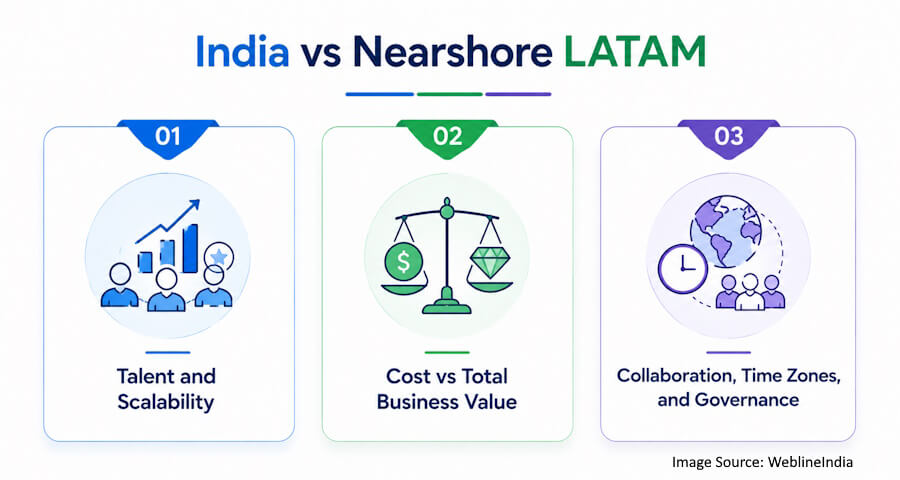
Talent and Scalability
Latin American technology hubs produce talented professionals but graduate fewer total engineers than Asian counterparts. When enterprises need a dedicated development team India offers a much larger pool of available specialists. Finding hundreds of qualified developers locally takes months of recruiting effort. Overseas markets supply continuous talent streams for massive enterprise initiatives.
Cost vs Total Business Value
Hourly rates for technical talent vary greatly between regions and affect long-term project budgets. Nearshore providers often charge higher rates because of geographic proximity and smaller talent pools. India vs Latin America software outsourcing comparisons show that Asian providers deliver high value at competitive price points. Technology leaders must weigh hourly rates against overall output quality when evaluating potential vendors.
- Hourly service fees differ substantially across various global geographic locations.
- Asian providers deliver strong value through large-scale resource optimization.
- Total project evaluation must include both initial cost and long-term output quality.
Collaboration, Time Zones, and Governance
Geographic distance creates twelve-hour time differences that require careful communication planning from project managers. Nearshore vs offshore software development for CIOs remains a central debate regarding daily operational friction. South American executives managing projects in Asia use overlapping hours for critical daily sync meetings.
Clear documentation and modern collaboration tools minimize the challenges of working across distant time zones.
Looking for the Right Software Development Outsourcing Partner for your business?
How AI Is Reshaping Software Development Outsourcing
Advanced automation tools now handle standard template generation and syntax verification across enterprise workflows. Outsourcing vendors adopt these technologies to accelerate testing phases and reduce delivery timelines. External development partners use intelligent agents to minimize manual friction.
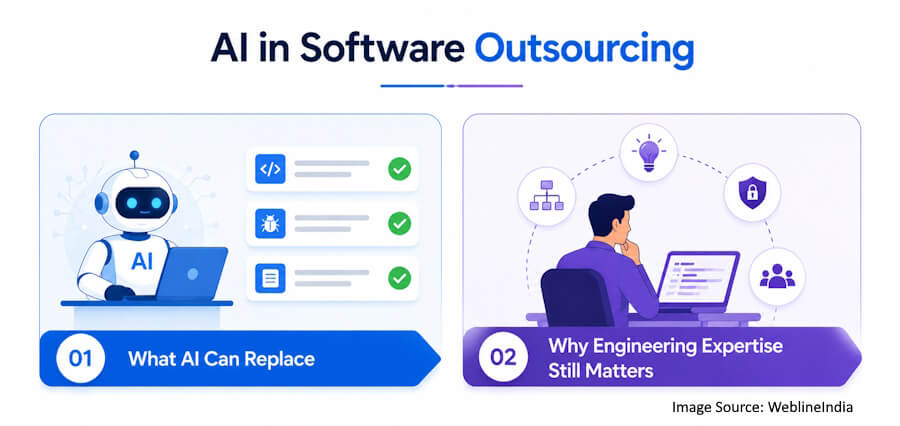
What AI Can Replace
Automated coding tools handle boilerplate syntax generation and basic bug detection tasks efficiently. Junior programming roles face disruption as intelligent software writes routine code snippets automatically.
Overseas vendors increasingly combine automated testing platforms with qa automation services to streamline testing workflows and speed up delivery. Understanding benefits of outsourcing software development to India involves recognizing how modern tools enhance vendor efficiency.
Why Engineering Expertise Still Matters
Advanced automation cannot design custom system architectures or solve complex enterprise security challenges. Human engineers remain essential for understanding business requirements and translating them into functional software modules.
Global engineering teams provide the strategic thinking that artificial intelligence systems lack entirely. True software innovation depends on experienced professionals who understand how different systems interact.
- Strategic software architecture requires deep human insight rather than basic code generation.
- Complex business security frameworks demand experienced engineering oversight at every stage.
- Custom system integration relies on professional problem-solving capabilities.
A CIO’s Checklist for Choosing an Indian Software Development Partner
Evaluating potential vendors requires looking closely at past project portfolios and verified client references. Enterprises must verify whether the vendor has successfully delivered similar systems for international clients. Careful screening protocols protect corporate capital and prevent costly operational mistakes during execution.
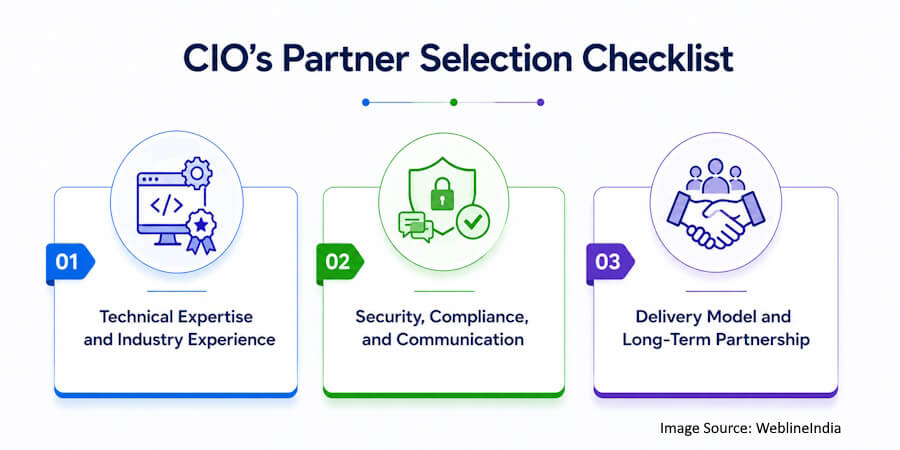
Technical Expertise and Industry Experience
Evaluating potential vendors requires looking closely at past project portfolios and verified client references. Enterprises must verify whether the vendor has successfully delivered similar systems for international clients.
Now, how to choose an Indian software development company involves testing candidate coding skills through practical assessments. Proven domain experience ensures the partner understands industry-specific regulations and technical standards.
- Review past project portfolios to confirm relevant industry delivery experience.
- Conduct technical assessments to validate candidate coding proficiency levels.
- Verify international client references to ensure reliable operational performance.
Security, Compliance, and Communication
Protecting intellectual property is a top priority for executives outsourcing projects across international borders. Vendors must maintain strict data security certifications like ISO and SOC compliance frameworks.
Clear communication channels prevent misunderstandings during complex software development cycles. Assessing software development outsourcing to India for South American companies requires checking English proficiency among technical leads.
Delivery Model and Long-Term Partnership
Successful outsourcing relationships depend on flexible engagement models that adapt to changing business needs. Partners should offer dedicated resource models or fixed-price project structures based on specific requirements.
A reliable software development partner India acts as a true extension of the internal IT department. Long-term collaboration builds mutual trust and improves delivery speed over successive project phases.
Best Practices for Successful India–South America Collaboration
Establishing structured operational guidelines ensures that technical departments bridge geographic distance smoothly without encountering costly delays. Organizations maximize output value by implementing transparent project tracking systems and maintaining continuous dialogue across distant locations. Thoughtful workflow synchronization eliminates misunderstandings and aligns overseas engineering units with regional corporate objectives.
Managing Time Zone Differences
- Establish daily core hours where both teams overlap for urgent discussions.
- Document all technical requirements clearly to reduce dependence on real-time chat.
- Assign trusted local project leads to coordinate daily task assignments with overseas groups.
Building High-Performing Distributed Teams
- Host virtual welcome sessions so distant team members feel included in company culture.
- Use centralized project management software to track task progress and milestone deadlines.
- Conduct regular code reviews and coordinate software testing services to maintain consistent quality standards across distributed development units.
Final Thoughts: Choosing the Right Global Delivery Strategy
Selecting an overseas partner requires careful planning and alignment with long-term business goals. Companies navigating outsourcing software development from South America to India find that structural execution determines ultimate project success. Evaluating offshore software development for Brazilian companies highlights the growing need for scalable technical resources.
When organizations need reliable engineering capacity, WeblineIndia delivers exceptional outsourcing solutions tailored for global enterprises. Partnering with WeblineIndia ensures access to skilled professionals and robust project management frameworks. Modern technology leaders trust WeblineIndia to accelerate digital transformation initiatives and drive sustainable business growth.
Ready to Build a More Scalable Global Software Delivery Strategy?
Frequently Asked Questions
When should a South American company outsource software development to India?
South American companies should look to India when local talent pools cannot support rapid expansion or when specialized expertise is required for massive digital initiatives. Organizations choose this path to bypass long local recruitment cycles, accelerate enterprise modernization, and scale technical capacity without inflating operational overhead.
Is outsourcing software development to India still cost-effective in 2026?
Yes, outsourcing to India maintains a distinct financial advantage for global enterprises. While wage adjustments occur in major tech hubs, the overall cost of outsourcing software development to India remains significantly lower than maintaining local or North American teams. Organizations optimize budgets further by utilizing blended teams across different geographic tiers.
How does India compare with nearshore software development in Latin America?
Nearshore providers in Latin America offer closer time zone alignment for real-time daily communication. Conversely, India delivers much larger talent pools, superior long-term scalability, and deeper multi-discipline technical depth. CIOs choose between these regions based on whether they prioritize absolute workforce scale or immediate hourly overlap.
What types of projects are best suited for outsourcing to India?
Large-scale legacy cloud migrations, extensive application maintenance, and complex artificial intelligence integrations suit overseas delivery models well. Projects requiring dozens of certified engineers simultaneously benefit most from the massive talent availability found in Asian engineering hubs.
Can Indian development teams work effectively with South American time zones?
Distributed groups collaborate successfully by establishing structured daily overlap hours for critical sync meetings. Teams also rely heavily on thorough documentation and centralized tracking software to maintain clear communication despite the distance.
What are the biggest risks of outsourcing software development to India?
Potential challenges include communication barriers, process overhead, and managing a twelve-hour time difference. Organizations mitigate these risks by partnering with established vendors that enforce strict security protocols and clear documentation standards.
How do AI tools affect software outsourcing decisions?
Artificial intelligence speeds up routine coding and testing tasks across vendor environments. Outsourcing providers leverage these smart tools to reduce delivery schedules, shifting the core focus of human engineers toward high-level architecture and complex problem-solving.
What should CIOs evaluate before selecting an Indian software development partner?
Technology leaders must inspect past project portfolios, verify international security certifications, and test technical proficiency. Selecting a reliable partner like WeblineIndia ensures robust project management frameworks and access to skilled engineering professionals.
Globally Recognized for Unmatched Quality and Reliability




Testimonials: Hear It Straight From Our Global Clients
Our development processes delivers dynamic solutions to tackle business challenges, optimize costs, and drive digital transformation. Expert-backed solutions enhance client retention and online presence, with proven success stories highlighting real-world problem-solving through innovative applications. Our esteemed Worldwide clients just experienced it.
Awards and Recognitions
While delighted clients are our greatest motivation, industry recognition holds significant value. WeblineIndia has consistently led in technology, with awards and accolades reaffirming our excellence.

OA500 Global Outsourcing Firms 2025, by Outsource Accelerator

Top Software Development Company, by GoodFirms

BEST FINTECH PRODUCT SOLUTION COMPANY - 2022, by GESIA

Awarded as - TOP APP DEVELOPMENT COMPANY IN INDIA of the YEAR 2020, by SoftwareSuggest