Tips to Avoid Nightmares When Choosing a React Native Development Outsourcing Company
Choosing the wrong React Native outsourcing company can cost you time, money, and product quality. This guide shares practical tips to vet agencies, compare engagement models, check technical skills, protect IP, and hire a React Native team that fits your business goals.


 ChatGPT
  Perplexity
 From statistics, currently over 11 million websites throughout the world run on React Native. The platform offers tremendous benefits to enterprises in showcasing their strength on the Internet. However, finding the right partner – a React Native development outsourcing company to build your mobile app is tricky. When you choose React Native for mobile app development, you are making the best possible decision for your business, as it allows you to build a top-notch cross-platform application for both Android and iOS to save money and time.
To bring your vision to reality, you must outsource react native development to a team that gets your business objectives. With thousands of React Native development services available in the market, how do you separate the naive from a renowned React Native development company?
Let’s find out:
Why Outsource React Native Development?
Before getting on to choosing a React Native development outsourcing company, it is essential to know why businesses prefer to partner with an offshore agency rather than having React Native developers in-house.
- Cost efficiency: React Native development company offshore is more affordable than hiring full-time, in-house React Native developers. Overheads such as salaries, infrastructure, and software licences cost you a lot.
- Scalability and flexibility: When you hire React Native developers offshore, it is easy to scale up or down your team of React Native engineers. The outsourced company has the agility to adjust team size on your demand.
- Access to global talent: When you outsource React Native development, you are no longer restricted to local talent. An offshore software development approach gives businesses access to engineers beyond their local talent pool.
- Faster TTM: A React Native development agency has pre-built workflows and templates that they can customize quickly as per your requirements. QA processes are quick to go, hence you get a quicker time to market.
Looking for a trusted React Native development outsourcing company?
A Step-by-step Guide to Hire React Native Development Company
Here are the steps you need to follow to get the best React Native development company offshore:
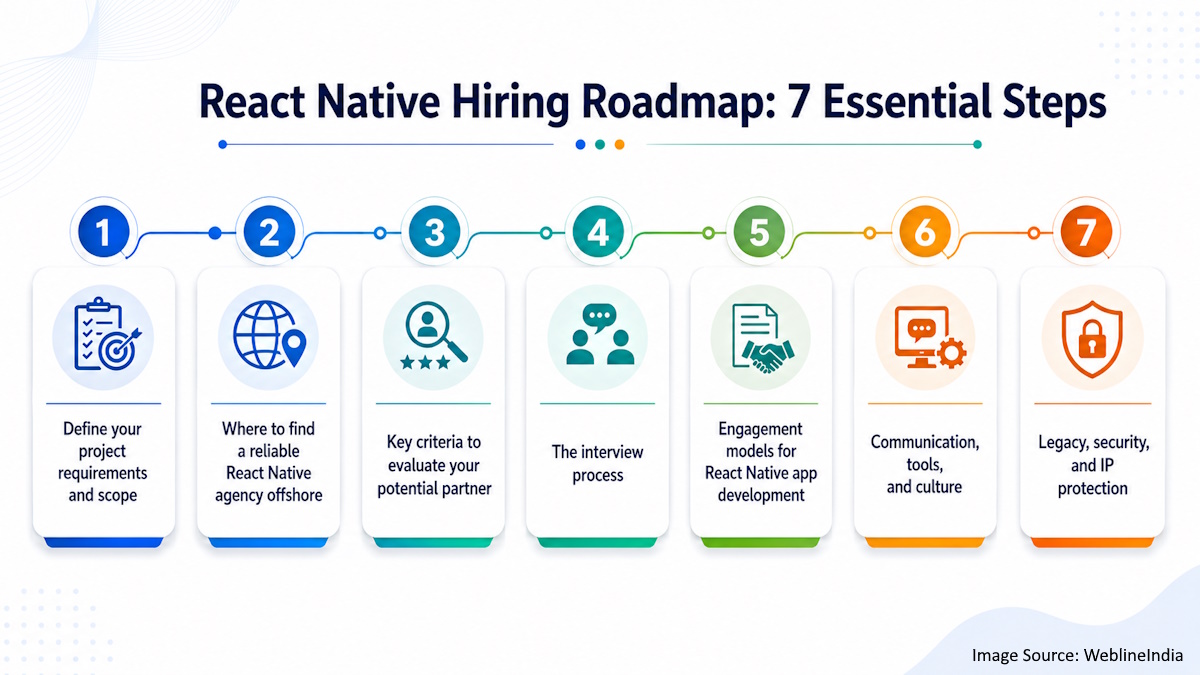
Step 1: Define your project requirements and scope
It becomes difficult to find the right React Native development agency if you are not clear about what you want to build. Before you reach out to any provider of React Native development services, outline your project basis:
Determine the project scope
Are you considering MVP development services to test your business idea, or do you want a full-fledged enterprise application with complex integrations? You need to make the list of core features, needed third-party APIs (such as payment gateway or maps), and a preferred timeline.
Establish a realistic budget
For outsourcing React Native development, expecting the cheapest rate often ends up in poor code, missed deadlines, and substandard quality. You need to set a budget that is feasible and justified.
Step 2: Where to find a reliable React Native agency offshore
It is essential to get the best React Native development company offshore. Though there are many B2B rating platforms, such as GoodFirms, Clutch, and so on, you need to verify each of the React Native development companies with their testimonials and project portfolios. Professional networks can also get you a renowned React Native development agency offshore. You can find a lot of React Native development companies that offer the offshore model to build quality IT solutions at affordable rates without compromising on security.
Step 3: Key criteria to evaluate your potential partner
Once you shortlist a few React Native development agencies offshore, it is time to evaluate their capabilities thoroughly.
Technical expertise and portfolio assessment
Any React Native agency that claims that they provide top-notch React Native development services should have a portfolio or case study proofs. You may review their website and check for the application in React Native development. When you check their app made on React Native, look for:
- UX: does the app feel native, responsive, and smooth?
- Design consistency: are UI elements aligned properly across screen sizes?
- Performance: is the app loading quickly and providing easy navigation?
Experience with core React Native concepts
When you take a technical interview, make sure that React Native developers for hire are proficient in the fundamentals and advanced concepts:
| Core React Native Competency | Why It Matters |
| Bridge and TurboModules | Crucial for connecting JavaScript code with native Java/Kotlin or Objective-C/Swift code when native device features are needed. |
| State Management | Expertise in tools like Redux, MobX, or Context API to ensure data flows smoothly across large applications. |
| Performance Optimization | Ability to reduce app bundle sizes, optimize image assets, and eliminate memory leaks. |
| CI/CD Pipelines | Automated testing and deployment setups (using tools like Fastlane or Bitrise) to ensure seamless updates. |
Industry-specific experience
A React development agency should build exceptional mobile apps for specific industries. They should have experience in building fintech, eCommerce, healthcare, automobile, and so on, as per the industry standards.
Step 4: The interview process
When you sit down with a potential React Native development agency, consider it a deep dive consultation. You need to get from surface-level questions to a deep understanding of React Native app development. Here are some of the questions:
- Can you show me your work where you integrated native iOS and Android code into a React Native product?
- How do you handle communication across time zones for React Native app development?
- What is your total experience in React Native app development?
- What policies do your React Native development agency follow to protect my IP rights and confidentiality?
Step 5: Engagement models for React Native app development
When you prepare to hire React Native developers offshore, you need to evaluate the available software outsourcing models.. A renowned React Native development company has three standard hiring models:
Fixed Price Model
You agree on a set price for a strictly defined set of deliverables. This works well for small apps or MVPs with concrete requirements. The downside is lack of flexibility; any change in scope requires a formal, paid change-request process.
Time and Materials (T&M) Model
You pay for the actual hours spent on development. This model is perfect for agile projects where requirements evolve based on user feedback. It offers maximum flexibility but requires close tracking to prevent scope creep.
Dedicated Team Model
The agency provides a full team (developers, QA engineers, project managers) who work exclusively on your product. This acts as a direct extension of your company and is the most effective model for long-term, complex product development.
Step 6: Communication, tools, and culture
Technical skills make a major part of React Native development services, but communication is the backbone. A successful outsourcing relationship banks on transparency and shared information.
- Project management tools: make sure that the React Native development team offshore uses industry-standard tools such as Teams, Trello, Jira, and so on. You must have access to these boards when your project starts.
- Code repositories: your React Native development agency should commit code regularly to secure repositories like GitLab and GitHub owned by you. Don’t allow a React Native development agency to host your code.
- Communication channels: it is essential to have clear and daily communication through Teams and Slack to reduce misunderstanding. Weekly video conferences keep the entire team in line.
Step 7: Legacy, security, and IP protection
When you outsource React Native development services, protecting your intellectual property (IP) and data privacy is non-negotiable. Before sharing any sensitive project details, ensure the agency signs a comprehensive Non-Disclosure Agreement (NDA).
When drafting the final contract, confirm the following clauses are explicitly stated:
- IP Ownership: A clause stating that all code, designs, and assets created during the partnership belong solely to your company upon payment.
- Data Security Standards: Compliance with relevant regional regulations like GDPR, HIPAA, or CCPA, depending on your app’s target audience and industry.
- Termination Clause: Clear terms on how either party can terminate the contract if deliverables or payment terms are repeatedly missed.
Need help choosing the right React Native team for your app?
Common Red Flags to Avoid during React Native Development Outsourcing
Keep an eye out for these warning signs during your evaluation process:
- Unbelievably Low Rates: If an agency quotes a price that is a fraction of the market average, they are likely cutting corners, utilizing untrained junior developers, or planning to add hidden fees later.
- Poor Communication Skills: If it takes days to get a response during the sales process, communication will only degrade once the contract is signed.
- Lack of Questions: A reliable development partner will challenge your assumptions and ask deep questions about your business goals, target audience, and monetization strategy. If they simply say yes to everything without analysis, proceed with caution.
- No Dedicated QA Engineers: Avoid agencies where developers do their own testing exclusively. Dedicated QA testing services can help uncover edge cases and critical bugs before your users do.
Get Professional React Native Development Services Now
Finding the right partner for react native for mobile app development is a matter of balance. Technical competence is the base layer; however, the secret sauce for sustained success is cultural fit, open communication, and trustworthy legal protections.
Use the time you have during the vetting process. Read reviews, interview the actual developers that will be working on your project, and if you want to test the waters, start with a small paid pilot project. Following this systematic approach, you will get a reliable react native development services provider that helps you scale your business and delivers a top-tier mobile application.
Social Hashtags
#ReactNative #ReactNativeDevelopment #MobileAppDevelopment #AppDevelopment #Outsourcing #SoftwareOutsourcing #HireReactNativeDevelopers #CrossPlatformApps #MobileApps #OffshoreDevelopment #DedicatedDevelopers #TechOutsourcing #StartupApps #EnterpriseApps
Want to build a secure React Native app without hiring in-house?
Frequently Asked Questions
Globally Recognized for Unmatched Quality and Reliability




Testimonials: Hear It Straight From Our Global Clients
Our development processes delivers dynamic solutions to tackle business challenges, optimize costs, and drive digital transformation. Expert-backed solutions enhance client retention and online presence, with proven success stories highlighting real-world problem-solving through innovative applications. Our esteemed Worldwide clients just experienced it.
Awards and Recognitions
While delighted clients are our greatest motivation, industry recognition holds significant value. WeblineIndia has consistently led in technology, with awards and accolades reaffirming our excellence.

OA500 Global Outsourcing Firms 2025, by Outsource Accelerator

Top Software Development Company, by GoodFirms

BEST FINTECH PRODUCT SOLUTION COMPANY - 2022, by GESIA

Awarded as - TOP APP DEVELOPMENT COMPANY IN INDIA of the YEAR 2020, by SoftwareSuggest