AI Development Cost Calculator: What Determines Your Project Budget?
AI development costs can vary widely based on project scope, data needs, cloud usage, model training, security, and long-term support. This blog breaks down key cost factors, budget ranges, hidden expenses, ROI planning, and practical ways to reduce AI project costs without hurting quality.


 ChatGPT
  Perplexity
 Investing in AI (Artificial Intelligence) needs clear financial planning. Organizations often struggle to estimate the necessary capital for deployment. A sudden spike in computing expenses can stall an active initiative. You need to understand the financial requirements upfront to prevent major AI project failures. But the question is, how to estimate AI development costs?
Let’s begin with the basics.
Why Understanding AI Development Costs Matters
If you misjudge the required investment, it leads to abandoned software. Software engineering teams are likely to underestimate data cleaning needs, and hardware rental costs can pile up rapidly during training periods. Hence, leaders like MDs and CEOs must calculate the total cost of ownership before getting the first line of code written. Now, when it comes to factors affecting AI development cost, there are many, and you must consider them all.
When you have an accurate AI development cost framework, it aligns financial expectations with technical realities. Also, it protects AI engineering teams from budget exhaustion midway through the software development lifecycle. You must have clear cost visibility to allow or allocate funds strategically throughout data sourcing, model design, and integration.
Let’s go through this useful AI software development pricing guide.
Wondering how much your AI project may cost before development starts?
How Much Does AI Development Cost?
If you evaluate it, the overall ROI in AI development varies based on project scope, data requirements, and accuracy targets. Projects fall into distinct financial tiers depending on corporate scale and system complexity.
Small AI Projects
Small AI project initiatives generally depend on pre-trained models. AI development teams providing ai software development services can adapt existing frameworks using tools like OpenAI APIs or open-source libraries.
- Average Budget Range: $20,000 to $50,000
- Typical Timeline: 1 to 3 months
- Common Deliverables:
- basic customer service chatbots
- internal search tools
- automated text classification scripts
Mid-Sized AI Solutions
Mid-sized systems need tailored data pipelines. AI development engineers fine-tune foundational algorithms using proprietary business data. Hence, they achieve specialized outputs.
- Average Budget Range: $50,000 to $150,000
- Typical Timeline: 3 to 6 months
- Common Deliverables:
- predictive sales analytics dashboards
- automated document processing engines
- recommendation engines for regional e-commerce stores
Enterprise AI Applications
These are the large-scale software tools. They ask for bespoke architecture because these platforms handle massive data streams. They need strict compliance standards and continuous retraining.
- Average Budget Range: $150,000 to $500,000+
- Typical Timeline: 6 to 12+ months
- Common Deliverables:
- automated diagnostic support tools for hospital networks
- fraud detection networks for global banks
- autonomous supply chain systems.
Key Factors That Affect AI Development Costs
Budget variations stem from architectural choices and data realities. Several technical elements dictate the final estimate on an AI project cost calculator.
Project Complexity
Simple automation rules cost very little. Advanced deep learning models require a massive investment. If a system handles unstructured multi-modal data, expenses rise sharply. The number of unique user roles also increases frontend engineering hours.
Type of AI Solution
Generative text models differ from computer vision setups. A standard machine learning model for tabular data is relatively cheap, while more specialized machine learning development services may involve additional engineering, data preparation, and infrastructure requirements. Computer vision requires processing video frames, which demands costly and specialized hardware. Natural language processing involves expensive token processing fees.
Data Collection and Preparation
Data serves as the foundation, and raw data is usually messy, incomplete, or corrupted.
- Sourcing: Licensing proprietary databases incurs steep external fees.
- Cleaning: Engineers spend hours removing duplicates and fixing errors.
- Labeling: Human annotators must tag thousands of images or text snippets manually.
- Storage: Secure cloud storage arrays add to monthly operational overhead.
AI Model Development
Building from scratch requires elite data scientists. AI model fine-tuning an existing open-source model reduces engineering hours significantly. Using simple API calls signifies the cheapest path, though it limits customization.
Third-Party Integrations
Connecting AI to legacy enterprise resource planning systems takes time. Custom application programming interfaces must be built if standard connectors do not exist. Middleware development adds to the overall engineering bill. Vendors also charge recurring subscription fees for proprietary database connections.
Cloud Infrastructure Costs
Training neural networks demands graphics processing units. Cloud providers rent these processors by the hour, while the cost of supporting AI through scalable cloud computing services can also increase when continuous real-time inference demands high-availability clusters.
Security and Compliance Requirements
Regulated industries face strict software auditing rules. Encryption mechanisms must protect data both at rest and during transmission. Penetration testing teams charge premium rates to find system vulnerabilities. Compliance certification processes delay deployments and increase administrative hours.
AI Development Cost Breakdown
Every dollar spent is split across distinct operational phases. The budget or the custom AI development cost changes as a project moves from ideation to production.
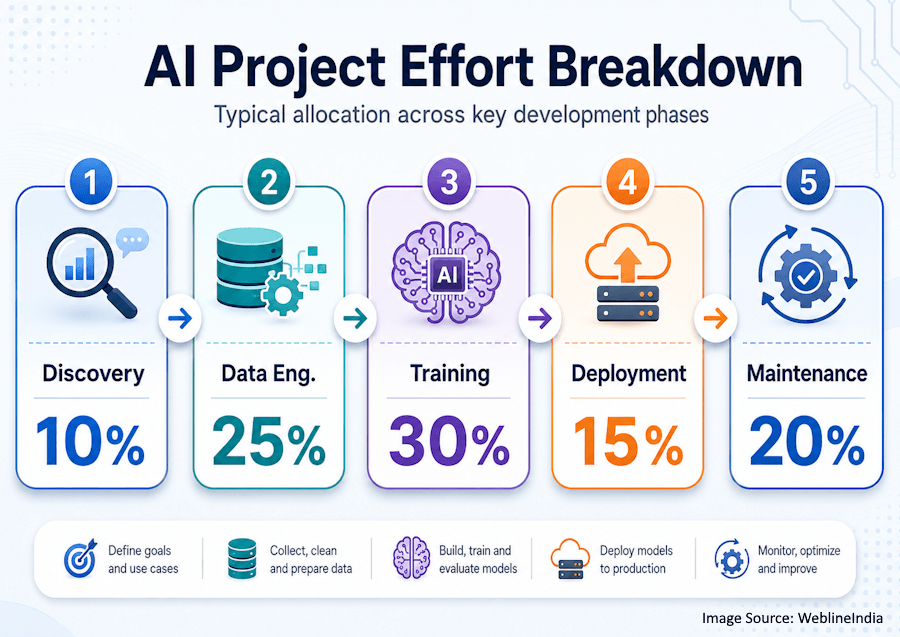
Discovery and Planning
Architects define project boundaries during this initial stage. Consultants evaluate existing corporate infrastructure to select the right technology stack. This phase minimizes the risk of building useless features later.
- Typical allocation: 10% of total budget.
Data Engineering
Engineers build reliable ingestion pipelines. They establish storage architecture and run extraction scripts. This phase ensures the model receives clean information during training.
- Typical allocation: 25% of total budget.
Model Training
Data scientists run training cycles on high-end hardware servers. They adjust hyperparameters to maximize system accuracy. This phase uses the most computing power.
- Typical allocation: 30% of total budget.
Testing and Deployment
During this phase, quality assurance services help identify bias, errors, and other issues before the AI system moves into production. DevOps engineers package the model into virtual containers. They set up monitoring tools to track live performance.
- Typical allocation: 15% of total budget.
Maintenance and Optimization
As live data changes over time, they cause model drift. Hence, engineers must retrain models periodically to maintain accuracy. Ongoing software maintenance services covering bug fixes, security patches, and optimization also require continuous investment after deployment.
- Typical allocation: 20% of total budget annually.
Want to avoid surprise costs in your AI project budget planning?
AI Development Cost Calculator Framework
Organizations can use a structured framework to carry out a custom AI development cost estimate before consulting external teams. This approach breaks down variables into calculable cost blocks. It is worth noting that the AI consulting cost will be an add-on in most of the project outsourcing cases.
Business Requirements
Clearly define the business problem. Will the software save human labor hours? Knowing the target user base helps determine the necessary system scale and availability.
Feature Requirements
List every required capability. Multi-language support adds complexity. Real-time processing costs more than batch processing at midnight. The table below outlines how specific features impact the overall AI software development cost.
| Feature Category | Low Complexity | Medium Complexity | High Complexity |
| User Interaction | Static forms | Dynamic dashboard | Voice/Gesture control |
| Processing Speed | Overnight batch | Near real-time | Sub-millisecond latency |
| Language Support | Single language | Multi-language translation | Dialect localization |
| Analytical Output | Simple classification | Trend forecasting | Autonomous decision making |
Infrastructure Costs
For an enterprise AI development cost, you also need to calculate monthly cloud resource consumption. Factor in storage volume and network bandwidth fees. Budget for third-party software licenses and external model API usage.
Development Team Costs
Total up the hourly rates for the technical specialists. A standard team requires multiple distinct engineering roles.
- Project Manager: Organizes sprints and timelines.
- Data Engineer: Builds data pipelines.
- AI/ML Specialist: Designs and trains algorithms.
- Frontend/Backend Developer: Connects models to user interfaces.
- QA Engineer: Validates system performance.
AI Project Cost Examples by Industry
Different fields present unique engineering hurdles. These specific industry needs influence the overall AI application development cost.
Healthcare AI Solutions
AI solution pricing also differs when you want to add some compliance. For instance, medical imaging software requires extreme accuracy. Systems must comply with strict regulations like HIPAA. Annotating medical scans demands expensive input from certified doctors.
- Estimated Budget: $200,000 to $450,000
Finance AI Applications
Algorithmic trading systems and fraud detection systems need sub-millisecond processing speeds. Hence, financial institutions demand absolute data privacy, which generally requires on-premise infrastructure setup.
- Estimated Budget: $180,000 to $400,000
Retail AI Systems
E-commerce recommendation engines track buyer behavior patterns. Inventory forecasting models can combine AI with data analytics services to process historical sales records and support supply chain optimization. These systems scale up rapidly during holiday shopping rushes.
- Estimated Budget: $60,000 to $150,000
Manufacturing AI Automation
An AI development service cost for business automation also depends on myriad factors. Predictive maintenance software monitors factory floor machinery sensors. Computer vision networks check production lines for physical defects. Now, these setups require integration with diverse industrial hardware.
- Estimated Budget: $120,000 to $300,000
Hidden Costs Businesses Often Overlook
Initial project quotes rarely cover the full lifetime expense. Unexpected line items frequently emerge after system deployment.
Data storage costs grow exponentially as user interaction increases. Cloud vendors charge data egress fees when moving files between different networks. Model drift requires periodic retraining sessions, which demand unexpected compute budgets. User training sessions also require internal company time. Employees require onboarding documentation to get used to a new software tool effectively. Experts opine that legal teams may need a few more hours to review data privacy compliance updates as local or regional laws change. To know the complex costs, an enterprise AI project budget calculator is available online to try.
Ways to Reduce AI Development Costs Without Compromising Quality
Enterprises do not need to build everything from scratch because the smart architectural decisions they make save significant capital.
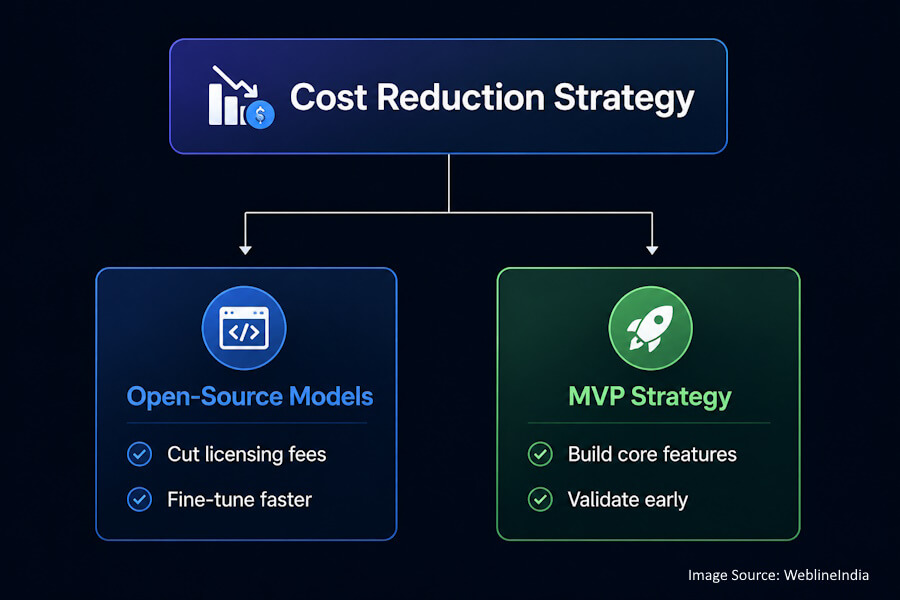
Using open-source base models like Llama or Mistral can help you get rid of heavy proprietary software fees; also, fine-tuning an existing framework will take a fraction of the time required to train a new one. This approach is the best to slash initial compute bills.
Starting with an MVP development helps validate the business concept. It is advisable that teams should focus on a single core feature rather than build secondary tools. This method is used to prevent spending money on features users do not actually want.
Outsourcing software development to experienced software firms reduces fixed overhead expenses and also the AI implementation cost. This approach eliminates the need to source, hire, and retain expensive in-house machine learning talent.
Custom AI Development vs Off-the-Shelf AI Solutions
Selecting upon buying commercial software and building a custom platform may have a small to a big impact on your AI development cost. Off-the-shelf software offers a fast initial setup. Companies pay predefined or anticipated monthly subscription fees per user, which keeps initial costs low. However, these tools offer limited customization options. They can also become expensive as a company adds hundreds of users over time.
Custom systems also alter your AI development pricing. Customization requires significant upfront capital. They take months to plan, build, and deploy. However, custom software provides an enduring competitive advantage. Organizations own the intellectual property completely, avoiding recurring per-user licensing fees.
How to Calculate ROI Alongside AI Development Costs
An expensive project is worth the AI development budget if it yields high returns. Financial officers must weigh development costs against measurable business outcomes.
ROI = (Financial Gains – Total Development Cost) / Total Development Cost
Track operational efficiency metrics. For business process automation services, measure hours saved by automating routine data entry and other repetitive workflows when calculating potential returns. Calculate the financial impact of reduced factory equipment downtime brought by predictive alerts.
Compare customer service costs before and after deploying automated chat assistants. Increased customer retention rates from better product recommendations also boost top-line revenue. The value of custom software shows clearly when these gains outweigh development and cloud maintenance fees over a multi-year lifecycle.
Choosing the Right AI Development Partner
Building complex software requires deep technical expertise. A poorly chosen agency will waste capital and deliver buggy code. Evaluate a partner’s past portfolio closely. Look for concrete case studies that demonstrate experience handling real corporate data pipelines. A reliable team values data security and implements clear encryption practices.
The ideal partner does not just write code blindly. They provide useful advice during the initial design phase to help lower development costs. They communicate openly about cloud resource expenses and establish clear project milestones.
Final Thoughts
Since you have gone through this AI development budget planning guide, you have learned that navigating artificial intelligence budgets requires balancing technical realities with clear business goals. Using an AI development cost calculator framework helps estimate upfront expenses accurately. This approach prevents expensive surprises during development.
When searching for reliable AI development services cost options, WeblineIndia provides an efficient path forward. The firm delivers clear cost breakdowns tailored to specific project needs. WeblineIndia helps businesses deploy smart, scalable applications within a predictable financial plan. Contact WeblineIndia today to secure a transparent, highly accurate project estimate.
Social Hashtags
#AIDevelopment #AICostCalculator #AIDevelopmentCost #AIProjectBudget #CustomAI #AIImplementation #AIForBusiness #EnterpriseAI #GenerativeAI #AIROI #SoftwareDevelopment #WeblineIndia
Need help calculating your AI development budget with better clarity?
Frequently Asked Questions
Globally Recognized for Unmatched Quality and Reliability




Testimonials: Hear It Straight From Our Global Clients
Our development processes delivers dynamic solutions to tackle business challenges, optimize costs, and drive digital transformation. Expert-backed solutions enhance client retention and online presence, with proven success stories highlighting real-world problem-solving through innovative applications. Our esteemed Worldwide clients just experienced it.
Awards and Recognitions
While delighted clients are our greatest motivation, industry recognition holds significant value. WeblineIndia has consistently led in technology, with awards and accolades reaffirming our excellence.

OA500 Global Outsourcing Firms 2025, by Outsource Accelerator

Top Software Development Company, by GoodFirms

BEST FINTECH PRODUCT SOLUTION COMPANY - 2022, by GESIA

Awarded as - TOP APP DEVELOPMENT COMPANY IN INDIA of the YEAR 2020, by SoftwareSuggest