Why AI Development Projects Fail and How to Build AI That Works in the Real World
Many companies rush into AI without fixing broken processes, poor data systems, or user adoption issues. That is why many AI development projects fail before reaching real value. This blog explains the common reasons AI projects collapse and shares a practical framework to build AI systems that work in day-to-day business operations.

Listen to the podcast :

 ChatGPT
  Perplexity
 Companies are burning through massive budgets to launch AI initiatives. The board asks for it, the investors expect it, and the competition is doing it. So, engineering teams rush to build. Six months later, the project is abandoned. The model does not work in the field, the data is messy, and the users ignore the output.
Most AI projects fail because teams treat them like software launches. They think if they write enough code, clean the data once, and train a model, the job is done. This mindset is the primary cause of failure. It also leads to rising AI software development cost, because teams keep investing heavily upfront without planning for the ongoing iteration, monitoring, and maintenance that AI systems actually require. AI is not a software product you ship and forget. It is a system that needs to be taken care of all the time.
If you want to move past the hype and actually deliver results, you need to understand where the wheels fall off.
Want to know why your AI project is stuck before launch?
The Reality of Why AI Projects Fail
When a project stops delivering value, it is rarely due to the quality of the math. Modern algorithms are incredibly capable. The failure happens in the space between the code and the business operation.
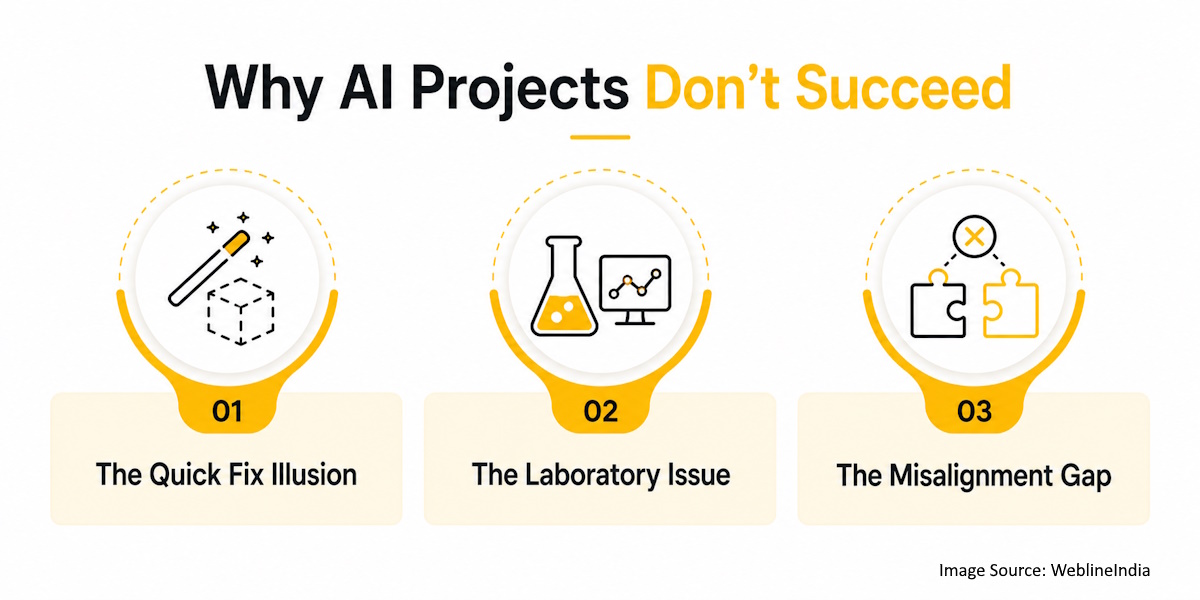
The Quick Fix Illusion
Many businesses think of AI as a magic fix for broken processes. They think that if their manual data entry is slow or their sales forecasting is wrong, an AI model will fix it on its own. This is a big mistake. When companies focus on prioritizing AI solutions without first fixing the systems that are causing the problems, they end up making the problems worse instead of better. AI only works with what you give it. If your input process is chaotic, the AI will produce chaotic output at high speed. You cannot automate a mess and expect order.
The Laboratory Issue
Data scientists often work in protected environments. They get a static snapshot of data, clean it perfectly, and train a model until it hits high accuracy scores. This works in a notebook. It fails in production because real data is not static. Real data is messy, delayed, and prone to sudden changes. When teams build in a vacuum, they fail to account for the unpredictable nature of how the business actually runs.
The Misalignment Gap
This is one of the most common reasons for AI project failures. Data teams focus on technical accuracy—getting the model to predict the right number 95 percent of the time. Business teams focus on outcomes—saving money or speeding up a process. Despite the huge possibilities for business with artificial intelligence, that potential is often wasted when these two perspectives are not aligned. If the model is 95 percent accurate but does not solve the actual user problem, it is a failure. Without a shared language between technical teams and business stakeholders, you end up building high-tech tools that solve irrelevant problems.
Specific AI Development Challenges
Even when teams have the right intentions, technical and operational barriers often block success. These challenges are predictable, yet many companies ignore them until it is too late.
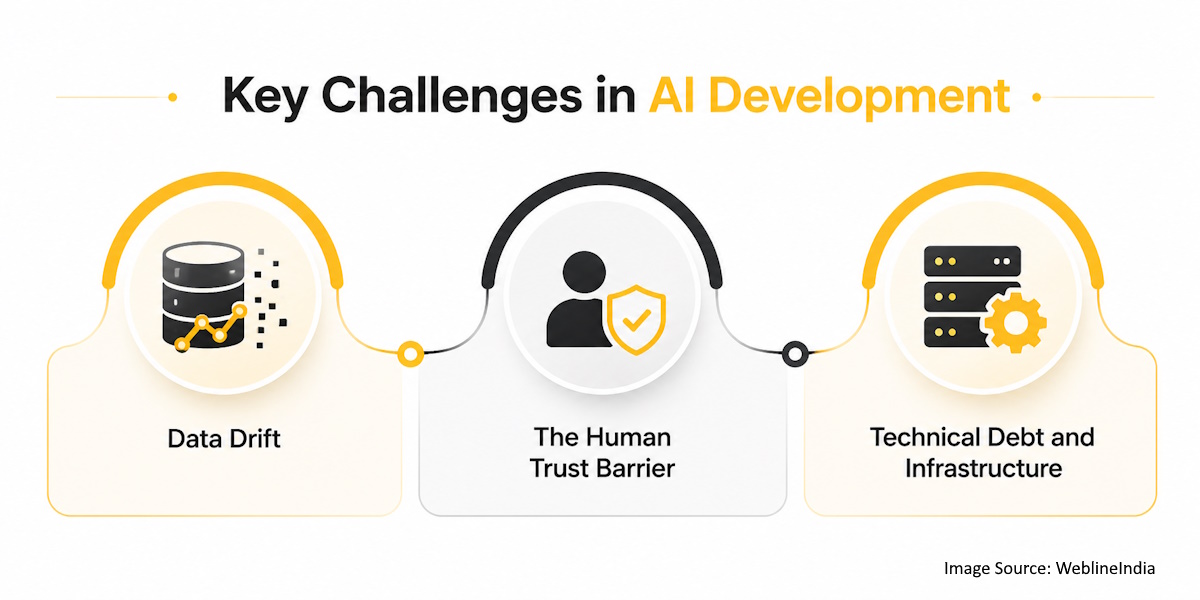
Data Drift
A model learns from patterns in past data. But the world changes. Customer preferences shift. Economic conditions alter purchasing behavior. A model trained on 2024 data might perform poorly in 2026. This is data drift. If your system cannot detect when its own predictions are losing accuracy and trigger a retrain, it will slowly become useless. Most companies do not build for this maintenance phase. They treat the model as a static asset rather than a living component that needs regular recalibration.
The Human Trust Barrier
If an AI provides a recommendation that feels wrong, an employee will stop using it. This is a common issue in the supply chain or healthcare. If the model cannot provide a clear reason for its output, users will default to their own intuition. Building AI that works requires designing for the human in the loop. You need to show the user why a decision was made. If you treat the model as a black box, you lose the trust of the very people who need to use it.
Technical Debt and Infrastructure
You cannot build a skyscraper on a swamp. If your data is trapped in legacy systems, siloed across different departments, or formatted inconsistently, your AI project will spend 80 percent of its life simply trying to access information. This is not just a technical observation but AI statistics consistently show that data preparation and integration consume the majority of project time. Before you start on the AI, you must fix the plumbing. If the data pipelines are fragile, the AI will be fragile.
Need a custom AI system built around your workflow and won’t fail?
The Custom AI Development Process
To get this right, you need to change your approach. Successful AI implementation requires a shift from research-driven development to product-driven engineering. Follow this framework to build systems that survive the real world.
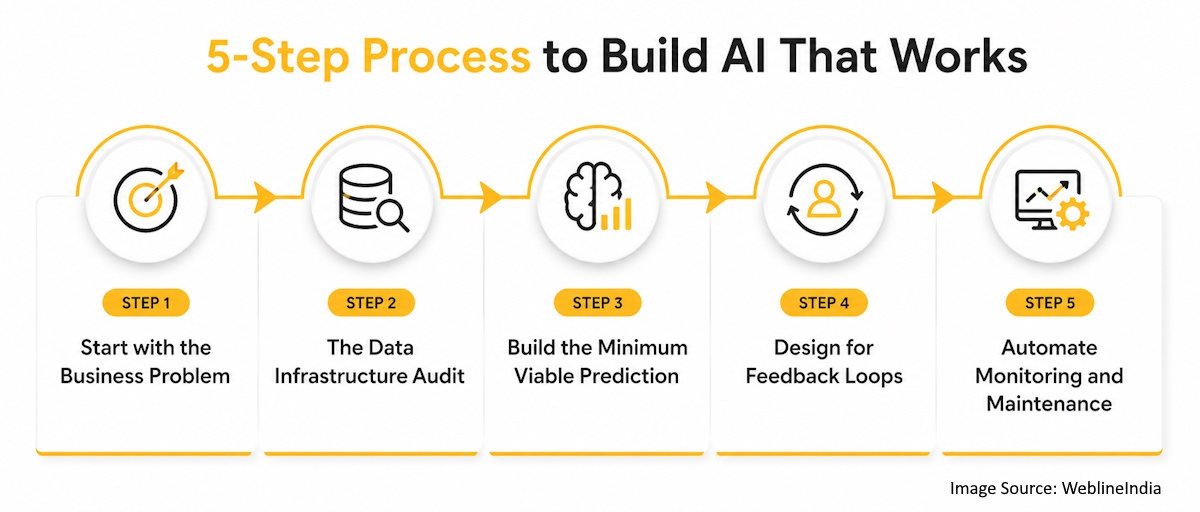
Step 1: Start with the Business Problem
Never start with the technology. Do not ask how to use a specific model or tool. Ask what manual, repetitive, or error-prone task costs the company the most time or money. Define the metric you want to improve. If you cannot track the success of the AI project with a clear business metric, do not start it.
Step 2: The Data Infrastructure Audit
Before a data scientist writes a single line of code, an engineer must verify the data. Is the data available in real-time? Is it clean? Does the team have access to it without navigating political red tape? If you are building a model for inventory prediction, you need to ensure the data for sales, returns, and shipments is actually connected. If the data is not ready, the project is not ready.
Step 3: Build the Minimum Viable Prediction
Do not aim for perfection on day one. Build the smallest system that provides value. If you want to automate a customer service workflow, do not try to build a bot that handles everything. Start by building a tool that helps agents categorize tickets faster. Get that tool into the hands of real users as quickly as possible. The feedback you get from the first day of real-world usage is worth more than three months of internal model testing.
Step 4: Design for Feedback Loops
A system that does not learn is dead on arrival. Build your AI so that users can verify or correct its predictions. If the AI suggests a price, let the user override it and record why they made that change. This becomes a data point for future training. The human input creates a loop where the system improves every day based on the expertise of your staff.
Step 5: Automate Monitoring and Maintenance
This is where successful AI implementation is separated from the rest. You need a system that monitors the model in production. You should have alerts that trigger when the model confidence drops or when input data patterns change significantly. If the model starts to drift, the team should know immediately so they can investigate and retrain it.
Lessons for Successful AI Implementation
The path to building functional AI is paved with boring, disciplined engineering. It is not about clever hacks or the newest research papers. It is about stability, integration, and user trust.
Focus on Integration, Not Isolation
The biggest mistake is building an AI tool that requires a separate login or a new dashboard. People will not use it. The AI must live where the work happens. If your staff uses a specific CRM, the AI suggestions should appear right inside that CRM. The intelligence should feel like an extension of their current workflow, not a new chore they have to manage.
Prioritize Interpretability
Avoid the urge to use the most complex model available if a simpler one works. If a simple regression model achieves 90 percent accuracy and a deep neural network achieves 92 percent, pick the simple one. The simple model is easier to explain, easier to debug, and faster to fix when things go wrong. In a business context, reliability and explainability are almost always more valuable than a marginal gain in accuracy—and this principle will define the future of AI in business, where practical impact matters more than technical sophistication.
Build Cross-Functional Teams
An AI project cannot live in the data science department. It requires a mix of people. You need data engineers to build the pipelines. You need to hire ai developers to integrate the model. You need subject matter experts to tell you if the AI output actually makes sense. If you do not have all these people at the table from day one, you are building in a bubble.
Manage Expectations
AI is probabilistic, not deterministic. It will make mistakes. As part of effective AI consulting services, it’s important to set realistic expectations when presenting AI initiatives to leadership. Be transparent about potential error rates and explain that the goal is to improve the average outcome, not achieve perfection every time. If you position AI as a flawless solution, you’ll lose credibility the first time it makes a mistake. Instead, present it as a tool that reduces human error, improves decision-making, and increases efficiency to build long-term trust and a sustainable adoption strategy.
Build AI Solutions for Business Workflows That Work
The hype surrounding artificial intelligence has made it easy to lose sight of the objective. The objective is not to adopt AI. The objective is to solve business problems.
The challenges are real. The path to production is filled with data issues, cultural resistance, and technical hurdles. But these problems are solvable. They require a rigorous, product-focused approach.
Stop focusing on the capability of the algorithms and start focusing on the reliability of the system. Build for the users who have to live with the software. Fix the data pipes before you build the features. Create feedback loops that allow the system to learn from its own mistakes.
If you treat AI as a persistent engineering challenge rather than a magic wand, you will find that it is possible to build tools that actually work. This is why disciplined AI development is so important, not just building models but refining them, deploying them and aligning them with real-world use. The companies that win in the next few years are not going to be the ones that talk most about AI. They will be the ones who quietly embed it into their operations, day by day, until it becomes the engine that drives their efficiency.
The era of rushing is over, and the era of building with discipline has begun. Contact WeblineIndia to build quality AI solutions while avoiding the common pitfalls. Create a system that adds real value to your organization now.
Social Hashtags
#AI #ArtificialIntelligence #AIDevelopment #MachineLearning #BusinessAI #DigitalTransformation #GenerativeAI #AIForBusiness #WhyAIDevelopmentProjectsFail
Ready to turn AI initiatives into business results?
Frequently Asked Questions
Globally Recognized for Unmatched Quality and Reliability




Testimonials: Hear It Straight From Our Global Clients
Our development processes delivers dynamic solutions to tackle business challenges, optimize costs, and drive digital transformation. Expert-backed solutions enhance client retention and online presence, with proven success stories highlighting real-world problem-solving through innovative applications. Our esteemed Worldwide clients just experienced it.
Awards and Recognitions
While delighted clients are our greatest motivation, industry recognition holds significant value. WeblineIndia has consistently led in technology, with awards and accolades reaffirming our excellence.

OA500 Global Outsourcing Firms 2025, by Outsource Accelerator

Top Software Development Company, by GoodFirms

BEST FINTECH PRODUCT SOLUTION COMPANY - 2022, by GESIA

Awarded as - TOP APP DEVELOPMENT COMPANY IN INDIA of the YEAR 2020, by SoftwareSuggest