AI Development Services: Questions Every CTO Should Ask Before Starting an AI Project
Choosing the right AI development partner takes more than reviewing technical skills. CTOs need to assess business goals, data readiness, security, scalability, costs, vendor experience, governance, and long-term support. This guide covers the essential questions technology leaders should ask before starting an AI project, helping them reduce risk, set realistic expectations, and make better decisions before signing a development contract.


 ChatGPT
  Perplexity
 Artificial intelligence is no longer just a futuristic concept for tech companies. It has become a core business requirement across industries. CTOs face immense pressure to innovate rapidly. When a company is determined to remain competitive, it becomes essential to outsource AI development services to enhance your core business processes.
As the CTO, you are on the hunt for AI development services to make your innovative business ideas a reality. With so many options available in the market, it can be hard to find the right service provider for your business goals. As there are many different AI vendors out there for CTOs to choose from, it can be difficult to decide on the right one for your company.
This guide is intended to help CTOs choose the right AI vendor for their company by asking the right questions before entering into a contract with any AI development company.
Let’s begin with the basics.
Ready to turn your AI idea into a successful business solution?
Why CTOs Need a Strategic Approach to AI Development
The process of building artificial intelligence is different from software development. The core of any machine learning model is based on high-quality data, which also needs to be retrained from time to time to harvest value from the technical investment.
So, in order to create value in the short term and be able to measure it in the long term, a strategic plan must first be created to test out a proof-of-concept in a structured manner. Hence, a CTO of a company has to align the AI efforts of his company with the main objectives of the company. A trend-driven implementation of machine learning leads to a scattered IT infrastructure and does not bring any value to the company. Only a disciplined approach to new technologies and digital transformation services will bring the desired return on investment.
Risk mitigation: As automation, AI, and other smart processes are introduced into the business, the way it can be attacked also changes. Not only are the normal ways of attacking processes such as the processing of customer data within models that make decisions, but the data used in these models for decision-making also has to be governed so that no fines are incurred, and the smart processes do not fail in unpredictable ways.
What Are AI Development Services?
The term AI development services can refer to a variety of different services, often provided on a project basis and designed to enable organizations to create applications and services that incorporate AI in some form or another. They could provide a series of high-level pointers to help an organization get started with AI, or create specific AI-based models to power a variety of different applications.
Leading providers of AI development services offer a range of specialized services to build scalable intelligent applications. These services can be broadly categorized into the following groups:
- AI consulting services for defining strategic roadmaps and identifying high-impact use cases.
- Custom AI development services tailored to specific domain workflows and specialized enterprise data.
- AI implementation services to transition experimental models into resilient production environments.
- Generative AI development services for building specialized LLM workflows and automated content tools.
- AI software development services focusing on clean application logic and seamless user interfaces.
- Machine learning development services centered around predictive modeling and data pipeline engineering.
- AI integration services to bridge modern models with legacy infrastructure and backend databases.
- AI outsourcing services to rapidly scale internal engineering teams with specialized external talent.
Selecting the right combination of enterprise AI development capabilities ensures complete coverage across the entire project lifecycle.
Questions Every CTO Should Ask Before Hiring an AI Development Company
Before signing a contract, you must evaluate both internal requirements and vendor capabilities. Asking targeted questions early saves months of wasted effort.
Key Evaluation Pillars:
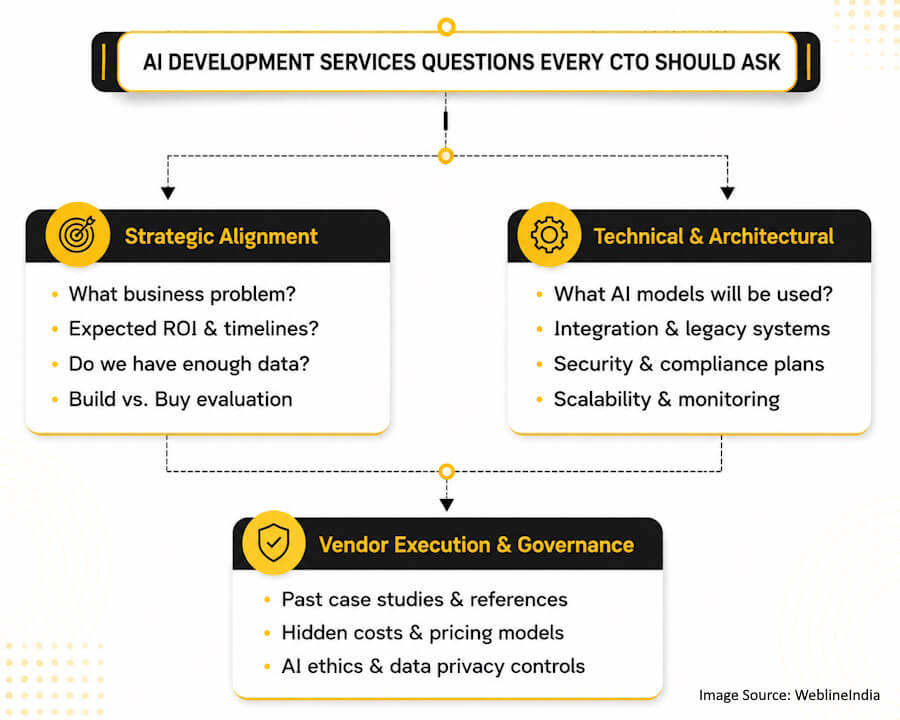
What Business Problem Will AI Solve?
Technology should always serve a clear business purpose. You must define whether the goal is reducing operational overhead or improving customer retention. Vague objectives like optimizing operations rarely yield success.
Map out the exact friction points in your current workflows. Determine if automated intelligence is actually necessary to solve the issue. Sometimes standard database queries or simple automation rules perform better.
What ROI Can We Expect?
The ROI of intelligent systems, such as AI-powered enterprise software solutions, can consist of both direct and indirect benefits to your organization. The direct benefits would be the hours of your employees’ time saved daily by automating tasks, as well as the money not spent on hiring as many employees to manage these time-consuming manual tasks.
Establish baseline metrics before writing a single line of code. Monitor these metrics throughout the development lifecycle to verify economic viability.
Do We Have Enough Data for AI?
Data is the lifeblood of any intelligent application. Without clean and structured data, even advanced algorithms fail completely. You must audit your current data architecture and assess whether data analytics services are needed before initiating AI solution development.
- Evaluate the volume and historical depth of your existing records.
- Identify data silos across different departments and cloud environments.
- Check for missing values, biases, and formatting inconsistencies.
- Determine if synthetic data generation will be required for training.
Should We Build or Buy AI Solutions?
As with any application, intelligent applications can be developed from scratch or by using intelligent software solutions that have already been pre-developed for common tasks and processes. Developing custom models for intelligent applications can provide maximum flexibility.
Intelligent systems that are core to your business’s value proposition are best created and commissioned as build or commissioned intelligent systems. Non-core administrative tasks such as simple ticketing are generally better suited to buying off-the-shelf software.
What AI Technologies are Best for this Project?
The choice of AI technologies also depends on the specific performance characteristics of your application, i.e., processing speed and latency. For example, Deep Neural Networks are extremely powerful when it comes to image recognition of unstructured data; however, they are less suitable for real-time or latency-sensitive applications as they require powerful servers to process.
Classical Statistical Models, on the other hand, perform extremely well at forecasting from structured data in fixed-size tables.
Technical Questions CTOs Must Ask
Technical leaders must look past high-level sales pitches and inspect architectural details. Probing deeply into execution strategies prevents severe scaling issues later.
What AI Models Will Be Used?
Ask vendors to justify their selection of specific algorithm architectures. Inquire whether they plan to use open-source foundation models or proprietary APIs.
Understand the trade-offs between model size, accuracy, and operational inference costs. Fine-tuning a smaller specialized model often yields better efficiency than querying massive public APIs.
How Will the Solution Integrate With Existing Systems?
Modern software typically is not monolithic, so the new application will have to integrate with several legacy systems, including a database, an ERP system, and other 3rd party APIs. Review the proposed API architecture as well as the proposed strategy for the development of the AI application.
Review the proposed API architecture and middleware layers. Ensure that AI application development strategies include robust fallbacks for system downtime.
How Will Data Security Be Handled?
Data exposure is likely to cause extreme damage to a company’s business in a very short period of time. Thus, one must ensure that sensitive customer data is protected sufficiently both during model training and during inference in production.
- Enforce end-to-end encryption for data at rest and in transit.
- Implement strict role-based access controls across all environments.
- Anonymize personally identifiable information before feeding it to models.
- Ensure vendor pipelines do not retain your proprietary data for external training.
What Is the Scalability Plan?
User traffic spikes can quickly overwhelm poorly optimized model endpoints. Your architecture must automatically scale compute resources up or down based on real-time demand.
So, what are the options for cloud consulting services, provisioning, containerization, and serverless technology? What is the underlying database architecture and how does it perform with large numbers of concurrent analytical queries?
How Will Model Performance Be Monitored?
Unlike static software code, machine learning models degrade over time as real-world conditions change. This phenomenon is known as model drift or data drift.
Create a pipeline to monitor the following quality indicators for your models: accuracy, latency, and required resources. Set up this pipeline to automatically trigger alerts for your development team when any of the indicators deviate from defined thresholds.
Need help choosing the right AI development partner for success?
Questions to Ask an AI Development Partner
Selecting the best AI development company requires thorough vetting of technical capabilities, cultural fit, and execution history. These direct questions to ask an AI development company will help separate top-tier firms from inexperienced agencies.
What Relevant AI Projects Have You Delivered?
Ask for concrete evidence of past achievements in your specific industry vertical. Experience in financial technology does not automatically translate to healthcare compliance or manufacturing logistics.
Find out the specific technical challenges the other AI development company faced with previous projects and how they overcame them. Financial technology, for example, does not automatically translate into achieving similar results for healthcare compliance projects within the hospital sector, as opposed to manufacturing logistics.
Can You Share Case Studies and References?
Reviewing detailed case studies gives clear insight into a vendor’s problem-solving approach. Ask to speak directly with technical leaders from their previous client engagements.
During reference calls, ask about the vendor’s communication habits and deadline adherence. Inquire whether the final system met original performance expectations under real load.
What Is Your Development Methodology?
Traditional software development methodologies must adapt when handling non-deterministic machine learning models. Iterative experimentation and rapid prototyping are critical components of a successful strategy.
Clarify how sprint cycles manage model training failures and data cleaning delays. Clear progress metrics should be defined for every delivery milestone.
What Post-Launch Support Do You Provide?
The relationship with a software development vendor doesn’t have to come to an end when the project they have been developing for you launches. The vendor’s maintenance function should continue to service the system they developed for you, retraining the models, fixing any vulnerabilities, and keeping any relevant dependencies up to date for you.
| Support Scope | In-House Engineering Team | External AI Partner |
| Model Drift Monitoring | Requires dedicated MLOps staff | Often included in managed service contracts |
| Infrastructure Scaling | High internal effort and manual tuning | Automated cloud management services |
| Bug Fixing & Patches | Deep familiarity with custom code | SLA-backed response times for quick fixes |
| Data Pipeline Updates | Requires continuous data engineering | Handled via routine maintenance agreements |
Clarify the terms of your service level agreement before signing. Ensure response times for critical system outages are clearly defined and enforceable.
Budget and Cost Considerations
Budget overruns are common in machine learning initiatives due to unpredictable compute requirements. Understanding the cost drivers behind AI development services for enterprises allows for accurate financial forecasting and understand ROI in AI development.
How Much Will AI Development Cost?
Initial project scope, model complexity, and team composition dictate total AI development cost. Simple API integrations cost significantly less than training proprietary models from scratch.
Factor in software licensing, third-party API usage fees, and specialized hardware provisioning. Always build a buffer into your initial financial projections for unexpected experiments.
What Hidden Costs Should We Expect?
Many organizations overlook ongoing operational expenditures associated with hosting intelligence engines. Data storage costs accumulate rapidly as transaction histories grow over time.
Continuous inference calls to cloud-hosted foundation models create monthly operational expenses. Account for data cleaning, labeling, and continuous MLOps infrastructure from the beginning.
What Pricing Model Is Best?
Fixed-price contracts work well for small projects with rigid requirements and low complexity. Time-and-materials contracts offer flexibility when research and experimentation are required.
Governance, Compliance, and Risk Management
Navigating the legal landscape surrounding modern algorithms requires strict compliance management. Failing to address governance early can result in massive regulatory fines and public backlash.
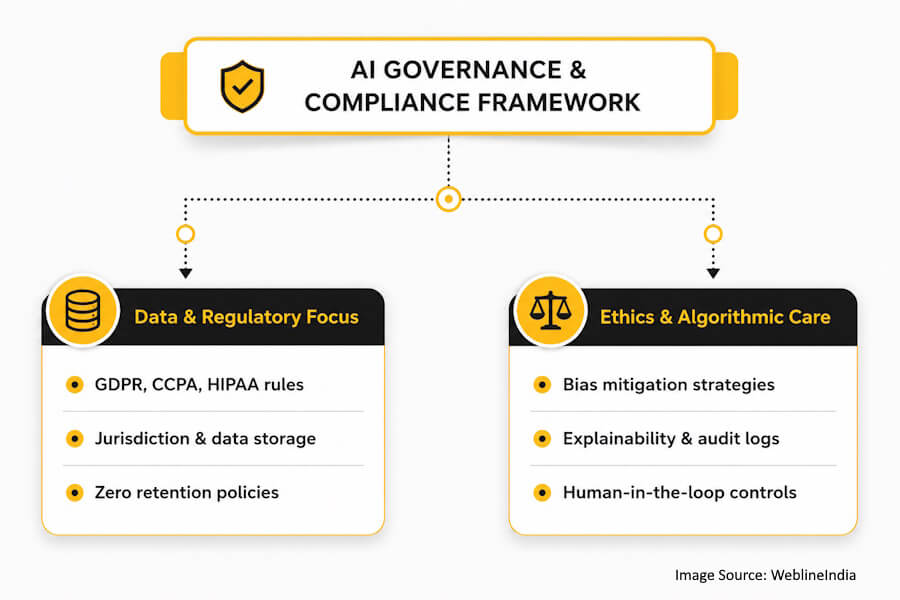
Data Privacy Requirements
Your processing workflows must comply with regional legislation such as GDPR, CCPA, and HIPAA. Verify where vendor processing servers are physically located to avoid cross-border data transfer violations.
Implement zero-retention policies when utilizing external API services for enterprise data handling. Secure client consent clearly before utilizing user activity data to train custom models.
Regulatory Compliance
Industry regulations evolve rapidly as governments establish frameworks for intelligent technologies. Technical teams must stay updated on emerging local and global compliance standards.
AI Ethics and Responsible AI
Algorithmic bias can ruin your company’s reputation and lead to unfair discriminatory outcomes. You must evaluate training sets for historical biases before writing application code.
- Audit training datasets for balanced demographic and contextual representation.
- Establish explainability frameworks to understand how models reach specific decisions.
- Incorporate human oversight checkpoints for sensitive high-stakes workflows.
- Create clear procedures to address user complaints about automated outcomes.
Common Mistakes CTOs Make When Investing in AI
Even experienced technology leaders fall into common traps when deploying complex intelligent tools. Avoiding these mistakes saves valuable development cycles and capital.
- Chasing hype over utility: Investing in trendy architectures without first determining whether AI or more conventional business process automation services best fit the use case.
- Neglecting data quality: Attempting to train algorithms on messy, incomplete datasets.
- Underestimating MLOps: Focus entirely on initial model training while ignoring long-term deployment workflows.
- Ignoring organizational change management: Building complex software that employees reject due to poor usability.
- Failing to conduct proper AI development company due diligence: Partnering with vendors that lack real engineering experience.
Addressing these risks early protects your organization from costly technical debt and operational delays.
AI Project Readiness Checklist
This CTO checklist for AI development projects helps assess your organization’s readiness before engaging external partners. Thorough preparation prevents delays during vendor onboarding.
Operational & Technical Readiness Checklist
- Business Alignment: Clear business objectives and key performance indicators defined.
- Data Infrastructure: Data cleaned, centralized, and audited for access rights.
- Budget Allocation: Funds allocated for initial development, cloud hosting, and long-term maintenance.
- Security Protocols: Compliance frameworks established for processing sensitive inputs.
- Internal Ownership: Product managers assigned to oversee vendor deliverables.
- Vendor Vetting: AI consulting questions before hiring prepared for vendor interviews.
- Integration Strategy: Legacy system touchpoints mapped out for implementation.
Completing this AI project planning checklist for CTOs ensures your team is prepared for a smooth partnership.
Final Questions Before Signing an AI Development Contract
Before signing a final contract, ask these critical AI implementation questions for CTOs:
- Who retains full intellectual property rights to the custom models and fine-tuned code?
- What are the precise performance criteria required before the project is marked complete?
- How will our sensitive internal data be isolated from other client workloads?
- What is the exit strategy if we decide to bring model maintenance in-house?
Conducting thorough evaluations of AI vendors and development companies safeguards your long-term technical investments. A strong agreement protects intellectual property while holding partners accountable for performance.
Ready to Build a Successful AI Strategy?
Navigating the choice of the right AI development partner requires balancing business goals with technical requirements. By conducting thorough enterprise AI development partner evaluation and asking targeted questions, technical leaders can avoid costly missteps and build scalable solutions. Strategic planning ensures every technical investment yields measurable business value.
If you are looking for a reliable software partner, WeblineIndia provides comprehensive custom engineering capabilities. Their team delivers customized solutions that streamline operations and drive business growth. Partnering with WeblineIndia helps you execute a successful technical strategy with confidence.
Want to reduce risks before starting your next AI project?
Frequently Asked Questions
What questions should a CTO ask before starting an AI project?
Before starting an AI initiative, CTOs should clarify the business problem, expected outcomes, available data, technical feasibility, budget, timeline, and success metrics. It's also important to evaluate whether AI is the right solution, how it will integrate with existing systems, and what resources are required for deployment and long-term maintenance.
How do I choose the right AI development services provider?
Look for a partner with proven AI expertise, relevant industry experience, strong case studies, transparent development processes, and end-to-end capabilities—from strategy and data engineering to deployment and support. A reliable AI development company should also prioritize security, scalability, and measurable business outcomes.
What is the most important factor in AI project success?
Clearly defined business objectives are the biggest driver of AI project success. Even the most advanced AI models cannot deliver value without high-quality data, stakeholder alignment, and a well-defined implementation strategy focused on solving a real business problem.
How can CTOs measure AI project ROI?
AI ROI can be measured through improvements in operational efficiency, cost savings, revenue growth, customer satisfaction, process automation, and productivity gains. Establish baseline metrics before implementation and compare performance against predefined KPIs after deployment.
What should be included in an AI development proposal?
A comprehensive AI development proposal should include project objectives, scope, technical approach, data requirements, technology stack, development timeline, cost estimates, deliverables, risk assessment, success metrics, and post-launch support plans.
How much data is needed for an AI project?
The amount of data depends on the use case and the AI model being developed. While some projects require millions of data points, others can achieve strong results using smaller, high-quality datasets combined with transfer learning or pre-trained models. Data quality is generally more important than data volume.
Should businesses build custom AI or use existing AI platforms?
It depends on the business requirements. Existing AI platforms are ideal for common use cases because they reduce development time and costs. Custom AI solutions are better suited for organizations with unique workflows, proprietary data, strict compliance requirements, or competitive differentiation goals.
What security concerns should CTOs consider in AI projects?
Key security considerations include data privacy, regulatory compliance, secure model training, access control, API security, model vulnerabilities, data encryption, and continuous monitoring. Organizations should also establish AI governance policies to ensure responsible and compliant AI usage.
How long does a typical AI development project take?
Project timelines vary based on complexity. A proof of concept typically takes 6–10 weeks, while a production-ready AI solution may require 3–9 months or longer. Factors such as data preparation, integrations, testing, and regulatory requirements significantly influence delivery timelines.
What skills should an AI development company have?
An experienced AI development company should have expertise in machine learning, deep learning, natural language processing, computer vision, data engineering, MLOps, cloud platforms, software engineering, cybersecurity, and AI strategy. Strong project management and domain knowledge are also valuable.
What are common AI project risks?
Common risks include poor data quality, unclear business objectives, unrealistic expectations, model bias, integration challenges, security vulnerabilities, regulatory compliance issues, budget overruns, and low user adoption. Identifying these risks early improves project outcomes.
How can CTOs reduce AI implementation risks?
CTOs can reduce AI implementation risks by starting with a pilot project, validating data quality, setting measurable objectives, involving stakeholders early, selecting an experienced AI development partner, implementing robust governance practices, and continuously monitoring model performance after deployment.
Globally Recognized for Unmatched Quality and Reliability




Testimonials: Hear It Straight From Our Global Clients
Our development processes delivers dynamic solutions to tackle business challenges, optimize costs, and drive digital transformation. Expert-backed solutions enhance client retention and online presence, with proven success stories highlighting real-world problem-solving through innovative applications. Our esteemed Worldwide clients just experienced it.
Awards and Recognitions
While delighted clients are our greatest motivation, industry recognition holds significant value. WeblineIndia has consistently led in technology, with awards and accolades reaffirming our excellence.

OA500 Global Outsourcing Firms 2025, by Outsource Accelerator

Top Software Development Company, by GoodFirms

BEST FINTECH PRODUCT SOLUTION COMPANY - 2022, by GESIA

Awarded as - TOP APP DEVELOPMENT COMPANY IN INDIA of the YEAR 2020, by SoftwareSuggest