The CTO’s Playbook: A Master Checklist for Hiring eCommerce Developers in a High-Stakes Market
The ultimate CTO playbook for hiring eCommerce developers—covering scalable architecture, performance engineering, security, integrations, and technical vetting to build future-ready digital commerce platforms in a high-stakes market.


 ChatGPT
  Perplexity
 The online shopping business has been the apple of the eye of most entrepreneurs for the past many years. If you are one of them and planning to hire eCommerce developers in a high-stakes market to transform your vision into a product successfully, you should consider a CTO’s checklist.
Undoubtedly, eCommerce has become an integral part of global retail, and, like many other industry verticals, buying and selling goods has undergone a substantial transformation with the advent of new tools and technologies.
Thanks to the ongoing digitalization of modern life, customers all across the globe now benefit from the perks of eCommerce websites and applications.
Build Your eCommerce Team with CTO-Level Confidence
Get expert guidance to hire developers skilled in scalable architecture, security, integrations, and performance.
The boom of eCommerce worldwide
JP Morgan reports that eCommerce takes 14% of total retail in the United States, with 77% of the population considering online shopping. The US eCommerce market was predicted to touch a compound annual growth rate (CAGR) of around 11.2% just a couple of years back.
Not just retail and B2C, worldwide eCommerce sales for B2B have also witnessed steady growth every year for the last decade, valued at US $36 trillion in 2026, according to the government portal International Trade Administration.
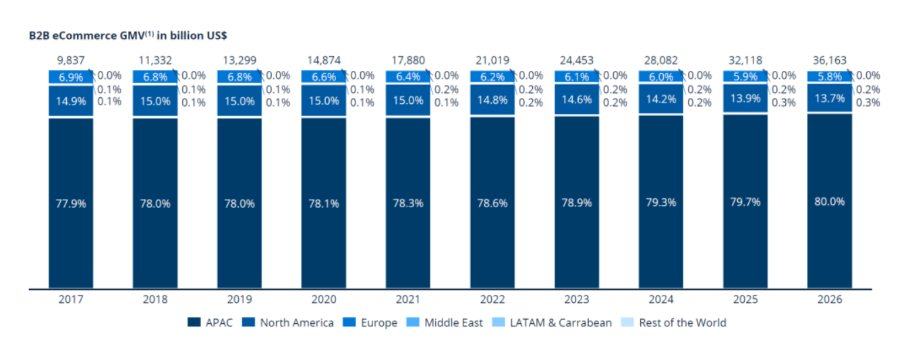
Source: Trade.gov
If you want to opt for eCommerce development services, as a Chief Technology Officer, you are responsible for making sure that every line of code contributes to business objectives while maintaining a clean and scalable infrastructure that withstands global traffic surges and volatile customer expectations.
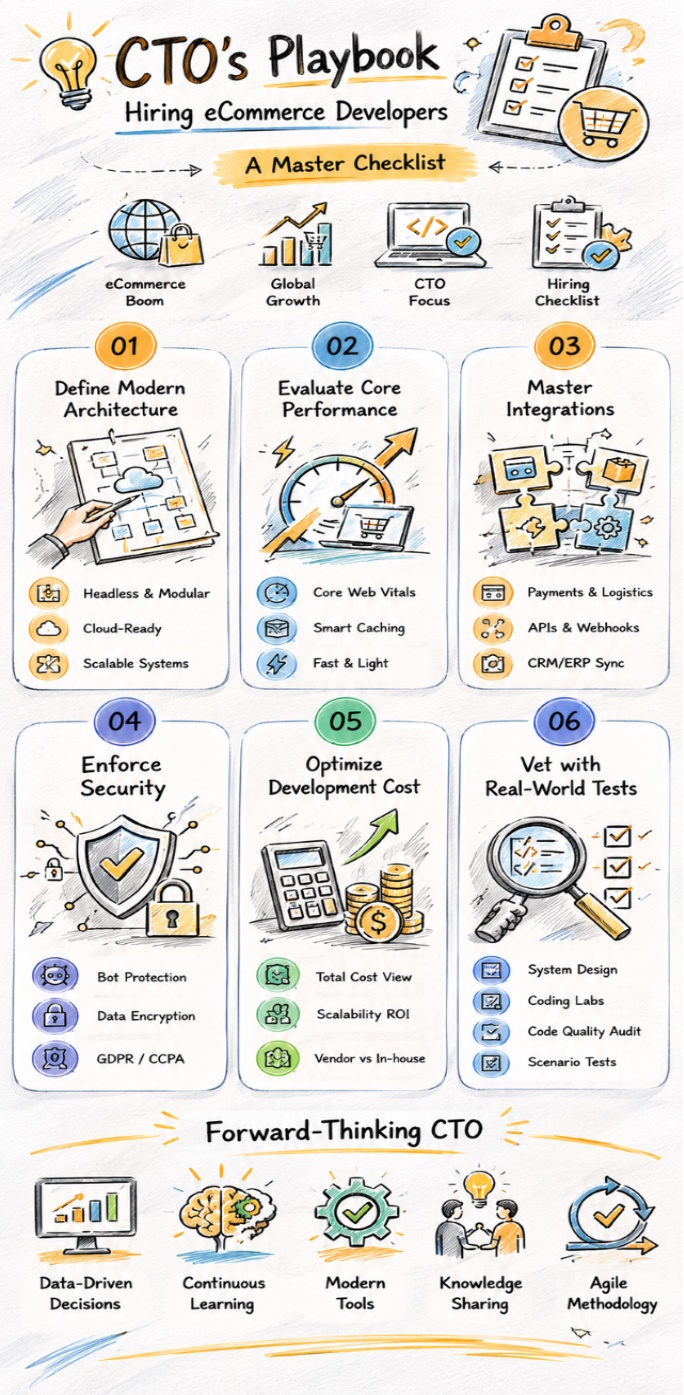
Here are the phases of the checklist that will help you hire eCommerce developers and carry out your project smoothly.
Phase 1
Define the modern architecture requirements
Before you begin the search to hire eCommerce developers, it is essential to define specific architectural paradigms as your business objectives to keep up the competitive edge today. Modern commerce is beyond simple templates; you need distributed systems, cloud services for deployment, and headless configuration for extreme flexibility.
Ecommerce development services you opt for should ensure a philosophy prioritizing modularity and the separation of concerns to get rid of the pitfalls of monolithic technical debt. You can choose custom eCommerce solutions from experienced developers who have:
- Headless commerce expertise: experience in separating the presentation layer from the logic layer, with strong front-end development services expertise using frameworks like Nuxt or Next.js.
- Multi-tenant architecture: ability to develop systems that support multiple storefronts and international locales from a single codebase
- Edge computing deployment: practical experience in deploying logic at the network level that minimizes latency and increases global page load speeds
- Microservices architecture: skills in creating and managing independent services that communicate flawlessly and have well-documented APIs
- State management expertise: capability to manage complex data flows across large-scale apps with common platforms
Phase 2
Evaluate core performance engineering skills
Assess core performance engineering skills. Performance is an essential metric affecting conversion rates and search engine visibility. When you evaluate candidates for eCommerce development services, you need engineers who take performance as their core strength.
Successful custom eCommerce solutions are built by developers who understand the complex connection between browser rendering, server response time, and the psychological effect of speed on the end users.
Check for a minimized critical rendering path and optimized assets to guarantee a seamless experience across the devices in the network:
- Core web vitals optimization: have in-depth knowledge of FID, LCP, and especially the new Interaction to Next Pain (INP) metrics.
- Advanced caching strategies: sense of implementing stale-while-revalidate patterns and sophisticated CDN configuration to serve content instantly.
- Payload reduction: build strategies for code-splitting and utilizing modern image formats such as AVIF to keep portals lightweight
Phase 3
Integrate mastery and third-party orchestration
The next phase in the hiring eCommerce developers’ checklist is putting the ability to build resilient integration first. Ranging from payment gateways to advanced logistics and marketing automation, a modern-day digital storefront is linked with many external services. Hire eCommerce developers who possess the skills to write custom middleware bridging the gap between niche third-party vendors and your eCommerce platform. This implies a defensive coding methodology where every external call is encapsulated with proper timeout logic, extensive logging, and error handling for enhanced system visibility:
- Logistics and shipping APIs: Integration of global carriers and 3PL providers to provide accurate, real-time shipping tracking and quotes.
- Payment gateway security: Expertise in integrating PayPal, Adyen, Stripe, etc., whilst adhering to strict PCI-DSS security/compliance.
- Middleware customization: Development of absolute abstraction layers to ensure that changes in third-party vendors do not break the business flow or logic.
- Webhooks management: Proficiency in handling asynchronous events and ensuring data consistency across cloud services.
- ERP and CRM sync: Building real-time data pipelines between backend systems through suitable ERP integrations and crm development services.
- Marketing stack connectivity: Seamlessly integrating server-side tracking, pixels, and customer data platforms without impacting the functionality of the frontend storefront.
Is Your eCommerce Platform Ready for Growth?
Let our experts assess your platform’s scalability, security, performance, and integration readiness before traffic spikes.
Phase 4
Security protocols for high-volume transactions
When the market is a high-stakes adventure, even a minor security breach can lead to irreparable brand damage and huge financial penalties from global regulatory bodies. When you seek custom eCommerce solutions, you seek a fortress for your user data and financial transactions that can survive intelligent cyberattacks.
Hire eCommerce developers who are well-versed with the latest cybersecurity protocols, from cross-site scripting to the latest SQL injections and automated bot attacks. Choose the ones who advocate a zero-trust security model wherein each request is authenticated and authorized to ensure that administrative tools and customer databases are impenetrable.
- Bot mitigation: utilize tools such as Cloudflare Bot Management or specialized WAF rules that prevent credential stuffing and inventory scraping
- Authentication frameworks: expertise in multi-factor authentication, OIDC, OAuth2, etc., to protect accounts and sensitive data
- Data encryption standards: implementing stringent AES-256 encryption for data at rest and TLS 1.3 for all data in transit
- Regulatory compliance: deep understanding of CCPA, GDPR, and regional privacy measures to ensure legal data handling globally
Phase 5
Navigate the eCommerce development cost
The eCommerce development cost is beyond the salaries of developers. You need to understand the financial implications of your decisions to hire eCommerce developers to keep up with your budget while achieving project milestones.
One may think of going for eCommerce development services by juniors, but you risk technical debt and architectural mistakes. As a CTO, you must balance the instant budget constraints with the need for hiring eCommerce web developers who are capable of offering high ROI. Keep in mind these essential factors:
- Total cost of ownership: factoring in software maintenance services, hosting, and the cost of future feature iterations into the initial hiring budget
- Scalability ROI: evaluating how a scalable system brings down the requirement for expensive server upgrades as your business grows
- Vendor vs. in-house analysis: deciding when to go for professional agencies versus having an internal team of dedicated full-time eCommerce engineers
Phase 6
The technical interview and vetting process
The final phase of the checklist to hire eCommerce developers involves a stringent vetting process beyond standard programming tests to real-world problem-solving. You should see how eCommerce development services by experts function under pressure and how the latter approach complex architectural dilemmas.
Focusing on practical exercises like performing a code review on challenging eCommerce modules or designing a system that handles a 100X traffic spike during Christmastide helps you evaluate eCommerce developers. Here are the tests you can bank on:
- System design reviews: ask eCommerce developers to white-board a top-level architecture for a multi-storefront platform that is global and has integrated legacy systems.
- Practical coding labs: you can learn about eCommerce developers’ abilities to solve real-world issues such as cart logic, complex discount engine rules, or inventory sync.
- Code quality audit: another common way is to review their past work. When you hire eCommerce developers, you may look at their technical test for readability, documentation, and compliance adherence.
- Scenario-based troubleshooting: you may present a live site outage scenario and observe eCommerce developers’ diagnostic processes and strategies.
Are you a forward-thinking CTO?
Successful eCommerce software development in this high-stakes market is challenging – you require technical foresight as well as commitment to excellence. As you have followed the hiring eCommerce developers checklist, you can now ensure that your project is led by perfect-fit minds.
Keep these factors in mind:
- Data-driven decisions: Analytics and monitoring tools will help guide your technical roadmap and justify future hiring or infrastructure investment.
- Continuous learning: Encourage the team of eCommerce developers to strengthen their knowledge of Node.js, including practices relevant to node js development services, alongside React and cloud technologies.
- Modern tool adoption: Regularly evaluate and adopt new developer tools that enhance productivity and code reliability across the board.
- Knowledge sharing: Promote an internal culture of training juniors by seniors for better outcomes.
- Agile methodology: implement iterative development cycles that result in speedy testing and deployment of the latest features or fixes.
Enjoy custom eCommerce solutions by having an efficient team at WeblineIndia. Building an eCommerce development team is an ongoing process of adaptation and refinement to the latest technologies. For smooth execution, you must be agile and well-informed, with the technical integrity of your platform as a priority.
Social Hashtags
#eCommerceDevelopment #HireDevelopers #CTO #TechLeadership #HeadlessCommerce #CustomSoftware #WebDevelopment #DigitalCommerce
Hire CTO-Approved eCommerce Developers Today
Build a future-ready eCommerce platform with experienced developers without the cost and complexity of in-house hiring.
Frequently Asked Questions
Globally Recognized for Unmatched Quality and Reliability




Testimonials: Hear It Straight From Our Global Clients
Our development processes delivers dynamic solutions to tackle business challenges, optimize costs, and drive digital transformation. Expert-backed solutions enhance client retention and online presence, with proven success stories highlighting real-world problem-solving through innovative applications. Our esteemed Worldwide clients just experienced it.
Awards and Recognitions
While delighted clients are our greatest motivation, industry recognition holds significant value. WeblineIndia has consistently led in technology, with awards and accolades reaffirming our excellence.

OA500 Global Outsourcing Firms 2025, by Outsource Accelerator

Top Software Development Company, by GoodFirms

BEST FINTECH PRODUCT SOLUTION COMPANY - 2022, by GESIA

Awarded as - TOP APP DEVELOPMENT COMPANY IN INDIA of the YEAR 2020, by SoftwareSuggest