Enterprise Generative AI: Benefits, Challenges, and Best Practices
Discover how enterprise Generative AI can improve efficiency, productivity, customer experiences, and decision-making. Explore key use cases, adoption challenges, security considerations, best practices, and strategies for building long-term business value.


 ChatGPT
  Perplexity
 Enterprise generative AI empowers modern organizations by driving intelligent automation, optimizing operational efficiency, and unlocking new revenue streams. However, successful adoption requires balancing major benefits with robust security, strict compliance frameworks, and strategic deployment practices. Let us explore each one of its benefit, challenge, and the best practice method.
But first, the basics:
What is Enterprise Generative AI and Why is it Revolutionising Modern Businesses?
Enterprise Generative AI is a huge shift in how Organizations utilise artificial intelligence to promote transformation, growth, and operational excellence. Companies are embedding state-of-the-art enterprise generative AI models into their fundamental corporate infrastructure, rethinking operational paradigms and unlocking tremendous value across global marketplaces. This wave of AI digital transformation allows organizations to go beyond the standard analytical tools and embrace creative issue solving, predictive analytics, and automated content development.
Further, organizations that embrace business AI are witnessing profound shifts in work execution and are positioning themselves well ahead of competitors using legacy techniques and antiquated procedures. Additionally, this technology revolution is altering organizational culture, promoting continuous learning, and nurturing a culture where human creativity and machine intelligence are continuously synergizing toward achieving strategic business milestones and long-term viability.
Ready to Turn Generative AI into Measurable Business Value?
Key Benefits of Enterprise Generative AI for Business Growth, Productivity, and Innovation
Utilizing the full capabilities of modern machine learning technologies provides organizations with a significant competitive edge in today’s fast-paced digital economy. By focusing on core operational improvements, companies can realize massive cost savings, increase employee productivity, and deliver superior customer experiences across every channel.
Hence, the strategic integration of these tools with larger business objectives ensures that digital investments convert immediately into quantifiable financial benefits and sustainable, long-term market leadership.
How Enterprise Generative AI Improves Operational Efficiency
Operational efficiency is a key benefit of generative AI in business operations. Strong enterprise AI solutions may help companies automate redundant administrative tasks, simplify complex paperwork processes, and optimise the use of resources across different departments.
Now, such a seamless combination of AI automation removes human barriers, enabling core teams to shift their strategic emphasis toward high-impact company goals and long-term growth projects. Additionally, automated routine checks greatly minimize error rates, ensuring high quality control standards and uniform production velocity across business units.
Enhancing Employee Productivity with AI
Smart gadgets make work easier and make staff more productive daily and happier with their work. Workers gain immediate access to synthesised corporate information, automated drafting assistants, and intelligent document summarisation tools through the advanced enterprise AI platform. Therefore, companies see a significant decrease in the time it takes to find internal data, which in turn enhances inter-departmental collaboration and boosts employee satisfaction across the entire business, from entry-level associates to executive leadership.
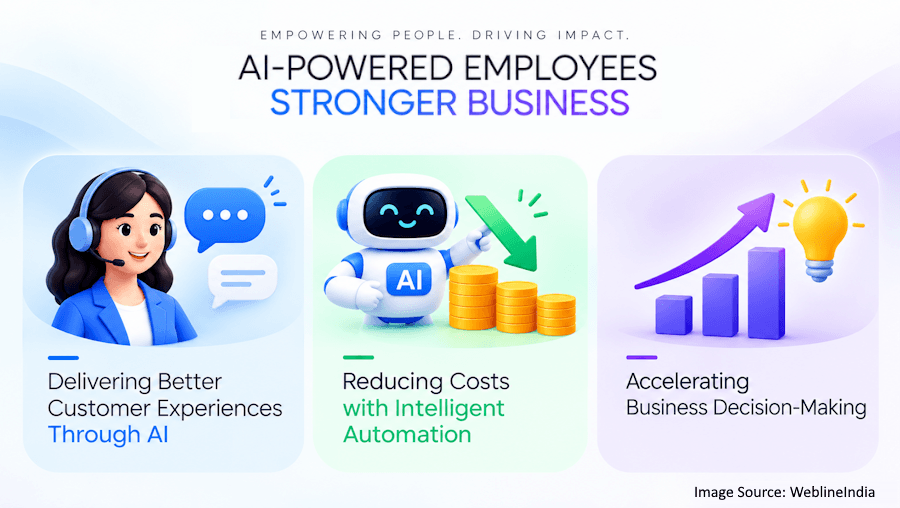
Delivering Better Customer Experiences Through AI
Today’s consumer wants hyper-personalized, real-time engagement across all channels of communication. Organizations may utilise the latest corporate AI use cases in customer service environments to deploy intelligent virtual agents that can respond to difficult enquiries round-the-clock. This persistent reactivity results in improved customer satisfaction levels, deep brand loyalty, and consistent, sympathetic service at every customer touchpoint.
Reducing Costs with Intelligent Automation
Strategic deployment of business AI solutions is key to bottom-line optimization and financial resiliency. As companies continue to integrate AI, business process automation services can help reduce the costs associated with manually inputting data, routing customers to the right service agents, and other avoidable administrative duties. Meaningful cost savings can then be reinvested in core research, product design and worldwide market expansion projects, fuelling sustainable, long-term fiscal health.
Accelerating Business Decision-Making
Making data-driven decisions is key to dealing with volatile and uncertain market situations. With the help of specialised enterprise AI development services, companies can funnel their massive corporate data lakes into useful insights in real time, in seconds. Leaders will see developing market patterns, predictive financial predictions, and granular risk assessments with crystal clarity, enabling them to make strategic choices quickly, with high levels of information and total confidence.
Top Generative AI Use Cases for Enterprises in Different Industries
Generative artificial intelligence has come of age beyond a general-purpose curiosity, to a highly specialised asset that is uniquely suited to the specific pain points of different industrial sectors. As they manage their clinics and automatically track rules, Organizations around the world are finding new ways to improve the way they work.
Indeed, it’s a good example of how flexible modern machine learning frameworks have become for forward-looking CEOs in these vertical-specific use cases.
- Healthcare: AI-powered healthcare workflow automation can support areas such as patient onboarding, document processing, insurance verification, and compliance, while enterprise Generative AI can also facilitate clinical recording, medical research synthesis, and customised patient communication.
- Financial Services: AI is used in the financial sector for automated fraud detection, algorithmic risk modelling, personalised wealth management advisory creation, and full regulatory reporting compliance across foreign jurisdictions.
- Retail and eCommerce: Retailers use corporate AI solutions to hyper-personalize product suggestions, dynamically optimise pricing based on real-time demand and generate innovative, localised marketing copy at scale.
- Construction: Manufacturing companies use strong AI automation to forecast equipment problems before they happen, optimise assembly sequences on the shop floor and speed up technical design cycles for complicated mechanical parts.
- Supply Chain & Logistics: Logistics companies use AI-powered logistics workflow automation to streamline operational processes, while AI can also help detect supply chain bottlenecks, optimise global shipping routes in real-time, and automate vendor-related workflows.
- Personnel: Using tailored modules of corporate AI platforms, HR teams automate the first screening of resumes, build customised strategies for employee onboarding and compile feedback from company-wide surveys.
- Marketing & Sales: Sales and marketing teams employ generative technologies to create hyper-targeted email sequences, write detailed proposal outlines, and conduct rapid, precise analyses of competitive positioning landscapes.
- Support for Customers: Customer service departments use advanced conversational agents powered by enterprise generative AI implementation to handle real-time multi-level customer assistance tickets without compromising quality.
Is Your Enterprise Ready to Scale Generative AI Securely?
Six Enterprise Generative AI Challenges and How Businesses Can Solve Them
The benefits of using machine learning are enormous, but Organizations face a complicated set of operational, technical, and regulatory challenges. Addressing these hurdles head-on is critical to minimizing security breaches, managing financial spend, and ensuring enterprise-wide adoption. Recognizing these typical pitfalls enables leadership teams to develop holistic mitigation plans prior to scaling their efforts.
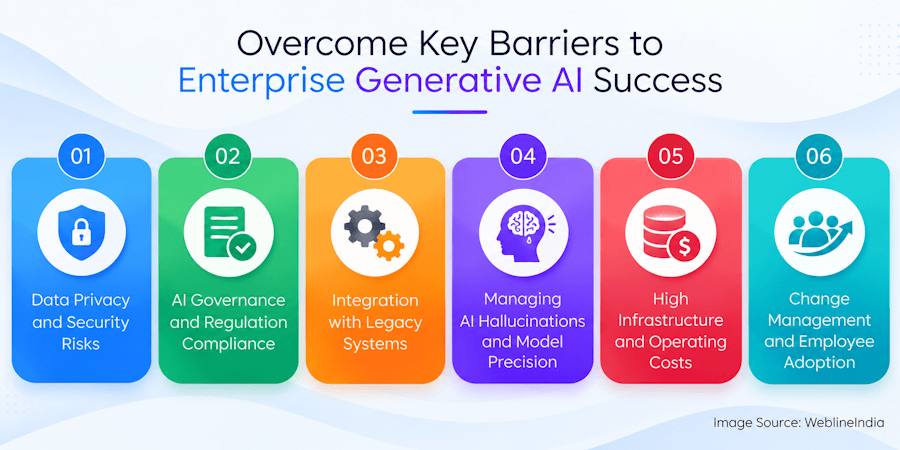
Data Privacy and Security Risks
Protecting proprietary corporate data and confidential customer information is critical, and retaining consumer trust is paramount. Feeding sensitive records into public models is often a significant organizational AI security concern, requiring stringent perimeter controls, data masking and privacy-first architecture approaches.
AI Governance and Regulation Compliance
A strong and comprehensive AI governance framework is key to navigating difficult domestic and international regulatory environments. Strict enterprise AI compliance helps companies avoid expensive legal penalties, reputational damage, and loss of public faith in automated corporate operations.
Integration with legacy systems
A key technical challenge is how to bridge contemporary machine learning algorithms with outdated databases and monolithic software structures. Specialized middleware, robust APIs, and extensive legacy modernization plans are required for seamless AI integration to prevent system disruptions.
Managing AI Hallucinations and Model Precision
Generative models are inherently prone to creating false or fake information if left uncontrolled. Within generative AI development services, these flaws can be addressed through stringent validation layers, retrieval-augmented generation (RAG), and ongoing human-in-the-loop monitoring procedures.
High Infrastructure and Operating Costs
Heavy foundation language models have high computational and energy costs to deploy and scale. To successfully manage financial overhead, a strategic hybrid cloud implementation, optimization of tokens, and resource provisioning is needed.
Change Management and Employee Adoption
Technology is only as good as the humans at the end of it. Organizations can overcome internal opposition to new digital workflows through extensive training programs, transparent communication, and compassionate leadership during transitions.
Enterprise Generative AI: Best Practices for Effective Adoption
To achieve enduring success, artificial intelligence demands focused execution, adherence to established processes, and a commitment to ongoing optimization. Organizations that set clear standards from the outset are much better positioned to maximize their return on investment while minimizing unforeseen hazards.
Hence, by using these proven operational standards, you make sure that the evolution of technology continues to correspond with the overall values and security objectives of the company.
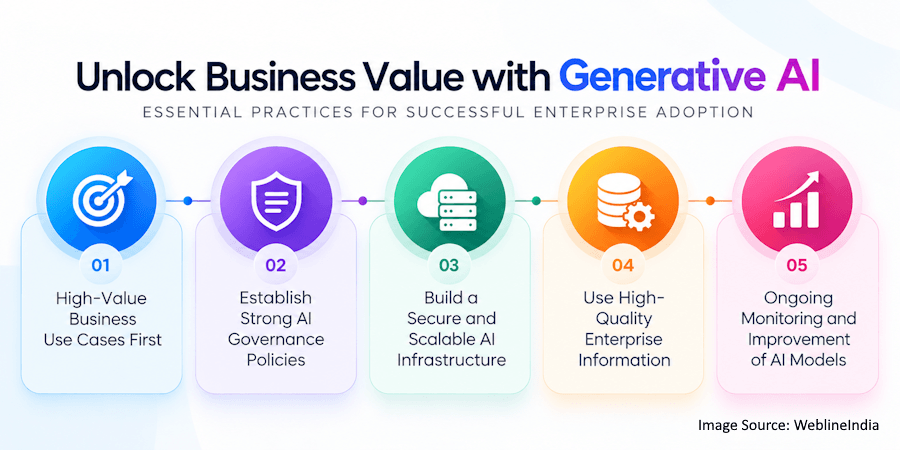
High-value business use cases first
Selecting low-risk, high-return pilot initiatives will build early momentum and get buy-in from stakeholders. Generative models offer quick, verifiable productivity gains without disruption to essential infrastructure; thus, organizations should be looking at workflows that fit this bill.
Establish Strong AI Governance Policies
The starting point for proactive AI risk management is explicit policy formulation. We establish ethical parameters, operational guidelines, and lines of responsibility to ensure that any model we implement meets the fundamental principles and legal requirements of our company.
Build a Secure and Scalable AI Infrastructure
A sound plan for Enterprise AI adoption needs to be built on cloud-ready, modular architecture that can dynamically scale computational capacity as organizational demands and workloads change.
Use High-Quality Enterprise Information
The effectiveness of AI model fine tuning services is highly dependent on the quality of the training data, while retrieval quality similarly depends on well-managed enterprise information. Organizations need to clean, structure, and manage internal data repositories to get rid of historical bias, redundancies, and factual mistakes.
Ongoing Monitoring and Improvement of AI Models
Deployment is never the end of the AI life cycle. We conduct regular audits, drift detection, and performance evaluations to ensure our models continue to perform with the accuracy, security, and alignment to changing business requirements.
How to Build an Enterprise Generative AI Strategy That Delivers Long-Term ROI
Building a unified plan that will stand the test of time is the foundation of any successful enterprise-wide technology implementation. With no clear roadmap, calculating ROI on AI investments might be easily dispersed, resulting to operational inefficiencies and missed financial targets. A good framework combines the high-level executive vision and everyday technical execution to ensure long-term value development.
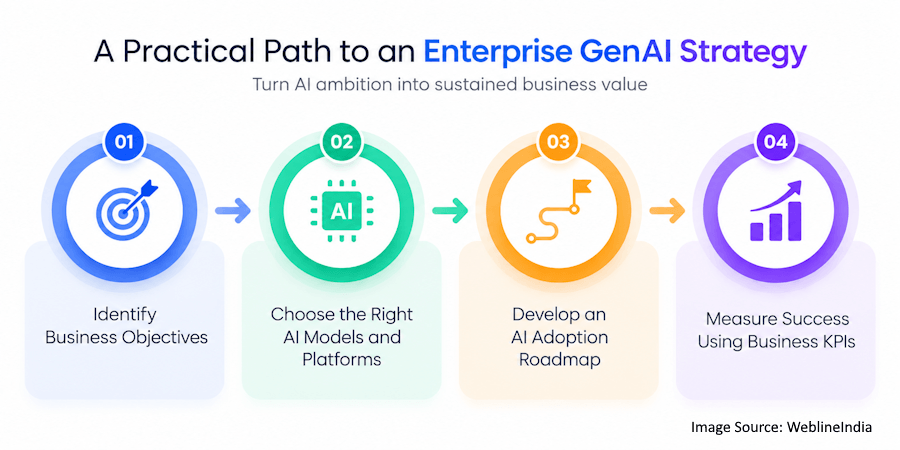
Identify Business Objectives
Any good AI strategy must be clearly aligned with broader corporate goals and strategic aspirations. Clear aims drive technological choices, whether the primary focus is cost savings, revenue acceleration, or customer experience improvement.
Choose the Right AI Models and Platforms
Choosing the right foundation models or working with an experienced enterprise generative AI development company helps ensure that the selected technology is appropriate for the enterprise’s particular vertical and scale needs.
Develop an AI Adoption Roadmap
Having an generative AI implementation roadmap is a systematic path that defines milestones, resource allocation, security checkpoints, and timetable expectations throughout the phases from sandbox testing to enterprise-wide adoption.
Measure Success Using Business KPIs
Tracking indicators like hours saved, cost per transaction deflection, revenue growth per user, and model accuracy rates help promote organizational transparency and validate ongoing capital investments.
Enterprise Generative AI Security, Compliance and Responsible AI Considerations
As AI takes a more autonomous role in business processes, it’s imperative to ensure strict compliance and ethical governance. Regulators are imposing rigorous regulations around the world to protect consumer data and business transparency. Being fully compliant with the standards protects the business from liability and builds long-term trust with customers and partners.
GDPR Compliance
If you run a multinational organization, you need to comply with European data protection standards. AI pipelines follow stringent data anonymization and right-to-be-forgotten procedures, ensuring complete regulatory compliance.
HIPAA Compliance
Healthcare deployments require tight protection of electronic protected health information (ePHI) and demand specialized isolated deployments, zero-data-retention agreements, and strong encryption standards on all nodes.
ISO 27001 and SOC 2 Standards
Following accepted security frameworks shows that you are serious about strong internal controls, high availability, processing integrity, and confidentiality and privacy protections.
Responsible AI and Ethical AI Practices
Fairness, transparency, and accountability must be built into every stage of development to prevent algorithmic bias and to avoid unintentional discriminatory results in automated commercial settings.
How to Choose the Right Generative AI Development Partner for Enterprise
Choosing the right external partner is a significant inflection point that may influence the overall direction of a business digital initiative. The ideal partner provides irreplaceable technical skill, domain insight, and architectural foresight to the partnership. In selecting the potential vendors, we apply stringent criteria in an effort to establish a collaborative relationship based on transparency, technical quality, and shared business objectives.
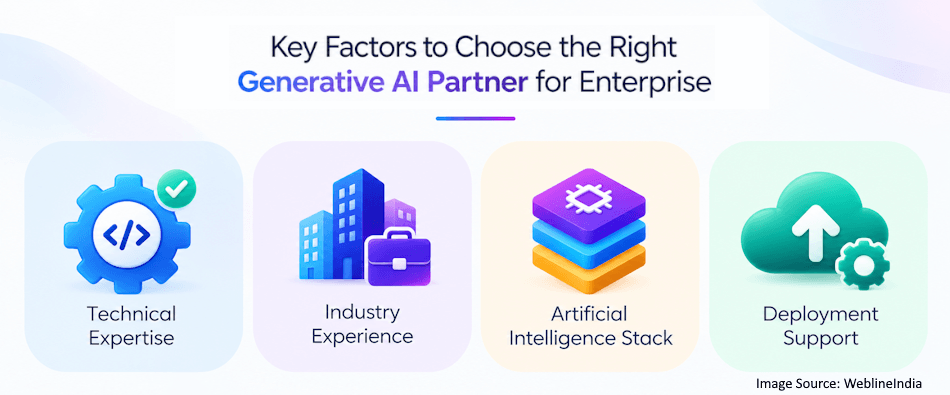
Technical Expertise
Look for external partners who are experts in custom model fine-tuning, vector databases, API orchestration, and scalable cloud deployments across numerous enterprise contexts.
Industry Experience
A provider of specialized generative AI consulting services with domain experience in your specific business will comprehend unique regulatory needs, workflow subtleties, and operational issues.
Artificial Intelligence Stack
Ensure that the partner you select is using modern, flexible development frameworks so that you are not locked in with one vendor and can move to another as newer, more efficient models come into the market.
Deployment Support Following
Ongoing maintenance, quick tuning, security patching, and regular model upgrades are essential for long-term operational performance and adjusting to changing market conditions.
Future Trends Shaping Enterprise Generative AI Adoption Beyond 2026
The technology landscape around artificial intelligence is changing at an incredibly rapid speed, bringing paradigms that will eventually reshape modern business processes. By staying ahead of these rising waves, forward-thinking organizations may future-proof their investments and maintain a unique business edge. Such changes can be predicted and absorbed when technology moves from experimental ideas to basic industry norms.
Autonomous AI Agents
Primitive prompt-response interfaces will be replaced in current enterprise contexts by autonomous agents able to independently execute multi-step complex operations, resulting in unparalleled productivity.
Multi-modal AI Models
Unified architectures will make possible richer, more natural human-computer cooperation across a wide range of business domains, including native processing of text, audio, video, and spatial data.
Private Language Models
Organizations will spend more on specialized, smaller, super-secure language models that are trained only on private internal data repositories, for maximum confidentiality and domain precision.
Agentic AI Workflows
Through agentic AI development services, connected networks of specialized AI agents can handle complex software development pipelines, supply logistics, and financial auditing while working together dynamically with limited human oversight.
AI-Native Enterprise Applications
Tomorrow’s enterprise software will be built with intelligence hard-coded in, making the typical monolithic user interface obsolete and setting new norms for user experience.
Final Thoughts on Implementing Enterprise Generative AI Successfully
Enterprise AI is a complex beast and requires strategic vision, careful risk management and experienced technical execution at every level of the company. To get the most out of your investment, partner with industry leaders like WeblineIndia for a successful digital transition.
WeblineIndia provides end-to-end corporate AI development services, especially made to suit your specific business goals and operational issues. Today, visit WeblineIndia and fast-track your way to intelligent enterprise automation and a sustainable competitive edge.
Looking for the Right Generative AI Strategy for Your Enterprise?
Frequently Asked Questions
What is enterprise generative AI?
Enterprise generative AI involves deploying advanced machine learning models within secure corporate ecosystems to automate workflows, generate insights, and scale content creation. Unlike consumer tools, it is customized for strict business security and operational integration.
How are enterprises using generative AI?
Organizations deploy generative AI to automate customer service interactions, synthesize medical or legal research, draft software code, personalize marketing initiatives, and optimize supply chain logistics. It accelerates task completion across departments.
What are the biggest challenges of enterprise AI?
Key hurdles include protecting data privacy, preventing model hallucinations, integrating with fragile legacy software systems, managing high compute costs, and overcoming employee resistance during digital transformation initiatives.
How do companies securely implement AI?
Firms ensure security by utilizing private cloud environments, enforcing zero-data-retention agreements with vendors, applying role-based access controls, and masking sensitive information before processing queries through language models.
What are enterprise AI best practices?
Best practices include starting with high-value, low-risk pilot projects, using clean and curated internal datasets, establishing cross-functional governance teams, and continuously monitoring model outputs for drift or bias.
How can large organizations scale AI?
Scaling requires building modular cloud architectures, utilizing multi-model routing gateways, standardizing tool-calling protocols, and deploying task-specific small language models alongside heavy frontier models.
What governance is needed for enterprise AI?
A robust governance framework requires explicit ethical guidelines, transparent audit trails, regulatory compliance tracking (such as GDPR and HIPAA), and regular validation checks to maintain operational accountability.
How does AI integrate with enterprise systems?
AI connects to existing enterprise architecture via secure APIs, custom middleware, vector databases, and enterprise service buses, allowing models to query internal data repositories without destabilizing core infrastructure.
What are common enterprise AI implementation mistakes?
Frequent errors include launching initiatives without clear business objectives, neglecting user training, failing to establish data privacy policies, and relying on unverified public outputs without human oversight.
How do companies measure enterprise AI success?
Success is tracked through quantitative business metrics, including hours saved per employee, cost reductions in customer service routing, transaction processing speed, and overall return on infrastructure investment.
What industries benefit most from enterprise AI?
Healthcare, financial services, retail, manufacturing, and supply chain sectors gain immense value by leveraging vertical-specific models to automate complex compliance, risk modeling, and operational workflows.
What is the future of enterprise generative AI?
The future centers on autonomous agentic workflows, multimodal processing capabilities, private domain-specific language models, and deeply embedded AI-native applications driving end-to-end business automation.
Globally Recognized for Unmatched Quality and Reliability




Testimonials: Hear It Straight From Our Global Clients
Our development processes delivers dynamic solutions to tackle business challenges, optimize costs, and drive digital transformation. Expert-backed solutions enhance client retention and online presence, with proven success stories highlighting real-world problem-solving through innovative applications. Our esteemed Worldwide clients just experienced it.
Awards and Recognitions
While delighted clients are our greatest motivation, industry recognition holds significant value. WeblineIndia has consistently led in technology, with awards and accolades reaffirming our excellence.

OA500 Global Outsourcing Firms 2025, by Outsource Accelerator

Top Software Development Company, by GoodFirms

BEST FINTECH PRODUCT SOLUTION COMPANY - 2022, by GESIA

Awarded as - TOP APP DEVELOPMENT COMPANY IN INDIA of the YEAR 2020, by SoftwareSuggest