Signs Your Business is Ready for Generative AI Implementation
Is your business ready for Generative AI? This guide covers the key signs to watch, including repetitive manual work, rising support demands, growing data volumes, content challenges, workflow bottlenecks, and scalability issues. It also includes an AI readiness checklist, common adoption challenges, best practices, and a practical Generative AI implementation roadmap.


 ChatGPT
  Perplexity
 Let’s understand the obvious flow: business AI Solutions for companies to enable their staff to focus on creative work. AI Integration enables data to flow between customer relationship management software and the company’s internal knowledge base. The AI Digital Transformation roadmap for enterprises requires suitable cloud computing infrastructure and training data before implementing an AI Transformation project. Before investing in an AI Transformation project, companies first need to assess the technological maturity of their business.
In this blog, we shall dive deep into signs that indicate that your business is ready for AI automation.
But first, the definition.
What Is Generative AI Implementation
Generative AI implementation, or Generative AI enterprise AI implementation, refers to the integration of current Machine Learning Models for Generative AI into existing processes for automated generation of text and code. Companies are searching for Generative AI Consulting Services and digital transformation services to modernize their operations and stay competitive.
The successful Enterprise AI implementation in a company is planned across several departments. Companies are looking for AI business automation solutions. AI Development company experts are designing software architectures for organizations. A good AI adoption strategy is needed for a smooth transition from existing legacy systems to modern Gen AI development platforms.
Enterprise AI Solutions for processing unstructured information in the form of text enable businesses to deal with large volumes of data. Scalable AI enterprise solutions are used for processing large amounts of data. Professional AI consulting services is required to assist business leaders with compliance with relevant laws as well as with the data privacy of businesses.
Is Your Business Ready to Move Forward with Generative AI Implementation?
Why Businesses Are Investing in Generative AI
Investing in Generative AI implementation can give businesses a competitive edge and unlock new revenue streams. Business AI Solutions for enterprises deliver unprecedented levels of efficiency and productivity. Marketing and software development, for example, can become much more efficient.
Large enterprises invest in enterprise AI solutions in order to grow their business, without having to grow the corresponding amount of labor in order to deliver the same level of service. The corresponding investment in AI transformation does, however, have tremendous returns in the long run.
Now, in order to automate and improve processes and to eliminate human error when processing large amounts of documents of a repetitive nature, companies invest in AI Business Automation. These solutions need to be aligned with business objectives by using professional Generative AI Consulting Services.
So, the question is: why should you adopt an AI adoption strategy for your business? As businesses begin to embark on their Enterprise AI transformation journey using AI, it is worth noting that AI digital transformation initiatives, for example, start with simple chatbots before moving on to more complex predictive modeling applications. Also, the type of enterprise AI Solutions that can help businesses communicate better with their remote teams and clients all over the world are in high demand.
Furthermore, Gen AI Development companies are being sought by businesses to create custom applications for them, built to understand the specific terminology and jargon used by a business. Businesses are looking for AI development services that can help them automate and integrate the various software applications and systems currently in use, to create one unified data warehouse.
Top Signs Your Business is Ready for Generative AI
If you want an answer to how to prepare AI implementation, it is essential to decide whether your business is ready for it.
Here is how you know it:
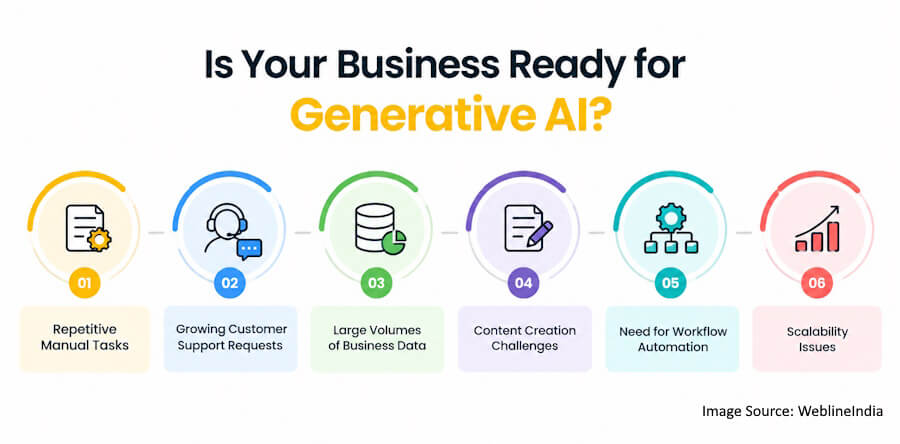
Repetitive Manual Tasks
Many companies view the manual data entry work that their employees complete on a daily basis as a waste of time. For example, employees can spend a huge amount of time simply copying and pasting information from one spreadsheet to another. Instead of having employees complete repetitive business processes that can cause errors, companies can use AI to automate the work.
- More than 30% of employees’ working time is spent on filling out forms manually.
- Human mistakes in data processing cost companies thousands of dollars annually.
- Operational managers report severe employee burnout due to monotonous daily routines.
Growing Customer Support Requests
Repetitive customer support requests that are very time-consuming need to be automated by business AI solutions for better customer service. Quite low client satisfaction scores due to long support ticket queues need to be addressed immediately by enterprise AI solutions deployment. Very fast and automated conversational agents for auto-resolving customer inquiries need to be deployed immediately by business AI solutions.
- Customer wait times exceed industry standards during peak business hours.
- Support agents answer the same basic troubleshooting questions repeatedly every single day.
- Client retention rates decline due to slow response times on digital channels.
Large Volumes of Business Data
For enterprises accumulating unstructured data, an AI implementation roadmap is required immediately. The vast amount of information within such documents (PDFs, recorded customer service calls, etc.) can remain underused without appropriate data analytics solutions.
The factors that determine the question of AI adoption are the amount of data generated by a company and the processing power of said company. An AI implementation checklist should therefore contain milestones for the implementation of an AI system, such as the setting up of a central data repository.
- Terabytes of customer feedback remain unanalyzed in company storage servers.
- Decision makers wait weeks for reports because data retrieval is entirely manual.
- The marketing and sales departments lack insight into the hidden value within the unorganized document archives of the various departments.
Content Creation Challenges
The problem of writer’s block in Marketing can be solved with Generative AI Consulting. The value of daily blog posts and social media updates can be extracted by your company. Then, with the help of an AI Adoption Strategy, the company’s brand voice can be maintained on all channels.
- Marketing departments are unable to meet publishing deadlines.
- Advertising campaign variations take weeks to conceptualize and write from scratch.
- A very low engagement on social media.
Need for Workflow Automation
Workflows between departments are typically complex and can greatly benefit from the integration of AI into existing workflows. Business AI Solutions can help bridge the gap between existing business workflows and AI-powered processes.
Workflow handoffs between departments such as legal, finance, and operations can be automated. Instead of waiting for weeks for projects to be approved, they can be approved in a matter of weeks. Lack of visibility into the task completion status of remote workers can cause much frustration for managers.
Also, in many cases, tasks are completed on time but never advised to management in a timely manner, leading to operational bottlenecks and resulting delays and missed product launch dates.
- Project approvals take multiple weeks due to fragmented departmental communication channels.
- Managers lack real-time visibility into task completion status across remote teams.
- Operational bottlenecks cause missed product launch deadlines on a regular basis.
Scalability Issues
We serve fast-growing companies in their marketing phase and face scalability issues with their current infrastructure. Enterprise AI implementation supports fast and efficient international expansion. Whether a company is ready for generative AI is a complex issue. A simple indicator is when your order processing systems fail when sales volume increases suddenly during marketing campaigns.
- Order processing systems crash when sales volume spikes during promotional events.
- Although the company hires more staff in the core production units, the output limitations cannot be solved.
- Regional expansion plans stall because administrative systems cannot handle new markets.
Want to Know Where Generative AI Can Create the Most Value for Your Business?
AI Readiness Assessment Checklist
Before you have an enterprise AI implementation checklist, you should have an AI-readiness assessment that is intended for businesses and companies. To assess the AI-readiness of a business, first the current IT infrastructure as well as the data-governance policies and practices of a company have to be assessed.
Enterprise AI-readiness assessment for businesses is offered by AI consulting. Here, the current hardware as well as the current cloud-based storage space of a company are assessed. Moreover, the current internal data of a company has to be clean enough to train a machine learning system, such as a generative neural network.
- All data within the organization is properly secured (e.g., access controls, authentication, authorization, etc.).
- Are the current cloud architecture and storage of an organization able to handle heavy computational workloads of AI applications?
- Management teams verify that all corporate data adheres to strict security standards.
- Controllers should account for the generative ai development cost, along with ongoing software maintenance, cloud infrastructure, and subscription fees, when planning the company’s AI budget.
- Project measurement and evaluation criteria to measure return on investment for AI development.
Common AI Implementation Challenges
A lot of organizations encounter unexpected roadblocks during their initial Enterprise AI Implementation. For example, data privacy issues are discovered by an organization’s legal department before they can be fixed in a non-compliant manner to how an organization’s data is currently stored.
Hence, change management for Enterprise AI Implementation can also be challenging in order to get all employees on board with the software applications being rolled out.
- Integration issues of legacy systems with newly developed cloud-based neural networks.
- Incorrect training data that generates AI output that is not reliable.
- As the project progresses, objectives are unclear, leading to scope creep and excessive expenditure.
- Employee fear of job loss leads to sabotage of automation.
- Regulatory audits can uncover processing of customer data in violation of enterprise policies and laws.
Best Practices for Successful AI Adoption
Guidelines for Enterprise AI Implementation services to achieve sustainable results in AI Implementation. Business AI adoption strategy also requires executive sponsorship of AI projects and enables funding and cross-departmental cooperation in the development of required software.
High-quality data is required for good results from generative AI models. In production, results from models are used after checking the quality of the data used for training the models. Continuous monitoring of the algorithm is required in order to prevent AI implementation of drift and to ensure high-quality results from the AI algorithms in the long term.
- Appoint a dedicated project leader to oversee all technical development milestones.
- Begin with small pilot projects to test and refine AI applications before deploying them throughout the entire enterprise.
- Comprehensive training and education of all users (employees, customers, partners, etc.) of the Generative AI systems (Generative AI Apps and Platforms).
- Establish clear ethical guidelines regarding content ownership and algorithmic transparency.
Track and evaluate performance measures to validate financial returns on investment.
Generative AI Implementation Roadmap
Our roadmap to successful AI transformation outlines the various steps to effectively implement and integrate the corresponding Business AI Solutions.
Our roadmap begins with the definition of the respective business objectives and then assesses the current AI maturity. Then follows the cleaning of the respective data and the setup of storage in the cloud. Subsequently, we search for the right Gen AI development company that can provide custom software development with Generative AI.
- Conduct initial workshops to identify high-impact business automation opportunities.
- Build prototype applications and test them with small internal user groups.
- Refine model parameters based on user feedback and performance testing results.
- Deploy production-grade applications across targeted departments with full monitoring tools.
- Scale successful solutions enterprise-wide while maintaining rigorous security protocols.
Conclusion
A business enterprise transforms into a futuristic digital enterprise by successfully implementing modern technology such as AI through strong partnerships with industry leaders like WeblineIndia.
AI transformation strategy for enterprises includes engaging with top-quality expert genvirtual AI and the best quality enterprise-class AI implementation engineering team, such as offered by WeblineIndia.
Doing so, it derives the highest value by means of custom generative AI enterprise-class business process automation with AI and top-quality enterprise-class generative AI applications.
Above all is uniquely tailored to suit individual business enterprises’ needs, to be executed through simple-to-use Expert consultation pages offered by WeblineIndia for start-up enterprises embarking on an AI-based digital business transformation journey.
Social Hashtags
#GenerativeAI #EnterpriseAI #AIImplementation #DigitalTransformation #AIReadiness #BusinessAutomation #AIAdoption #BusinessInnovation
Not Sure How Your Business Should Start Its Generative AI Implementation Journey?
Frequently Asked Questions
How do I know if my business is ready for generative AI?
Organizations notice high readiness when repetitive data entry tasks consume excessive weekly hours. Leaders evaluate data cleanliness and infrastructure scalability before launching major software upgrades.
What are the signs that a company should adopt generative AI?
Growing customer support queues and sluggish content creation cycles indicate an urgent need for automation. Companies facing frequent operational bottlenecks and high error rates benefit greatly from deployment.
Which businesses benefit most from generative AI?
Data heavy sectors like finance, healthcare, and retail gain massive efficiency advantages from smart models. Firms dealing with large volumes of unstructured documentation achieve the highest return on investment.
Is my company ready for AI implementation?
Evaluating internal readiness requires assessing cloud computing capacity and data storage organization levels. Management teams must verify that employees possess a willingness to learn new digital tools.
What should I prepare before implementing generative AI?
Enterprises must clean existing databases and establish secure compliance frameworks prior to software deployment. Setting clear performance metrics ensures accurate tracking of long term financial goals.
What industries should invest in generative AI first?
Customer service sectors, marketing agencies, and software development firms adopt generative models for immediate impact. High volume transaction industries utilize automated workflows to reduce operational overhead expenses.
How can businesses assess AI readiness?
Leadership groups conduct comprehensive technical audits covering hardware limits and data privacy standards. Engaging professional consultants helps identify high value use cases for initial pilot testing.
What challenges should businesses expect during AI adoption?
Common hurdles include legacy software integration friction and employee resistance to new automation workflows. Unclean training datasets can produce inaccurate outputs that require strict monitoring protocols.
How do companies successfully implement generative AI?
Successful firms start with small pilot projects before executing enterprise wide deployment plans. Appointing dedicated project leaders ensures cross departmental cooperation throughout every development phase.
What departments should use generative AI first?
Customer support and marketing teams typically lead initial software testing schedules due to high volume demands. Administrative departments also adopt document intelligence tools to eliminate manual data entry.
How can AI improve business operations?
Smart algorithms streamline communication channels and automate repetitive multi department workflows efficiently. Real time data processing empowers executives to make faster and more accurate strategic decisions.
What is the first step in implementing generative AI?
The initial phase involves defining clear business objectives and assessing current technological maturity levels. Stakeholders conduct discovery workshops to map out high impact automation opportunities.
Globally Recognized for Unmatched Quality and Reliability




Testimonials: Hear It Straight From Our Global Clients
Our development processes delivers dynamic solutions to tackle business challenges, optimize costs, and drive digital transformation. Expert-backed solutions enhance client retention and online presence, with proven success stories highlighting real-world problem-solving through innovative applications. Our esteemed Worldwide clients just experienced it.
Awards and Recognitions
While delighted clients are our greatest motivation, industry recognition holds significant value. WeblineIndia has consistently led in technology, with awards and accolades reaffirming our excellence.

OA500 Global Outsourcing Firms 2025, by Outsource Accelerator

Top Software Development Company, by GoodFirms

BEST FINTECH PRODUCT SOLUTION COMPANY - 2022, by GESIA

Awarded as - TOP APP DEVELOPMENT COMPANY IN INDIA of the YEAR 2020, by SoftwareSuggest