Should European Companies Still Outsource Software Development to India in 2026?
Should European companies still outsource software development to India in 2026? The answer now goes far beyond lower development costs. This guide explores how access to engineering talent, AI capabilities, scalability, mature delivery models, and long-term technical partnerships are shaping Europe’s outsourcing decisions. It also compares India with Eastern Europe and covers security, GDPR compliance, collaboration, and the key factors European technology leaders should evaluate before choosing an offshore development partner.


 ChatGPT
  Perplexity
 For decades, software development was mainly done in the country where a company was based. However, for European business leaders trying to get the most out of their technical budget, traditional programming in local offices has not proven to be cost-effective. The global delivery model of software development has long since opened up the huge skills pool available worldwide to businesses.
How Outsourcing has Changed After AI
The fact that AI was released to the market a few years ago has dramatically changed the way in which companies can be outsourced. First, some programs automatically generated lots of code, but for a long time the automatically generated code was of such poor quality that it was thrown away and completely rewritten by a human coder.
However, the most recent versions of these types of programs have gotten so clever that not only do they automatically generate lots of code, but most of that code is of greater quality than would have been written by a human coder in the same amount of time. In some cases, the code is automatically written in a matter of seconds.
No company today wants to outsource the intelligent development of software to a foreign country in search of cheap coders to write code according to given specifications. Instead, today’s companies are looking for strategic partners, i.e., other companies, that possess the required know-how to solve complex problems.
Ultimately, companies are looking for business partners who are up-to-date on the latest technologies or even adopt intelligent software engineering.
Looking to scale your software team beyond Europe without lengthy hiring cycles?
The Evolution of Software Outsourcing in Europe
There has been a remarkable AI impact on software outsourcing in Europe. Outsourcing software development in Europe is growing. A few years ago, companies were sending work like data entry work to foreign companies in order to take advantage of cheap labor that was cheap.
These days, though, there is a huge shift towards companies wanting to outsource software development work to foreign countries, so they can save on the operational costs of employing developers internally.
Check out the GrandView Research report:
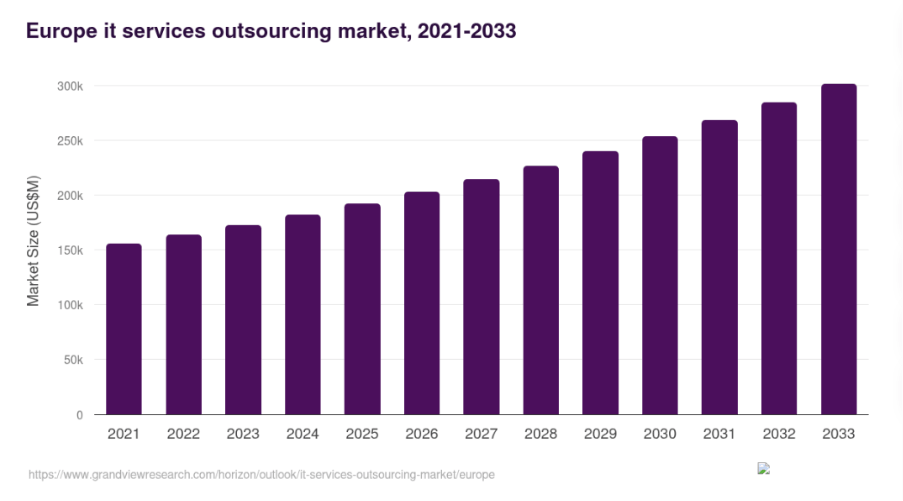
Source: GrandView Research
- The European IT services outsourcing sector brought in USD 192,694.9 million in revenue throughout 2025.
- Projections indicate the market will expand at a 5.79% CAGR starting from 2026 and extending through 2033.
- Application services stood out as the top revenue-generating segment during 2025.
- Emerging Technology Services represents the most lucrative category, anticipated to experience the quickest expansion across the forecast timeline.
- France is projected to achieve the highest CAGR among all countries from 2026 to 2033.
From Cost Savings to Strategic Partnerships
Software development outsourcing for European companies has changed. No longer do they look for cheap coders to be able to pay them off to do the work and take dictation. Instead, the foreign partners are to be Intelligent Software Engineering partners. They are to be able to solve complex problems and to work in tandem with the European developer, using the intelligent software engineering tools.
Many large European corporations that currently outsource software development to India are working within a foreign corporate ecosystem with hundreds of service providers, all with their own quality processes and certified delivery processes. As a result, cost will no longer be the primary driver for the European corporation for any software development outsourcing to India; instead, focus will shift to the value that the corporation can derive from the relationship with the selected service provider(s). In order to derive value from the relationship, the corporation and service provider(s) will develop a joint roadmap and evaluate suitable software outsourcing models that can support collaboration over several years.
Why India Continues to be Europe’s Preferred Offshore Destination
Today, India is a huge market of talented engineers from all over the globe. With millions of engineering graduates entering the workforce every year, there is no dearth of young and dynamic engineers in the country.
With a huge talent pool to draw from, India is well poised to handle large volumes of work in software development outsourcing for European companies. And, with a huge focus on practical application of computer science and related subjects, young engineers in India are well equipped to handle software development outsourcing for European companies.
There are ample benefits of outsourcing software development to India. Why?
Here are some of the core factors that continue to make India the number one outsourcing destination for software development.
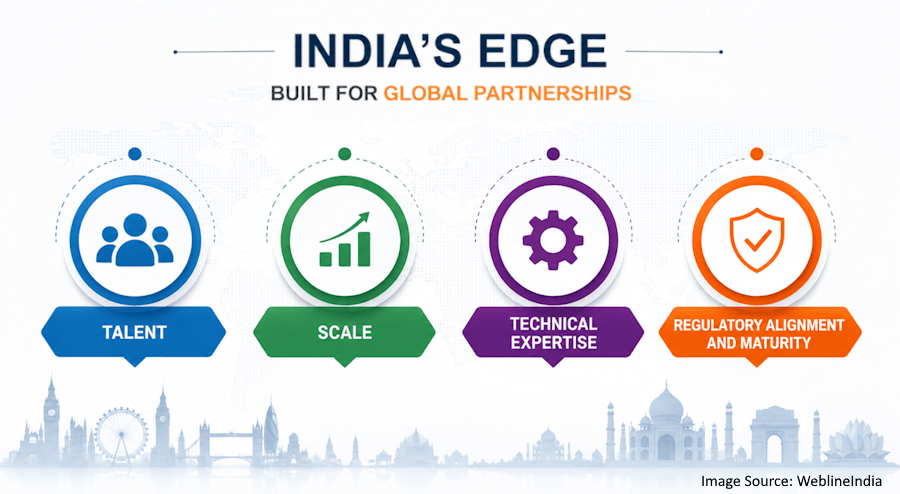
- Talent: Millions of engineering graduates enter the workforce every single year. Educational institutions across the country focus heavily on practical computer science principles, problem-solving, and emerging tech stacks, ensuring a continuous supply of fresh, highly adaptable minds ready to tackle complex corporate challenges.
- Scale: Large multinational companies have large in-house engineering capabilities, which can be scaled up or down to meet market demands. Thus, it is easy to find hundreds of certified developers within weeks, as opposed to months, through local recruitment processes in Europe.
- Technical Expertise: Indians, particularly the service providers, have started to upscale themselves to modern technology software outsourcing trends 2026. For example, AI and Machine Learning and have started to deliver end-to-end software development services, which enable foreign clients to include them in their core innovation teams and collaborate with them as intelligent software engineering partners to develop intelligent software products and solve complex business problems.
- Regulatory Alignment and Maturity: To serve clients globally, companies based in India have matured to meet international data security standards. Large companies have even set up Global Capability Centers (GCCs) in various parts of the country and thus enable organizations to set up centers in India and meet stringent European standards from anywhere in the world. Also, the delivery model enables 24/7 delivery from anywhere in the world.
Is India still the best outsourcing destination for Europe?
Lots of market analysts try to determine whether the advantages of nearshoring (e.g. proximity, local culture, easier communication) are greater than the advantages of offshoring (e.g. lower price, huge talent pool).
There are many reasons why European companies choose India for software development. Experience of working with IT companies from India allows a company to obtain a competitive edge in business. It will not be a problem to hire dedicated developers in India to quickly get used to new programming languages. So, they will be able to properly respond to any unexpected issues that may arise during the project development.
Nearshoring vs Offshoring: Eastern Europe or India?
European decision-makers often struggle to pick between local neighbors and distant nations. Both options offer unique advantages depending on the specific project goals.
Cost comparison
Financial efficiency remains a primary driver for corporate boardrooms. Eastern European nations offer competitive rates compared to Western Europe, yet local inflation pushes prices higher each year. Offshore software development in India delivers superior financial savings due to a lower cost of living and vast labor supply.
When we think of software development outsourcing, we basically think of a company being run by a Board of Directors – and cost is one of the most important factors when making a decision. In general, they check for the cost comparison: India vs Eastern Europe software development analysis, which may include the pros and cons of software development outsourcing costs for Eastern Europe and India.
Software development outsourcing to Eastern Europe has competitive costs compared to the rest of Western Europe, but these are constantly increasing as a result of high inflation. India software development outsourcing locations, on the other hand, have the lowest costs for software development in the world. There are millions of highly skilled and qualified engineers with high talent, and a low cost of living in India.
| Feature | Eastern Europe (Nearshore) | India (Offshore) |
| Average Hourly Rates | Moderate to High | Highly Competitive |
| Talent Pool Size | Medium | Massive |
| Time Zone Alignment | Close to Western Europe | Moderate offset |
| Ecosystem Maturity | Growing | Highly Established |
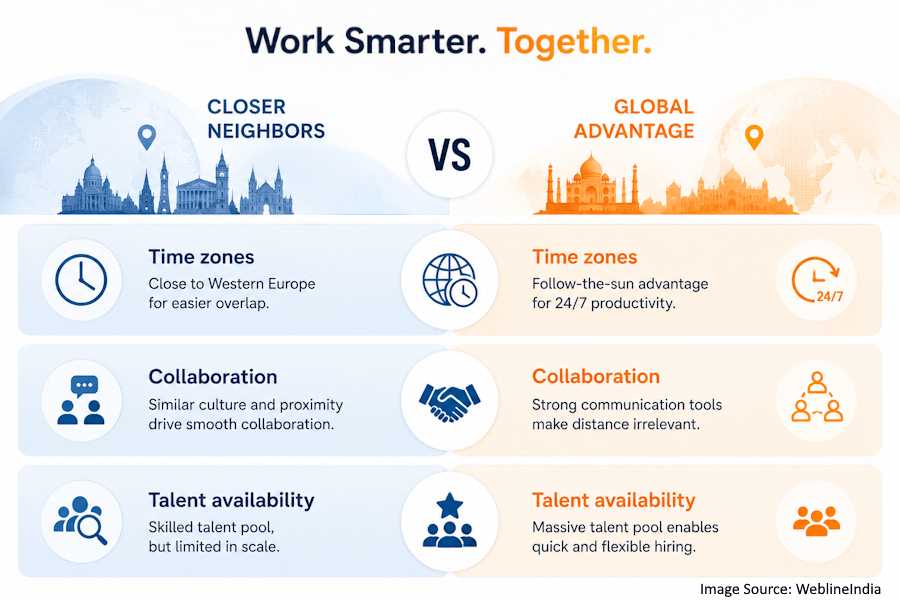
Time zones
This huge difference between nearshoring and offshoring the business processes of a company can be turned into a huge plus for successful companies. They are running their business 24/7 or follow-the-sun model, and their local teams review and test the work done by foreign teams overnight; they comment on it first thing in the morning.
Collaboration
Now, for collaboration, as we mentioned before, with today’s technology, communication is not a problem. Although various tools can pose cultural issues, with Indians, as they are the primary offshore providers, English is the lingua franca of business and computing, so as long as a company can communicate in English, that’s not a problem. The day-to-day interaction with clients and engineers is generally not a problem.
Talent availability
Local markets are struggling to fill positions of security experts and cloud architects. Even the talent pool of Eastern Europe is not big enough to fulfill the local demand. Large offshore software development hubs, on the other hand, have a massive pool of experts from which required talent can be deployed quickly.
Want to know if India is the right outsourcing destination for your next software project?
How AI is Reshaping Software Development Outsourcing
Artificial intelligence influences all levels of software development, starting from code generation to testing and validation. Routers and architects can thus focus on higher-level aspects of system design while AI handles all routine coding.
In testing, AI supports human engineers in bug detection and performance tuning. Thus, in Europe’s software outsourcing market, projects can now be completed much faster than before. As a result, foreign service providers integrate automated testing into their development pipelines, often alongside cloud and devops services, to detect errors before they can be deployed.
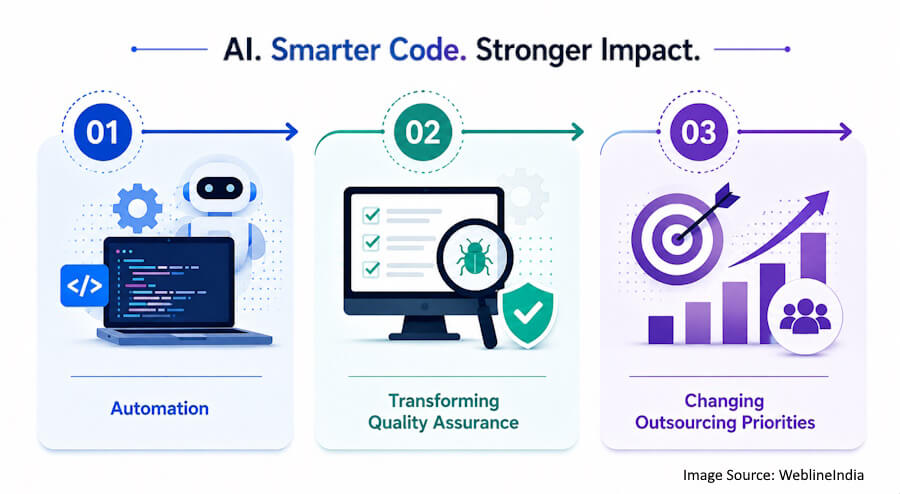
Automation
Another huge challenge in the technical departments of companies in Western and Northern Europe is the severe lack of qualified staff. Even the longest recruitment processes for specialized software developers are typically over in a few months.
Now, those companies involved in software development outsourcing in Europe are able to compensate for the lack of local staff by tapping into the huge pool of specialists from offshore software development houses. And thanks to generative coding assistants, the initial basic structure of a system can be set up in a matter of seconds. The architect of the system can then review it and go on to design the business logic of the system.
- Generative Coding Assistants: Platforms generate boilerplate components instantly.
- Rapid Talent Acquisition: Offshore houses bypass lengthy local recruitment cycles.
- Operational Velocity: Workflow speeds increase exponentially across project milestones.
- Reduced Friction: Automated scaffolding streamlines early project setup phases.
Transforming Quality Assurance
The testing that is done manually today is slow, causing additional delays and often even more defects. Modern software testing automation services, including autonomous validation tools, can test large volumes of code far faster than conventional manual testing. They can also find security holes that can be fixed before a hacker even uses them to cause harm. And many of the machine learning tools used by software development outsourcing companies located in Europe today are even configured to meet very strict data protection rules of companies located in Europe.
- Autonomous Validation: Tools scan millions of lines of code within minutes.
- Security Mitigation: Systems isolate vulnerabilities before malicious actors exploit them.
Changing outsourcing priorities
For a long time, intelligent agents have been used by client companies to support their employees on a daily basis in their work. In the meantime, work that is done by code has to be performed by means of automated tools quickly and correctly in order not to become outdated. Therefore, the top providers work with human expertise and very efficient machine learning tools in order to achieve the highest possible efficiency for their customers throughout the entire product life cycle.
- Value-Based Models: Fixed-price contracts give way to productivity metrics.
- Continuous Optimization: Buyers evaluate vendors based on automated velocity tools.
- Enterprise Expectations: Manual ticket resolution no longer satisfies modern corporate buyers.
- Strategic Partnerships: Vendors transition from simple staff augmentation to trusted innovation advisors.
- Efficiency Guarantees: Service agreements tie commercial value directly to output intelligence.
The Future of Collaborative Ecosystems
The future of software product engineering lies in collaborative ecosystems where machines handle repetitive syntax while humans concentrate on creative problem-solving and delivering intuitive user experiences. Hence, large offshore firms that are able to balance both would corner the majority of global market share.
- Syntax Automation: Machines handle repetitive code generation seamlessly.
- Human Creativity: Specialists focus on complex problem-solving.
- Market Dominance: Balanced firms capture major global shares.
When European Companies Should Choose India
Specific business scenarios demand robust offshore collaboration models. Certain projects benefit immensely from the scale found in the subcontinent.
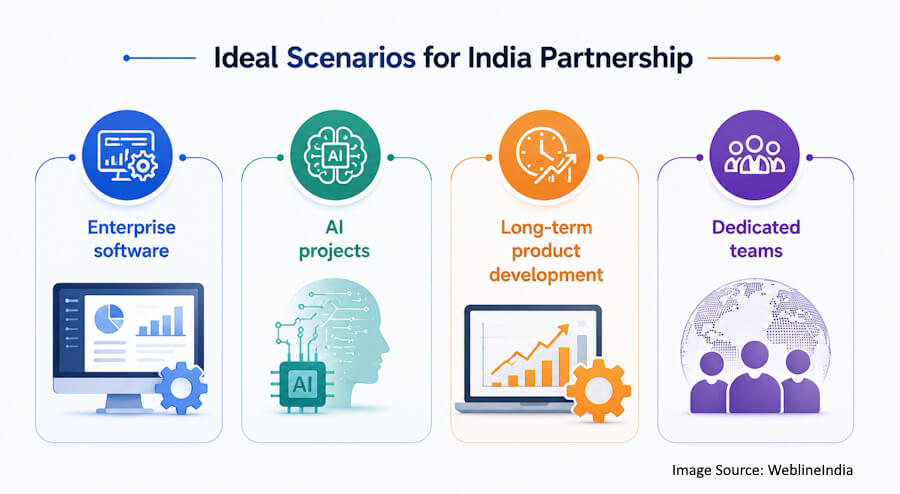
Enterprise software
Large-scale corporate platforms require extensive testing and security hardening, along with ongoing software maintenance services that can be efficiently managed through structured offshore collaboration.
AI projects
Implementing machine learning development services effectively requires specialized expertise from data scientists, software engineers, and cloud engineers. Many European companies choose to do software development in India for this very reason.
Long-term product development
Long-term product development requires ongoing innovation that can be managed efficiently using agile methods. If you want to set up a stable team of resources to develop your product over the long term, hiring Dedicated Developers in India would be the best option for you.
Dedicated teams
Dedicated teams are also the right model for companies who need to extend their in-house resources but do not have any locations in Europe. Dedicated teams function best as an integral part of the local organization.
Common Challenges and How to Mitigate Them
Working across a large area of the world to provide custom software development services to clients across the globe can pose a few challenges to the successful operation of a software outsourcing company. But these challenges can be easily managed with some foresight.
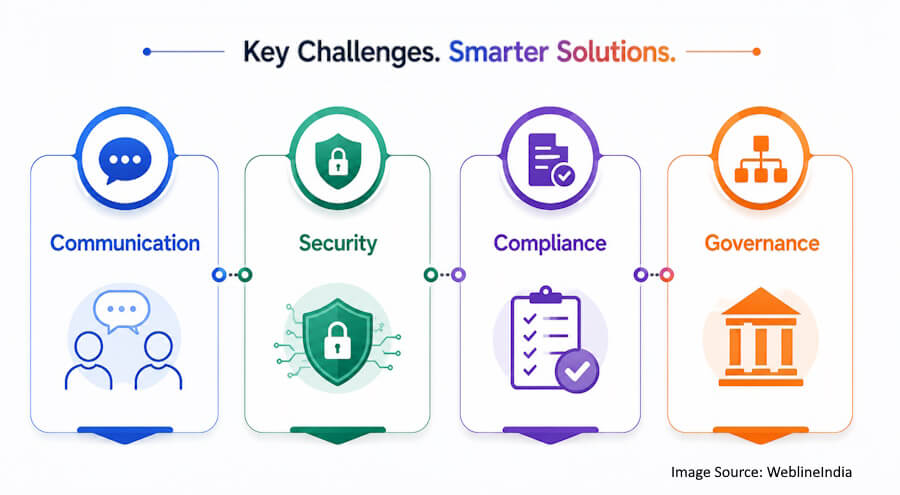
Communication
Unclear written requirements cause problems. Daily sync meetings prevent these kinds of problems and ensure successful collaboration.
Security
The Intellectual Property of a company is its biggest asset today. Thus, it is very critical for a company to choose the right vendor who can maintain the highest level of confidentiality and also store all the information in the most secure cloud environment. Also, it is good to have non-disclosure agreements in place to avoid any kind of risk.
Compliance
Most of the technology companies have to adhere to European data privacy regulations, such as the General Data Protection Regulation (GDPR). A good software vendor for outsourcing to deliver software to European clients will have a strict data handling policy and store data in secure cloud environments.
Governance
For the work of a partner to be tracked with a set of milestones, a company must have its Governance in place. It is also very critical for a company to have its Governance in place so that the work of a partner can be tracked with a set of Key Performance Indicators (KPIs).
Future Outlook: Software Outsourcing Beyond 2026
As far as the future of software outsourcing is concerned for the technology sector, which is evolving too fast with new technologies like Edge computing and quantum-ready cryptography coming into the market, there will be plenty of opportunities for digital transformation. This transformation would require support from technical experts and, hence, offshore software engineering partners.
In addition, there is a trend of “hyper-specialized engineering partnerships for software outsourcing” emerging, and companies across the globe would require specialized vendors for specialized services in various geos across the world.
Traditionally, the conventional vendor relationships have not served the requirements of modern enterprises. As enterprises are forming Strategic Partnerships with the vendors, they are seeking integrated solutions with proactive problem-solving by the vendors.
The strategic buyers, on the other hand, are not interested in mere labor arbitrage and are seeking technical expertise of professional software engineers to service the requirements of modern enterprises. The vendors based out of offshore locations would thus need to enhance the local educational frameworks on an ongoing basis.
- Advanced Capabilities: Vendors must master automated delivery pipelines and secure cloud ecosystems.
- Strategic Alignment: Long-term contracts reward providers who contribute directly to core product architecture.
- Adaptive Security: Strict compliance standards require robust data governance across international borders.
The global software market is rapidly moving towards the development of new capabilities and the running of projects in an agile manner. Technology hubs in South Asia and Eastern Europe are growing rapidly and are trying to service the requirements of client companies. However, there is a severe shortage of quality AI talent, and as a result, client companies are now open to adopting a blended delivery model. In this model, part of the project can be outsourced to overseas vendors while the rest of the work can be done by local talent.
More recently, the environmental sustainability of a vendor’s data centers as well as the sustainability of the code that a vendor writes have started to matter to companies.
In summary, the decade going ahead will be one of collaboration, learning, and treating the external technical partners as innovation catalysts to gain the necessary operational velocity in their businesses.
Conclusion
Deciding whether ‘should European companies outsource software development to India in 2026?’ requires a careful look at current market realities. The combination of unmatched scale, technical depth, and competitive pricing makes the subcontinent an ideal choice.
Now, finding the best software outsourcing partner for European companies determines ultimate project success. Enterprises must evaluate potential vendors based on transparency, past performance, and adaptability.
When searching for a reliable software outsourcing company, look no further than WeblineIndia. Operating as a premier offshore software development partner since 1999, WeblineIndia helps global businesses scale through innovative solutions. Their unique approach combines human expertise with artificial intelligence to deliver exceptional web, mobile, and enterprise applications.
WeblineIndia focuses on your core business goals while managing technical execution smoothly; hence, this AI offshore company stands out as the ultimate answer on how to choose an offshore software development company in India.
Ready to work with an experienced Indian development partner for your European business?
Frequently Asked Questions
Is outsourcing software development to India still worth it in 2026?
Outsourcing to India remains highly valuable because the country offers massive tech talent pools. Businesses gain scalable engineering teams quickly without heavy local hiring overhead.
Why do European companies outsource software development to India?
European firms rely on Indian tech hubs for cost efficiencies and round-the-clock productivity. Companies like WeblineIndia deliver robust enterprise solutions that accelerate digital transformation goals seamlessly.
Is India cheaper than Eastern Europe for software development?
Indian development rates are typically lower than Eastern European averages. This pricing advantage allows startups to stretch their budgets further for larger project scopes.
How has AI changed software outsourcing?
Generative tools now automate routine coding tasks and speed up delivery cycles. Developers spend more time on complex architecture rather than repetitive writing.
What are the risks of outsourcing software development to India?
Common challenges involve time zone differences and potential communication bottlenecks. Strong project management practices and clear milestones easily mitigate these operational hurdles.
When should companies choose nearshoring instead of offshoring?
Nearshoring suits projects requiring constant real-time meetings and overlapping working hours. Offshoring works better for asynchronous tasks and large-scale dedicated development teams.
Which industries benefit the most from outsourcing to India?
Financial services and healthcare sectors leverage external teams heavily for modern apps. Retail and logistics companies also utilize offshore developers to scale rapidly.
How do I choose the right software development partner in India?
Review past client testimonials and inspect technical portfolios before signing contracts. Ensure the vendor maintains transparent communication channels and proven data security standards.
Globally Recognized for Unmatched Quality and Reliability




Testimonials: Hear It Straight From Our Global Clients
Our development processes delivers dynamic solutions to tackle business challenges, optimize costs, and drive digital transformation. Expert-backed solutions enhance client retention and online presence, with proven success stories highlighting real-world problem-solving through innovative applications. Our esteemed Worldwide clients just experienced it.
Awards and Recognitions
While delighted clients are our greatest motivation, industry recognition holds significant value. WeblineIndia has consistently led in technology, with awards and accolades reaffirming our excellence.

OA500 Global Outsourcing Firms 2025, by Outsource Accelerator

Top Software Development Company, by GoodFirms

BEST FINTECH PRODUCT SOLUTION COMPANY - 2022, by GESIA

Awarded as - TOP APP DEVELOPMENT COMPANY IN INDIA of the YEAR 2020, by SoftwareSuggest