The Headless Revolution: Why Your Next Ecommerce Outsource Partner Needs to Think Beyond Templates
Headless commerce is changing how brands build faster, flexible, and scalable online stores. See why the right eCommerce outsourcing partner must think beyond templates.


 ChatGPT
  Perplexity
 The template-first eCommerce trend is now fading. Brands that used to rely on powerful storefront themes and plugin-heavy ecosystems today find it difficult to keep up with highly volatile user expectations and omnichannel experiences. AI-driven personalization and rapidly changing digital commerce are in, and enterprises are heading to outsource eCommerce development to have more flexible, scalable, and composable architectures.
Headless commerce is trending today, and your eCommerce outsource partner should think beyond templates.
If you are planning to hire eCommerce developers, you must choose the right architecture because it is not just a good technical decision; rather, it is a growth decision. Whether you are in need of multi-channel selling, enhanced performance, future-ready integrations, and personalized user experience for your customers, your ability to scale utterly hinges on whether your outsourcing eCommerce partner understands the market beyond prebuilt templates.
The present-day enterprises prioritize API-first commerce ecosystems, modular infrastructure, and decoupled frontends to get an edge in the competitive global market. According to industry research cited on Shopify, businesses that adopt headless commerce are likely to accelerate release cycles, improve scalability, and improve omnichannel experiences.
Is your eCommerce store struggling with slow templates, plugin overload, and limited flexibility?
What is headless commerce?
In simple language, headless commerce separates the frontend presentation layer from the backend commerce engine. The ‘head’ is what users see, and it operates independently from the commerce logic that powers inventory, checkout, pricing, fulfillment, and customer data.
Traditional eCommerce platforms tightly hold frontend templates and backend systems. Hence, you observe certain limitations in that:
- Plugin dependency overload
- Slow updates in designs
- Reduced UX flexibility
- Performance bottlenecks
- Limited omnichannel expansion
Headless architecture addresses these issues through APIs. Instead of forcing eCommerce developers into using predefined templates, headless systems enable teams to develop entirely customized customer experiences through modern frontend frameworks such as Next.js, Angular, React, or Vue. However, during this, the backend commerce engine is kept intact.
This is the reason enterprises increasingly outsource eCommerce development to teams capable of building custom frontend experiences, as compared to those teams that just configure themes.
Why eCommerce templates are seen as business liabilities
ECommerce templates once helped businesses launch faster during the early growth of eCommerce sector. However, modern digital eCommerce demands much better solutions because buyers’ expectations have changed. What is needed today:
- Personalized experience in eCommerce
- Mobile-first interactions and transactions
- Voice and social commerce compatibility
- Instant page loading
- AI-powered recommendations
- Regionalized content experience
- Seamless cross-device shopping
Ecommerce templates struggle to support all these demands at scale. In addition, many businesses discover that once they begin customizing rapidly, they are actually loading their platforms with innumerable plugins, which results in conflicting dependencies and technical debt. Hence, innovation would slow down because every frontend change would bring risks of breaking backend functions. This has become one of the primary reasons why companies now see custom eCommerce solutions and not off-the-shelf storefronts. Research from Shopify highlights that headless commerce can get you flexible, agile, and personalized omnichannel commerce with scalability.
The rise of composable commerce
Headless commerce quietly evolves into composable commerce. While headless separates frontend and backend, composable commerce pushes modularity further and allows enterprises to freely select and integrate special services like:
- PIM
- CRM
- CMS
- Search engine
- Checkout
- Analytical tools
- Loyalty platforms
- Recommendation engines
- Payment systems
Instead of a monolithic platform that controls everything, enterprises blend a best-of-breed ecosystem customized to their business objectives. Such flexibilities reshape how modern enterprises evaluate an eCommerce development company. An ideal eCommerce development company would not just another shopify development agency; it would architect scalable digital commerce ecosystems.
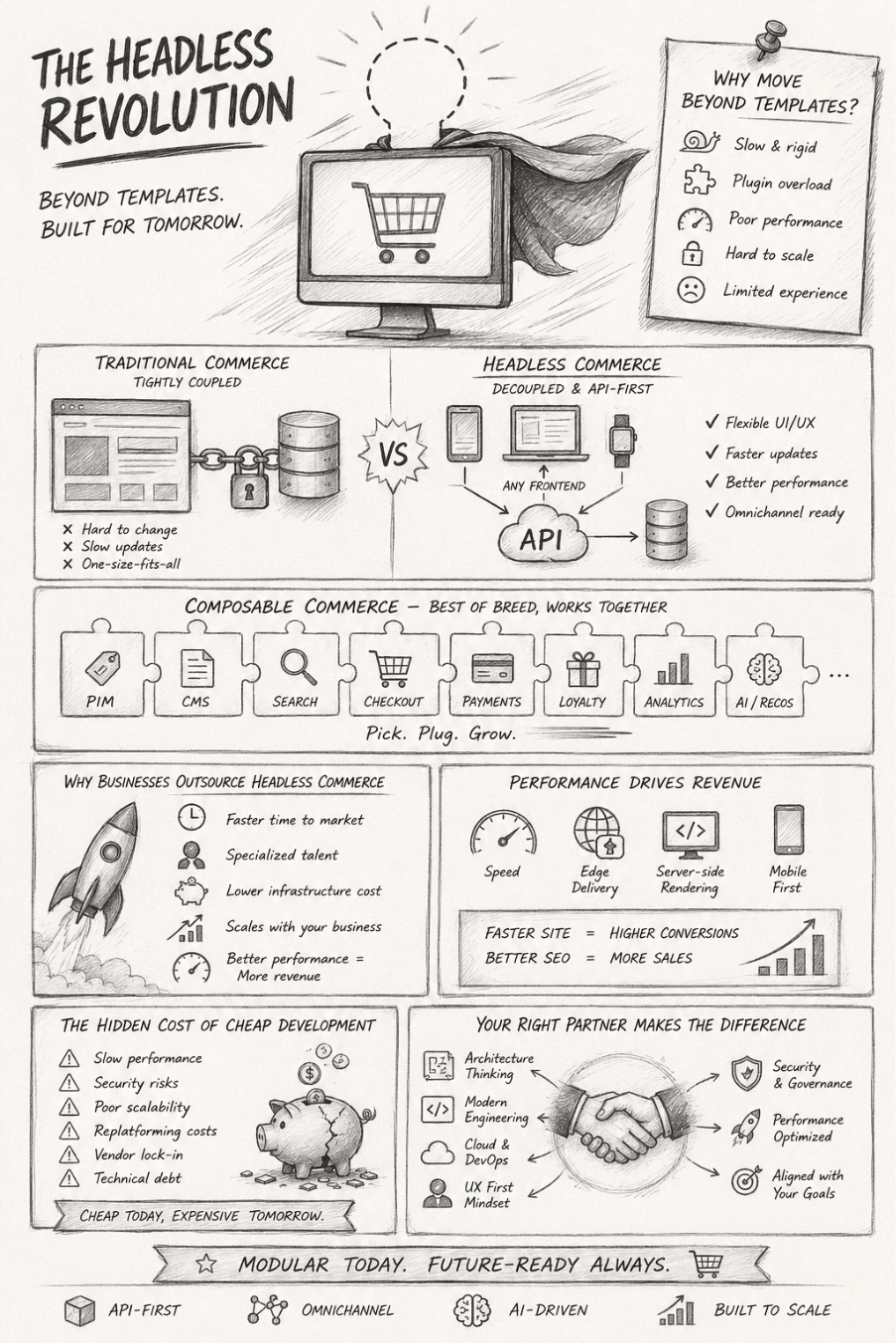
Why do businesses outsource headless commerce development
If you want to hire eCommerce developers, you must ensure that they build modern commerce systems with the following factors, at least:
- DevOps
- Frontend engineering
- API architecture
- UX strategy
- Cloud infrastructure
- Security governance
- Integration engineering
- Performance optimization
Most enterprises find it difficult to maintain these skills under one roof. As a result, they increasingly outsource eCommerce development to a renowned company offshore or an outsourced team with experience in headless commerce and composable ecosystem development. The outsourcing market here has the upper hand, providing good advantages:
Faster time to market
Composable and headless architecture makes parallel frontend and backend development, and, therefore, teams can deploy more quickly without waiting for monolithic release cycles. Some businesses opine that they get 30-50% faster development cycle after having a composable architecture.
Specialized headless eCommerce talent
A modern eCommerce development company has standard practices such as API integration, commerce engine optimization, and modern framework usability to get the top eCommerce solutions at affordable costs.
Low infrastructure costs
Outsourcing eCommerce solutions to offshore companies reduces recruitment overhead. When you hire eCommerce developers offshore, you get rid of DevOps complexities and long-term maintenance challenges.
Scalability
A custom eCommerce solution is possible when you outsource your project to a renowned eCommerce development company offshore. You can ask for scalable solutions so that when your business evolves, you can rapidly scale engineering capacity without facing delays in internal recruitment and training.
Excellent performance is also revenue
Your eCommerce portal should have a tremendously short loading speed. It is not just a technical achievement, but the first step to conversion. SEO visibility, ad performance, and customer retention heavily depend on page load speed. When you outsource eCommerce development to offshore companies, they make sure of this.
Outsource eCommerce development to a partner who understands the following optimizations because they are not a template-level task, they require architecture-level experience:
- API caching
- Edge rendering
- Core Web Vitals
- Server-side rendering
- CDN delivery
- Progressive web applications
- Mobile responsiveness
Want to outsource eCommerce development to a team building scalable and API-first shopping experiences?
The hidden cost of cheap eCommerce development
Many enterprises initially focus only on the eCommerce website development cost. While budget matters, low upfront pricing generally conceals expensive long-term consequences. Here are some of the concerns when only low costs are considered to outsource eCommerce development:
- Slow performance
- Security vulnerabilities
- Poor scalability
- Limited customization
- Replatforming costs
- Vendor lock-in
- Plugin dependency issues
- Technical debt
Cheap eCommerce development becomes terribly expensive when businesses outgrow their architecture. Research that compares composable and headless commerce consistently highlights how scalable and operational flexibilities can bring down the long-term ownership costs, though there were high initial implementation investments.
Headless commerce is not for everyone
Despite the usefulness, headless commerce is not for all businesses. They don’t need a fully composable ecosystem. Smaller businesses with restricted technical know-how may succeed with optimized traditional platforms. In fact, there are many industry experts who opine that overengineering commerce architecture may harm you prematurely.
Hence, you need to have a balanced offshore eCommerce development company who help you determine whether you need:
- Traditional commerce
- Full composable architecture
- Headless-on-platform
A professional eCommerce development company does not sell complexity for the sake of revenue or trends. They align architecture with your business scale to meet operational readiness and growth strategy. The most effective approach generally lies in headless-on-platform models. Here, enterprises enjoy flexibility in the frontend while retaining flawless operations of established commerce platforms.
Artificial intelligence is accelerating a headless technology
AI is remarkably improving and reshaping digital commerce. Modern commerce experiences are now heavily dependent on:
- Voice commerce
- Dynamic pricing
- Predictive search
- AI-powered personalization
- Visual search
- Conversational commerce
- Smart recommendation
- Predictive search
- Dynamic pricing
- Automated merchandising
Traditional eCommerce templates struggle to support such advanced integrations with ease. Hence, headless architecture powered by AI is used. However, they are API driven and hence make AI integration easier. Emerging industry trends show that businesses are now embedding Artificial Intelligence into a composable eCommerce system for real-time assistance, predictive analysis, and intelligent shopping. AI is becoming central to digital commerce; enterprises that rely more on templates might fall behind.
WeblineIndia is your eCommerce outsourcing partner
Not every vendor claims headless expertise. But when you hire eCommerce developers offshore, WeblineIndia is the right answer to your needs. We are a renowned offshore eCommerce development company with proven expertise in:
- API-first development: modern commerce depends a lot on API orchestration throughout the systems
- Frontend engineering: we practice modern frontend frameworks such as React, Vue, and Next.js
- Performance optimization: frontend speed directly affects conversion and SEO, which we take care of
- Commerce platform experience: We understand your business objectives and can help you build Shopify Plus, BigCommerce, Magento, Adobe Commerce, commercetools, and other enterprise ecosystems
- DevOps and cloud infrastructure: We help you build scalable commerce with cloud-native deployment strategies
- UX strategy: Technology alone helps you achieve business objectives less. We put user experience in place for all your eCommerce development projects
- Long-term architecture thinking: We do not solely focus on launch speed; rather, we think about scalability for long-term success through our eCommerce development
The future of eCommerce is modular. Digital commerce is taking newer shapes every day. Hire eCommerce developers from us, and we will help you get custom eCommerce solutions that are modular, composable, omnichannel, AI-driven, and API-first.
Social Hashtags
#HeadlessCommerce #ComposableCommerce #EcommerceDevelopment #EcommerceOutsourcing #DigitalCommerce #AIInEcommerce #ModernCommerce #WeblineIndia
Ready to move beyond basic storefront themes and build a faster, future-ready commerce platform?
Frequently Asked Questions
Globally Recognized for Unmatched Quality and Reliability




Testimonials: Hear It Straight From Our Global Clients
Our development processes delivers dynamic solutions to tackle business challenges, optimize costs, and drive digital transformation. Expert-backed solutions enhance client retention and online presence, with proven success stories highlighting real-world problem-solving through innovative applications. Our esteemed Worldwide clients just experienced it.
Awards and Recognitions
While delighted clients are our greatest motivation, industry recognition holds significant value. WeblineIndia has consistently led in technology, with awards and accolades reaffirming our excellence.

OA500 Global Outsourcing Firms 2025, by Outsource Accelerator

Top Software Development Company, by GoodFirms

BEST FINTECH PRODUCT SOLUTION COMPANY - 2022, by GESIA

Awarded as - TOP APP DEVELOPMENT COMPANY IN INDIA of the YEAR 2020, by SoftwareSuggest