How to Build a Custom LLM for Your Business
Learn how to build a custom LLM for your business with a step-by-step approach covering data preparation, foundation model selection, fine-tuning, RAG, infrastructure, deployment, security, costs, and enterprise use cases.


 ChatGPT
  Perplexity
 Building a custom LLM for your business involves identifying specific use cases, preparing relevant data, selecting the right model architecture, and implementing effective training and testing processes. A tailored LLM can improve automation, efficiency, customer experiences, and decision-making across business operations.
What is a Custom Large Language Model (LLM) and Why Do Businesses Need One?
Standard foundational artificial intelligence models serve broad public queries. These generic models lack specific operational context. Organizations struggle with accuracy gaps. Generic systems hallucinate corporate facts. Companies require specialized domain knowledge. Custom LLM Development bridges this exact gap. Proprietary data remains internal. Security protocols restrict external data leakage. Organizations build an enterprise LLM to process sensitive documents.
Custom AI development services target specific workflows. Employees upload internal technical manuals. The system learns proprietary terminology instantly. Large Language Model Development involves heavy parameter tuning. Businesses shift from public tools to secure infrastructure. Private LLM deployments guarantee data isolation. Financial institutions process confidential filings safely. Healthcare providers protect patient records meticulously.
Standard models fail technical queries. Custom GPT development addresses niche verticals. Organizations utilize AI model development to automate complex writing tasks, including solutions such as an AI-powered email content generator. Enterprise AI models understand internal metrics. Companies adopt open-source LLM solutions to retain code ownership. This approach eliminates third-party subscription fees. Proprietary weights stay on local servers. High operational control empowers internal engineering squads. AI infrastructure demands powerful compute clusters. Engineers configure distributed processing nodes.
We believe that in the future, the vast majority of organizations will develop customized models that are personalized to their industry, business, or use case.
— OpenAI
Key Benefits of Building a Custom LLM for Enterprise Business Applications
Building a custom Large Language Model (LLM) empowers organizations to retain proprietary data security, drastically reduce hallucinations through domain-specific fine-tuning, and seamlessly automate complex internal workflows.
Let’s understand why tailoring an AI model specifically to your organizational data unlocks unmatched operational efficiency and a true competitive edge in modern enterprise environments.
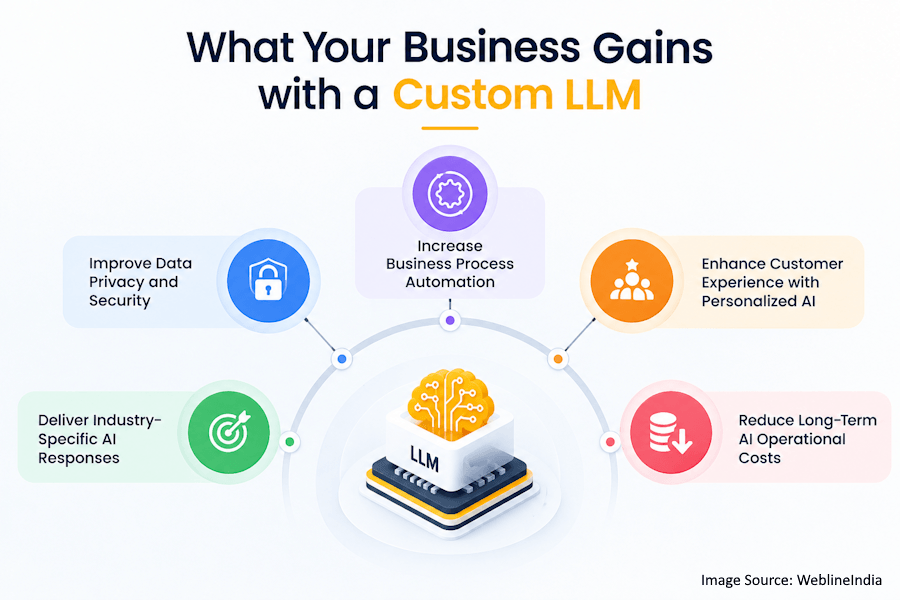
Improve Data Privacy and Security
Public artificial intelligence platforms store user inputs. External servers ingest proprietary corporate secrets. Businesses face severe regulatory penalties. Custom AI model development services eliminate public cloud risks. Data stays inside local data centers. Security teams encrypt information at rest. Employees share confidential reports safely. Compliance officers enforce strict access controls. Private LLM development secures intellectual property.
- Corporate servers store prompt logs locally.
- External API providers never see internal data.
- Security engineers configure strict firewall rules.
Deliver Industry-Specific AI Responses
Generic models misunderstand technical jargon. Specialized domains demand precise vocabulary. Custom LLM development services train models on niche datasets. Engineers use fine tune an LLM for business accuracy. Legal firms upload case law archives. Medical researchers process clinical trial notes. The system outputs correct terminology.
- Legal databases feed specialized training pipelines with historic documents.
- Medical journals improve clinical query accuracy for hospital diagnostics.
- Engineering teams integrate blueprints to guide technical reasoning engines.
Increase Business Process Automation
Manual document sorting drains human hours. LLMs can also complement business process automation services by supporting workflows such as document processing, ticket routing, and information extraction. Systems route incoming support tickets instantly. Enterprise AI development services can support architectures designed to keep sensitive business data within controlled environments. Algorithms extract data from unstructured invoices. Enterprise AI models execute multi-step business logic.
- Automated invoice processing saves accounting departments hundreds of manual hours every single month.
- Support chatbots resolve technical tickets instantly by referencing internal troubleshooting wikis.
- Logistics systems parse shipping manifests automatically to update inventory databases.
- Data entry errors drop significantly across enterprise departments.
Enhance Customer Experience with Personalized AI
Generic responses frustrate buyers. Buyers demand contextual assistance. Business AI model development integrates customer history databases. The platform recalls past purchases. Support agents resolve issues faster. Brand loyalty increases steadily.
- Recommendation engines analyze past purchase behavior to suggest relevant merchandise items.
- Chatbots reference individual customer subscription tiers to provide accurate account tier support.
Reduce Long-Term AI Operational Costs
External API tokens accumulate high fees. High-volume enterprise traffic increases monthly bills. Companies train their own language model to bypass per-token charges. Fixed hardware costs replace variable API billing. Organizations manage budgets predictably.
- Fixed infrastructure costs replace scaling API bills during high traffic periods.
- High query volumes run cheaper on local enterprise GPUs over time.
- Internal teams optimize inference speeds independently without third-party platform limitations.
- Resource allocation matches exact business demand peaks efficiently.
Turn your business data into a secure, domain-specific AI solution built around your workflows, users, and enterprise requirements.
Custom LLM vs Pre-Trained LLM: Which AI Model Is Right for Your Business?
Pre-trained models provide immediate, cost-effective capabilities for general tasks, whereas custom models deliver unmatched security and precision tailored precisely to your unique industry jargon.
Let’s dive into a comprehensive comparison to determine which strategic path aligns best with your long-term business goals.
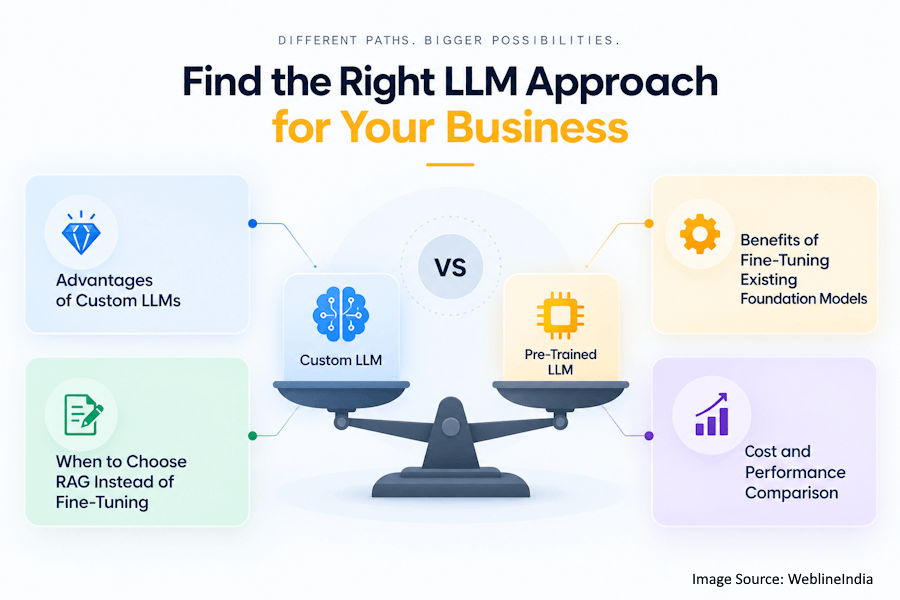
Advantages of Custom LLMs
Organizations own their model weights. Engineers modify neural network layers directly. Custom LLM Development provides unmatched architectural control. Proprietary algorithms protect competitive advantages. Security policies enforce zero-data-retention rules. Performance matches exact enterprise workloads.
- Total ownership prevents vendor lock-in traps and arbitrary pricing changes.
- Fine-tuning parameters adapt to niche industrial domains with high precision.
- Inference speed optimizes for specific hardware configurations in local data centers.
Benefits of Fine-Tuning Existing Foundation Models
Building from scratch costs millions. AI model fine tuning services can reduce the need for training from scratch by adapting existing foundation models to domain-specific requirements. Existing models provide strong baseline grammar. Domain datasets adapt the pre-trained weights. Training cycles finish within days. Engineers leverage open source LLM development frameworks.
- Pre-trained weights provide fast baseline competence without extensive scratch training.
- Computational expenses stay lower than full multi-million dollar training runs.
- Specialized datasets redirect general reasoning capabilities toward specific business tasks.
- Development timelines shrink from years to weeks.
When to Choose RAG Instead of Fine-Tuning
Training changes core model weights. Retrieval-Augmented Generation leaves weights untouched. Companies update external knowledge bases daily. RAG systems fetch documents dynamically. Engineers choose RAG for frequently changing wikis. Development costs remain minimal.
- Dynamic document updates require zero retraining cycles or weight updates.
- External vector databases store live company wikis for instant retrieval.
Cost and Performance Comparison
Custom architectures demand massive computing clusters. Foundation fine-tuning requires moderate GPU rentals. RAG architectures rely on fast vector searches. Financial planners calculate exact return on investment. Performance benchmarks dictate architectural selection.
- Custom pre-training incurs multi-million-dollar computational bills for raw training runs.
- Fine-tuning requires modest cloud GPU budgets for adapter weight updates.
- RAG implementations optimize database storage costs while maintaining high factual accuracy.
- Latency metrics guide final production deployment choices across different business units.
Step-by-Step Process to Build a Custom LLM for Your Business
Building a custom LLM involves defining specific business use cases, gathering and cleaning proprietary data, selecting the right base model, fine-tuning through specialized training, and rigorously evaluating performance before secure enterprise deployment.
Let’s explore each phase in detail to see how this structured roadmap ensures your AI implementation succeeds seamlessly.
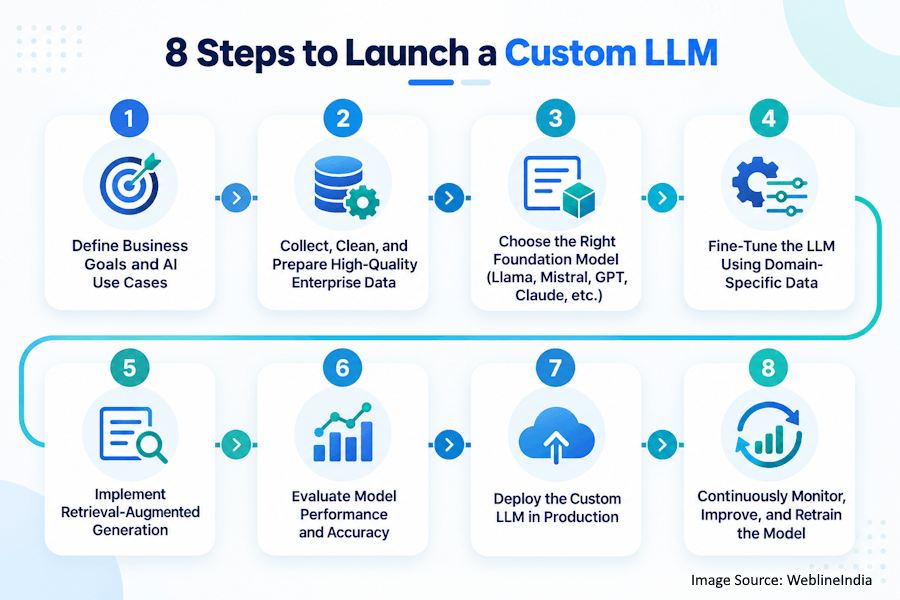
Define Business Goals and AI Use Cases
Executives outline exact operational bottlenecks. Engineers isolate repetitive manual tasks. Project managers define success metrics. Clear targets prevent wasted computing resources. Stakeholders review alignment documents thoroughly.
Collect, Clean, and Prepare High-Quality Enterprise Data
Raw corporate data contains formatting errors. Engineers scrub duplicate records ruthlessly. Text parsers remove sensitive personal identifiers. Clean datasets feed training pipelines. High data quality ensures reliable outputs.
- Data engineers extract raw text from legacy enterprise databases.
- Automated scripts remove corrupted character encodings from documents.
- PII scrubbing protects internal employee privacy before training begins.
- Formatted JSON files organize training samples properly for models.
Choose the Right Foundation Model (Llama, Mistral, GPT, Claude, etc.)
Model selection dictates downstream success. Engineers test multiple base architectures. Open weights offer local deployment freedom. Proprietary models provide strong reasoning baselines. Licensing agreements dictate commercial usage rights.
- Benchmark tests evaluate baseline reasoning speeds across various candidate models.
- Licensing terms permit commercial enterprise deployment without legal risks.
Fine-Tune the LLM Using Domain-Specific Data
Specialized adapters modify model behavior, while machine learning development services can support the broader training, validation, and model-engineering workflow. Loss curves decline during epoch iterations. Engineers validate outputs against test sets. Final weights save to secure repositories.
- LoRA adapters minimize active training parameter counts during fine-tuning.
- GPU clusters process terabytes of domain text efficiently.
- Loss metrics track convergence rates during model training epochs.
Implement Retrieval-Augmented Generation
Text splitters chunk long enterprise reports. Embedding models convert text into vectors. Vector databases index semantic information. Search algorithms retrieve relevant document context. Prompts combine retrieved facts with queries.
- Text chunking divides large manuals efficiently into smaller segments.
- Embedding models translate words into numerical vectors for indexing.
- Vector databases store multi-dimensional semantic indices for fast queries.
- Context injection grounds model responses in verified facts.
Evaluate Model Performance and Accuracy
Automated testing scripts measure response quality. Human reviewers grade subjective outputs. Benchmark suites test reasoning limits. Security filters test for prompt injection vulnerabilities. Poor scores trigger immediate retraining.
- Automated evaluation scripts run benchmark test suites against outputs.
- Human experts grade domain accuracy manually for qualitative review.
Deploy the Custom LLM in Production
DevOps services can support the provisioning of cloud inference servers, deployment pipelines, and scalable production environments for custom LLMs. Load balancers distribute incoming user traffic. API endpoints connect internal applications. Monitoring tools track system health. Production environments ensure high availability.
- Kubernetes clusters scale inference nodes automatically during traffic surges.
- API gateways manage enterprise user authentication tokens securely.
- Load balancers distribute heavy request traffic smoothly across servers.
- Fallbacks prevent unexpected system downtime events during maintenance.
Continuously Monitor, Improve, and Retrain the Model
User feedback highlights operational failures. Logging pipelines capture incorrect responses. Data scientists curate new training samples. Scheduled retraining updates model weights. Enterprise systems evolve with business needs.
- Feedback buttons capture user rating metrics instantly after generation.
- Logging systems flag recurring hallucination events for review.
- Data pipelines ingest newly updated corporate policies weekly.
- Scheduled retraining cycles keep intelligence current with markets.
Ready to turn your LLM roadmap into a production-ready solution? Our AI engineers can help you build, fine-tune, deploy, and scale it.
Choosing the Best Foundation Model for Custom LLM Development
Selecting an optimal foundation model requires balancing crucial parameters such as computational overhead, architectural license constraints, domain baseline performance, and inference latency requirements against your organization’s specific technical constraints.
Let’s analyze how to systematically evaluate these architectural variables to identify the model that maximizes both capability and cost-efficiency.
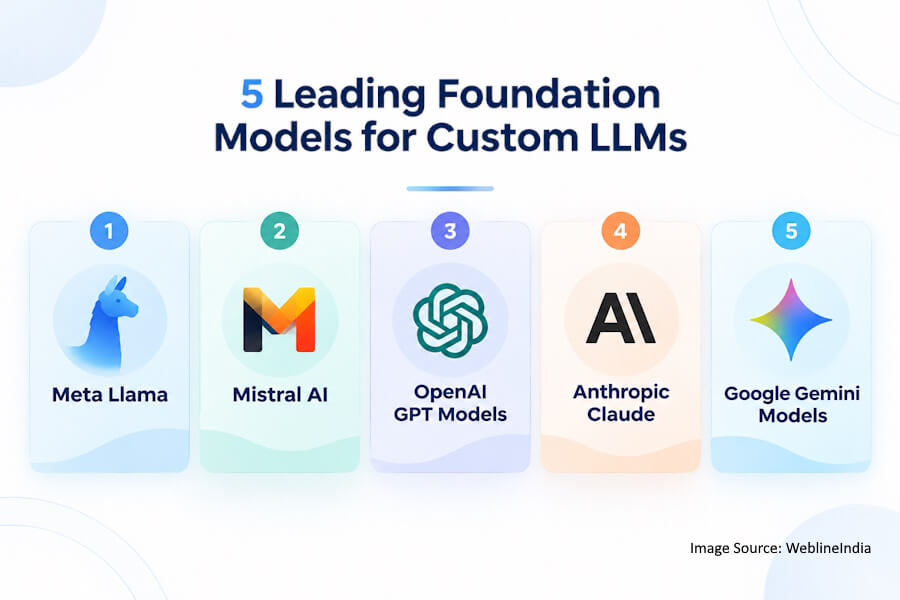
Meta Llama
Open weights attract enterprise developers. Local deployment guarantees data security. Fine-tuning Llama models requires standard hardware. Community forums provide extensive troubleshooting guides.
- Open source weights permit localized server deployment behind firewalls.
- Parameter sizes scale from small to massive enterprise configurations.
Mistral AI
European engineering drives high efficiency. Compact models deliver rapid inference speeds. Enterprise clients license proprietary weight variants. Architecture designs optimize memory consumption.
- Efficient architecture reduces operational computing overhead significantly.
- Compact model sizes accelerate response generation times for users.
- Strong reasoning benchmarks rival larger industry competitors.
- Flexible licensing suits diverse commercial business structures.
OpenAI GPT Models
Proprietary APIs offer powerful reasoning baselines. Developers avoid managing infrastructure clusters. Regular updates introduce advanced feature sets. Privacy policies protect enterprise customer data.
- Managed APIs eliminate infrastructure maintenance tasks for internal teams.
- Advanced reasoning handles complex logic problems easily without tuning.
Anthropic Claude
Long context windows process entire books. Safety guardrails minimize toxic outputs. Enterprise clients integrate secure API endpoints. Financial analysts parse large spreadsheets directly.
- Massive context windows ingest complete codebases and dense reports.
- Built-in constitutional safety reduces harmful or toxic outputs.
- Document parsing extracts structured data from dense financial pages.
Google Gemini Models
Multimodal capabilities process text and video. Cloud infrastructure integrates native AI tools. Enterprise search capabilities connect internal drives. Scalable architectures handle heavy workloads.
- Native multimodality processes images and video streams directly.
- Google Cloud integration simplifies enterprise deployment pipelines.
Infrastructure and Technology Stack Required for Custom LLM Development
Developing a robust custom LLM demands high-performance computing clusters equipped with specialized GPUs, scalable data pipelines, enterprise orchestration frameworks, and secure vector databases for retrieval-augmented generation.
Let’s examine the essential technical architecture required to power your enterprise AI infrastructure effectively.
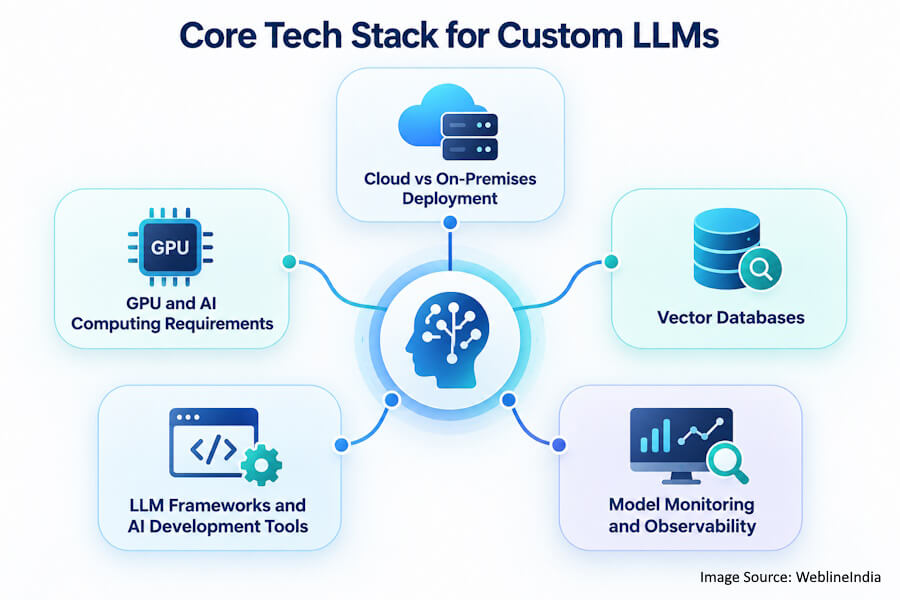
Cloud vs On-Premises Deployment
Cloud providers offer elastic GPU scaling. On-premises servers protect highly classified secrets. Financial regulations dictate hardware placement rules. Hybrid architectures balance cost and security.
GPU and AI Computing Requirements
Deep learning demands specialized accelerator chips. High VRAM capacity loads large models. Interconnect speeds accelerate distributed training tasks. Power consumption drives data center budgets.
- NVIDIA H100 clusters accelerate model training times drastically.
- High VRAM capacities load massive parameter weights safely.
- High-speed interconnects link multiple training nodes without latency.
Vector Databases
Embeddings require specialized storage solutions. Similarity searches retrieve matching document chunks. Scalable architectures handle billions of vectors. Indexing speed impacts query latency.
- Pinecone manages cloud-native vector search indices efficiently.
- Milvus scales across distributed local server clusters seamlessly.
- Qdrant handles rapid metadata filtering operations during search.
LLM Frameworks and AI Development Tools
Python libraries simplify pipeline construction. Orchestration tools chain complex agent steps. Quantization packages reduce model memory footprints. Containerization tools standardize deployment environments.
- LangChain orchestrates complex multi-step artificial intelligence agent workflows.
- LlamaIndex connects external documents to models for RAG.
Model Monitoring and Observability
Metrics track token consumption rates. Error logging exposes prompt failure points. Drift detection spots declining accuracy trends. Security scanners block malicious inputs.
- Grafana dashboards display real-time system resource usage metrics.
- Logging tools capture user prompt error traces for analysis.
- Drift monitors alert engineers to performance drops.
- Security filters block unauthorized prompt injection attempts.
Common Challenges in Custom LLM Development and How to Overcome Them
Custom LLM development often introduces hurdles like soaring computational expenses, data privacy risks, catastrophic forgetting during fine-tuning, and managing model drift over time.
Let’s uncover the proven mitigation strategies required to successfully navigate these common technical roadblocks.
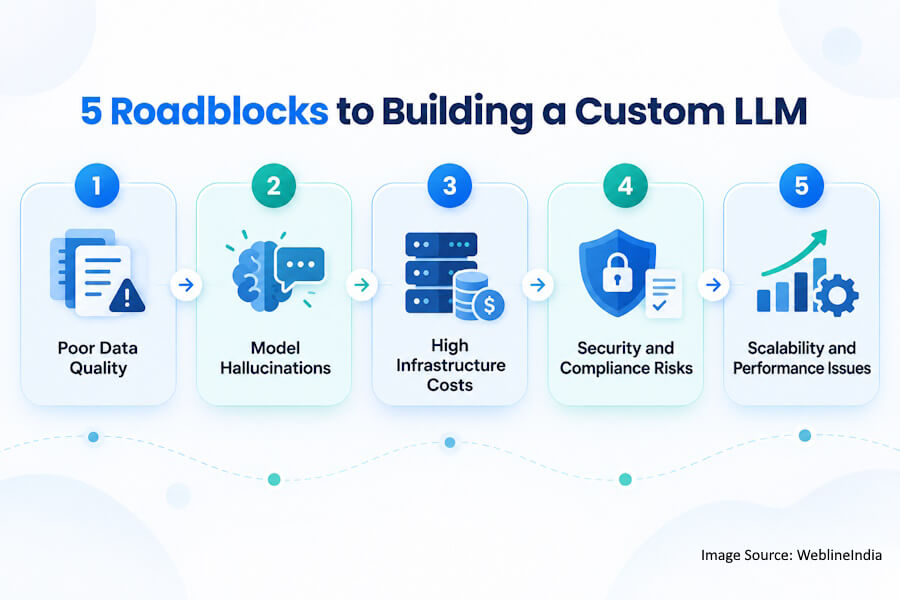
Poor Data Quality
Incomplete documents cause erratic model behavior. Data cleaning pipelines remove noise. Automated validation scripts check text formats. Human auditors verify dataset integrity.
- Missing document sections create logical reasoning gaps during training.
- Automated regex scripts purge corrupted text characters from files.
Model Hallucinations
Models invent false historical facts. RAG architectures ground answers in truth. Strict temperature settings reduce creative fabrication. Evaluation suites catch errors early.
- Grounding prompts restrict answers strictly to provided source documents.
- Low temperature settings decrease random output generation rates.
- Citation requirements force models to reference document sources.
High Infrastructure Costs
GPU rentals drain corporate budgets. Model quantization reduces memory footprints. Smaller models replace massive foundation systems. Efficient batching maximizes hardware utilization.
- Model quantization shrinks file sizes by half without quality loss.
- Spot GPU instances lower cloud computing rental bills significantly.
- Request batching maximizes active hardware compute capacity utilization.
Security and Compliance Risks
Data leaks trigger regulatory fines. Encryption protocols secure stored files. Access control lists restrict user permissions. Regular audits verify system integrity.
- Encryption standards protect files during internal network transfers.
- Role-based access limits sensitive document visibility across departments.
- Compliance audits verify adherence to industry regulatory frameworks.
- Penetration testing uncovers hidden application security vulnerabilities.
Scalability and Performance Issues
High user traffic causes server bottlenecks. Load balancers distribute incoming request loads. Caching layers store frequent query results. Asynchronous queues manage heavy workloads.
- Load balancers prevent single server overload crashes during traffic spikes.
- Response caching serves identical queries instantly without inference.
How Much Does It Cost to Build a Custom LLM for Your Business?
Constructing a custom enterprise LLM involves variable financial commitments, spanning from basic API configurations to resource-intensive training pipelines. Organizations must account for GPU compute overhead, data preparation pipelines, specialized engineering talent, and long-term maintenance costs.
Let’s break down the actual financial variables and budget estimates to help you plan an accurate investment strategy for your upcoming enterprise artificial intelligence project.
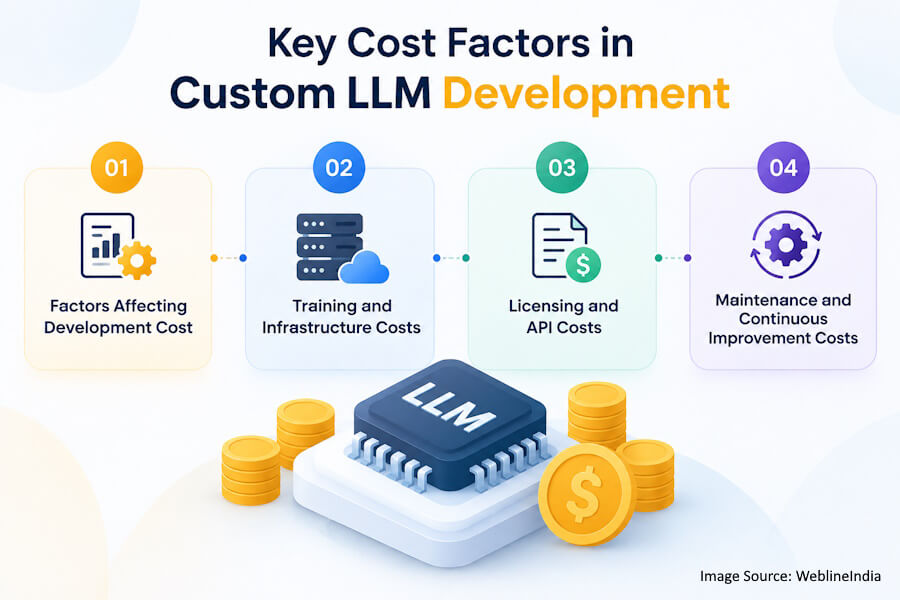
Factors Affecting Development Cost
Dataset size impacts data preparation labor, while model parameter counts dictate hardware needs. AI consulting services can help organizations assess integration complexity, infrastructure requirements, and other factors that influence project scope.
- Large datasets require extensive manual cleaning time by engineers.
- High parameter models demand expensive high-end GPU hardware.
Training and Infrastructure Costs
Compute clusters require substantial funding. Electricity bills add ongoing operational expenses. Cloud providers charge hourly GPU rates. Hardware purchases require upfront capital.
- Cloud GPU hourly rentals accumulate rapidly during training runs.
- Power and cooling overhead increases facility budgets for servers.
- Cluster setup requires expensive high-speed networking hardware equipment.
- Maintenance contracts cover unexpected server component hardware failures.
Licensing and API Costs
Proprietary foundation models charge subscription fees. Commercial use permits incur extra charges. Open source weights eliminate recurring licensing bills. Legal reviews ensure compliance.
- Commercial API tokens accumulate monthly charges based on volume.
- Proprietary model subscriptions scale with active user counts.
- Open source weights avoid recurring software licensing fee burdens.
Maintenance and Continuous Improvement Costs
Models require ongoing retraining cycles. Engineering teams fix operational bugs. Security patches protect infrastructure servers. Monitoring tools incur subscription fees.
- Retraining pipelines ingest newly updated corporate documents regularly.
- Support engineers troubleshoot unexpected production error logs daily.
- Security teams apply software patches to enterprise servers.
- Observability tools charge fees based on log data volumes.
Get a realistic custom LLM estimate based on your use case, data, model choice, integrations, infrastructure, and deployment requirements.
Best Practices for Building Secure, Accurate, and Scalable Enterprise LLMs
Implementing robust enterprise LLMs requires enforcing strict data encryption, establishing continuous feedback loops to minimize hallucinations, and designing horizontal scaling architectures to handle peak workloads.
Let’s explore the core deployment strategies that ensure your AI ecosystem remains protected, highly precise, and infinitely adaptable to future organizational growth.
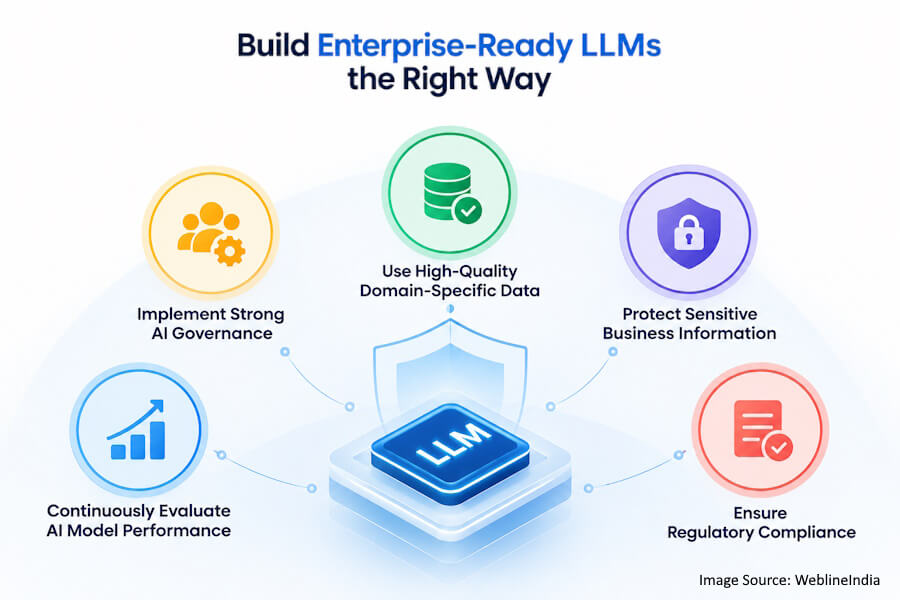
Implement Strong AI Governance
Committees oversee artificial intelligence projects. Ethics guidelines prevent biased outputs. Version control tracks model updates. Documentation records architectural decisions.
Use High-Quality Domain-Specific Data
Curated datasets improve output accuracy. Noise removal eliminates confusing text. Standardized formats streamline training pipelines. Regular audits maintain data health.
- Curated datasets provide clear semantic learning signals for models.
- Noise reduction filters out irrelevant internet text completely.
- Standardized schemas organize multi-source corporate documents properly.
Protect Sensitive Business Information
Data masking hides confidential numbers. Local servers isolate proprietary files. Zero-retention policies protect user privacy. Network firewalls block external threats.
- Data masking replaces real names with secure placeholders.
- Local server deployments isolate files from public networks.
- Zero-data-retention agreements protect corporate prompt privacy strictly.
- Network firewalls block unauthorized external intrusion attempts.
Continuously Evaluate AI Model Performance
Automated benchmarks measure accuracy trends. User feedback flags operational issues. Red teaming uncovers hidden vulnerabilities. Regular reviews update performance targets.
- Automated testing scripts track accuracy metric trends over time.
- User rating buttons capture real-world performance feedback instantly.
Ensure Regulatory Compliance
Legal teams review data handling practices. GDPR guidelines protect customer privacy. Industry standards dictate security controls. Documentation proves regulatory adherence.
- Legal reviews ensure adherence to strict data privacy laws.
- GDPR protocols manage user consent and data deletion requests.
- Industry standards mandate specific encryption key strengths.
Real-World Business Use Cases of Custom LLM Development Across Industries
Custom LLMs transform industries by automating complex legal document analysis in finance, powering hyper-personalized diagnostic suggestions in healthcare, and driving hyper-targeted inventory logistics in retail. Discover how organizations across diverse sectors leverage these tailored systems to optimize workflows, drastically cut overhead costs, and secure a massive competitive advantage.
Healthcare
Clinical models summarize patient histories. Medical researchers analyze drug interaction studies. Diagnostic assistants process scan notes. Administrative workflows speed up billing.
- Clinical models summarize dense patient medical histories for doctors.
- Research tools analyze complex drug interaction studies quickly.
Banking and Financial Services
Fraud detection algorithms analyze transaction streams. Algorithmic traders process market reports. Compliance systems review loan applications. Automated agents answer account queries.
- Fraud detection algorithms flag suspicious transaction streams instantly.
- Financial models analyze earnings reports for corporate investors.
- Compliance tools review loan application risk factors thoroughly.
- Automated assistants answer routine customer account queries 24/7.
Legal
Contract analyzers spot unfavorable clauses. Case law search engines retrieve precedents. Document summarizers review depositions. Due diligence pipelines process mergers.
- Contract analyzers highlight unfavorable liability clauses instantly.
- Legal search engines retrieve relevant historical case precedents.
Manufacturing
Supply chain models predict material shortages. Maintenance logs schedule machine repairs. Quality control systems analyze defect reports. Design assistants review blueprints.
- Supply chain models predict raw material shortage risks early.
- Maintenance logs schedule proactive factory machine repairs.
- Quality control systems analyze assembly defect reports.
- Design assistants review complex engineering technical blueprints.
Retail and eCommerce
Recommendation engines suggest relevant products. Inventory models forecast seasonal demand. Multilingual chatbots assist global shoppers. Sentiment analyzers review feedback.
- Recommendation engines suggest relevant products to online buyers.
- Inventory models forecast seasonal stock demand accurately.
Customer Support
Ticketing systems route issues automatically. Sentiment trackers prioritize angry callers. Knowledge bases generate instant answers. Response assistants draft polite replies.
- Ticketing systems route customer issues to appropriate agents.
- Sentiment trackers prioritize angry caller support queues.
- Knowledge bases generate instant answers for users.
- Response assistants draft polite email customer replies.
How to Choose the Right Custom LLM Development Company for Your Business
Evaluating potential custom LLM development partners requires analyzing their portfolio of deployed enterprise models, technical expertise in fine-tuning frameworks, data security protocols, and post-launch maintenance capabilities.
Here we dive into the critical evaluation criteria needed to select a reliable technology vendor that can successfully transform your ambitious artificial intelligence vision into a secure, production-ready enterprise reality.
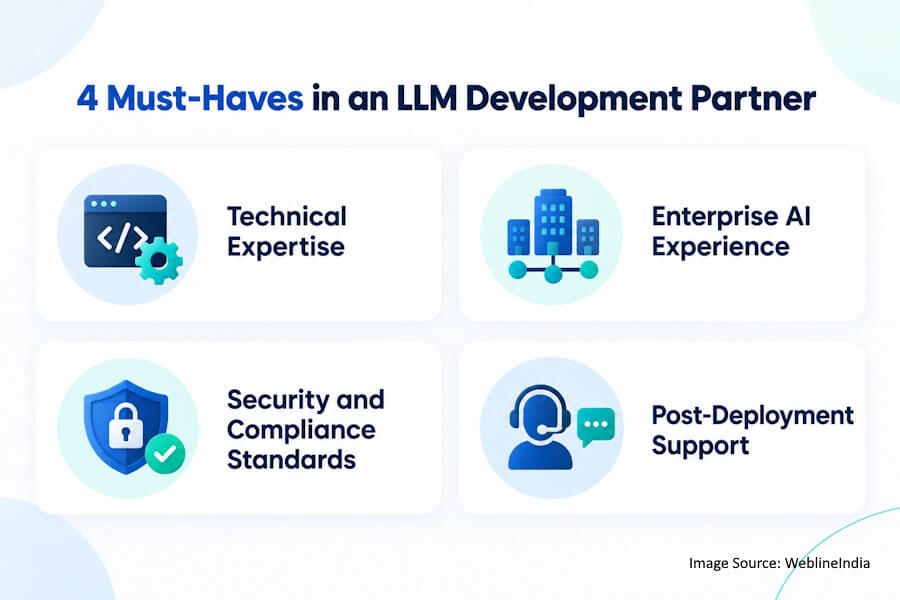
Technical Expertise
Engineers evaluate deep learning credentials. Teams demonstrate successful model deployments. Certifications prove cloud infrastructure proficiency. Portfolios highlight complex enterprise solutions.
Enterprise AI Experience
Vendors understand corporate security requirements. Case studies prove industry-specific knowledge. Client references validate past performance. Scale capabilities match business needs.
- Vendors understand strict corporate security compliance requirements.
- Case studies prove deep industry-specific operational knowledge.
Security and Compliance Standards
Partners enforce strict data privacy rules. Certifications verify infrastructure security. Legal agreements protect intellectual property. Audit trails ensure regulatory adherence.
- Development partners enforce strict internal data privacy rules.
- Security certifications verify robust cloud infrastructure protection.
- Legal contracts protect proprietary corporate intellectual property.
- Audit trails ensure full regulatory industry adherence.
Post-Deployment Support
Post-deployment software maintenance services can include ongoing monitoring, regular updates, and support for production issues.
- Maintenance agreements guarantee high application system uptime.
- Monitoring services track live performance accuracy metrics.
Future Trends in Custom LLM Development and Enterprise AI
The enterprise AI landscape is rapidly shifting toward hyper-efficient edge computing, multi-modal capabilities, and autonomous agentic workflows that execute complex, multi-step business processes without human intervention.
Now we uncover the upcoming technological breakthroughs and strategic innovations poised to redefine how your enterprise leverages custom large language models in the coming years.
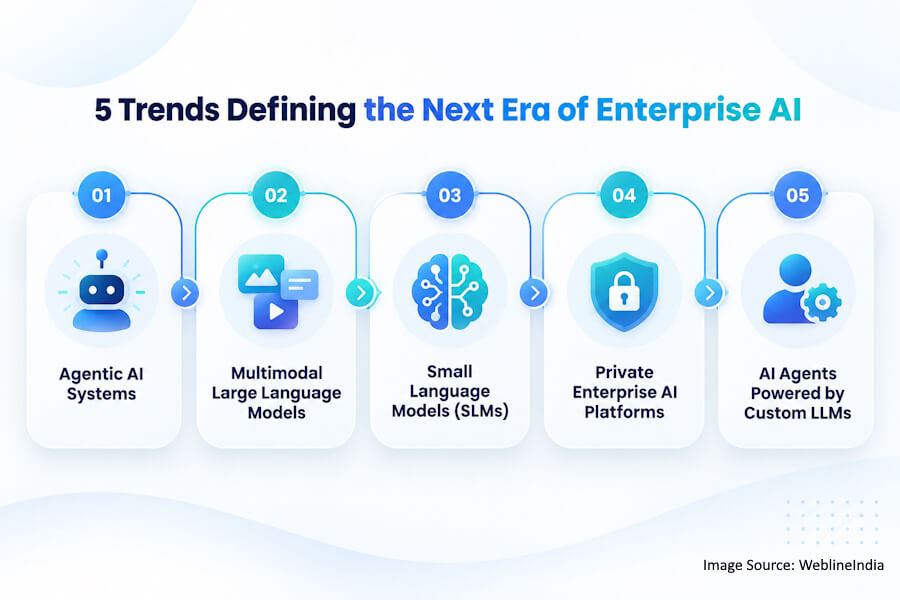
Agentic AI Systems
Autonomous agents execute multi-step workflows. Systems collaborate to solve problems. Decision engines manage complex tasks. Productivity increases across departments.
Multimodal Large Language Models
Models process text, audio, and video. Integrated sensors analyze physical environments. Rich inputs improve contextual understanding. Applications span multiple sensory types.
- Models process text, audio, and video streams simultaneously.
- Integrated sensors analyze physical factory work environments.
- Rich input streams improve deep contextual understanding.
- Applications span multiple sensory data types seamlessly.
Small Language Models (SLMs)
Compact models run on edge devices. Local hardware processes queries instantly. Resource demands drop significantly. Privacy improves through local execution.
- Compact models execute locally on edge devices.
- Local hardware processes user queries instantly.
Private Enterprise AI Platforms
Secure platforms centralize artificial intelligence tools. Internal marketplaces share trained models. Governance dashboards monitor system usage. Enterprises control their AI destiny.
- Secure platforms centralize corporate artificial intelligence tools.
- Internal marketplaces share custom-trained model weights.
- Governance dashboards monitor company-wide system usage.
- Enterprises control their artificial intelligence infrastructure completely.
AI Agents Powered by Custom LLMs
Enterprise AI agent development can combine specialized agents with custom LLMs to execute business operations and coordinate software workflows. Smart assistants manage daily schedules. Efficiency gains transform enterprise workflows.
- Specialized agents execute complex business operations automatically.
- Automated tools coordinate software development deployment pipelines.
Final Thoughts on Building a Custom LLM for Long-Term Business Success
Artificial intelligence adoption dictates future market leaders. Generic public tools fail enterprise demands. Organizations build custom models to secure data. Proprietary workflows demand specialized intelligence. Long-term success requires robust AI infrastructure. Companies partner with expert providers to accelerate execution.
WeblineIndia delivers exceptional Custom LLM Development services. Engineering teams build secure enterprise LLMs. Specialists fine-tune models for maximum accuracy. WeblineIndia transforms business operations through custom AI solutions. Organizations achieve sustained competitive advantages today. Contact WeblineIndia to begin custom artificial intelligence integration.
Social Hashtags
#CustomLLM #LargeLanguageModels #EnterpriseAI #GenerativeAI #ArtificialIntelligence #LLM #AIDevelopment #AIEngineering #AgenticAI #AIAgents #RetrievalAugmentedGeneration #RAG #MachineLearning #AIInfrastructure #DigitalTransformation #EnterpriseTechnology #MLOps #AIInnovation #PrivateAI #BusinessAutomation
Build a secure, scalable custom LLM tailored to your enterprise data and workflows with an experienced AI development team.
Frequently Asked Questions
How do I build a custom LLM for my business?
Companies collect proprietary data, select powerful open-source architectures, fine-tune model weights on secure servers, and deploy scalable infrastructure to automate internal workflows and protect sensitive intellectual property assets.
Should I build or fine-tune an existing LLM?
Fine-tuning existing foundation models saves money and time while adapting pre-trained grammar to specific domains. Scratch training remains necessary only for completely unique linguistic or security requirements.
What data is required to train a custom language model?
Engineers gather clean internal documents, technical manuals, historical transcripts, and structured database records. Teams must scrub personal identifiers and format text carefully before feeding training pipelines.
How much does custom LLM development cost?
Expenses vary based on parameter sizes, hardware rentals, and data preparation labor. Cloud GPU clusters demand significant capital while fine-tuning existing adapters lowers overall implementation budgets.
Which open-source LLM is best for enterprises?
Meta Llama and Mistral AI offer exceptional performance and open weights for secure local deployments. Organizations select specific variants based on parameter limits and available computing resources.
How long does it take to build a custom LLM?
Timelines range from several weeks to multiple months depending on dataset complexity. Phased rollouts and pre-trained foundation models accelerate initial deployment schedules for corporate teams.
Can businesses create private AI models?
Enterprises deploy models on local server hardware or secure private cloud subnets. This guarantees complete data isolation and prevents external API providers from viewing confidential corporate records.
What infrastructure is needed for LLM development?
Deep learning requires high-performance GPU clusters, robust networking hardware, and fast vector databases. DevOps engineers configure scalable Kubernetes nodes to handle heavy inference traffic demands.
How do companies deploy custom LLMs?
DevOps teams provision cloud inference instances or local server nodes. API gateways connect internal business applications while load balancers distribute incoming request traffic smoothly across servers.
What are the benefits of private LLMs?
Private models ensure strict data privacy, eliminate per-token subscription fees, and deliver accurate industry-specific responses. Organizations retain absolute control over model weights and system security policies.
What is RAG and how does it compare to fine-tuning?
Retrieval-Augmented Generation fetches live external documents dynamically without changing core model weights. Fine-tuning modifies neural network parameters directly for specialized vocabulary and behavior adaptation across enterprise workflows.
How secure are enterprise LLMs?
Enterprise platforms enforce strict role-based access controls, data encryption at rest, and zero-retention policies. Security audits and local firewalls protect confidential information against malicious cyber threats.
Globally Recognized for Unmatched Quality and Reliability




Testimonials: Hear It Straight From Our Global Clients
Our development processes delivers dynamic solutions to tackle business challenges, optimize costs, and drive digital transformation. Expert-backed solutions enhance client retention and online presence, with proven success stories highlighting real-world problem-solving through innovative applications. Our esteemed Worldwide clients just experienced it.
Awards and Recognitions
While delighted clients are our greatest motivation, industry recognition holds significant value. WeblineIndia has consistently led in technology, with awards and accolades reaffirming our excellence.

OA500 Global Outsourcing Firms 2025, by Outsource Accelerator

Top Software Development Company, by GoodFirms

BEST FINTECH PRODUCT SOLUTION COMPANY - 2022, by GESIA

Awarded as - TOP APP DEVELOPMENT COMPANY IN INDIA of the YEAR 2020, by SoftwareSuggest