How to Choose the Right AI Development Company
Choosing the right AI development company is key to building successful AI solutions. This guide covers the essential factors to evaluate, including technical expertise, industry experience, pricing, security, case studies, and ongoing support. It also highlights common hiring mistakes and practical questions to ask before making a decision. Whether you're a startup or an enterprise, these insights will help you find a trusted AI partner that delivers lasting business value.


 ChatGPT
  Perplexity
 A recent McKinsey survey found that more organizations are adopting AI. About 88 percent of respondents said their companies use AI in at least one business function. This marks an increase from 78 percent reported in the previous year. There has been tremendous growth, and most organizations are testing AI through pilot projects or early-stage experiments. Around one-third of respondents indicated that their companies have started expanding AI initiatives across the business.
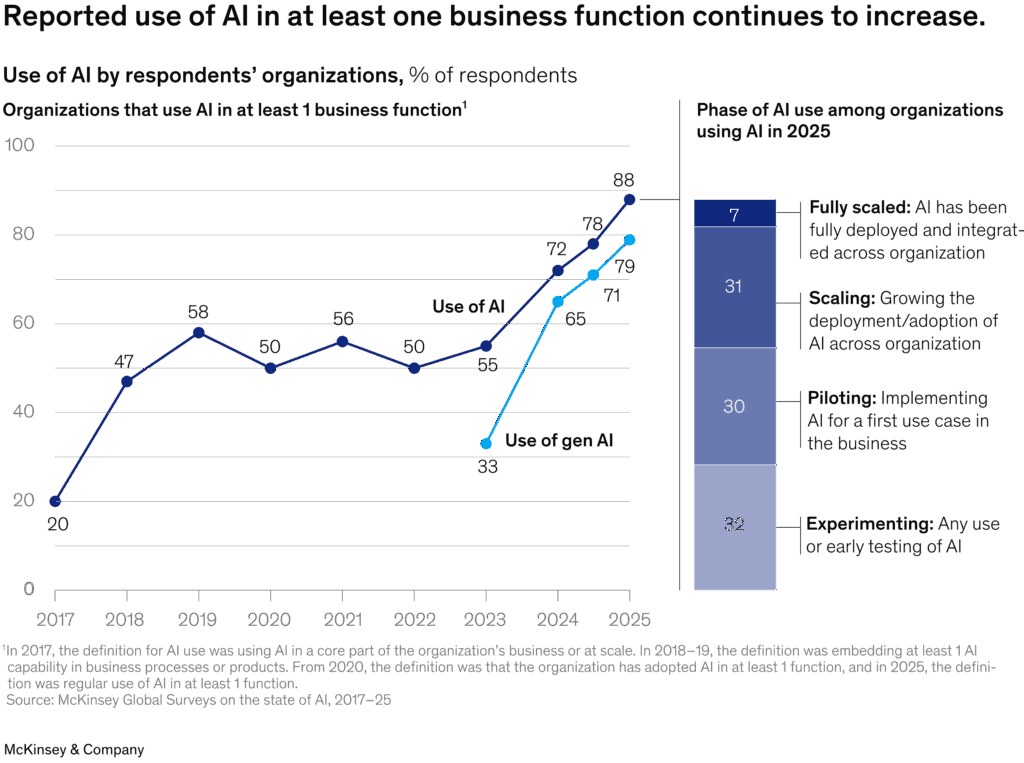
Source: McKinsey & Co.
Building quality AI-powered business applications requires a solid foundation where your AI development partner plays a key role. Now, choosing a technology partner defines a business trajectory, but a wrong choice wastes capital. The right choice creates market dominance, so enterprises look for mathematical precision and ability to handle the shift in AI engineering before selecting the firm. If you are looking to automate your business processes with Artificial Intelligence solutions, this guide is worth reading.
Let us outline the exact framework required to evaluate an AI development company, protecting enterprise infrastructure from costly mistakes.
Not sure which AI development company is the right fit for your business goals and budget?
Why Choosing the Right AI Development Partner Matters
AI systems operate on complex infrastructure, so bad code destabilizes data pipelines. A specialized AI development company ensures system stability, and they prevent algorithmic bias. Failure rates in machine learning go high if poorly trained models yield incorrect predictions. An experienced AI software development company minimizes these risks because they understand data validation. They protect the enterprise from financial loss, which saves the brand reputation.
Strategic implementation demands more than simple API calls, since true competitive advantage stems from bespoke architecture. The wrong firm builds brittle scripts, but the right firm builds scalable assets.
Every sector faces unique computational hurdles, so a generalist AI development agency cannot handle deep mathematical abstraction. Specialized talent makes the difference, and this selection process governs corporate efficiency for subsequent decades.
So, how to avoid this and get the right AI development company?
Define Your AI Project Goals Before Hiring a Company
Clarity precedes development, and substandard vendors cannot guess business intent. But before all, internal alignment must happen first to accelerate the onboarding phase.
Business Challenges to Solve
Identify specific operational bottlenecks before scheduling interviews.
- High customer churn rates require predictive analytics. It helps sales teams intervene early.
- Manual data entry is one area where business process automation services can reduce repetitive work and free human resources for more complex tasks.
- Inventory inefficiencies require demand forecasting to reduce warehouse overhead costs.
- Legacy software modernization demands algorithmic intervention to update ancient corporate systems.
Expected Outcomes
Define success with metrics, but do not use vague terms.
- Reduce processing time by 40 percent, which optimizes resource spending.
- Increase sales conversions via recommendation engines and raise average order value.
- Automate customer service triage with 90 percent accuracy to improve satisfaction rates.
Budget and Timeline Considerations
AI development demands substantial investment because computing power costs money. It would be highly recommended to calculate ROI before investing in AI development. High talent salaries affect pricing, so establish a financial ceiling early. Be realistic about deployment speed, because machine learning models require thorough training phases.
Model training takes consecutive weeks, which often surprises non-technical stakeholders. Data curation adds significant overhead; hence, rushing the discovery phase ruins system architecture. Budget transparently for infrastructure maintenance, and to avoid unexpected bills for the AI development project.
Key Factors to Consider When Choosing an AI Development Company
Evaluation requires a strict framework as it allows you to look beyond marketing claims. Inspect technical realities to ensure maximum returns on innovation spending.
AI Expertise and Technical Capabilities
Assess the engineering team by looking for specialized degrees. Check contributions to open-source AI repositories and verify familiarity with deep neural networks.
Engineers must understand statistical variance, so they should possess mastery over optimization algorithms. Ask about their testing frameworks because a competent firm demonstrates rigorous validation procedures.
Industry Experience
An AI consulting company must understand specific domain constraints, especially since healthcare requires specialized knowledge. Finance demands low-latency execution, but generalist agencies often fail specific compliance checks.
The nuances of logistical data differ from retail metrics, meaning sector expertise guarantees faster deployment. The team will grasp business terminology instantly, allowing them to bypass basic learning curves.
Custom AI Development Capabilities
Off-the-shelf software rarely fits complex workflows, so the vendor must provide custom AI development services. Additionally, they must tailor algorithms to proprietary datasets to maximize model accuracy.
Customization safeguards proprietary business logic, and it allows integration with internal legacy tools. Pre-built applications lack this adaptability, whereas tailored code scales efficiently alongside business expansion.
Generative AI and Machine Learning Expertise
Different problems require different architectures. Hence, you must categorize your technical needs.
- Large language models handle textual data, which improves document processing.
- Computer vision processes video feeds that allow automated quality control.
- Neural networks discover patterns; hence, they solve unpredictable predictive challenges.
- Reinforcement learning optimizes robotics to streamline automated warehouse operations.
A generative AI development company excels at content synthesis, while machine learning development services focus on predictive modelling; match the vendor’s skills to the technical need to improve the chances of project success.
Data Engineering and Integration Skills
AI requires clean data, and the partner must offer AI integration services. They must connect models to legacy databases because poor integration creates data silos.
Data orchestration and data analytics services both depend on reliable data foundations, including the pipeline architecture required to process information effectively. The company must deploy robust data lakes, and they need pipelines that handle unstructured information. Without clean inputs, systems fail completely.
Want to discuss your AI project with experienced developers before making a final hiring decision?
Evaluate Their Portfolio and Case Studies
Portfolios reveal actual capabilities; hence, look for depth and avoid companies that rely purely on theoretical frameworks. That is because academic knowledge does not guarantee production stability.
Past AI Projects
Examine production-ready applications, but do not accept proof-of-concept demonstrations. You may also demand to see live systems and verify user interfaces alongside backend performance. A stable system handles high concurrent traffic and proves structural stability. It is also advisable to look for evidence of longevity in their portfolio because systems running for years confirm reliability.
Measurable Business Results
Look for numbers, because good case studies show statistical improvements.
- A client saved millions via predictive maintenance, optimizing factory floor operations.
- An enterprise AI development project increased throughput, which boosted quarterly revenue.
- A retail app optimization boosted average order value, validating the implementation strategy.
Client Testimonials
Another way to test whether you have hired right AI development team is to speak to past references and ask about communication styles. You may inquire about technical competence during crises to discover how engineers handle sudden model failures. In addition, verify their ability to meet milestones as it ensures the project stays on schedule. Ask if project costs escalated unexpectedly, which helps you eliminate unreliable candidates.
Questions to Ask Before Hiring an AI Development Company
Interviews expose weak AI development agencies, so prepare your questionnaire carefully. Use these specific questions to ask an AI development company during initial evaluations.
- What data cleaning methodologies do engineers use, and how do they handle missing values?
- How does the system handle model drift over time, especially when consumer behavior shifts?
- Who owns the intellectual property of the custom-trained model, including the weights?
- What is the infrastructure cost estimate for cloud computing, including training and deployment?
- How do you prevent hallucination in natural language applications to ensure brand safety?
- What backup protocols safeguard training data during infrastructure failures and prevent data loss?
Understanding AI Development Costs and Pricing Models
The AI development company pricing guide structures vary; thus, select the model based on project predictability. Ensure alignment between expenditure and milestones to protect your financial resources.
Fixed Price Model
This model works for well-defined scopes. Hence, it makes it highly predictable.
- Scope creep is minimal, since boundaries are established early.
- Deadlines are rigid. It helps internal product planning.
- Ideal for initial pilot programs, limiting financial exposure.
Dedicated Team Model
Hire dedicated developers for long-term flexibility, especially when building complex enterprise tools.
- Monthly payments cover engineering salaries. Ultimately, it simplifies budget forecasting.
- Product roadmaps evolve naturally to allow adaptation to market changes.
- The client retains direct management control, which aligns with internal processes.
- Accelerates velocity through continuous collaboration. Thus, it removes communication friction.
Time and Material Model
Pay for actual hours worked, and you fit experimental research phases.
- Ideal for initial discovery. Here, requirements remain fluid.
- Adjust the course based on early accuracy milestones so that you minimize wasted effort.
- Maximizes resource efficiency during highly volatile research steps and protects capital.
Red Flags to Watch Out For
Avoid problematic agencies if you spot warning signs during initial consultations. Protecting capital requires immediate rejection of deceptive vendors if you want to save your organization from prolonged failures.
Unrealistic Promises
Avoid vendors promising 100 percent accuracy. AI cannot solve every business issue because Machine Learning and AI rely on probability, and absolute certainty indicates fraudulent marketing.
Lack of AI Case Studies
Many web agencies rebrand as an AI development agency overnight as they want to exploit recent market hype. Inspect their history, and demand historical proof of AI deployment. Look at corporate registration dates to verify actual longevity.
No Post-Deployment Support
Models degrade over time because real-world data changes continuously, making ongoing optimization and software maintenance services important for preventing rapid system obsolescence after deployment.
Limited Data Security Practices
AI software requires access to corporate data, but weak security leads to leaks; hence, you must avoid vendors without clear data governance policies. Systems without compartmentalized access expose operations to espionage.
Importance of Data Security and Compliance
Data breaches destroy companies, making security a non-negotiable factor. Systems must repel external adversarial attacks to protect proprietary user metrics.
Here are a few compliances to look for:
GDPR Compliance
European user data requires strict handling. It means models must respect privacy mandates; thus, anonymization pipelines must process training inputs thoroughly to eliminate personal identifiers.
HIPAA Compliance
Medical data demands encryption to ensure patient confidentiality. Check for the following ones:
- Access logs must be immutable to prevent unauthorized changes.
- Storage must use secure cloud instances. And, it should also comply with federal regulations.
- Business associate agreements must be executed immediately; it legalizes the partnership.
Enterprise Security Standards
Look for SOC 2 certification, which proves operational integrity. The AI solutions provider must encrypt data at rest, and they must secure data in transit. Penetration testing should occur quarterly, exposing vulnerabilities before hackers find them.
Need expert guidance to estimate the cost, timeline, and scope of your AI development project?
How AI Development Companies Approach Project Delivery
Process dictates outcome, and professional agencies follow a structured pipeline. This ensures predictable delivery schedules and reduces friction between internal teams.
Discovery Phase
Engineers analyze existing data, and they assess technical feasibility.
- Data availability checks happen here to identify pipeline gaps.
- Teams define the technical architecture and select appropriate frameworks.
- Compute requirements are calculated accurately so that we can estimate monthly hosting bills.
Development and Testing
Engineers build pipelines, and they train models.
- Data scientists split data into training and validation sets. Hence, they prevent overfitting.
- QA engineers test for algorithmic bias to ensure fair outcomes.
- Stress testing verifies stability under extreme loads and prepares code for launch.
Deployment and Optimization
The model goes live, but work continues. The AI implementation partner monitors performance, and they tweak hyperparameters to maintain accuracy. Regular telemetry updates guarantee continuous peak functionality to preserve system health.
AI Development Company Checklist
Use this AI development company selection checklist during selection. Doing so, you ensure that no criteria are forgotten.
- Verify history in machine learning engineering. For this, you may look at past GitHub repositories.
- Clarify the matter of intellectual property ownership terms. It protects your software assets.
- Document data security protocols; it fulfils corporate compliance needs.
- Check out the AI development agency’s experience with API integration. Ask whether they can connect legacy platforms smoothly.
- Transparent pricing guidelines are essential. The right AI development company should have no hidden consulting fees.
- Your AI implementation partner should incorporate devops services and practices for continuous monitoring, deployment workflows, and faster identification of production issues.
- One of the factors to consider when choosing an AI partner is to check their proven track record in computing resource optimization. It lowers operational costs.
Top Benefits of Working with the Right AI Partner
The right choice of an AI solutions provider accelerates growth, and it establishes insurmountable technological barriers against competitors.
Here are the top benefits of choosing the right AI vendor:
- Reduced operational expenses through intelligent automation and scaling internal productivity.
- Predictive insights leading to better executive decisions and reduced market risks.
- Amazing and unique customer experiences using a customized AI app development. Delight your customers or end users.
- Unlocked hidden value within underutilized historical databases. This would turn records into assets.
- Rapid scalability achieved without proportional headcount inflation; ultimately, you witness maximized profit margins.
Comprehensive Market Assessment: AI Consulting vs AI Development Company
Understanding the distinction between strategic advice and technical execution prevents structural missteps, especially since enterprises often confuse these two industry offerings.
An AI consulting company primarily focuses on strategy and building high-level architecture designs. They assess organizational readiness and calculate return on investment projections, along with building business cases. They rarely write production-ready code, which surprises non-technical buyers.
Conversely, a development firm builds the actual software asset to deliver functioning code by employing the data scientists, infrastructure engineers, and backend developers who write the underlying neural networks. They manage the entire life cycle of deployment to execute the actual build phase.
Here is the bet: selecting the right AI development company that handles both domains bridges the execution gap and initiates streamlined communication. It further ensures that strategic promises align with actual algorithmic reality to prevent expensive conceptual errors.
Demystifying Generative AI Development Company Selection
The sudden rise of large language models has flooded the market with inexperienced agencies that have made verification essential. It is essential to note that true expertise in generative AI systems requires a deep understanding of vector databases, prompt engineering optimization, and fine-tuning methodologies. Businesses evaluating potential partners should also understand how to choose generative AI development company based on technical expertise, security practices, LLM capabilities, scalability, pricing, and long-term support.
An elite generative AI development company selection strategy evaluates how well a firm manages token expenses, which prevent runaway operational bills. Unoptimized calls to proprietary language models drain corporate budgets quickly; hence, engineering proficiency matters. An AI development agency must demonstrate proficiency in open-source model deployment to mitigate ongoing licensing fees.
Furthermore, it is also needed to address the risk of hallucinations before deploying models to the end customers. The AI engineering firm must know how to implement retrieval-augmented generation architectures, forcing models to cite internal sources. This grounds the model output in verified corporate documentation to protect your brand from erroneous algorithmic proclamations.
The Best AI Development Company for Startups
Startups operate under intense resource constraints, which makes aggressive timelines mandatory. They cannot afford the prolonged multi-month discovery phases typical of enterprise procurement and require agile execution. The best AI development company for startups prioritizes speed to market, with mvp development services providing a structured path toward minimum viable product execution.
Furthermore, they also utilize agile frameworks to deliver functioning prototypes within weeks. It allows early-stage companies to secure investor funding based on working technology, rather than relying on simple slide decks.
The best AI development company for startups must also design the architecture for future scale to avoid future migration costs. While the initial build might serve only a few hundred users, the underlying code must accommodate millions once scaling begins. Startups should seek agencies offering fractional development teams that conserve early-stage equity and working capital.
Summary: Factors to Consider When Choosing an AI Partner
| Evaluation Metric | High-Performing Vendor | Low-Performing Vendor |
| Data Strategy | Conducts deep audit of existing pipelines before writing code, saving development hours. | Attempts to train models on unverified raw datasets, leading to corrupted outputs. |
| IP Ownership | Grants complete ownership of code and weights to the client, protecting corporate assets. | Retains core model ownership, forcing ongoing licensing fees down the line |
| Infrastructure | Optimizes model size to minimize cloud hosting expenses, maximizing profitability. | Uses bloated architectures that inflate monthly compute bills needlessly. |
| Model Validation | Utilizes strict mathematical validation protocols, ensuring predictive consistency. | Relies on superficial success metrics during staging, hiding underlying flaws. |
Final Thoughts: Finding the Best AI Development Company for Your Business
Selecting the right AI development partner is not about flashy presentations; it is about proven engineering strength. Companies that succeed in AI projects focus on technical depth, secure data handling, and scalable delivery.
WeblineIndia offers enterprise ai development services designed around tailored AI solutions for business requirements.
- WeblineIndia combines global delivery experience with local adaptability.
- The company avoids rigid templates, instead building custom AI solutions.
- Engineers specialize in machine learning frameworks and secure integration.
- Their deployments emphasize scalability, accuracy, and long-term reliability.
- Partnering with WeblineIndia enables businesses to unlock growth through AI.
- Corporate data becomes a competitive asset when guided by its expertise.
Choosing the right AI partner is ultimately about trust and delivery. WeblineIndia has demonstrated both through its technical expertise and global success stories. When you hire AI developers from us, you gain not just software solutions but a long-term partner committed to innovation.
With WeblineIndia, the path to sustainable growth through AI software development becomes clear and achievable.
Social Hashtags
#AIDevelopment #ArtificialIntelligence #AIDevelopmentCompany #GenerativeAI #MachineLearning #EnterpriseAI #CustomAI #AIConsulting #DigitalTransformation #BusinessAutomation #AIAgents #LLM #AIInnovation #TechTrends2026 #AIForBusiness
Looking for a trusted AI partner to build, deploy, and scale your custom AI solution successfully?
Frequently Asked Questions
Globally Recognized for Unmatched Quality and Reliability




Testimonials: Hear It Straight From Our Global Clients
Our development processes delivers dynamic solutions to tackle business challenges, optimize costs, and drive digital transformation. Expert-backed solutions enhance client retention and online presence, with proven success stories highlighting real-world problem-solving through innovative applications. Our esteemed Worldwide clients just experienced it.
Awards and Recognitions
While delighted clients are our greatest motivation, industry recognition holds significant value. WeblineIndia has consistently led in technology, with awards and accolades reaffirming our excellence.

OA500 Global Outsourcing Firms 2025, by Outsource Accelerator

Top Software Development Company, by GoodFirms

BEST FINTECH PRODUCT SOLUTION COMPANY - 2022, by GESIA

Awarded as - TOP APP DEVELOPMENT COMPANY IN INDIA of the YEAR 2020, by SoftwareSuggest