In-House AI Team vs AI Development Agency: Cost and Performance Comparison
Choosing between an in-house AI team and an AI development agency can affect your budget, project speed, and long-term success. This guide compares costs, hiring challenges, scalability, expertise, and ROI to help businesses decide which approach fits their goals. Whether you're planning a proof of concept or building enterprise AI products, you'll learn when outsourcing makes sense and when an internal team is the better investment.


 ChatGPT
  Perplexity
 Deploying machine learning models requires clear financial and structural planning. Enterprise leaders face a foundational architectural choice. Should the company build an internal business unit from scratch? Or should the organization partner with an external provider? The choice between an in-house AI team vs ai development agency dictates project timelines, product performance, and long-term capital allocation.
Artificial intelligence engineering is fundamentally different from traditional software development. The technology demands continuous data validation, mathematical optimization, and specialized infrastructure.
This AI development outsourcing guide analyzes the financial realities and operational outputs of both approaches.
Let’s begin with the basics.
Wondering whether an AI development agency can save you time and money on your next project?
Why Businesses Face This AI Development Decision
Rapidly adding machine learning to current processes quickly hits operational walls. Just because a pre-built API wrapper exists for a particular service does not mean it can easily handle complex processes or a company’s idiosyncratic data structures. High-value functionality is usually achieved through enterprise AI development services that involve specialized systems, tooling, and corresponding infrastructure. Plus, those also require corresponding amounts of expertise to maintain them.
The greatest risk, as companies decide whether to treat their AI systems as core intellectual property or as a tool to run their back office, is that they will abandon a multi-million dollar repository of their engineering hours, treating it as an afterthought.
What is an In-House AI Team?
An internal artificial intelligence division operates completely within the corporate structure. This unit focuses exclusively on company-owned assets, internal product roadmaps, and specific operational requirements for AI development services.
Team Structure
An internal artificial intelligence group does not function as a standard software engineering department. It operates as a cross-functional unit split between research, data operations, and systems architecture. The organization must establish direct reporting lines between this unit and senior technology leadership to ensure proper data governance.
Typical Roles Required
A minimal production-ready internal setup requires multiple specialized engineering roles, which is also why some organizations choose to hire machine learning engineers externally rather than build every capability in-house:
- Data Engineer: Constructs data collection pipelines, manages feature stores, and sanitizes unstructured datasets.
- Machine Learning Engineer: Optimizes algorithm architectures, handles hyperparameter tuning, and trains models.
- MLOps Specialist: Deploys trained neural networks to cloud environments, builds CI/CD pipelines for models, and configures drift monitoring.
- AI Product Manager: Translates business needs into model validation criteria and tracks operational metrics.
Average Hiring Costs
The cost to bring in experts of this caliber is high. In major tech hubs, senior engineers receive an annual base salary of $180,000 or more. To this must be added the corporate benefits, the payroll taxes, the cost of the real estate to house a physical team, the computers, and the software that this team will use to complete their work. For a lean organization of four such experts, the annual cost of their payroll alone would be $800,000 or more.
What is an AI Development Agency?
An AI development agency is an external vendor providing specialized engineering teams, mature delivery frameworks, and pre-built code accelerators. These entities deploy dedicated technical units to build, integrate, and optimize machine learning applications for client enterprises.
Services Offered
A professional AI development company provides comprehensive engineering support across the entire software lifecycle. This includes initial data audits, custom neural network training, computer vision deployment, and natural language engine design. They also construct the surrounding software infrastructure, including API endpoints, user interfaces, and database integrations.
Engagement Models
Clients typically engage an AI consulting agency through three distinct commercial frameworks:
- Fixed-Price Projects: Best for precisely scoped systems with deterministic requirements.
- Time and Materials (T&M): Ideal for iterative research, complex fine-tuning, or exploratory data discovery.
- Dedicated Development Teams: A long-term retainment model providing a full-time, managed technical unit operating under the client’s direct guidance.
Project Delivery Approach
Agencies utilize structured, repetitive implementation methodologies developed across dozens of client deployments. They bring pre-tested templates for data ingestion, model evaluation, and monitoring dashboards. This structural maturity removes the exploratory trial-and-error phases that frequently delay new internal software initiatives.
Cost Comparison: In-House Team vs AI Agency
Should you hire an AI development agency? Well, you need to keep in mind various factors such as costs, quality, and safety. An accurate AI team cost comparison requires evaluating total expenses beyond simple baseline salaries or agency hourly rates. Hidden overhead drastically changes the final cost of ownership. Hence, you must learn the cost of outsourced AI development and in-house production.
| Cost Component | In-House AI Team | AI Development Agency |
| Recruitment | High upfront costs ($15k–$40k per hire) | Zero recruitment fees |
| Base Compensation | Fixed monthly liabilities with benefits | Variable hourly or project-based fees |
| Infrastructure & Compute | Client pays full hardware/cloud costs | Shared setup costs or optimized client cloud |
| Training & Upskilling | Continuous company financial obligation | Borne completely by the vendor |
Recruitment Costs
The cost of building an in-house AI team requires extensive human resource investment. Finding specialized engineers takes months. Technical recruiters charge high placement fees, often running 20% to 25% of the engineer’s first-year base salary. If an internal engineer resigns, the business absorbs these replacement expenses all over again. Conversely, utilizing an external agency removes recruitment fees completely. The vendor bears all staffing, interviewing, and placement liabilities. To estimate the overall budget for your project before deciding on an in-house team or outsourcing, you can also use an AI development cost calculator to compare expected development costs based on your project scope, features, and timeline.
Salary Expenses
Internal AI staffing costs represent a fixed, permanent balance-sheet liability. The enterprise pays these salaries regardless of project milestones or business fluctuations. When opting for AI project outsourcing, these capital obligations shift to a flexible operational expense. The enterprise pays exclusively for active development hours. Once the system enters a steady maintenance phase, the monthly bill drops significantly.
Infrastructure Costs
Training deep learning models requires substantial computational power. Internal groups often demand dedicated physical workstations containing specialized enterprise graphics processors, or massive cloud compute provisions. An experienced external vendor minimizes these AI development costs by utilizing pre-trained foundational weights, optimized quantization, and efficient hardware sharing. This optimization prevents client companies from over-paying for under-utilized cloud instances.
Training and Retention Costs
The machine learning ecosystem evolves rapidly. Internal engineers require paid corporate time and educational budgets to master new architectures, framework updates, and security standards. High industry demand also drives frequent developer turnover. Losing a primary researcher stalls code production for months. When outsourcing, the agency absorbs all training costs and guarantees immediate team backfills to keep the project moving forward.
Want to compare in-house AI team costs with agency pricing before making a decision?
Performance Comparison
Evaluating AI outsourcing vs in-house development requires balancing immediate delivery capabilities against long-term internal technical knowledge.
Speed to Market
An agency delivers production code much faster than a newly assembled internal unit. While an enterprise spends the first quarter filtering resumes and setting up local servers, an external vendor initiates development within days. They reuse mature code blocks for security logging, user management, and data ingestion, allowing them to launch software months ahead of schedule.
Technical Expertise
A generalist internal software developer rarely possesses the mathematical background required for complex neural architecture optimization. An agency employs domain specialists who focus specifically on discrete niches like retrieval-augmented generation (RAG), spatial analytics, or edge computing. This deep expertise ensures the system remains scalable and free from architectural bottlenecks.
Scalability
A rigid internal workforce cannot pivot quickly when project scopes fluctuate. If a project requires sudden data annotation help, the internal team slows to a crawl. An external AI implementation partner scales team capacity up or down instantly. They can add data annotators, UI engineers, or cloud architects for brief operational bursts without saddling the client with permanent long-term headcount.
Innovation and Best Practices
Internal groups often suffer from narrow operational perspectives, limiting their exposure to diverse technological stacks. Agency engineers work across multiple corporate sectors simultaneously. They apply architecture lessons learned in logistics optimization to fintech security engines, keeping your technology pipeline modern and efficient.
Pros and Cons of Building an In-House AI Team
Understanding in-house AI team costs and challenges requires analyzing structural trade-offs.
- Pro: Complete Cultural Integration. Internal engineers work closely with daily business operations, developing a deep, nuanced understanding of the company’s workflows.
- Con: Extreme Financial Attrition. High fixed salaries, continuous tooling subscriptions, and management overhead strain quarterly operational budgets.
- Con: Operational Single-Point Failures. If a key engineer leaves mid-project, undocumented model training methodologies can easily cripple the entire initiative.
- Con: Overall functioning and management costs and overheads. Recruitment time and retention of employees will also cost you more.
Pros and Cons of Hiring an AI Development Agency
There are challenges and benefits of outsourcing AI development. In other words, it offers specific advantages but introduces distinct vendor management responsibilities.
- Pro: Accelerated Time-to-Value. Pre-existing delivery frameworks and immediate team availability shorten timelines from quarters to weeks.
- Pro: Reduced Capital Risk. Fixed-scope contracts protect businesses from runaway research expenses. Various AI developer hiring models to choose from.
- Pro: Scaling up and down the offshore AI development team as and when required without any management or recruitment hassle.
- Con: Dependency Challenges. Long-term updates and backend alterations require ongoing contract extensions with the external provider.
Which Option Delivers Better ROI?
AI development agency cost comparison with in-house requires a strategic view before making the final decision. Along with costs, determining the best option for AI project development depends on the total duration of the system’s life cycle. It’s also important to calculate ROI in AI development by evaluating long-term operational savings, productivity gains, and maintenance costs alongside the initial investment. For short-term deployments or initial product validations, an external agency delivers a much higher return on investment. The enterprise avoids heavy recruitment fees and initial hardware investments, paying only for the direct creation of the software asset.
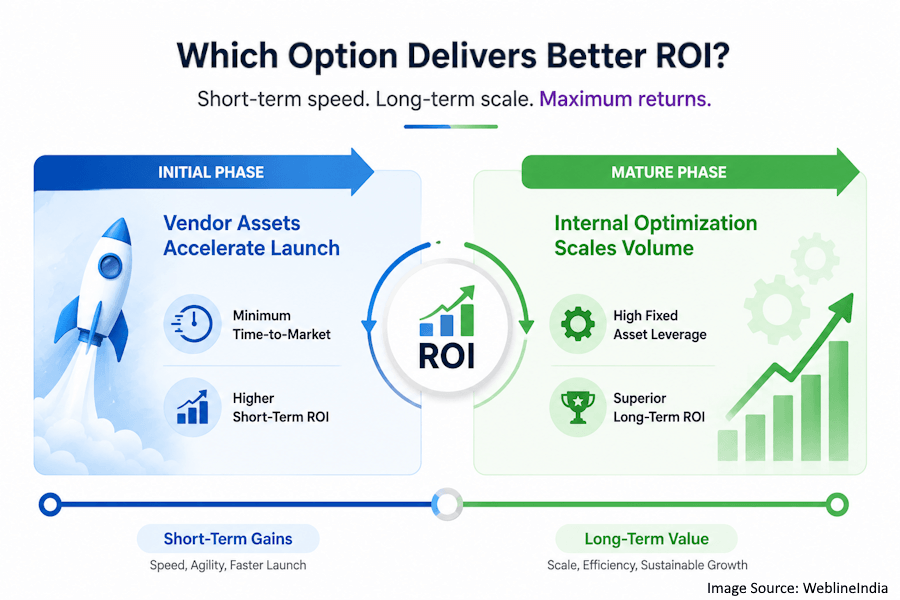
For massive, permanent production systems processing millions of daily transactions, an internal team can eventually yield better long-term financial returns. Once the core code stabilizes, the marginal cost of internal maintenance drops below ongoing agency hourly fees. However, reaching that break-even point typically requires several years of continuous production scale.
When an In-House AI Team Makes Sense
Building a dedicated internal group is the right strategic move under specific business conditions:
- Core IP Drivers: The machine learning algorithm is the primary commercial product or core intellectual property.
- Highly Regulated Environments: Defense, deep healthcare, or proprietary trading infrastructure where third-party data access is strictly forbidden.
- Constant Iteration Pipelines: Automated systems that require real-time model retraining based on continuous internal data streams.
When an AI Development Agency is the Better Choice
So, when to hire an AI development company? Well, determining whether you have hired right AI development team becomes straightforward when assessing specific operational challenges:
- Urgent Timeline Pressures: The enterprise must deploy a functional machine learning tool ahead of an immediate competitive cycle.
- Proof-of-Concept Validation: Testing a machine learning hypothesis without risking hundreds of thousands of dollars in permanent hiring pipelines.
- Workflow Automation Focus: Integrating predictive models or language engines into non-core supporting software like customer support desks or inventory systems.
Hybrid Model: Combining Internal Teams with AI Agencies
An absolute choice between an AI development agency vs hiring AI engineers is no longer mandatory. Forward-thinking enterprises frequently utilize a blended hybrid operational model.
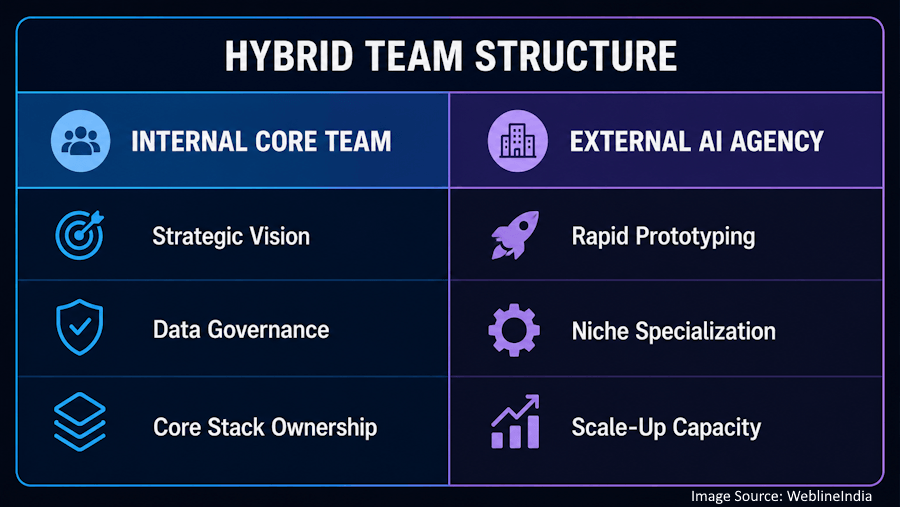
To manage the data in the long term and keep the corporation compliant, we have a lean team of AI product managers and data architects within the enterprise. The heavy engineering, the building of pipelines, and the initial model training are done by an external AI development agency like WeblineIndia. This means you can keep the strategy within the enterprise but immediately leverage the huge speed and large scale of external partners with immense technical depth.
Questions to Ask Before Making a Decision
Before signing employment offers or vendor contracts, management teams should answer these fundamental operational questions:
- Is the data ready? Clean, structured, labeled data is mandatory. If the internal data architecture is messy, an agency can build data ingestion pipelines much faster than an internal team can fix them from scratch.
- What is the real timeline? If a functional tool is needed in production within ninety days, recruitment delays make an internal build mathematically impossible.
- Is there long-term internal management capacity? Managing an internal machine learning group requires sophisticated technical leadership. Without an experienced internal CTO or VP of AI, internal engineers often lack clear, actionable direction.
Final Verdict: Which AI Development Approach is Right for Your Business?
Choosing between a permanent internal build and a flexible external partnership shapes a company’s technological trajectory for years to come. For organizations prioritizing rapid delivery, controlled budgets, and deep technical expertise without long-term recruitment liabilities, choosing an offshore AI development agency is the logical path forward.
When searching for an experienced, high-performance AI development agency, WeblineIndia provides a reliable, secure engineering solution. Operating as a proven AI development company, WeblineIndia supplies dedicated development teams, specialized machine learning architects, and clear, transparent delivery frameworks.
When you hire WeblineIndia as an AI development agency, it allows your business to bypass the friction of the tech hiring bubble that increases your AI development costs and deploy production-ready machine learning solutions quickly and securely.
Looking for the fastest and most cost-effective way to launch your AI solution?
Frequently Asked Questions
Globally Recognized for Unmatched Quality and Reliability




Testimonials: Hear It Straight From Our Global Clients
Our development processes delivers dynamic solutions to tackle business challenges, optimize costs, and drive digital transformation. Expert-backed solutions enhance client retention and online presence, with proven success stories highlighting real-world problem-solving through innovative applications. Our esteemed Worldwide clients just experienced it.
Awards and Recognitions
While delighted clients are our greatest motivation, industry recognition holds significant value. WeblineIndia has consistently led in technology, with awards and accolades reaffirming our excellence.

OA500 Global Outsourcing Firms 2025, by Outsource Accelerator

Top Software Development Company, by GoodFirms

BEST FINTECH PRODUCT SOLUTION COMPANY - 2022, by GESIA

Awarded as - TOP APP DEVELOPMENT COMPANY IN INDIA of the YEAR 2020, by SoftwareSuggest