AI Software Development Cost in 2026: Complete Cost Breakdown & Budget Guide
Any business planning for AI software development in 2026 quickly learns the real challenge isn’t just building it, it’s budgeting for data, talent, infrastructure and ongoing run costs. This guide walks through pricing tiers, regional rates and smart ways to cut costs while keeping quality high. Read the full article for the complete breakdown.

The landscape of AI software development has undergone a tectonic shift as we move through 2026. While the hype of previous years has settled, it has been replaced by a rigorous focus on AI ROI and production-grade reliability. For businesses and investors, the question is no longer if they should integrate artificial intelligence, but rather how much they must allocate to remain competitive without draining their capital.
In 2024, the global artificial intelligence (AI) market was valued at approximately USD 638.23 billion. The same figure was recorded for 2025 and projections indicate that the market could expand to nearly USD 3.68 trillion by 2034. And, it reflects a compound annual growth rate (CAGR) of about 19.2% over the period from 2025 to 2034.
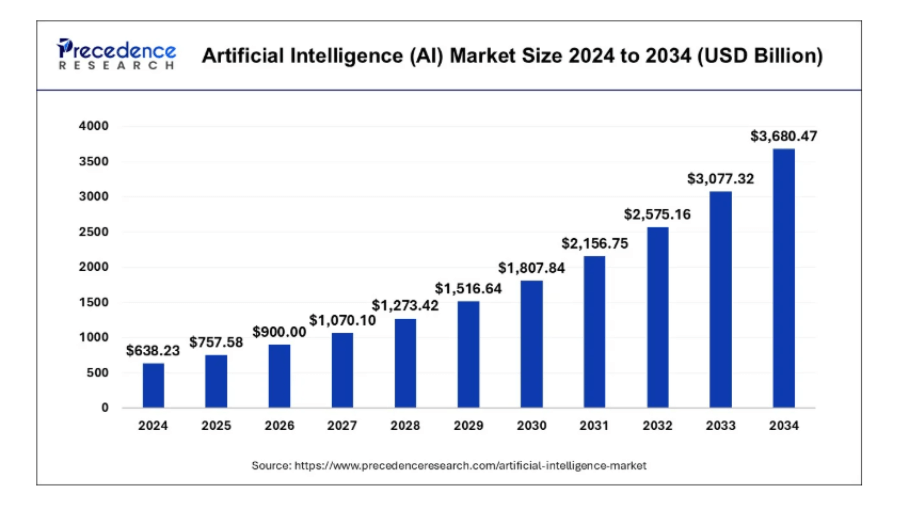
Source: Precedence Research
However, navigating the cost to build AI app solutions in 2026 requires more than just a developer’s quote; it requires an understanding of a highly volatile market. In another report, it is said that this year, the global AI market is projected to surpass $900 billion, driven largely by enterprise AI adoption and the move from experimental pilots to full-scale autonomous systems.
In this guide, we provide a definitive look at the AI software development cost in 2026. From the rise of agentic AI workflows to the commoditization of GPU cloud compute, we break down every financial variable you need to navigate.
How much should your business realistically budget for AI software development in 2026?
Why Understanding AI Development Costs Matters in 2026
For businesses and investors, the 2026 AI development budget is the difference between a scalable asset and a sunk cost. In 2026, the focus has shifted from ‘Can we build it?’ to ‘Can we afford to run it?’ Miscalculating the AI software development cost can lead to stalled projects, as inference costs and data compliance fees often catch unprepared teams off guard.
Snapshot of key trends shaping cost dynamics
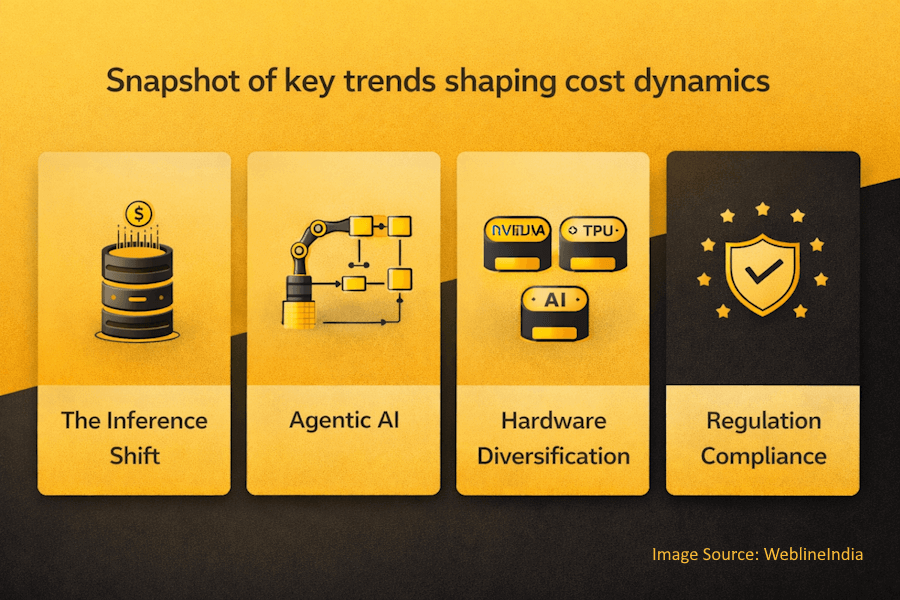
- The Inference Shift: In 2026, recurring operational costs (inference) are often higher than the initial model training cost.
- Agentic AI: Developing autonomous agents that execute tasks across software platforms is the new standard, requiring more complex backend integration.
- Hardware Diversification: The arrival of specialized AI chips (NVIDIA Blackwell, Google TPU v6) has created tiered pricing for cloud compute, allowing for more flexible AI project pricing.
- Regulation Compliance: Mandatory audits under the EU AI Act and similar global frameworks now account for roughly 10% of a standard AI project budget plan.
What is AI Software Development?
To accurately forecast the AI software development cost, one must first understand that AI is no longer a monolithic term.
In 2026, AI software development refers to the specialized engineering of systems that move beyond static code to perform autonomous reasoning, perception and decision-making. Unlike traditional apps, these systems require a continuous loop of data ingestion, model refinement and real-time inference.
Definition & Types of AI Software 2026
The types of AI software 2026 market offers can be categorized by their core functional architecture. Each type carries a unique price tag based on the complexity of its underlying brain:
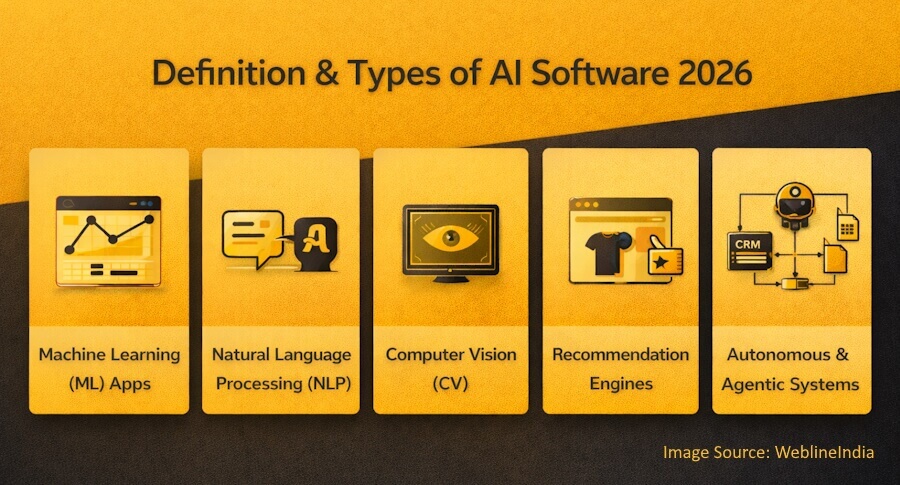
- Machine Learning (ML) Apps: These focus on predictive analytics. Common in finance for fraud detection or in retail for demand forecasting, these models learn patterns from historical data.
- Natural Language Processing (NLP): This is the backbone of advanced multilingual chatbots and document summarizers. In 2026, the focus has shifted toward Large Language Model (LLM) fine-tuning for industry-specific jargon.
- Computer Vision (CV): Used in medical diagnostics and manufacturing quality control, CV systems process visual data. These are high-cost projects due to the intense GPU requirements for processing video and high-resolution images.
- Recommendation Engines: Seen in e-commerce and streaming services, these systems require high-frequency data processing to deliver hyper-personalized user experiences.
- Autonomous & Agentic Systems: The 2026 gold standard. These AI agents do not just respond; they act. They can navigate between different software tools (e.g., a CRM and a billing system) to complete a multi-step task without human intervention.
How Complexity Influences Cost
The AI software development cost is a direct reflection of technical depth. A project’s complexity is typically measured by three factors:
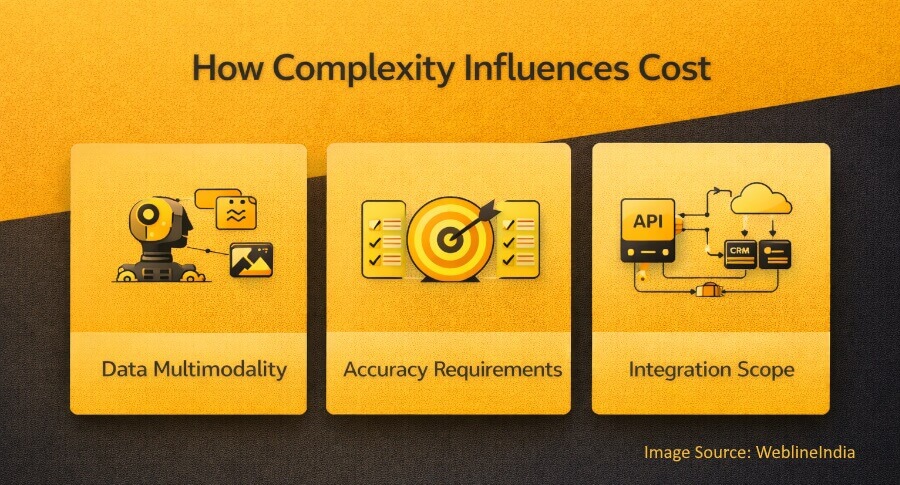
- Data Multimodality: A system that only processes text is significantly cheaper than one that must synchronize text, audio and video simultaneously.
- Accuracy Requirements: Moving a model from 90% accuracy to 99% accuracy can often triple the AI development budget because the “long tail” of edge cases requires massive amounts of niche data.
- Integration Scope: A standalone AI tool is affordable. However, an enterprise AI system that must integrate with legacy databases and third-party APIs requires extensive custom middleware, driving up the total AI project pricing.
By identifying which of these types of AI software aligns with your business goals in 2026, you can begin to narrow down the specific cost to build AI app solutions for your organization.
AI Software Development Cost Estimates in 2026
Providing a concrete AI development cost in 2026 requires a look at data-driven benchmarks. While every project is unique, the market has matured enough to offer standard pricing tiers based on the scope, data volume and technical complexity.
In 2026, the cost to build AI app solutions is heavily influenced by whether you are using pre-trained models via APIs or building proprietary architectures.
Typical Cost Examples
The following table outlines the AI project pricing landscape for the most common development tracks this year.
| Project Type | Estimated Cost | Notes |
| AI Proof of Concept (PoC) | $20,000 – $60,000 | Focuses on feasibility; uses existing APIs and basic datasets. |
| Small to Mid MVP | $60,000 – $250,000 | Limited-scope projects with custom UI and basic MLOps integration. |
| Enterprise AI Systems | $250,000 – $1.5M+ | Full-scale integration, high-security features and custom data pipelines. |
| Custom Large Models / LLM | $600,000 – $6M+ | Specialized architectures, proprietary training data and massive compute. |
AI Proof of Concept
A PoC is the lowest entry point for an AI software development cost. In 2026, these are often used to test agentic AI workflows within a controlled environment. The goal is to prove AI ROI to stakeholders before committing to a six-figure enterprise AI budget. These projects typically wrap up within 4 to 8 weeks.
Small to Mid-Sized MVP
A Minimum Viable Product (MVP) at this level usually involves fine-tuning a foundational model (like GPT-5 or Llama 4) on a company’s private data. This tier represents the most common AI development budget for startups. It includes a functional user interface, secure user authentication and a scalable backend.
Enterprise AI Systems
For established corporations, the AI software development cost reflects the need for industrial-grade reliability. These systems must handle thousands of concurrent users and adhere to strict data residency laws. A significant portion of this AI development cost in 2026 goes toward ensuring the system can operate across different departments, such as HR, Legal and Finance, simultaneously.
Custom Large Models and Proprietary LLMs
Only a small percentage of companies require a ground-up model. This is the high-stakes tier of AI project pricing. The costs are driven by the massive model training cost, which includes hiring specialized PhD-level researchers and securing months of dedicated GPU cloud compute. These models provide a massive competitive moat but require a multi-million dollar commitment.
Variable Ranges and Domain Complexity
It is important to note that a feature-rich app in a highly regulated domain (like a healthcare AI assistant) will always sit at the higher end of these brackets. Data volume remains the primary hidden variable; a model processing 1 terabyte of data will naturally command a higher AI development budget than one processing 10 gigabytes, simply due to the infrastructure required to store and move that information.
Regional Cost Comparisons
In 2026, the AI software development cost is heavily dictated by the geographic location of your engineering team. While cloud infrastructure costs are relatively global, the human capital remains the most significant variable in your AI project budget plan.
Modern businesses often utilize a global delivery model, mixing high-level strategy from onshore architects with scalable execution from offshore hubs.
North America
North America, particularly the United States, remains the most expensive region for AI software development.
- Hourly Rates: Expect to pay between $120 and $250+ per hour for senior AI architects.
- Annual Salaries: A senior AI developer cost in USA typically starts at $180,000, with specialized Generative AI engineers in hubs like San Francisco or New York exceeding $300,000.
- Value Proposition: You are paying for proximity to the world’s leading AI research labs and the ability to conduct real-time, high-stakes collaboration.
Europe
The European market is bifurcated between Western and Eastern regions, each offering different AI project pricing dynamics.
- Western Europe (UK, Germany, France): Rates range from $100 to $180 per hour. This region is ideal for projects requiring strict adherence to the EU AI Act, as local teams have a native understanding of these regulatory hurdles.
- Eastern Europe (Poland, Romania, Ukraine): Known for premium quality at scale, hourly rates here fall between $50 and $90. Poland has specifically emerged as a global hub for custom AI software development, offering a balance of high technical literacy and moderate costs.
Asia and India
For organizations looking to maximize their 2026 AI development budget, Asia and India in particular are the primary destinations.
- India: The AI development cost in India is the most competitive globally, with senior engineers charging between $30 and $70 per hour. India has shifted from being a back-office hub to a center of excellence for LLM fine-tuning and data annotation.
- Southeast Asia (Vietnam, Philippines): These rising stars offer rates as low as $25 to $50 per hour, making them ideal for AI MVP development cost optimization and large-scale data processing tasks.
Latin America
Latin America has become the preferred nearshore partner for North American firms.
- Brazil, Mexico, Argentina: Rates typically range from $40 to $110 per hour.
- The Time Zone Advantage: Unlike the 10-12 hour gap with Asia, Latin American teams work in parallel with US business hours, reducing the communication overhead that often inflates the AI software development cost.
Offshore vs Onshore Cost Trade-offs
Choosing between offshore AI developers pricing and onshore teams involves more than just comparing hourly rates.
| Factor | Onshore (US/UK) | Nearshore (LATAM) | Offshore (India/SEA) |
| Direct Cost | High (100%) | Mid (60-70%) | Low (30-40%) |
| Communication | Real-time | Real-time | Asynchronous |
| Talent Pool | Niche/Competitive | Growing | Massive/Scalable |
| Best For | Strategy & R&D | Agile Product Builds | Large-scale Execution |
While offshore AI developers pricing can save you up to 70% on raw labor, you must account for an additional 10-15% management tax to handle the logistics of remote coordination. For a 2026 project to be successful, a hybrid model (onshore leadership with offshore development) often yields the best AI ROI.
How to Budget for an AI Project in 2026
Budgeting for an AI software development cost in 2026 has evolved into a multi-dimensional financial exercise. Static budgets are no longer effective because AI systems are living assets that consume resources differently than traditional buy-and-hold software.
A modern AI project budget plan must account for both the initial capital expenditure and the long-tail operational costs that peak in years two and three.
Step-by-Step Budgeting Framework
To avoid the common pilot trap, where projects stall after the initial proof of concept, finance leaders now use a phased budgeting approach:
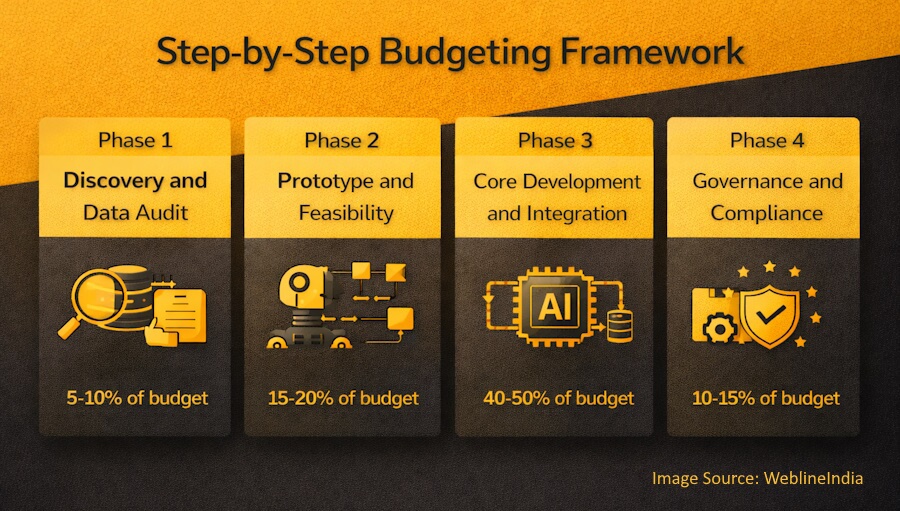
- Phase 1: Discovery and Data Audit (5-10% of budget): Before a single line of code is written, you must assess data quality. In 2026, data readiness is the top reason for budget overruns.
- Phase 2: Prototype and Feasibility (15-20% of budget): This stage validates the AI project pricing by testing the model on a small subset of real-world data.
- Phase 3: Core Development and Integration (40-50% of budget): The “heavy lifting” phase, where your AI development partner builds the custom pipelines and integrates them with your existing software stack.
- Phase 4: Governance and Compliance (10-15% of budget): Essential for meeting 2026 global regulatory standards, covering safety audits and bias testing.
Estimating First Year vs. Lifetime Cost
A critical mistake in AI development cost 2026 planning is ignoring the Total Cost of Ownership (TCO). In 2026, the initial build typically represents only 30% to 40% of the total three-year expenditure.
- Year 1 (The Build): High focus on talent, data acquisition and initial compute.
- Year 2 (The Scale): Focus shifts to inference costs and user adoption. As traffic increases, the cost to run the model often surpasses the original cost to train it.
- Year 3 (The Optimization): Maintenance, model retraining to combat “drift,” and security updates dominate the spend.
Calculating AI ROI and Payback Period
In 2026, boards are demanding hard financial metrics rather than speculative efficiency claims. The AI ROI calculator used by top firms follows this formula:

Key Metrics for ROI Success:
- Labor Offset: Total hours saved across departments multiplied by the fully-loaded hourly rate of employees.
- Revenue Lift: Incremental sales attributed to AI-driven personalization or lead scoring.
- Risk Mitigation: The avoided cost of regulatory fines or data breaches—a major factor for enterprise AI systems.
The Payback Period: While traditional software might see a return in 6 months, the average AI software development cost takes 18 to 30 months to reach the break-even point. This is due to the learning curve, where the model requires a period of production data before it reaches peak accuracy and efficiency.
What hidden AI operational costs impact long-term ROI the most?
Cost Saving Strategies Without Compromising Quality
In 2026, high-impact AI does not always require a high-impact price tag. As the market has matured, several technical shortcuts and architectural shifts have emerged that allow enterprises to reduce AI development cost by as much as 30% to 70%.
Organizations can allocate more of their 2026 AI development budget toward user experience and integration by moving away from the build everything from scratch mentality.
Use Open-source Models and Tools
The performance gap between proprietary models (like GPT-5) and open-source alternatives has narrowed to just a few months. In 2026, utilizing open-weight models like Llama 4, Mistral 8x22B or gpt-oss-120b has become a primary and affordable AI development strategy.
- Zero Licensing Fees: Open-source models eliminate the per-token tax associated with commercial APIs, which is vital for high-volume applications.
- Specialized Performance: Models like DeepSeek-V3 or MiMo-V2-Flash are often superior for specific tasks like coding or agentic AI workflows, allowing you to use a smaller and cheaper model for 90% of your needs.
- On-Premise Hosting: For regulated industries, hosting open-source models on private infrastructure avoids the cost of enterprise-grade security wrappers on public clouds.
Transfer Learning and Fine-Tuning
One of the most effective ways to reduce AI development cost is through transfer learning. Rather than training a model from the ground up (which can cost millions), developers take a model that already understands the world and fine-tune it on a small, high-quality dataset of company-specific information.
- Data Efficiency: Transfer learning reduces the required training data by up to 90%, moving the needle from millions of records to just a few thousand.
- Compute Savings: Fine-tuning typically requires hours of GPU time rather than the months required for foundational training, slashing the model training cost by 80% or more.
Cloud Cost Optimization and FinOps
In 2026, FinOps (Financial Operations) for AI is a mandatory discipline. Modern teams use these tactics to keep infrastructure spending under control:
- Spot Instances: Using interruptible cloud capacity for training can save 70% to 90% on GPU costs. In 2026, sophisticated orchestration tools automatically checkpoint training progress, so no data is lost if the instance is reclaimed.
- Inference Pruning: Techniques like quantization allow a model to run on cheaper, less powerful hardware (like CPUs or older GPUs) without a noticeable drop in accuracy.
- Ephemeral Environments: Development and staging servers that automatically shut down during non-business hours can cut monthly infrastructure bills by 30%.
Cross-Functional Teams and Modular Design
A modular approach to AI software development prevents the need for expensive, total-system overhauls.
- Microservices Architecture: Think of building AI features as independent modules and you can upgrade or swap out specific components (like moving from a text-based model to a multimodal one) without rebuilding the entire platform.
- Unified Data Layers: Investing early in a clean data pipeline prevents the re-cleaning tax, where data scientists spend 80% of their time fixing formatting issues instead of building models.
| Strategy | Potential Savings | Impact on Quality |
| Open Source Models | 40% – 60% (OpEx) | Minimal (with proper fine-tuning) |
| Transfer Learning | 80% – 90% (CapEx) | Often improves domain accuracy |
| Spot Instances | 70% – 85% (Compute) | None (affects timeline, not quality) |
| Quantization | 20% – 40% (Inference) | 1-2% drop in hyper-specific accuracy |
Businesses can ensure their project remains financially viable even as it scales to thousands of active users by implementing these affordable AI development strategy options.
Pricing Models and Partner Options
Choosing the right partner and contract structure is a pivotal decision that directly impacts the AI software development cost and the long-term viability of the project. In 2026, the complexity of agentic AI workflows and the speed of model iterations have made traditional outsourcing models more flexible. Businesses must decide between building an in-house team, hiring specialized freelancers or collaborating with a full-service AI development partner.
In-house vs Agency vs Freelancers for AI Software Development in 2026
The person behind your development determines not just the hourly rate, but the speed of deployment and the bus factor, the risk associated with knowledge being held by too few people.
- In-house AI Teams: Best for companies where AI is the core product. While this offers the highest level of control and IP security, it is the most expensive path. Annual salaries for a 5-person squad (Data Scientist, ML Engineer, Backend Developer, PM and MLOps) often exceed $800,000 to $1.2M, excluding recruitment fees and benefits.
- AI Development Agencies: The most common and the best choice for enterprise AI systems. An AI development agency provides a ready-to-go, cross-functional team and built-in Quality Assurance. In India, hourly rates are affordable ($50–$200), the time-to-market is significantly faster because they utilize pre-built automation marketplaces and established internal frameworks.
- Freelance AI Developers: Generally for very small-scale tasks, AI MVP development cost optimization or isolated script writing. Rates are budget-friendly ($50–$150 per hour), but the burden of project management falls entirely on you. In 2026, many high-end freelancers operate as solopreneurs specialized in niche areas like multimodal AI integration. However, the risks are higher compared to other AI software development options.
Comparative Decision Matrix
| Factor | In-House Team | AI Agency | Freelancer |
| Setup Speed | Very Slow (Months) | Fast (Weeks) | Instant (Days) |
| Cost | Highest (Fixed) | Flexible | Lowest (Variable) |
| Expertise | Deep & Institutional | Broad & Versatile | Average |
| Scalability | Hard to scale up/down | Highly Scalable | Limited |
Common Pricing Structures in 2026
Modern AI project pricing has moved away from rigid estimates toward models that better reflect the iterative nature of machine learning.
- Fixed Pricing: This model involves a set fee for a clearly defined scope. It works best for AI Proof of Concept (PoC) projects where the goals are stable. However, be aware that vendors often add a 20% to 30% risk premium to cover potential technical unknowns.
- Time and Materials (T&M): The standard for 2026 development. You pay for the actual hours worked and resources used. This is essential for complex custom AI software development where requirements evolve as the model is tested on real-world data. It offers maximum transparency but requires active budget monitoring.
- Dedicated Resources: A team or specific experts are assigned exclusively to your project. This ensures continuity, domain expertise and flexibility as priorities evolve. It usually involves higher upfront costs but provides long-term stability and alignment with your goals.
Choosing the Best AI Development Partner
To secure the best value for your 2026 AI development budget, look for partners who demonstrate AI-native workflows. In 2026, a top-tier partner should not be manually writing every line of boilerplate code; they should be using AI-assisted coding tools to complete tasks 50% faster, passing those efficiency savings on to you.
When evaluating a potential partner, prioritize their MLOps capabilities. A partner who can build a model but cannot explain how they will monitor its drift or automate its retraining will likely end up costing you more in technical debt within the first year.
Real-World AI Software Development Case Studies
To truly grasp the AI software development cost in 2026, we must look beyond theoretical brackets and analyze how organizations are actually allocating their capital. These case studies highlight the disparity between initial investment and long-term value. They provide a blueprint for your own AI development budget.
Case Study 1: Healthcare AI Diagnostic System
A mid-sized oncology network sought to implement a Computer Vision solution to assist radiologists in identifying early-stage anomalies in MRI scans.
- Project Scope: Integration of a custom-trained vision model into existing EHR (Electronic Health Record) systems with HIPAA-compliant data pipelines.
- Initial Build Cost: $380,000. This included $120,000 for high-fidelity data annotation and $150,000 for senior AI engineers to handle the complex medical integration.
- Operational Spend: $12,000/month for dedicated GPU inference and continuous model monitoring to prevent diagnostic drift.
- Outcome & ROI: Within 14 months, the system reduced manual review time by 40%. The network reported an AI ROI of $3.20 for every $1 invested, primarily through increased patient throughput and reduced insurance claim denials.
Case Study 2: Retail Hyper-Personalization Engine
A global e-commerce fashion retailer moved from a rule-based recommendation system to an agentic AI approach to drive sales.
- Project Scope: Building a multi-agent system that analyzes real-time user behavior, local weather patterns and social media trends to suggest outfits.
- Total AI Project Pricing: $210,000. The retailer saved 30% by using an open-source foundational model and fine-tuning it on their proprietary customer data.
- Maintenance Cost: $6,500/month for retraining the model every two weeks to keep up with fast-fashion cycles.
- Outcome: The retailer saw a 32% increase in Average Order Value (AOV) and a 25% boost in repeat purchase rates within the first six months. The project reached its break-even point in just 9 months.
Case Study 3: Autonomous Supply Chain Logistics
A logistics firm developed an autonomous dispatcher agent to manage fleet routing and warehouse inventory levels without human intervention.
- Project Scope: A high-complexity enterprise AI system utilizing reinforcement learning and real-time IoT (Internet of Things) data.
- Development Cost: $1.2M. A significant portion of this 2026 AI development budget was spent on red teaming and safety audits to ensure the system wouldn’t cause logistical gridlock during edge-case scenarios.
- Long-term Cost: $45,000/month for high-end cloud infrastructure and a dedicated MLOps team for 24/7 monitoring.
- Outcome: The system reduced fuel consumption by 18% and slashed warehouse dead stock by 22%. Despite the high AI software development cost, the firm expects a total saving of $4M over three years.
Comparative Summary of Case Studies
| Industry | Primary Tech | Initial Cost | Monthly OpEx | Payback Period |
| Healthcare | Computer Vision | $380,000 | $12,000 | 14 Months |
| Retail | Agentic AI / LLM | $210,000 | $6,500 | 9 Months |
| Logistics | Autonomous RL | $1,200,000 | $45,000 | 22 Months |
These AI budget examples 2026 demonstrate that while the sticker price of AI can be high, the ability to scale human-like decision-making leads to a rapid payback period compared to traditional software investments.
Future Cost Trends Beyond 2026
As we look toward 2027 and the end of the decade, the future AI development costs will be shaped by a paradox: while the cost of raw intelligence (tokens and processing) is plummeting, the cost of compliance and reliability is rising. Businesses must prepare for a landscape where the AI software development cost is no longer dominated by initial coding, but by automated lifecycle management and global regulatory adherence.
Impact of AI Automation Tools
The rise of AutoML and AI-augmented engineering is fundamentally shifting the 2026 AI development budget. Experts say that by 2027, AI building AI will be the industry standard.
- Democratization of Development: AutoML platforms are projected to grow at a CAGR of over 40% through 2031. These tools allow non-experts to build high-quality models, potentially reducing the need for massive, high-cost data science teams for standard business use cases.
- Agentic Automation: AI agents are now capable of handling up to 15% of total software engineering time. This trend will accelerate, meaning the cost to build AI app solutions will decrease for boilerplate features, allowing teams to focus exclusively on proprietary edge logic.
Hardware Commoditization and Edge AI
The compute crunch of the mid-2020s is easing as new players enter the hardware market.
- Beyond GPUs: The arrival of mass-produced NPUs (Neural Processing Units) in consumer devices is moving the burden of cost from the cloud to the edge.
- Inference Efficiency: Market experts say that by 2027, the cost of running an AI model (inference) is expected to drop significantly as specialized inference-only chips become widely available. This shift will make it more affordable for small businesses to deploy enterprise AI systems that were previously cost-prohibitive.
Regulatory Cost Impact
The most significant new driver in the AI project cost breakdown is the compliance tax. With the EU AI Act fully coming into effect between 2026 and 2027 and similar frameworks emerging in the US and Asia, regulatory spending is becoming a permanent line item.
- Mandatory Audits: High-risk AI systems (used in healthcare, finance or critical infrastructure) will require annual third-party audits. These can add $30,000 to $100,000 to the annual maintenance budget.
- Explainability Requirements: Interpretable Building models (meaning humans can understand why a decision was made) is technically harder and more expensive than building “black box” models. This requirement can increase the initial AI software development cost by 15-20%.
Summary of Future Cost Drivers
| Trend | Impact on Cost | Why? |
| AutoML Adoption | Decrease | Reduces dependency on expensive, specialized labor. |
| Regulatory Compliance | Increase | Requires continuous monitoring, auditing and legal overhead. |
| Edge Computing | Decrease | Shifts compute costs from expensive cloud providers to local hardware. |
| Inference Price War | Decrease | Massive competition among model providers (OpenAI, Google, Meta) keeps token prices low. |
The successful organizations of 2027 will be those that reinvest their “automation savings” into AI safety and governance, ensuring their systems are not only affordable but also legally and ethically resilient.
Partnering for Your AI Future
Navigating the AI software development cost in 2026 requires a partner who understands the delicate balance between cutting-edge innovation and fiscal responsibility. As AI continues to evolve from a standalone tool into an integrated digital co-worker, choosing a developer with a proven track record is the most critical decision for your project’s success.
Why WeblineIndia is a Top AI Development Agency
When it comes to building scalable, secure and cost-effective solutions, WeblineIndia stands out as the premier partner for businesses of all kinds and sizes. With over 26 years of experience in the technology landscape, we have transitioned through every major digital shift to become a veteran leader in the current AI-first era.
WeblineIndia’s Core Features and Expertise
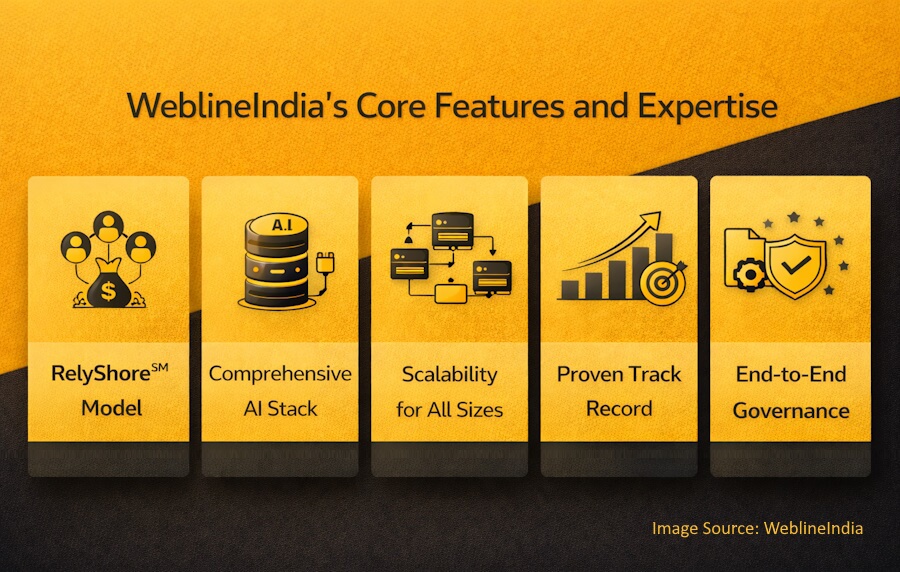
- RelyShoreSM Model: Our signature reliable offshore model ensures high-quality development at competitive rates. We offer the transparency and security of an onshore partner with the cost advantages of offshore talent.
- Comprehensive AI Stack: From Machine Learning and Natural Language Processing to advanced Agentic AI systems and Computer Vision, we possess the technical depth to handle the most complex enterprise requirements.
- Scalability for All Sizes: Whether you are a startup needing an AI MVP or a global enterprise deploying a multi-agent autonomous workflow, our flexible engagement models (Fixed Cost, T&M and Dedicated Teams) adapt to your specific budget.
- Proven Track Record: Having delivered over 3,600 projects to 825+ clients across 25 countries, we bring institutional knowledge that reduces development time and prevents common integration pitfalls.
- End-to-End Governance: WeblineIndia doesn’t just build code; we provide a complete roadmap, including AI strategy, data modernization and rigorous compliance testing to meet 2026 global AI safety standards.
Choose WeblineIndia as your AI development offshore agency in India. If you want to hire more than a vendor and gain a strategic collaborator dedicated to transforming your business logic into intelligent and future-ready software, we are the choice.
Social Hashtags
#AISoftwareDevelopment #AICost2026 #AIDevelopmentGuide #AIProjectBudget #AIAppDevelopment #ArtificialIntelligence #AITrends2026 #TechBusinessStrategy #AIForBusiness #AIInvestment
Which AI development approach delivers maximum value without overspending?
Frequently Asked Questions
Globally Recognized for Unmatched Quality and Reliability




Testimonials: Hear It Straight From Our Global Clients
Our development processes delivers dynamic solutions to tackle business challenges, optimize costs, and drive digital transformation. Expert-backed solutions enhance client retention and online presence, with proven success stories highlighting real-world problem-solving through innovative applications. Our esteemed Worldwide clients just experienced it.
Awards and Recognitions
While delighted clients are our greatest motivation, industry recognition holds significant value. WeblineIndia has consistently led in technology, with awards and accolades reaffirming our excellence.
OA500 Global Outsourcing Firms 2025, by Outsource Accelerator
Top Software Development Company, by GoodFirms

BEST FINTECH PRODUCT SOLUTION COMPANY - 2022, by GESIA

Awarded as - TOP APP DEVELOPMENT COMPANY IN INDIA of the YEAR 2020, by SoftwareSuggest