How Much Control Should We Give Machines in Automation and Privacy?
Automation and data privacy are critical in today’s digital world. Discover how businesses can balance efficiency with security, reduce risks and protect sensitive data while leveraging automation technologies for growth and innovation.

Listen to the podcast :

 ChatGPT
  Perplexity
 The march of automation and privacy concerns is becoming more and more linked. As we give machines more jobs, from simple data entry to complicated decision-making, we need to think carefully about how this will affect our personal information. The question is not whether automation will affect privacy, but rather the extent of control we maintain over our data in an increasingly automated landscape. As future of process automation keeps getting better, a lot of businesses are trying to figure out if it’s the future or just a trend that’s getting bigger.
This blog post goes into detail about the complicated relationship between automation and privacy. It looks at the possible pros and cons and talks about the important balance we need to find to protect people’s rights in the age of smart machines.
What is Automation, and how does it change privacy?
According to a study published in Harvard Business Review, nearly 80% of employees said that automation gave them more time to work on tougher projects, build better relationships with customers and stakeholders, and learn new skills.
Privacy and automation are becoming more and more connected as more businesses use automated systems for everything from customer service to running their own businesses. Automation is when technology does tasks with little to no help from people. A trusted process automation company usually does this. The technology can be as simple as software bots that do the same thing over and over again, or it can be more complicated systems that use artificial intelligence (AI) to make choices.
Automation has many benefits, but it also means dealing with a lot of data. This information often contains personal information that needs to be handled with care to protect privacy and security. Privacy in automation is a big deal because automated systems can handle and store a lot of data, some of which could be very private. Automation could cause data breaches or the misuse of private information if the right protections aren’t in place. This would hurt both the trust of users and the integrity of businesses.
Curious how automation could transform your business without risking data privacy?
How is the growth of automation affecting data privacy?
As you can see, automation is no longer something that will happen in the future; it is happening now. Machines are becoming more and more a part of our daily lives, from chatbots that help customers with their problems to AI-powered medical diagnoses. Data is a big part of this integration. By looking at huge datasets, which often include private information, machines learn and get better.
Automation’s reliance on data raises serious privacy issues. The more we automate, the more data we create, which means there is a bigger chance of it being misused or stolen. To make sure that automation is private, it is very important to know how data moves through automated systems.
What are the privacy risks of automating processes?
By automating repetitive tasks, process automation makes workflows easier. While keeping data private, many businesses use process workflow automation to boost sales. This could mean anything from automating email marketing campaigns to keeping track of complicated supply chains. Process automation can make things more efficient, but it can also make things less private and more risky. Think about a situation in which a company that automates processes makes a system for hiring people automatically. This system might look through resumes, look at candidate profiles, and even do video interviews on its own.
The amount of personal data that a system like this processes makes people worry about data security, access control, and the possibility of algorithmic bias. Any company that automates processes needs to have a strong understanding of privacy and process automation in order to build systems that are ethical and responsible. For a company that makes process automation software, following privacy-by-design principles throughout the development cycle is not just a good idea; it’s a must.
How Does Business Automation Handle the Growing Data Deluge?
Business automation includes a wider range of automated processes in a company, such as operations, HR, and finance. A company that automates business processes helps other companies set up these systems. Oracle quotes give some important numbers about marketing automation and lead generation in businesses around the world:
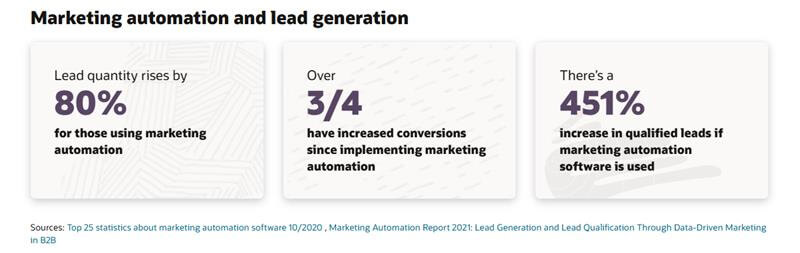
Source: Oracle on Marketing Automation and Lead Generation
Business automation can greatly boost productivity and cut costs, but it also creates a lot of data. Companies can get the most out of their investments without giving up privacy by learning how process automation experts boost ROI. If this data isn’t handled correctly, it could put people’s privacy at risk. Automated employee monitoring systems, for example, can gather private information about how employees act, which could lead to privacy violations even though they are meant to help performance.
A business automation company has to come up with systems that make work as efficient as possible without invading people’s privacy. Because of this, a company that makes process automation software should know a lot about data protection laws.
What part does marketing automation software play in keeping data safe?
Today, marketing automation software is one of the most important parts of business automation. These tools help businesses connect with customers better while cutting down on manual work. They can manage email campaigns, nurture leads, track customer interactions, and give detailed analytics.
At the same time, marketing automation software needs to protect customer privacy because it needs to use their data. Companies need to follow rules like GDPR and CCPA by using consent management, secure data storage, and clear communication. When used correctly, marketing automation software not only makes businesses more efficient and helps them grow, but it also builds trust between businesses and their customers.
How can businesses find a balance between privacy and efficiency in automation?
In the age of automation and privacy, the conflict between privacy and efficiency is a major problem. Automated systems often require access to personal data to function effectively. For instance, e-commerce sites use data about past purchases and browsing history to make personalized suggestions.
These suggestions may be helpful, but they also make me worry about how much our online behavior is being watched and studied. It’s important to find the right balance between the benefits of automation and the need to protect privacy in automation. This necessitates a comprehensive strategy, incorporating technical protections, regulatory structures, and ethical considerations.
Build Privacy-First Automation. Design automation systems that protect sensitive data while driving efficiency.
What technical protections keep privacy safe in automation?
To make automation more private, you can use a number of technical steps:
- Data Minimization: Only collecting the data that is absolutely necessary for the purpose at hand.
- Anonymization and Pseudonymization: Methods for removing identifying information from data so that it is hard to connect to specific people.
- Adding noise to datasets to protect individual privacy while still allowing for group analysis is called differential privacy.
- Encryption: Using encryption methods to keep data safe from people who shouldn’t have access to it.
- Access Control: Limiting who can see sensitive data based on their roles and permissions.
When used correctly, these technical protections can greatly lower the risks to privacy that come with automation. These are skills that a company that automates processes should have.
How do rules like GDPR affect automation and privacy?
Laws like the California Consumer Privacy Act (CCPA) and the General Data Protection Regulation (GDPR) are very important for setting standards for privacy and process automation. These rules for collecting, processing, and storing data give people more control over their own information.
For a company that automates processes and a company that automates businesses, following these rules is not only the law but also the right thing to do. These rules also change what a company that makes process automation does.
What ethical issues come up with privacy and automation?
In addition to technical safeguards and following the law, ethical issues are the most important thing to think about when dealing with the complicated relationship between privacy and automation. We need to ask ourselves:
- What effects could widespread automation have on society?
- How do we make sure things are fair and avoid bias in algorithms?
- How do we keep automated systems under human control?
These moral issues need to be thought about carefully and talked about openly. Following proven frameworks like ethical process automation best practices can help businesses be fair and responsible.
How does WeblineIndia protect privacy in business process automation?
WeblineIndia is great at making business process automation solutions because they put privacy first at every step. We put a lot of emphasis on security, so we use strong encryption, safe ways to handle data, and follow global privacy standards like W3C, GDPR, and CCPA.
Our team of experts makes sure that automation systems are customized to meet the needs of each business while keeping private data safe. WeblineIndia is a reliable process automation company that offers effective, privacy-conscious solutions that help businesses grow without putting data security at risk.
What Will Happen to Automation and Privacy in the Future?
The future of privacy and automation depends on how well we can find a long-term balance between new technologies and people’s rights. We need to keep up with how automation changes and how it affects privacy. This requires ongoing research, cooperation among stakeholders, and compliance with ethical standards.
The conversation about privacy and automation isn’t just about technology; it’s also about the kind of future we want to create as a society. A process automation company, a business automation company, or a process automation development company all have a role to play in making this future happen. Contact WeblineIndia, and we’ll make sure that the advantages of automation don’t come at the expense of your rights or those of your customers by putting privacy and process automation first.
Social Hashtags
#AutomationAndPrivacy #DataPrivacy #BusinessAutomation #ProcessAutomation #DigitalTransformation #AIandPrivacy #SecureAutomation #DataProtection #PrivacyFirst #GDPRCompliance #TechEthics #AutomationStrategy #CyberSecurity #PrivacyByDesign #WeblineIndia
Scale Smart with Secure Automation. Leverage automation without risking data breaches or compliance issues.
Frequently Asked Questions
– Data minimization (collecting only necessary data).
– Encryption & anonymization to secure sensitive information.
– Compliance with regulations like GDPR and CCPA.
– Privacy-by-design integration in development.
For expert guidance, consult a trusted business automation company like WeblineIndia.
Obtain user consent for data collection.
Allow data access/deletion requests.
Report breaches promptly.
Globally Recognized for Unmatched Quality and Reliability




Testimonials: Hear It Straight From Our Global Clients
Our development processes delivers dynamic solutions to tackle business challenges, optimize costs, and drive digital transformation. Expert-backed solutions enhance client retention and online presence, with proven success stories highlighting real-world problem-solving through innovative applications. Our esteemed Worldwide clients just experienced it.
Awards and Recognitions
While delighted clients are our greatest motivation, industry recognition holds significant value. WeblineIndia has consistently led in technology, with awards and accolades reaffirming our excellence.

OA500 Global Outsourcing Firms 2025, by Outsource Accelerator

Top Software Development Company, by GoodFirms

BEST FINTECH PRODUCT SOLUTION COMPANY - 2022, by GESIA

Awarded as - TOP APP DEVELOPMENT COMPANY IN INDIA of the YEAR 2020, by SoftwareSuggest