Custom Food Delivery App Features in 2026 That Cater to Hyperlocal Markets
The article walks through how food delivery in 2026 is becoming a fast, neighborhood-focused story where apps must feel personal, run smoothly, and support local kitchens and greener choices. It shows how smart features shape this growing world. Give the full article a read!

Listen to the podcast :
In the competitive landscape of on-demand services, the hyperlocal food delivery market is experiencing unprecedented growth. Valued at over $540 billion in 2025 and projected to reach $1.46 trillion by 2032, this sector is driven by urbanisation, digital adoption, and the consumer’s insatiable demand for speed and convenience.
For any business to capture a significant share of the custom food delivery market in 2026, a generic, off-the-shelf application is simply not enough. The key to long-term success lies in building a truly custom food delivery app designed with features meticulously tailored to the specific, micro-local needs of its target community. This also positions your platform as a custom marketplace built to support fast, localised demand.
This comprehensive guide will explore the essential and cutting-edge features that transform a standard application into a market-leading hyperlocal food delivery app in 2026. We will delve into how strategic food delivery app development can leverage 2026’s technological advancements, from AI-powered personalisation to sustainable delivery logistics. This is to ensure that your platform is not just functional but also future-proof.
Start building your Custom Food Delivery App with expert help from WeblineIndia.
The Hyperlocal Edge: Why Customisation is Crucial for Market Supremacy
The term “hyperlocal” means focusing on a very small and defined geographical area. It is often a single neighbourhood, city block, or small town. In this context, the customer expects an almost instantaneous service. Major global players have proven that custom food delivery app solutions in 2026 are the only way to meet these high expectations.
Your food delivery app development strategy must, therefore, be laser-focused on overcoming local logistical complexities and offering deeply personalised user experiences.
Key Trends Shaping Hyperlocal Delivery in 2026
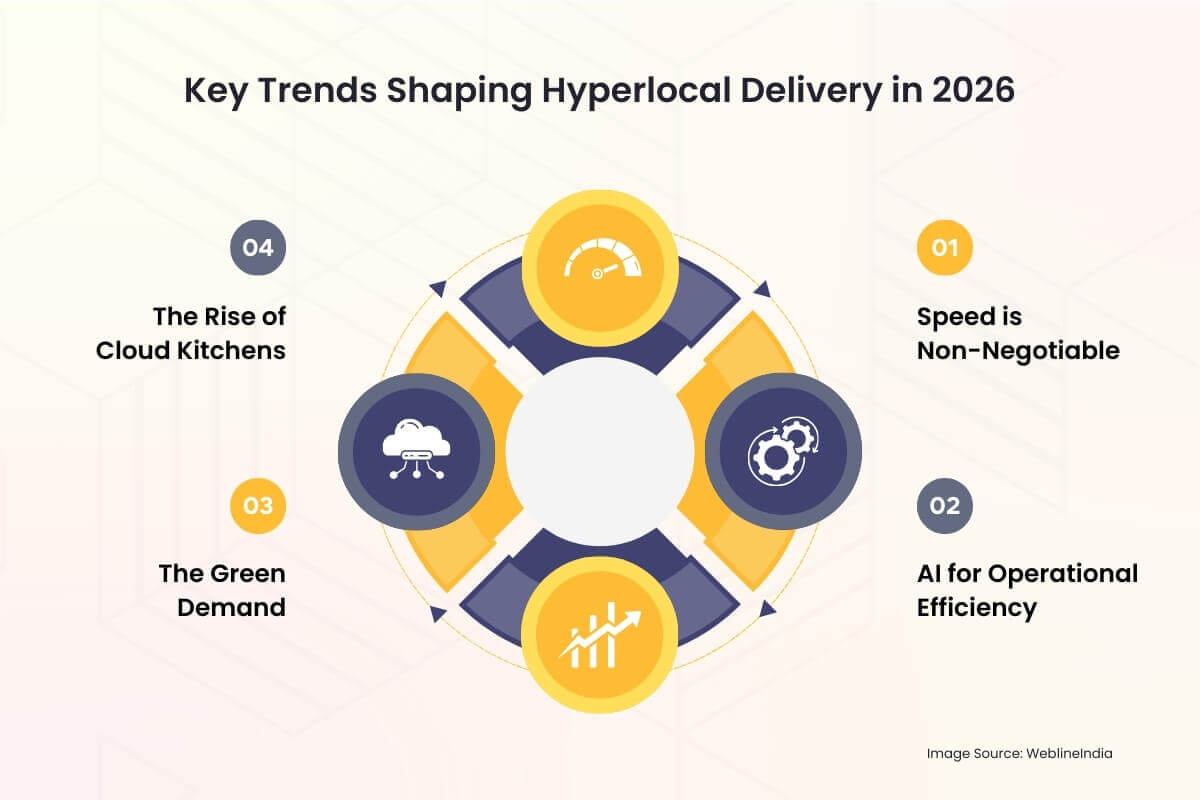
- Speed is Non-Negotiable: With quick-commerce giants pushing for 10-15 minute delivery times, every second counts. Delivery latency is the new battleground.
- AI for Operational Efficiency: AI-powered tools in 2026 are now essential for route optimisation and demand forecasting, directly reducing operational costs and enabling faster, more predictable service.
- The Green Demand: Increasing consumer preference for eco-friendly packaging and low-emission delivery options (for example, eBikes) is becoming a major differentiator in custom food delivery apps in 2026 and a critical element of local community engagement.
- The Rise of Cloud Kitchens: Delivery-only or virtual kitchens in 2026 are changing the supply side, requiring your platform to seamlessly integrate with these new food preparation models that rely entirely on digital delivery.
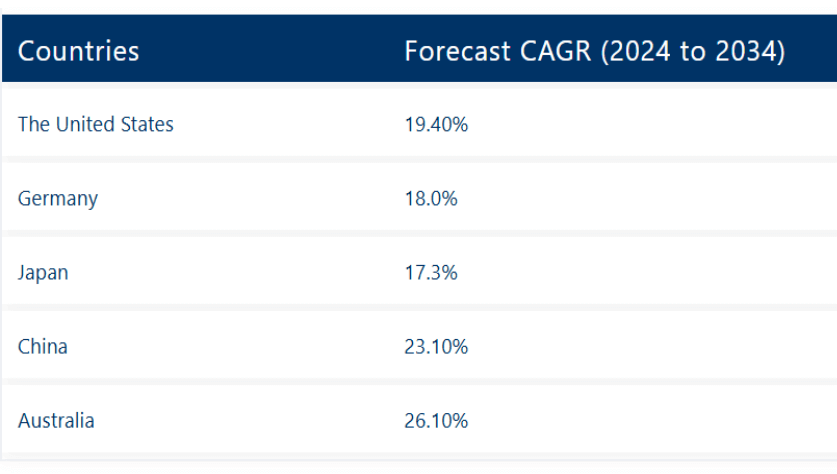
Dynamics of Hyperlocal Delivery App Market in 2026 by Country
The hyperlocal delivery app in 2026 has a landscape that is poised for strong expansion across major global markets, with several countries showing particularly robust momentum. Early indicators suggest that both mature and emerging economies are experiencing accelerated adoption of rapid-fulfillment services, driven by evolving consumer expectations and increased digitalization.
While growth rates vary, each country exhibits unique factors that range from technological readiness to demographic trends. These are shaping its trajectory in the coming decade. Here are the valuable findings by Future Market Insights:
The Core Pillars of a High-Performance Custom Food Delivery App in 2026
A successful custom food delivery app in 2026 is not one application but a cohesive ecosystem of four distinct platforms: the Customer App, the Restaurant/Vendor Panel, the Delivery Partner App, and the Admin Dashboard. Each platform requires specialized features for maximum efficiency in a hyperlocal environment.
1. Customer Mobile App Delivering Next-Generation User Experience (UX)
The customer-facing app must be intuitive, fast, and highly personalised. Frictionless ordering is paramount to reducing cart abandonment. The underlying technology for a custom food delivery app in 2026 will continue to be built for speed using frameworks like Flutter or React Native for cross-platform development excellence, or native Kotlin and Swift for superior performance at scale.
| Essential Feature | Hyperlocal Optimisation | Technical Function |
| Location-Aware Discovery | Geo-Fencing to automatically list only available restaurants within a precise, limited delivery radius (e.g., 5 km). This drastically reduces search friction. | Dynamic Geofencing and Location-Based Service (LBS) Integration for high-precision area mapping. |
| Hyper-Personalisation Engine | A Machine Learning (ML)-powered recommendation system that suggests dishes, restaurants, and promotions based on the user’s micro-local order history, time of day, and immediate context. | Predictive Analytics and Reinforcement Learning algorithms refining suggestions with every interaction. |
| Smart Search and Filtering | Advanced filters that allow customers to filter by dietary specifications (paleo, high-protein), specific local ingredients, and even restaurant health and sustainability scores. | Faceted Search integrated with Natural Language Processing (NLP) to handle complex or nuanced search queries. |
| Real-Time Order Tracking | Live GPS tracking integrated with a predictive Estimated Time of Arrival (ETA) algorithm that dynamically adjusts based on real-time traffic data, kitchen load, and delivery partner status. | Real-Time GPS API Integration (e.g., Mapbox, Google Maps) utilizing the WebSocket Protocol for low-latency updates. |
| Augmented Reality (AR) Menu | Allows users to preview a 3D model of their chosen dish on their table using their smartphone camera, enhancing the ordering experience and reducing disappointment from misleading images. | Implementation via ARKit/ARCore Integration and optimized 3D Asset Rendering. |
| Subscription-Based Model | Offering a premium recurring service (e.g., ‘Pro’ membership) that provides free delivery above a threshold and priority service, drastically boosting Customer Lifetime Value (LTV). | Dedicated Billing and Subscription Management System integrated with payment gateways. |
2. Restaurant/Vendor Panel for Streamlining Back-of-House Operations
The restaurant interface is the backbone of operational efficiency. In a hyperlocal food delivery setting in 2026, quick turnaround times will often be hampered by manual processes. A robust panel mitigates this.
| Essential Feature | Hyperlocal Optimisation | Technical Function |
| Unified Order Management System | A single dashboard to manage all orders. Crucially, a real-time ’86ing’ feature enables instant removal of out-of-stock items, preventing frustrating order cancellations. | Multi-Channel POS (Point-of-Sale) Integration via standardized Inventory Sync API. |
| Dynamic Prep Time Calculator | An AI-powered tool that automatically adjusts estimated food preparation time based on the restaurant’s current kitchen load, staff availability, and the complexity profile of the incoming order. | Load Balancing Algorithms and Historical Data Modeling for predictive accuracy. |
| Location-Based Pricing/Offers | The ability to set hyperlocal promotional pricing or special menus only for customers within a defined, close-by neighbourhood to stimulate demand during low-traffic periods. | Geo-Targeted Marketing Engine driven by a Dynamic Pricing API. |
| Performance and Local Insights | Provides detailed reports focused on local demand patterns. Example: peak order times in a specific kilometer radius, top-selling items, and localised customer satisfaction metrics. | Business Intelligence (BI) Dashboards leveraging PostgreSQL for fast structured data querying. |
3. Delivery Partner App with Intelligent Logistics and Speed
The delivery network is the lifeblood of a hyperlocal service. The partner app, often built on a high-concurrency backend like Node.js development or Go with a Microservice Architecture, must prioritise safety, speed, and logistical intelligence. This is a crucial area of food delivery app development in 2026.
| Essential Feature | Hyperlocal Optimisation | Technical Function |
| Advanced Route Optimisation | AI-driven algorithms that calculate the fastest, multi-stop route, intelligently accounting for real-time traffic flow, complex urban layouts, one-way streets, and optimized order batching. | Logistics SaaS Integration, implementation of Graph Theory Algorithms for efficient pathfinding. |
| Geo-Surge and Heatmaps | Real-time visual display of areas with elevated customer demand (heatmaps) and dynamic incentive calculation (surge pricing) to ensure immediate rider deployment to high-need zones. | Real-Time Data Visualization powered by rapid data streams and a Dynamic Incentive Model. |
| Contactless and Secure Handover | Integrated features for QR Code or One-Time Password (OTP) verification at the drop-off location, ensuring the correct customer receives the order without physical contact. | Secure Authentication Protocol and low-latency API calls for status updates. |
| E-Vehicle/Sustainable Tracking | Option for riders to specify and track the use of low-emission vehicles (e-bikes, bicycles). This data can be used to assign orders that require a lower environmental footprint. | IoT Integration for battery/usage telemetry and a Carbon Footprint Monitoring module. |
4. Admin Dashboard for Control, Automation, and Future-Proofing
The central command centre manages the entire digital ecosystem, ensuring seamless operational flow and facilitating strategic growth. A robust admin panel will be the foundation for any scalable custom food delivery app in 2026.
| Essential Feature | Hyperlocal Optimisation | Technical Function |
| Dynamic Delivery Zone Management | The ability to quickly define, modify, and manage complex, potentially overlapping delivery zones with specific rules for pricing, commission rates, and service-level agreements. | Geospatial Data Management with an integrated Zonal Rule Engine. |
| Automated Rider Dispatch | A sophisticated system that auto-assigns the most optimal delivery partner based on a complex weighted score: distance, vehicle type, current order load, and historical on-time performance metrics. | Algorithmic Dispatch System utilizing machine learning for predictive assignment accuracy. |
| Financial Settlement Engine | Automated, transparent, and accurate split payment processing between the customer, the platform, the restaurant, and the delivery partner, handling complex commission and tax calculations. | PCI DSS Compliance and integration with a specialized Split-Payment Gateway API. |
| System Health Monitoring | Real-time dashboards showing the platform’s operational status, including latency, API error rates, server load, and early warning systems for service degradation in specific hyperlocal areas. | Monitoring and Logging Tools (e.g., Prometheus, Grafana) are built into the Microservice Architecture. |
Need a sharper, hyperlocal app that runs fast and smooth? Talk to our team today.
Next-Generation Features for the Future of Hyperlocal Logistics in 2026 and Beyond
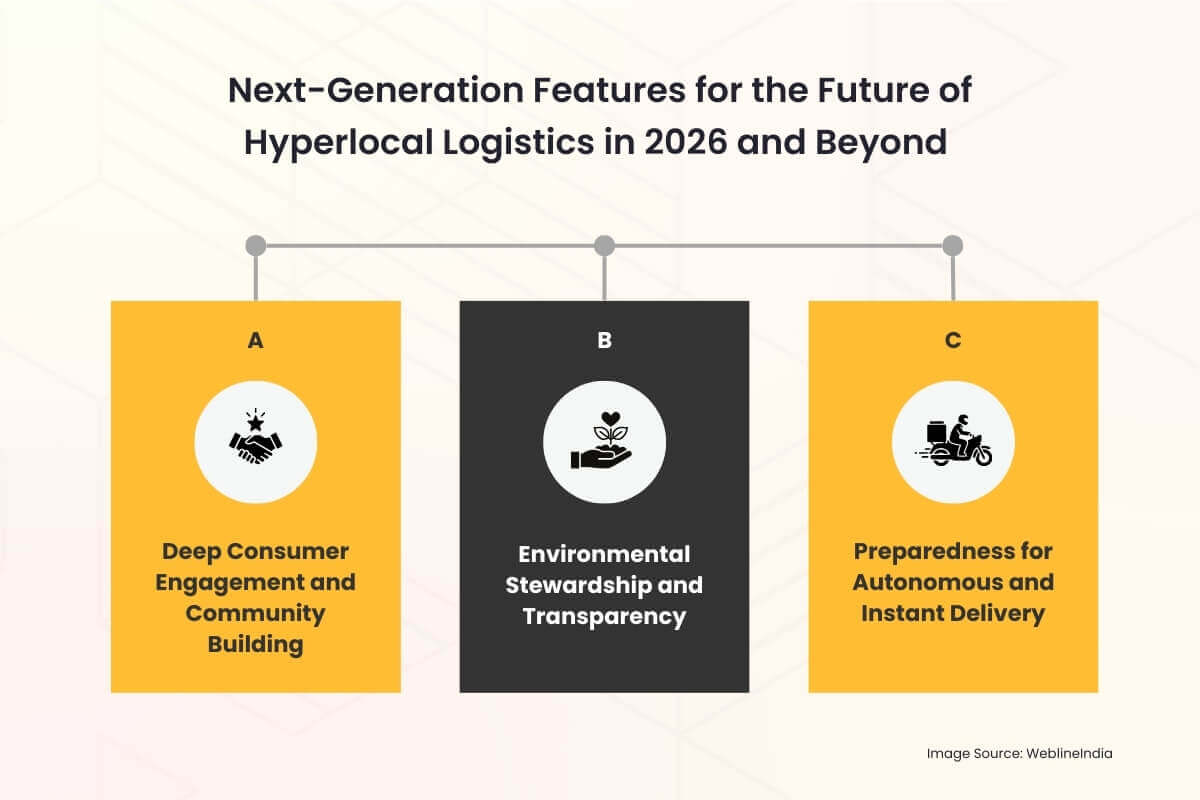
To truly capture the imagination of the modern consumer and maintain market leadership, your custom food delivery app in 2026 and beyond must incorporate tomorrow’s technologies today. These advanced functionalities are the product of the latest advancements in food delivery app development.
A. Deep Consumer Engagement and Community Building
- Blockchain-Lite Loyalty Systems: Utilizing a secure, distributed ledger concept (without the complexity of a public blockchain) to issue traceable ‘Food Tokens’ or reward points. This builds trust,supports ecommerce customer retention, encourages referrals, and assigns a tangible future value to customer loyalty.
- Integrated Meal Kits and Local Grocery Ordering: Expanding the platform beyond immediate consumption by adding a module for locally sourced groceries or pre-portioned meal kits. This transforms the app into a full ‘food ecosystem’ for the user’s hyperlocal needs.
- Real-Time Review Verification: Integrating the review system with the order database to ensure only verified, genuine customers can leave feedback for a restaurant, significantly boosting the credibility of vendor ratings.
B. Environmental Stewardship and Transparency
As community focus sharpens in hyperlocal markets in 2026, demonstrable commitment to sustainability is crucial.
- Carbon Footprint Visualization: Displaying the estimated CO2 emissions generated (or saved) for each order, encouraging users to select closer vendors or choose eco-friendly delivery options.
- Ingredient Provenance Tracking: Enabling restaurants to upload information regarding the source of their key ingredients securely. The app can then display the farm or supplier’s location, fostering transparency and supporting local agriculture.
- Reusable Packaging Program Management: A feature to track reusable containers (e.g., bowls, bags) checked out by the customer and incentivize their return, managing this complex reverse logistics flow.
C. Preparedness for Autonomous and Instant Delivery
While widespread autonomous delivery is still maturing, the custom food delivery app in 2026 will have an architecture that will be ready to integrate with these zero-latency methods.
- External Fulfillment Integration API: Designing the API to seamlessly hand off final-mile delivery tasks to third-party providers, including drone or robot delivery services, by defining precise drop-off coordinates and handover protocols.
- 10-Minute Micro-Fulfillment Hubs Management: For platforms aiming for the ultra-quick-commerce standard, the system must efficiently manage inventory, pick-pack-ship processes, and delivery cycles from small, decentralized micro-fulfillment centres or dark stores strategically placed within high-demand zones.
Build the Future of Food Delivery with WeblineIndia
At WeblineIndia, we excel in developing food delivery apps. We engineer the future of hyperlocal logistics. As we move into 2026, the on-demand delivery landscape is evolving rapidly as it demands faster, smarter, and more personalized service than ever before. This shift isn’t just a trend; rather, it’s a transformation. And WeblineIndia is leading the charge.
Creating a successful food delivery platform in 2026 and beyond means building a high-performance, AI-powered logistics engine that tackles last-mile delivery with precision.
Our expertise lies in crafting custom software solutions that go far beyond digitizing orders. We integrate:
- AI-driven hyper-personalization to tailor every user experience
- Advanced route optimization using graph-based algorithms for real-time efficiency
- Sustainability tracking to align with eco-conscious consumer expectations
With WeblineIndia, you’re meeting the pace. Our strategic approach ensures your custom food delivery app in 2026 is scalable, resilient, and eligible for market dominance. We help you build a platform that earns deep customer loyalty and thrives in the hyperlocal economy.
Ready to own your niche in the food delivery revolution? Let WeblineIndia turn your vision into a powerful and scalable custom food delivery app in 2026 and beyond.
Social Hashtags
#FoodDeliveryApp #HyperlocalDelivery #AppDevelopment #OnDemandApps #CustomApps #FoodTech #DeliverySolutions #MobileAppDevelopment #WeblineIndia
Ready to launch your Custom Food Delivery App in 2026? Let’s create it together.
Frequently Asked Questions
Globally Recognized for Unmatched Quality and Reliability




Testimonials: Hear It Straight From Our Global Clients
Our development processes delivers dynamic solutions to tackle business challenges, optimize costs, and drive digital transformation. Expert-backed solutions enhance client retention and online presence, with proven success stories highlighting real-world problem-solving through innovative applications. Our esteemed Worldwide clients just experienced it.
Awards and Recognitions
While delighted clients are our greatest motivation, industry recognition holds significant value. WeblineIndia has consistently led in technology, with awards and accolades reaffirming our excellence.

OA500 Global Outsourcing Firms 2025, by Outsource Accelerator

Top Software Development Company, by GoodFirms

BEST FINTECH PRODUCT SOLUTION COMPANY - 2022, by GESIA

Awarded as - TOP APP DEVELOPMENT COMPANY IN INDIA of the YEAR 2020, by SoftwareSuggest