How Can Legacy Software Modernization Unlock Business Growth?
Legacy software modernization empowers businesses to improve efficiency, security and scalability. Discover strategies, benefits and technologies to transform outdated systems and unlock sustainable business growth.

Businesses heavily dependent on outdated software often encounter mounting challenges that hinder operational efficiency, agility, and scalability. While such systems once provided robust support, technological progress, evolving customer expectations, and compliance requirements demand a shift.
Legacy modernization, also known as legacy software modernization or legacy system modernization, has become an essential strategy for organizations aiming to remain competitive and future-ready.
In this blog, we’ll explore how businesses can unlock their full potential by embracing legacy software modernization, dive into the technical facets of this transformation, and highlight why WeblineIndia stands out as a trusted modernization partner.
Is your outdated software slowing down your business growth?
What Are Legacy Systems and Why Do They Need to Change?
Legacy systems refer to outdated software applications or platforms that continue to support critical business operations. Often built on obsolete technologies, these systems are expensive to maintain, difficult to integrate, and pose security risks. While they may still function, they inhibit innovation and increase the total cost of ownership.
Organizations find themselves stuck with:
- Unsupported software and hardware
- Inability to integrate with modern applications
- Poor user experience and outdated interfaces
- Compliance issues due to outdated security protocols
- Limited scalability and performance
These constraints prompt enterprises to consider legacy system modernization not just as an upgrade, but as a strategic move to fuel growth, agility, and innovation.
What Is Legacy Modernization and How Does It Work?
Legacy modernization is the process of transforming, re-engineering or replacing legacy applications to align with current business goals and modern technological frameworks. It involves enhancing system functionality, improving maintainability, and reducing the risks associated with obsolete systems.
The process can include:
- Re-platforming
- Rehosting
- Code refactoring
- Architectural transformation
- Cloud migration
- Complete application rebuild
With these techniques, businesses can maintain core logic while improving performance, enabling integration, and reducing technical debt.
What Are the Key Benefits of Legacy Software Modernization?
Investing in legacy software modernization offers both immediate and long-term advantages that go beyond basic software updates.
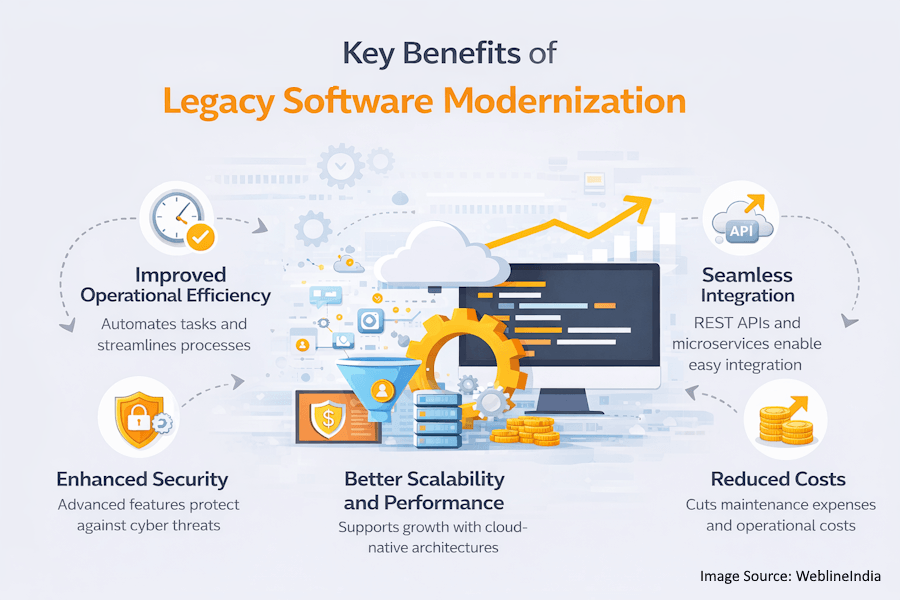
Improved Operational Efficiency
Outdated systems often require manual workarounds that slow down operations. Modernizing these systems automates tasks, streamlines processes, and reduces error rates.
Enhanced Security
Older software is vulnerable to threats due to a lack of vendor support and missing security patches. Modern systems provide encryption, role-based access control, audit logging, and other advanced security features.
Better Scalability and Performance
Modernized systems can be designed with microservices and cloud-native architectures that enable horizontal scaling and high availability, unlike their monolithic predecessors.
Seamless Integration
Modern applications support REST APIs, GraphQL, and message queues, allowing them to integrate seamlessly with CRM, ERP, analytics tools, and third-party applications.
Reduced Costs
Maintenance and operational costs reduce significantly after legacy system modernization due to fewer incidents, less manual labor, and improved efficiency.
What Are the Most Effective Approaches to Legacy System Modernization?
Depending on business needs and technological debt, organizations can choose from various approaches for legacy system modernization.
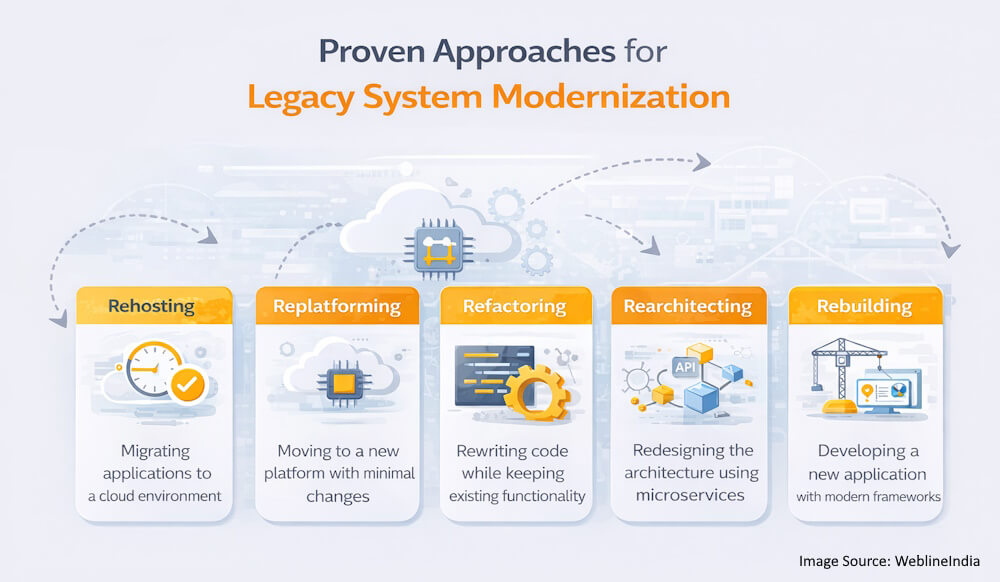
Rehosting (“Lift and Shift”)
This involves moving the existing system from on-premise infrastructure to the cloud without altering its codebase. While it offers quick wins in infrastructure savings, it does not address core architectural limitations.
Replatforming
The application is moved to a new runtime platform with minimal code changes, offering better scalability and improved performance while preserving existing functionalities.
Refactoring
Involves restructuring and optimizing the existing codebase without changing its external behavior. This approach improves maintainability and prepares the system for future enhancements.
Rearchitecting
A more extensive process, this replaces outdated architecture with microservices or service-oriented architecture (SOA), enabling scalability, agility, and better fault tolerance.
Rebuilding
Sometimes referred to as a greenfield approach, rebuilding is ideal when the legacy system is too rigid or outdated. A new system is developed from scratch using modern programming languages, frameworks, and architectural patterns.
Wondering if it’s time to modernize your legacy systems?
Which Technologies Power Successful Legacy Software Modernization?
Implementing legacy software modernization successfully requires a solid understanding of current technologies. Some of the most commonly used technologies and practices include:
- Microservices Architecture: Breaks down applications into loosely coupled services that can be developed, deployed, and scaled independently.
- Containerization with Docker and Kubernetes: Provides environment consistency, portability, and scalable orchestration.
- DevOps & CI/CD Pipelines: Automates testing, deployment, and monitoring, reducing time to market and enhancing release quality.
- APIs and Integration Layers: Ensures legacy systems can communicate effectively with modern platforms.
- Cloud Platforms (AWS, Azure, GCP): Offer scalable infrastructure, flexible pricing models, and robust services for modernization.
How Do You Know It’s Time for Legacy Software Modernization?
Organizations typically encounter specific signs that indicate the need for legacy modernization:
- High maintenance costs
- Difficulty in onboarding new developers
- Security vulnerabilities and compliance issues
- Frequent outages or performance bottlenecks
- Customer dissatisfaction due to slow interfaces
Waiting too long to act can result in revenue losses, reputational damage, and missed growth opportunities.
What Challenges Do Businesses Face in Legacy Modernization (and How Can They Overcome Them)?
Modernizing legacy systems is not without challenges. Understanding them helps plan a smoother transition.
Key Challenges
- Complex system dependencies
- Loss of undocumented business logic
- Downtime during migration
- Resistance from internal teams
- Data integrity and transformation issues
Best Practices to Overcome These Challenges
- Conduct a comprehensive system audit and gap analysis
- Prioritize features and systems based on business impact
- Use phased rollouts and parallel testing environments
- Train and involve key stakeholders early in the process
- Implement robust data migration and backup strategies
How Can You Build a Bulletproof Legacy Modernization Strategy?
Use these key elements to ensure a sustainable, successful legacy software modernization journey:
- Identify Business Goals: Align technology changes with desired outcomes.
- Perform Readiness Assessment: Evaluate current infrastructure, team capabilities, and existing tech stack.
- Select the Right Modernization Approach: Choose based on system complexity and business needs.
- Engage the Right Technology Partner: Partner with experienced teams that have domain-specific expertise.
- Focus on User Experience: Redesign workflows and interfaces for improved usability and adoption.
Why Should You Choose WeblineIndia for Legacy System Modernization?
WeblineIndia has a proven track record in delivering high-impact legacy modernization solutions across diverse industries. Our deep technical expertise, agile methodologies, and client-first approach position us as the ideal choice for modernizing mission-critical systems.
Why Choose WeblineIndia?
- Decades of experience with legacy platforms like COBOL, .NET, Java, and more
- Custom modernization strategies tailored to your business goals
- Skilled teams in microservices, cloud-native applications, and API development
- Zero-downtime migration and enterprise-grade security practices
- End-to-end support from audit and planning to deployment and optimization
Clients choose WeblineIndia not just for capability but also for reliability, transparency, and a collaborative mindset.
Ready to Start Your Digital Transformation Journey with Legacy Modernization?
Unlocking business potential through legacy software modernization is no longer optional—it’s a strategic necessity. Businesses that hold onto outdated systems risk falling behind, while those that embrace transformation position themselves for growth, innovation, and resilience.
Whether your goal is to enhance performance, reduce costs, or enable integration with modern tools, legacy system modernization is the catalyst. WeblineIndia, with its extensive experience and client-focused approach, can guide your journey from outdated infrastructure to a robust, scalable, and modern enterprise architecture.
Social Hashtag
#LegacySoftware #SoftwareModernization #DigitalTransformation #CloudMigration #TechInnovation #BusinessGrowth #ITStrategy #DevOps #EnterpriseTechnology #Microservices #ScalableSystems #TechUpgrade
Need a reliable partner to guide your legacy system transformation?
Frequently Asked Questions
Globally Recognized for Unmatched Quality and Reliability




Testimonials: Hear It Straight From Our Global Clients
Our development processes delivers dynamic solutions to tackle business challenges, optimize costs, and drive digital transformation. Expert-backed solutions enhance client retention and online presence, with proven success stories highlighting real-world problem-solving through innovative applications. Our esteemed Worldwide clients just experienced it.
Awards and Recognitions
While delighted clients are our greatest motivation, industry recognition holds significant value. WeblineIndia has consistently led in technology, with awards and accolades reaffirming our excellence.
OA500 Global Outsourcing Firms 2025, by Outsource Accelerator

Top Software Development Company, by GoodFirms

BEST FINTECH PRODUCT SOLUTION COMPANY - 2022, by GESIA
Awarded as - TOP APP DEVELOPMENT COMPANY IN INDIA of the YEAR 2020, by SoftwareSuggest