Top 10 Automation Opportunities in Wealth Management
Explore how AI, n8n and intelligent automation are transforming wealth management. From onboarding to compliance, discover 10 high-impact opportunities driving efficiency, personalization and growth in modern financial firms.
- Artificial Intelligence (AI)
- BFSI
- Business Intelligence
- Cloud
- Digital Transformation
- Machine Learning
- n8n Automation
- Process Automation

Listen to the podcast :
The financial industry is currently undergoing a structural transformation that mirrors the industrial revolution, yet it is occurring at the speed of fiber optics. We are witnessing the death of the manual advisor and the birth of the augmented strategist. This shift is not merely about replacing paper with PDFs; it is about the total algorithmic overhaul of how wealth is captured, managed, and reported.
For firms still relying on human-to-human data entry and manual reconciliation, the window of viability is closing. The future belongs to those who can orchestrate complex data flows through intelligent engines, turning raw financial information into a proprietary advantage before a competitor’s bot does it first.
Ready to automate your wealth management workflows and scale faster?
The Strategic Necessity of Automation in the AI Era
In the current epoch of financial process automation has transcended its role as a back-office efficiency tool to become the foundational bedrock of institutional survival. The AI era has introduced a level of market complexity and data velocity that renders human-only processing obsolete.
Bridging the Gap Between Data and Insight
Wealth management firms are no longer just competing on investment performance; they are competing on the ability to process, interpret, and act upon massive datasets in real-time.
- Data Orchestration: Without a robust automation layer, the most advanced Artificial Intelligence models are effectively paralyzed, as they lack the clean, orchestrated data streams required to generate actionable insights.
- Democratization of Strategy: Previously, hyper-personalized portfolio construction and tax-optimized trading were reserved for the ultra-wealthy due to the high cost of manual labor. Automation collapses these costs, allowing firms to provide institutional-grade service to a broader client base while maintaining healthy margins.
Meeting Modern Client Expectations
In an era where information is instantaneous, client expectations have shifted toward immediate gratification.
- Velocity of Service: An investor who can trade cryptocurrency or access global markets on a smartphone in seconds will not tolerate a three-day wait for a portfolio update or a manual wire transfer.
- Human-Centric Focus: Ultimately, the integration of automation in the AI era is about liberating the advisor from the mundane. Offloading the cognitive load of data reconciliation and administrative tracking to digital agents, professionals can return to the core of their craft: building deep, empathetic relationships.
Risk Mitigation and Compliance Guardrails
Moreover, automation acts as the essential guardrail for AI deployment.
- Closed-Loop Execution: As Machine Learning models begin to assist in decision-making, automation workflow tools ensure these decisions are executed within strict compliance and risk parameters.
- Error Reduction: It creates a system where data is ingested, analyzed by AI, and executed via automated pipes, reducing the surface area for human error, which remains the leading cause of regulatory breaches.
In this high-tech environment, the firms that automate the most effectively are ironically the ones that have the most time to be human.
Here is an exhaustive analysis of the top 10 automation opportunities that are currently redefining the wealth management sector.
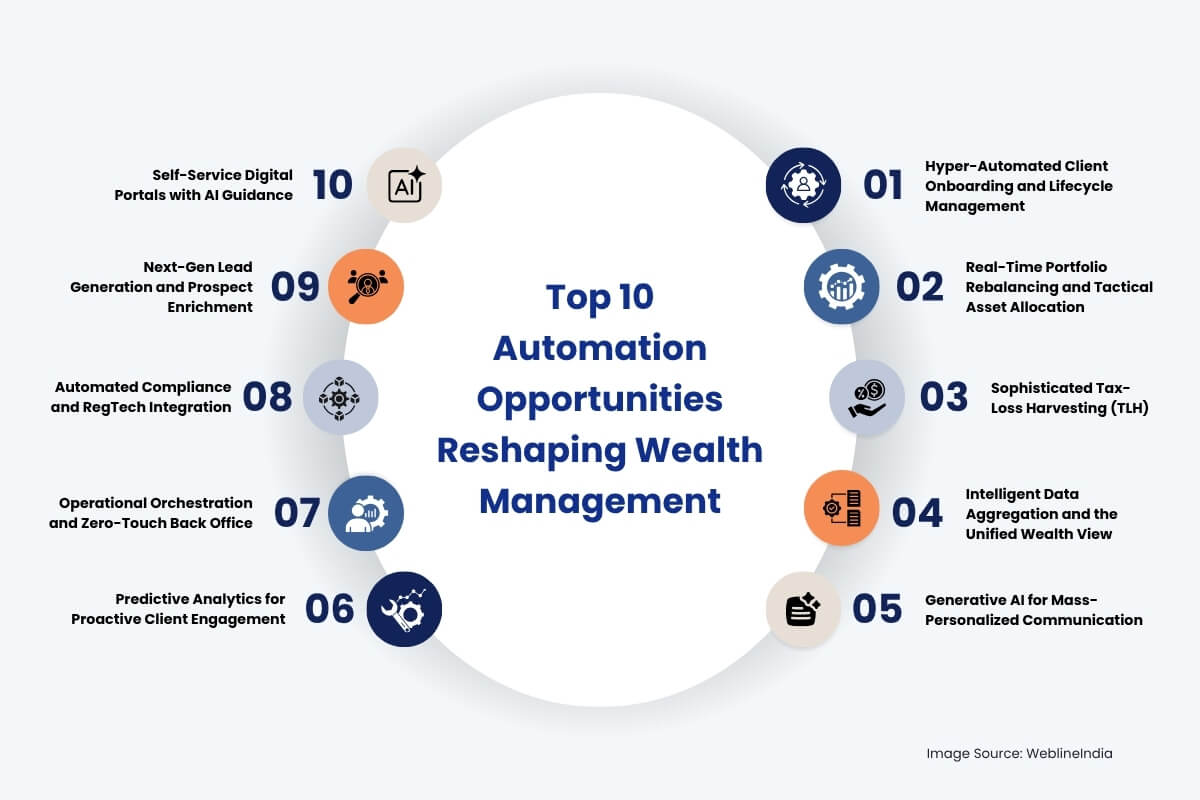
1. Hyper-Automated Client Onboarding and Lifecycle Management
The onboarding process has long been the primary friction point in wealth management. In the past, bringing on a High-Net-Worth (HNW) client required an average of 20 to 30 manual touchpoints. Today, automation has reduced this to a single digital interaction.
The Mechanics of Modern Onboarding
By utilizing Intelligent Document Processing (IDP) and Optical Character Recognition (OCR) powered by Machine Learning, firms can now ingest driver’s licenses, passports, and utility bills with 99% accuracy. These systems do more than just read text; they verify the authenticity of the document in real-time against global databases.
Integration with KYC and AML
Automation engines now trigger background checks the moment a lead enters the system. Using tools like n8n, a firm can create a workflow where a new lead in a CRM automatically triggers a search in LexisNexis or World-Check. If the prospect passes the risk assessment, the system automatically generates a personalized Investment Policy Statement (IPS) and sends it via an e-signature platform. This removes the administrative burden from the advisor, allowing them to focus on the relationship rather than the paperwork.
2. Real-Time Portfolio Rebalancing and Tactical Asset Allocation
Traditional rebalancing is reactive. An advisor notices a drift in asset allocation during a quarterly review and manually executes trades to bring the portfolio back in line. This approach is fraught with timing risks and missed opportunities.
Algorithmic Precision
Automated rebalancing engines monitor portfolios 24/7. When a specific asset class (such as emerging market equities) exceeds its target weight due to market movement, the system calculates the exact number of shares to sell and buy to restore the balance.
Tactical Shifts
Beyond simple drift correction, advanced AI models can execute tactical shifts based on macroeconomic signals. If an ML model detects a specific volatility pattern, it can automatically tilt the portfolio toward defensive assets like gold or short-term Treasuries. This level of responsiveness is impossible for a human advisor managing hundreds of accounts, but is a standard feature of an automated wealth platform.
3. Sophisticated Tax-Loss Harvesting (TLH)
Tax-loss harvesting is perhaps the most quantifiable alpha an advisor can provide. However, doing it manually across a large book of business is an operational nightmare.
The Automated Tax Alpha
Automation allows firms to perform daily tax-loss harvesting. The software monitors every individual security for a loss. When a loss reaches a specific threshold, the system sells the security to lock in the tax benefit and immediately replaces it with a highly correlated asset to maintain the portfolio’s risk profile.
Automating this, firms can provide a net benefit to the client that often covers the entire management fee. In a 2026 market where fees are under constant pressure, automated TLH is a critical tool for value justification.
4. Intelligent Data Aggregation and the Unified Wealth View
One of the greatest challenges in wealth management is the fragmentation of client data. A typical client might have a 401(k) at one bank, a brokerage account at another, and private equity investments held elsewhere.
Breaking Data Silos with n8n
Modern firms use n8n automation to build custom data bridges between these siloed institutions. By leveraging Open Banking APIs and specialized aggregation tools, n8n can pull real-time data from disparate sources and normalize it into a single database.
This creates a Total Wealth View. When an advisor logs in, they do not just see the assets they manage; they see the client’s entire financial life. Automation ensures this data is refreshed every hour, providing a level of transparency that was previously reserved for institutional family offices.
5. Generative AI for Mass-Personalized Communication
The biggest complaint from wealth management clients is a lack of communication. However, an advisor managing 200 clients cannot possibly send 200 personalized emails every time the Fed changes interest rates.
The LLM Revolution
Generative AI in fintech, specifically Large Language Models (LLMs), has solved the scale problem of communication. Feeding client portfolio data into a secure AI model, the system can draft a personalized note for every client.
For example, the AI might write: Dear John, following today’s 25-basis point hike, your bond ladder in your retirement account is positioned to capture higher yields. Here is how your projected income for 2027 has increased.
This is not a template; it is a unique, data-driven message. Automation handles the drafting, while the advisor simply hits approve, maintaining the human-in-the-loop while increasing output by 10x.
Want to reduce manual processes and boost client experience with AI?
6. Predictive Analytics for Proactive Client Engagement
Why wait for a client to call and say they are moving their money? Automation and Machine Learning can predict churn before it happens.
Sentiment and Behavioral Analysis
Analyzing patterns in client logins, email sentiment, and withdrawal frequencies, ML models can assign a health score to every relationship. If a client who usually logs in once a month suddenly logs in five times in a week during a market downturn, the system flags them as high anxiety.
The automation engine then tasks the advisor to call that client immediately. This proactive approach prevents outflows and builds deep institutional trust. Similarly, AI can identify propensity to invest by tracking large deposits into a client’s checking account, triggering an automated suggestion for a new investment strategy.
7. Operational Orchestration and Zero-Touch Back Office
The back office is where profitability goes to die. Manual trade reconciliation, corporate action processing, and fee billing are all ripe for automation.
The Role of n8n in the Back Office
n8n acts as the central nervous system of the firm. It can be programmed to:
- Reconcile trade confirmations against the CRM records at the end of every day.
- Automatically update fee schedules based on a client’s total Assets Under Management (AUM).
- Trigger a compliance alert if a trade is executed without a recorded client consent.
By moving toward a zero-touch back office, wealth management firms can significantly improve their margins and redirect their human staff toward high-value client-facing roles.
8. Automated Compliance and RegTech Integration
In 2026, regulatory scrutiny has reached an all-time high. Manual compliance checks are no longer sufficient to protect a firm from massive fines.
Continuous Compliance
Automation allows for Continuous Compliance Monitoring. Instead of a quarterly audit, every single action is checked in real-time. If an advisor recommends a product that is outside the client’s stated risk tolerance, the system blocks the trade and sends a notification to the Chief Compliance Officer.
Automated systems also handle the grueling task of document archiving. Every email, chat, and video call is automatically transcribed, indexed, and stored in a tamper-proof vault, ensuring the firm is always audit-ready.
9. Next-Gen Lead Generation and Prospect Enrichment
Wealth management has traditionally relied on the country club model of networking. This is being replaced by automated digital prospecting.
Data-Driven Hunting
Automation tools can scan public records for liquidity events. When a private company in a specific region is acquired, or when a senior executive receives a large stock option grant, the system captures this data.
The automation engine then enriches the lead with contact information and background data before pushing it into the advisor’s CRM. This ensures that the sales team is only spending time on prospects with a high probability of conversion and a high net worth.
10. Self-Service Digital Portals with AI Guidance
The modern investor, especially the millennial and Gen Z demographic, wants the ability to manage their wealth at 2 AM on a Saturday.
The Intelligent Portal
Beyond just showing a balance, automated portals now feature What-If simulators. A client can drag a slider to see how buying a $2M vacation home would affect their probability of a successful retirement.
Behind the scenes, the automation engine runs thousands of Monte Carlo simulations in seconds to provide an answer. If the simulation shows a high risk of failure, the system automatically offers a calendar link to book a meeting with their advisor. This creates a seamless bridge between self-service and professional advice.
The Infrastructure of the Modern Firm
Implementing these ten opportunities is not a matter of buying ten different pieces of software. It is about building a cohesive ecosystem. This requires a deep understanding of APIs, data security, and the specific regulatory nuances of the financial sector.
The firms that are winning in 2026 are not necessarily those with the best stock pickers; they are those with the best technical infrastructure. They have moved away from islands of automation and toward a fully integrated, orchestrated digital enterprise.
Why WeblineIndia is Your Strategic Automation Partner
Navigating this technical shift requires more than just developers; it requires architects who understand the weight of financial responsibility. WeblineIndia has established itself as a global leader in providing offshore software development specifically for the wealth management and BFSI sectors.
With over two decades of experience, we have mastered the art of balancing innovation with security. Our expertise in n8n allows us to create the complex integrations that make hyper-automation possible. Whether it is connecting a legacy mainframe to a modern AI engine or building a bespoke mobile portal for your HNW clients, our team delivers institutional-grade code.
At WeblineIndia, we provide:
- Custom Software Development: Our proven custom software development services build wealth management platforms that grow with your AUM.
- AI & Machine Learning Integration: Deploying predictive models that give your advisors an unfair advantage.
- Workflow Automation with n8n: Streamlining your back office to maximize operational efficiency.
- Rigorous Security Standards: Ensuring your firm remains compliant with GDPR, CCPA, and SEC regulations.
- Dedicated Offshore Teams: Access to a pool of top-tier talent at a fraction of the cost of domestic hiring.
The digital transformation of wealth management is a high-stakes race. Partnering with WeblineIndia, you gain the technical agility needed to not just participate in the market, but to lead it. Our mission is to handle the complexity of the how, so you can focus on the who—your clients.
Visit us at www.weblineindia.com to explore our case studies and see how we have helped firms worldwide achieve a 40% increase in operational efficiency through intelligent automation.
Social Hashtags
#Automation #AI #Fintech #WealthManagement #DigitalTransformation #MachineLearning #HyperAutomation #WealthTech #AIinFinance #OperationalEfficiency #PredictiveAnalytics #FutureOfFinance #SmartInvesting #TechInnovation #BusinessTransformation
Curious how automation can increase your firm’s efficiency and compliance?
Frequently Asked Questions
Globally Recognized for Unmatched Quality and Reliability




Testimonials: Hear It Straight From Our Global Clients
Our development processes delivers dynamic solutions to tackle business challenges, optimize costs, and drive digital transformation. Expert-backed solutions enhance client retention and online presence, with proven success stories highlighting real-world problem-solving through innovative applications. Our esteemed Worldwide clients just experienced it.
Awards and Recognitions
While delighted clients are our greatest motivation, industry recognition holds significant value. WeblineIndia has consistently led in technology, with awards and accolades reaffirming our excellence.
OA500 Global Outsourcing Firms 2025, by Outsource Accelerator

Top Software Development Company, by GoodFirms

BEST FINTECH PRODUCT SOLUTION COMPANY - 2022, by GESIA
Awarded as - TOP APP DEVELOPMENT COMPANY IN INDIA of the YEAR 2020, by SoftwareSuggest