How Asset Managers Save 40% Ops Cost Using Workflow Automation?
Asset managers are reducing operational costs by up to 40% through workflow automation and AI-driven orchestration. By replacing manual processes with intelligent systems, firms improve efficiency, reduce errors, and scale operations without increasing headcount. This blog explores key automation areas, emerging technologies like n8n, and how strategic implementation drives measurable ROI.
- Artificial Intelligence (AI)
- BFSI
- Digital Transformation
- Machine Learning
- n8n Automation
- Process Automation

The financial industry in 2026 shows that asset managers have shifted from surviving to thriving through technical superiority. As global assets under management (AUM) continue to grow, so does the complexity of managing them. Firms are increasingly finding themselves trapped between the pressure of fee compression and the soaring costs of manual middle- and back-office operations.
Recent data from McKinsey and industry leaders like Blue Prism suggests a transformative shift: by implementing a strategic business automation process, asset managers can slash operational costs by up to 40%. This is not merely a projection; it is a reality for firms leveraging workflow automation to replace legacy manual touches with intelligent, agentic systems.
Ready to eliminate manual processes and scale your investment operations faster?
Why Manual Ops Cost You 40% More?
In the present-day financial industry, the difference between a high-performing fund and a struggling one often comes down to the operational overhead hidden beneath the surface. For many asset managers, the reliance on legacy manual processes acts as a silent tax on every dollar of alpha generated. To understand how workflow automation can reclaim 40% of these costs, we must first dissect the structural inefficiencies that plague traditional firms.
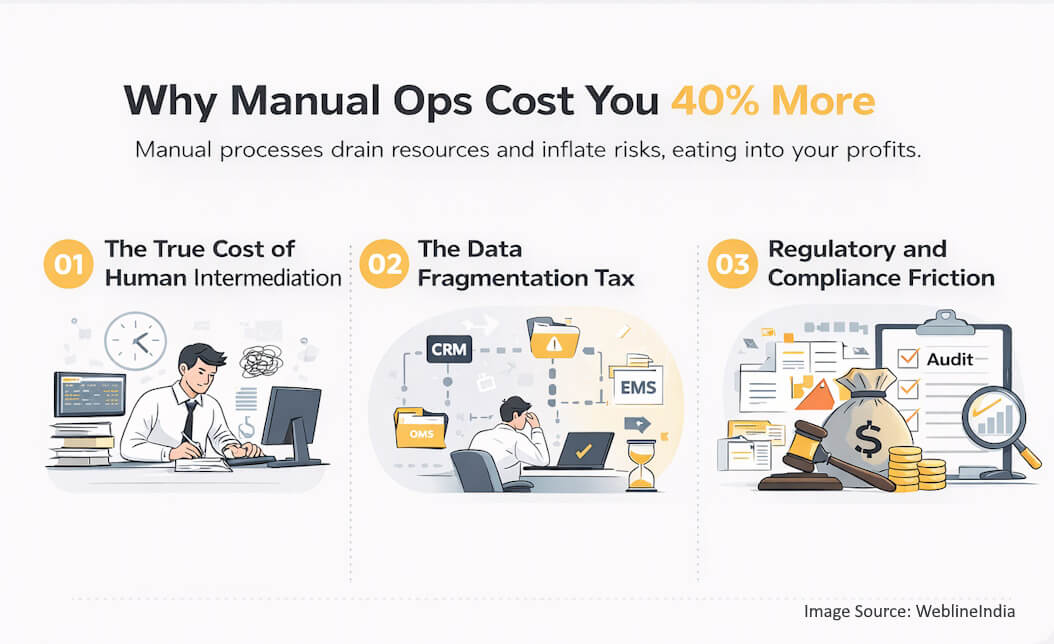
The True Cost of Human Intermediation
When a firm lacks a cohesive business automation process, its most expensive assets (highly skilled analysts and portfolio managers) are frequently relegated to data-entry roles. This mismatch of talent and task is the primary driver of the 40% efficiency gap. Every time an employee manually copies data from a Bloomberg terminal into a spreadsheet, or cross-references a PDF statement against a core accounting system, the firm loses money in three distinct ways:
- Direct Labor Costs: The hourly rate of a senior analyst performing clerical tasks is a poor use of capital.
- The Error Rate Multiplier: Human intervention inherently introduces a 2% to 5% error rate. In a high-volume environment, the cost of remediating one trade break can be ten times the cost of the original trade execution.
- Opportunity Cost: Every hour spent on manual reconciliation is an hour not spent on market analysis or client relationship management.
The Data Fragmentation Tax
Most firms suffer from a fragmented technological ecosystem, with various platforms (order management systems (OMS), execution management systems (EMS), and CRMs) operating in silos. Without professional workflow automation services to act as the glue between these systems, data remains trapped.
Manual data migration across these silos creates a phenomenon known as data stale-dating. By the time a report is manually compiled and reviewed, the market conditions have shifted, making the information less actionable. A dedicated business automation service provider identifies these bottlenecks, replacing manual hand-offs with instantaneous, API-driven data flows.
Regulatory and Compliance Friction
In 2026, the complexity of global regulations has reached an all-time high. Firms relying on manual compliance checks face an escalating cost structure.
- Audit Readiness: Manually preparing for an audit can take weeks of staff time, pulling focus away from core business goals.
- Penalties: The financial impact of a single manual oversight in an AML (Anti-Money Laundering) or KYC (Know Your Customer) check can be catastrophic, often exceeding the total investment required for a workflow automation consultation.
- Scalability Barriers: Manual operations create a ceiling on growth. If your Ops Cost scales linearly with your AUM, you cannot achieve true economies of scale.
Firms can identify these leaks through a professional workflow automation consultation to transition from a reactive posture to a proactive, automated model that scales without a proportional increase in headcount.
The 40% Breakthrough: Key Areas for Workflow Automation
Achieving a 40% reduction in operational expenditure is not about making marginal improvements to existing tasks; it is about fundamentally re-architecting how data and decisions move through the firm. Focusing on high-impact, high-friction domains, a business automation service provider can help asset managers transition from manual, reactive processes to a proactive, exception-based operating model.
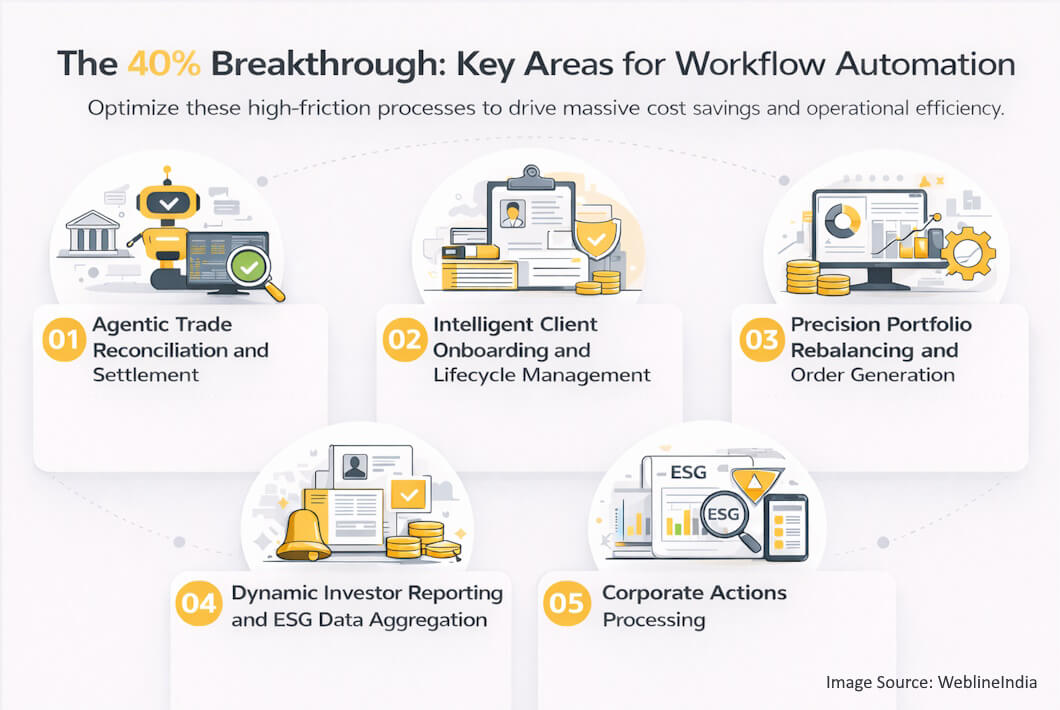
1. Agentic Trade Reconciliation and Settlement
In the traditional back office, trade reconciliation is a notorious bottleneck. Teams often spend the first four hours of every day manually matching internal transaction logs against external custodian bank statements.
- The Automated Shift: Using workflow automation services, firms can implement agentic workflows that ingest data via API or secure FTP, perform multi-variable matching, and automatically flag only the discrepancies (breaks).
- The Impact: This reduces the human workload by 80% to 90%, allowing a lean team to manage a significantly higher volume of trades without increasing headcount.
2. Intelligent Client Onboarding and Lifecycle Management
The initial impression a firm makes depends on its onboarding speed. Manual KYC (Know Your Customer) and AML (Anti-Money Laundering) checks are historically slow and prone to human oversight.
- The Automated Shift: A robust business automation process integrates digital identity verification, automated document parsing (OCR), and real-time screening against global sanctions lists.
- The Impact: Onboarding timelines shrink from weeks to hours. By automating the data flow into the CRM and portfolio management systems, firms eliminate redundant data entry and accelerate the time-to-revenue for new accounts.
3. Precision Portfolio Rebalancing and Order Generation
Portfolio managers often find themselves bogged down by the administrative burden of calculating trades across hundreds of individual accounts to maintain model weights.
- The Automated Shift: Through a professional workflow automation consultation, firms can design systems that monitor drift in real-time. When a threshold is breached, the system automatically generates a draft order for approval.
- The Impact: This ensures that portfolios stay aligned with mandates 24/7, reducing the risk of compliance breaches and significantly lowering the operational cost of managing custom SMAs (Separately Managed Accounts).
4. Dynamic Investor Reporting and ESG Data Aggregation
The demand for transparency, especially regarding ESG (Environmental, Social, and Governance) metrics, has created a massive data-processing burden.
- The Automated Shift: Automation tools can crawl multiple third-party data providers, aggregate ESG scores, and inject them directly into personalized investor reports.
- The Impact: This removes the manual assembly line feel of quarterly reporting. Workflow automation allows for the generation of thousands of bespoke reports at the push of a button, ensuring accuracy and professional consistency.
5. Corporate Actions Processing
Manually monitoring and acting upon dividends, stock splits, or mergers is a high-risk activity.
- The Automated Shift: Workflow automation services can monitor custodian feeds and news wires, automatically updating internal records and notifying relevant stakeholders.
- The Impact: This minimizes the risk of missed elections and ensures that the firm’s shadow accounting remains perfectly synchronized with the market. Hence, it prevents costly late-stage corrections.
Want to cut your asset management operational costs by 40% with automation?
Trending Automation Technologies in 2026: The Rise of n8n and AI Orchestration
Today, the technology stack for financial operations has moved far beyond simple spreadsheets and rigid legacy software. Asset managers are now adopting a modular approach to their business process automation, prioritizing flexibility, security, and the ability to integrate artificial intelligence. Leading this shift is the transition from traditional, task-based automation to full-scale AI orchestration.
Why n8n is the Gold Standard for Asset Management
While several platforms exist, n8n automation has emerged as the preferred choice for a professional business automation service provider working within the financial sector. Its unique architecture addresses the three biggest hurdles in asset management: security, complexity, and cost.
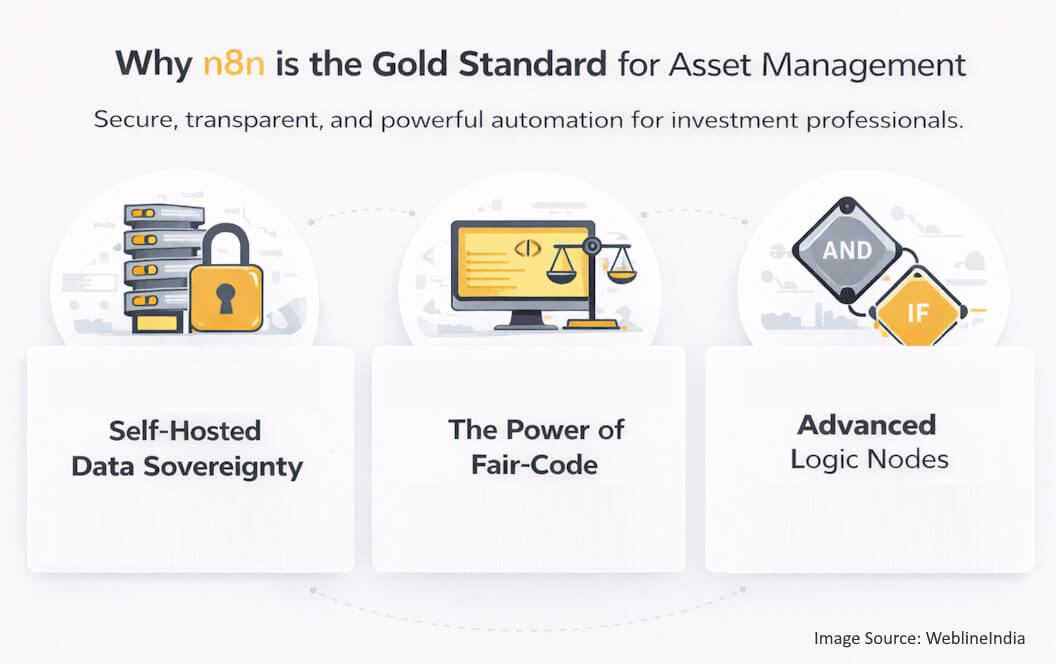
- Self-Hosted Data Sovereignty: Unlike many cloud-only competitors, n8n can be hosted on a firm’s own private servers. For asset managers handling sensitive PII (Personally Identifiable Information) and proprietary trade data, this ensures that no data leaves their secure perimeter, satisfying rigorous GDPR, SEC, and SOC2 compliance requirements.
- The Power of Fair-Code: In a high-volume environment, traditional per-task pricing can quickly erode the savings gained from automation. n8n’s execution-based model allows for thousands of automated steps without the exponential cost increase, making it the most scalable engine for workflow automation services.
- Advanced Logic Nodes: Asset management requires complex branching logic—such as evaluating multi-currency trade breaks or tiered approval hierarchies. n8n provides a visual interface that allows for deep JavaScript integration, bridging the gap between no-code ease and pro-code power.
The Era of Agentic AI Orchestration
The most significant trend in 2026 is the integration of Agentic AI solutions within the automation ecosystem. We are just moving more than data; we are moving intelligence.
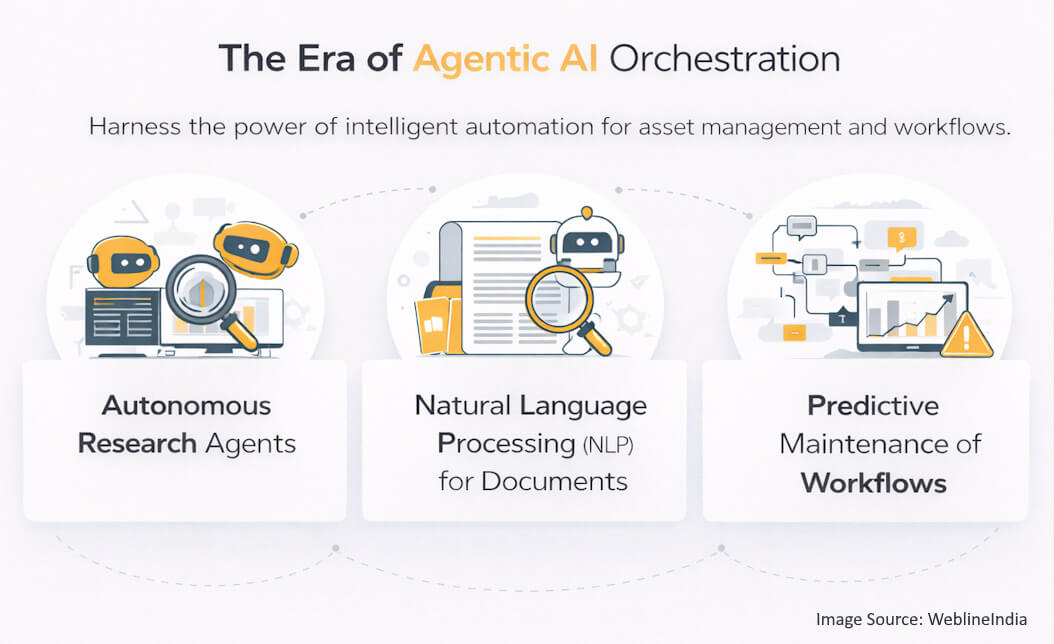
- Autonomous Research Agents: Using frameworks like LangChain integrated directly into n8n, firms are deploying agents that can read thousands of pages of quarterly earnings transcripts, sentiment-match them against social media feeds, and summarize key risks for portfolio managers in real-time.
- Natural Language Processing (NLP) for Documents: Modern workflow automation services now include nodes that can understand unstructured data. Whether it is an email from a custodian or a complex legal contract, AI agents extract the relevant data points and push them into the firm’s core systems.
- Predictive Maintenance of Workflows: AI is now used to monitor the automations themselves. If an API endpoint changes or a data format shifts, an AI orchestrator can often self-heal the workflow or alert a business automation service provider before a failure impacts the bottom line.
Combining the structural integrity of n8n with the cognitive power of AI, asset managers are building autonomous back offices that function with minimal human intervention, securing that elusive 40% reduction in operational overhead.
Strategic Implementation and the Value of Workflow Automation Consultation
The path to a 40% reduction in operational costs is rarely found by simply buying a software license and hoping for the best. In the sophisticated world of asset management, where every data point carries financial weight, the strategy behind the tool is more important than the tool itself.
This is why a professional workflow automation consultation is the foundational pillar of any successful digital transformation. Without a strategic roadmap, firms risk automating bad processes, which only serves to accelerate inefficiency and increase the surface area for technical debt.
Deconstructing the Operational DNA
A high-level workflow automation consultation begins with a forensic audit of a firm’s current state. Most asset managers have evolved organically over decades, resulting in a spaghetti architecture of legacy systems and manual workarounds. A consultant acts as an objective architect, mapping out the flow of data from the front-office execution to the back-office settlement.
During this discovery phase, a business automation service provider identifies high-impact opportunities that internal teams might overlook. These include:
- The Integration Gap: Identifying where data is manually transcribed between non-communicating systems (e.g., from an ESG data provider to a Portfolio Management System).
- The Latency Cost: Calculating the financial impact of delayed reporting or slow trade reconciliation.
- The Compliance Risk: Pinpointing manual touchpoints in the KYC/AML process that are vulnerable to human error.
Designing for Scalability and Security
Once the audit is complete, the consultation shifts toward designing a future-proof architecture. In 2026, this often involves selecting a core orchestrator like n8n for its ability to balance power with data privacy.
A strategic business automation process design ensures that the system is modular. If a firm changes its custodian or adopts a new CRM three years from now, a well-architected automation layer remains intact, requiring only a simple node update rather than a total system overhaul.
Furthermore, security is woven into the design from day one. A workflow automation consultation ensures that encryption standards, API authentication protocols, and data residency requirements are strictly met, protecting the firm from the catastrophic reputational damage of a data breach.
From Pilot to Automation Center of Excellence (CoE)
A professional business automation service provider does not just deliver a single workflow; they deliver a capability. The goal of a consultation is to help the firm establish an internal CoE. This involves:
- Defining Governance: Establishing who can build, approve, and deploy workflows to maintain system integrity.
- Standardizing Documentation: Ensuring every automated business process is documented for auditability and continuity.
- Measuring ROI: Setting up real-time dashboards that track time saved, error rates reduced, and the specific dollar value of the 40% cost reduction.
Asset managers can invest in a workflow automation consultation to move beyond task-flipping and toward a holistic operational strategy. This ensures that every dollar spent on workflow automation services is directly linked to a measurable increase in margin and a decrease in systemic risk.
WeblineIndia is Your Ideal Business Automation Service Provider
Selecting the right partner to overhaul your financial operations is a decision that impacts your firm’s scalability, security, and bottom line. WeblineIndia has established itself as a premier offshore IT agency, specializing in delivering high-impact workflow automation services tailored specifically for the rigorous demands of the asset management industry.
We provide more than software; we provide a holistic business automation process designed to capture that 40% reduction in operational costs while maintaining the highest standards of data integrity.
Deep Expertise in n8n and Financial Orchestration
At WeblineIndia, we recognize that asset managers have unique needs—chiefly the requirement for data sovereignty and the ability to handle complex, non-linear financial logic.
This is why we have positioned ourselves as a leading business automation service provider with deep expertise in n8n.
- Custom Node Development: If your proprietary legacy system doesn’t have a standard API, our developers create custom n8n nodes to ensure seamless connectivity across your entire tech stack.
- Secure Deployment: We specialize in self-hosted n8n environments, ensuring your sensitive investor data and trade secrets never leave your controlled infrastructure.
- Agentic AI Integration: Our team stays at the forefront of 2026’s trending technologies, integrating LLMs and LangChain into your workflows to create intelligent agents that can read, reason, and report.
A Comprehensive Workflow Automation Consultation
Every partnership begins with a thorough workflow automation consultation. We believe that technology should follow strategy. Our consultants spend time understanding your specific pain points, whether it is a bottleneck in trade settlement, a lag in investor reporting, or a high error rate in compliance monitoring. We then map out a multi-phase roadmap that prioritizes high-ROI quick wins while building toward a fully autonomous back office.
The Strategic Offshore Advantage
Choosing WeblineIndia as your business automation service provider, you benefit from a unique dual-cost advantage. First, you gain the 40% efficiency boost from the workflow automation itself.
Second, by leveraging our offshore delivery model, you access world-class automation engineers and financial technologists at a fraction of the cost of local hiring. This allows your firm to reinvest capital into your core investment strategies, further driving your competitive edge.
Our Commitment to Quality and Compliance
In the world of asset management, there is no room for error. WeblineIndia follows a rigorous development lifecycle:
- Security-First Architecture: Every business automation process we build is audited for vulnerabilities.
- Rigorous Testing: We use sandbox environments to simulate high-volume trade days, ensuring your workflows perform under pressure.
- Continuous Support: Our workflow automation services include 24/7 monitoring and maintenance, ensuring your digital workforce never goes offline.
WeblineIndia is more than a vendor; we are an extension of your operational team, dedicated to turning technical complexity into a streamlined and cost-effective reality.
Build an Automated Asset Manager with WeblineIndia
The next five years will see a widening gap between legacy firms and automated firms. Those who successfully implement a robust business automation process will enjoy 40% lower costs, higher employee satisfaction, and superior client retention. Those who wait will find themselves struggling with unsustainable margins.
The technology is ready, the ROI is clear, and the path is proven. The only question is how much longer you will let those operational costs eat into your budget.
Are you ready to transform your operations? Contact us to save more than 40% of operational costs by automating business workflow.
Social Hashtags
#ProcessAutomation #WorkflowAutomation #ArtificialIntelligence #DigitalTransformation #Fintech #AssetManagement #Automation #AI #MachineLearning #FutureOfWork #BusinessAutomation #TechInnovation #OperationalEfficiency #BFSI #AITools
Looking to implement AI-powered workflow automation in your asset management firm?
Frequently Asked Questions
Globally Recognized for Unmatched Quality and Reliability




Testimonials: Hear It Straight From Our Global Clients
Our development processes delivers dynamic solutions to tackle business challenges, optimize costs, and drive digital transformation. Expert-backed solutions enhance client retention and online presence, with proven success stories highlighting real-world problem-solving through innovative applications. Our esteemed Worldwide clients just experienced it.
Awards and Recognitions
While delighted clients are our greatest motivation, industry recognition holds significant value. WeblineIndia has consistently led in technology, with awards and accolades reaffirming our excellence.
OA500 Global Outsourcing Firms 2025, by Outsource Accelerator

Top Software Development Company, by GoodFirms

BEST FINTECH PRODUCT SOLUTION COMPANY - 2022, by GESIA

Awarded as - TOP APP DEVELOPMENT COMPANY IN INDIA of the YEAR 2020, by SoftwareSuggest