Financial Process Automation for Real-Time Fraud Detection and Prevention
Financial process automation helps companies catch fraud the moment it starts by watching transactions as they happen and reacting instantly. It keeps money safe, reduces manual work, and helps teams stay ahead of sneaky tricks. Give the full article a read for the whole story.

Listen to the podcast :
In the rapidly evolving financial sector, safeguarding against fraud is paramount. Traditional methods of fraud detection often fall short in addressing the complexities and speed of modern financial transactions. On the other hand, business process automation has set milestones in automating processes as well as safety actions. Financial process automation (FPA) has emerged as a critical solution, integrating advanced technologies to enhance efficiency and security.
Let us delve into how FPA, particularly through AI in financial fraud detection, facilitates real-time fraud detection and prevention.
Start securing your financial workflows with WeblineIndia’s automation experts.
Understanding Financial Process Automation
Financial process automation (FPA) leverages advanced software and AI-driven tools to replace manual and repetitive financial tasks such as invoicing, reconciliation, payroll processing, and compliance reporting.
Therefore, with robotic process automation in finance, you can have streamlined and error-free workflows. Businesses achieve greater accuracy, efficiency, and cost savings by minimizing human intervention while freeing up teams to focus on strategic decision-making.
Why Financial Automation
- Operational Efficiency: Automated workflows accelerate transaction processing, reducing delays in approvals, payments, and reporting. Real-time data synchronization ensures seamless cross-departmental coordination.
- Error Reduction: Manual data entry is prone to mistakes, leading to financial discrepancies. Automation enforces consistency, validating entries against predefined rules to prevent fraud and inaccuracies.
- Cost Savings: Companies reduce overhead costs by cutting labor-intensive tasks. A McKinsey study found that automation can lower finance operation expenses by up to 30%.
With automation handling routine tasks, finance professionals shift toward analytics-driven roles, leveraging AI insights for forecasting, fraud prevention, and strategic planning. This transformation fosters agility in responding to financial threats and opportunities in real time.
The Necessity of Real-Time Fraud Detection
Financial fraud poses a severe threat to businesses, leading to direct monetary losses, regulatory penalties, and reputational damage. Traditional fraud detection methods—such as manual audits or batch processing—are reactive, often identifying fraud only after it has occurred. Real-time detection transforms this approach by monitoring transactions instantaneously, allowing organizations to block suspicious activities before they cause harm.
Why Real-Time Detection is Critical
- Minimizing Financial Losses: Fraudulent transactions, if undetected, can drain accounts within seconds. Real-time systems flag anomalies (e.g., unusual payment amounts, unfamiliar locations) and freeze transactions for verification, preventing theft.
- Regulatory Compliance: Many industries (banking, healthcare, e-commerce) must comply with strict anti-fraud regulations (e.g., PSD2, AML). Automated real-time monitoring ensures compliance by logging and reporting suspicious activities immediately.
- Protecting Customer Trust: A single breach can erode consumer confidence. Instant fraud detection reduces false positives, ensuring legitimate transactions proceed smoothly while blocking malicious ones.
How Real-Time Fraud Detection Works
- AI-Powered Pattern Recognition: Machine learning models analyze historical and live transaction data to detect deviations (e.g., sudden high-value transfers, atypical login locations).
- Behavioral Biometrics: Systems track user behavior (keystrokes, mouse movements) to identify impersonation or account takeovers.
- Automated Alerts & Responses: Suspicious transactions trigger instant notifications to security teams or even auto-block payments pending review.
The Cost of Delayed Detection
Without real-time monitoring, companies face:
- Higher chargeback fees from fraudulent card transactions.
- Increased investigation costs due to delayed discovery.
- Long-term brand damage from repeated security failures.
Role of AI in Financial Fraud Detection
Artificial Intelligence has revolutionized fraud detection by enabling predictive, real-time analysis of financial transactions. Unlike rule-based systems, AI-powered solutions continuously evolve, detecting sophisticated fraud schemes that traditional methods often miss.
How AI Enhances Fraud Detection
- Pattern Recognition & Anomaly Detection: AI algorithms process millions of transactions per second, identifying subtle irregularities—such as unusual spending spikes, geographic inconsistencies, or atypical transaction timing—that signal potential fraud.
- Adaptive Machine Learning Models: Unlike static rules, AI learns from new fraud patterns, refining detection accuracy over time. For example, if fraudsters shift tactics (e.g., using synthetic identities), the system updates its risk models without manual intervention.
- Behavioral Analysis & Biometrics: AI monitors user behavior (login times, device usage, typing speed) to detect account takeovers. If a transaction deviates from a customer’s normal behavior, the system can flag or block it instantly.
Key AI Technologies in Fraud Prevention
- Supervised Learning: Trains models on labeled fraud datasets to recognize known scam patterns.
- Unsupervised Learning: Detects previously unknown fraud by clustering anomalies in unlabeled data.
- Natural Language Processing (NLP): Scans emails, invoices, and chat logs for social engineering or phishing red flags.
- Deep Learning Neural Networks: Analyzes complex, multi-layered fraud schemes (e.g., money laundering rings).
The Competitive Edge of AI-Driven Fraud Detection
- Reduces False Positives: By understanding context, AI minimizes unnecessary transaction blocks that frustrate customers.
- Scales with Business Growth: Handles increasing transaction volumes without proportional cost increases.
- Stays Ahead of Criminals: Self-improving algorithms outpace static fraud detection systems.
Want a smarter fraud defense powered by AI? Talk to our fintech specialists today.
Implementing Real-Time Fraud Detection Systems
To effectively combat fraud, financial institutions are integrating real-time fraud detection systems powered by AI. These systems monitor transactions in real time, flagging suspicious activities for immediate investigation. Integration with existing financial processes ensures seamless operation and swift response to potential threats.
Advantages of Financial Process Automation in Fraud Prevention
Financial process automation has become a game-changer in fraud prevention, offering organizations a proactive, efficient, and scalable defense against financial crimes. Businesses can detect, prevent, and respond to fraud faster than ever before by integrating AI-driven automation.
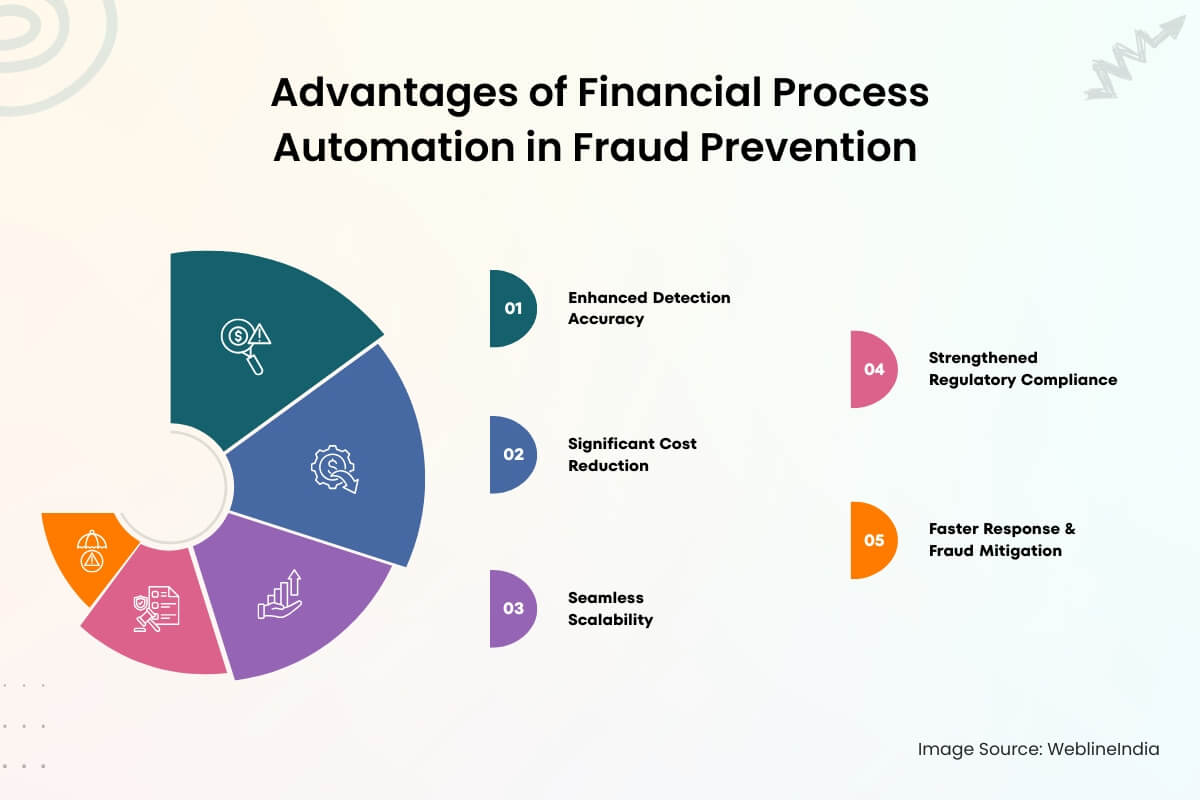
1. Enhanced Detection Accuracy
- AI-powered automation eliminates human error in transaction monitoring, reducing false negatives (missed fraud) and false positives (legitimate transactions flagged as fraud).
- Machine learning models analyze historical and real-time data, identifying subtle fraud patterns that manual reviews might overlook.
- Example: An automated system can detect micro-fraud—small, repeated fraudulent transactions that often go unnoticed in manual audits.
2. Significant Cost Reduction
- Automating fraud detection reduces labor costs associated with manual investigations and forensic accounting.
- Prevents financial losses by stopping fraud before funds are withdrawn or misused.
- Lowers operational overhead by minimizing the need for large compliance teams to monitor transactions.
3. Seamless Scalability
- Automated systems can process millions of transactions per second, making them ideal for growing businesses and high-volume industries (e.g., e-commerce, banking).
- Cloud-based fraud detection solutions scale dynamically, ensuring performance doesn’t degrade during peak transaction periods (e.g., Black Friday, tax season).
4. Strengthened Regulatory Compliance
- Automated audit trails and reporting ensure transparency, helping businesses comply with AML, KYC, GDPR, and SOX regulations.
- Real-time monitoring flags suspicious activities immediately, enabling timely reporting to financial authorities.
- Reduces compliance fines by maintaining accurate, up-to-date records for regulatory audits.
5. Faster Response & Fraud Mitigation
- Automated systems trigger instant alerts or auto-block fraudulent transactions, minimizing damage.
- AI continuously learns from new threats, adapting detection rules faster than manual updates.
- Example: If a stolen credit card is used, automation can freeze the account before further transactions occur.
Challenges in Implementing AI-Driven Fraud Detection
While the benefits are substantial, implementing AI-driven fraud detection systems presents challenges:
- Data Privacy Concerns: Handling sensitive financial data requires stringent security measures.
- Integration Complexities: Integrating AI systems with existing financial infrastructure can be complex and resource-intensive.
- Continuous Monitoring: AI systems require ongoing monitoring and updating to adapt to evolving fraud tactics.
Outsourcing and Offshore Solutions in Financial Automation
To overcome implementation challenges, many financial institutions opt to outsource or offshore their financial process automation needs. Collaborating with an offshore IT agency or hire remote developers provides access to specialized expertise and resources, facilitating the development and deployment of advanced AI-driven fraud detection systems.
AI and ML Approaches in Fraud Detection
Incorporating AI and ML solutions into fraud detection enhances the system’s ability to identify complex fraud patterns. AI agents can analyze transaction data in real time, learning from each interaction to improve future detection accuracy. This agentic AI approach allows for dynamic and adaptive fraud prevention strategies.
Case Studies of Successful Implementation
- American Express: Utilizes AI agents to analyze transaction data in real time, enhancing fraud detection capabilities.
- Reserve Bank of India: Developed MuleHunter AI, an AI/ML model to detect mule accounts used in fraudulent activities.
- BaFin (Germany): Integrated AI into its alert and market analysis system, improving the detection of market abuse and suspicious trading patterns.
Future Trends in Financial Fraud Detection
As financial fraud grows more sophisticated, the technologies combating it must evolve even faster. The future of fraud detection will be shaped by cutting-edge AI advancements, decentralized security models, and hyper-personalized risk assessment to create an ecosystem where fraud is predicted and prevented before it occurs.
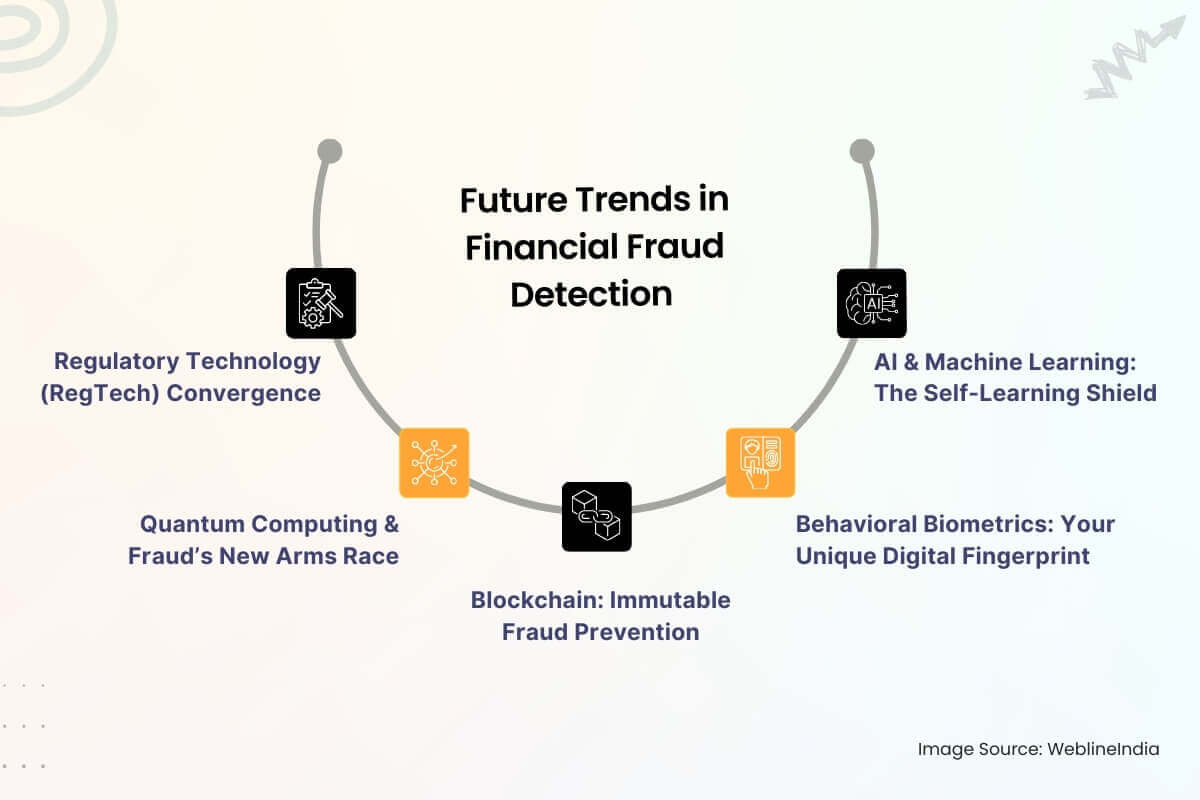
1. AI & Machine Learning: The Self-Learning Shield
- Deep Learning Fraud Networks: Next-gen AI will analyze cross-channel behavior (payments, logins, customer support interactions) to detect complex fraud rings.
- Explainable AI (XAI): Regulatory demands will drive transparent AI models that justify fraud alerts to auditors and customers.
- Predictive Fraud Scoring: Systems will assign real-time risk scores to every transaction, user, and device, blocking threats preemptively.
2. Behavioral Biometrics: Your Unique Digital Fingerprint
- Passive Authentication: Fraud detection will analyze typing rhythms, mouse movements, and even gait patterns (via mobile sensors) to verify users silently.
- Emotional AI: Systems may detect stress or hesitation during transactions—potential signs of account coercion or social engineering attacks.
3. Blockchain: Immutable Fraud Prevention
- Smart Contract Audits: Self-executing contracts on blockchains will automatically flag suspicious terms (e.g., money laundering loopholes).
- Decentralized Identity Verification: Users will control encrypted identity tokens, reducing synthetic identity fraud and KYC costs.
4. Quantum Computing & Fraud’s New Arms Race
- Quantum Encryption: Banks may adopt quantum-resistant algorithms to prevent next-gen hacking of traditional encryption.
- AI vs. AI Battles: Fraudsters will weaponize AI, forcing detection systems to simulate adversarial attacks during training.
5. Regulatory Technology (RegTech) Convergence
- Global Fraud APIs: Shared fraud databases (e.g., blockchain-based blacklists) will enable cross-border, real-time threat intelligence.
- Automated Compliance: AI will dynamically adjust controls to meet shifting regional regulations (e.g., crypto laws, PSD3 updates).
Businesses must invest in modular, AI-first fraud platforms that can integrate emerging tech like blockchain and quantum computing. The winners will be those who treat fraud prevention not as a cost center, but as a strategic differentiator for customer trust.
Why Choose WeblineIndia for Financial Process Automation?
WeblineIndia is a trusted partner for AI-powered financial automation, offering secure, scalable solutions tailored to banking, fintech, and insurance sectors. Their team of Artificial Intelligence and Machine Learning developers has access to fintech experts to deliver cutting-edge fraud detection, automated reconciliation, and regulatory compliance systems to ensure accuracy, cost savings, and real-time risk mitigation.
Key Advantages:
- Custom AI/ML Models – Advanced anomaly detection for fraud prevention
- End-to-End Automation – From invoicing to audit-ready reporting
- Regulatory Compliance – Built-in adherence to AML, KYC, and GDPR
- 24/7 Monitoring – Real-time alerts for suspicious transactions
- Proven Fintech Expertise – Trusted by global financial institutions
With agile development and seamless integration, WeblineIndia helps businesses future-proof their financial operations.
Social Hashtags
#FinancialProcessAutomation #FraudDetection #RealTimeSecurity #Fintech #AIinFinance #RiskPrevention #SecureTransactions #DigitalFinance #AutomationInFinance
Ready to protect transactions in real time? Let’s build your automation plan together
Frequently Asked Questions
Globally Recognized for Unmatched Quality and Reliability




Testimonials: Hear It Straight From Our Global Clients
Our development processes delivers dynamic solutions to tackle business challenges, optimize costs, and drive digital transformation. Expert-backed solutions enhance client retention and online presence, with proven success stories highlighting real-world problem-solving through innovative applications. Our esteemed Worldwide clients just experienced it.
Awards and Recognitions
While delighted clients are our greatest motivation, industry recognition holds significant value. WeblineIndia has consistently led in technology, with awards and accolades reaffirming our excellence.

OA500 Global Outsourcing Firms 2025, by Outsource Accelerator

Top Software Development Company, by GoodFirms

BEST FINTECH PRODUCT SOLUTION COMPANY - 2022, by GESIA

Awarded as - TOP APP DEVELOPMENT COMPANY IN INDIA of the YEAR 2020, by SoftwareSuggest