IT Solutions for Logistics: Building Resilient Systems for Supply Chain Disruptions
Supply chain hiccups like delays, shortages or delivery issues can throw everything off track — but smart IT solutions are helping logistics businesses stay steady. From custom platforms to mobile apps and real-time monitoring, these tools are built for fast fixes and smarter planning. Read the full article to learn how.

Listen to the podcast :
IT solutions for logistics have become foundational in ensuring that supply chains continue to operate during periods of disruption. Whether it’s a port shutdown, raw material shortage, or last-mile delivery failure, businesses require robust systems to mitigate the ripple effects.
The right IT solutions for logistics can provide operational resilience through intelligent route planning, predictive analytics, and real-time shipment visibility. Hence, modern logistics solutions are no longer just about moving goods from point A to point B. It’s about enabling proactive decision-making through data-driven platforms, backed by APIs, third-party integrations, and mobile support.
Ready to make your logistics disruption-proof? Talk to our experts today.
Logistics IT Solutions Globally
According to a report published on Fortune Business Insights, in 2024, the worldwide digital logistics sector achieved a valuation of $32.44 billion. Forecasts indicate a substantial expansion, with the market expected to surge from $37.64 billion in 2025 to approximately $120.33 billion by 2032. This growth trajectory represents a compound annual growth rate (CAGR) of 18.1%.
North America led the market in 2024, accounting for a 35.82% global share. Within this region, the U.S. market is anticipated to experience considerable growth, with projections estimating it will reach nearly $19.97 billion by 2032.
When properly implemented, a logistics solution helps businesses recover quickly from delays, optimize inventory movement, and maintain SLAs despite sudden changes in demand or supplier behavior.
Why Custom IT Solutions for Logistics Outperform Generic Platforms?
Every supply chain has unique bottlenecks—whether it’s temperature-controlled freight, cross-border regulations, or complex distribution centers. Off-the-shelf logistics software often fails to adapt quickly.
This is where custom logistics solutions come into play. These systems are purpose-built to meet the specific needs of an organization, enabling better integration with existing ERP, WMS, or TMS platforms. For example, different types of add-ons can be provided as part of customized logistics solutions, which include interaction with loading and unloading sensors, barcode scanning to register bay and terminals for the relevant company.
Custom logistic solutions offer:
- API-first architecture tailored for your internal ecosystem
- Advanced rule engines for exception handling and SLA management
- Real-time integrations with third-party carriers and sensor systems
- Scalable cloud-native infrastructure to handle traffic spikes
When disruptions occur, custom logistic solutions can automatically reroute deliveries, alert affected teams, and adjust the backend logistics model based on business logic.
Mobile App for Logistics: Enhancing Real-Time Agility
A robust mobile app for logistics is no longer optional. With drivers, warehouse staff, and dispatchers working across disconnected locations, mobility becomes essential. Whether it’s barcode scanning, signature capture, GPS tracking, or POD uploads, a mobile app for logistics enables real-time coordination.
Key features include:
- Offline support and auto-sync when the network reconnects
- Real-time navigation with traffic, weather, and hazard overlays
- Push notifications and incident reporting for disrupted routes
- Integration with sensors for monitoring cargo conditions (temperature, shocks)
A well-built mobile app for logistics and warehouse ensures business continuity even in blackout zones, border delays, or fleet breakdown scenarios. When combined with geofencing, analytics, and cloud-sync services, these apps enhance operational agility under stress.
Need a custom logistics app or platform? Let’s create one that fits your needs.
IT Architecture for Resilient Logistics Systems
Resilience is not a feature—it’s an architectural outcome. Effective IT solutions for logistics require systems that are fault-tolerant, distributed, and scalable. This involves embedding high-availability design patterns such as:
- Active-active database clusters and region-based replication
- Circuit-breaker logic for third-party API failures
- Redundant messaging queues and event-driven microservices
- Auto-scaling infrastructure with failover routing
In complex deployments, companies often engage an offshore IT agency or hire remote developers to build modular logistics platforms. Outsourcing these builds to teams skilled in containerized services, infrastructure-as-code, and secure data sync makes it possible to maintain operational uptime despite internal or external shocks.
Organizations working with an offshore IT agency often benefit from seamless development cycles, domain-specific expertise, and reduced internal staffing overhead. The use of remote developers is particularly effective for maintaining continuous delivery pipelines and microservice enhancements over time.
Smart Exception Management Using AI and ML
For companies with high disruption risk (e.g., perishable goods, pharmaceuticals, or international shipping), AI and ML solutions can provide predictive capabilities to reduce loss. Custom AI solutions and models work alongside core logistics solution components to flag delays, suggest reroutes, and optimize resource usage.
How AI agents and ML models are applied:
- AI agents predict shipment delays based on weather, political unrest, or route congestion
- An agentic solution automatically recalculates delivery paths and resource allocation
- ML algorithms detect anomalies like temperature deviations or delivery failures
- Historical data is analyzed to adjust lead times and buffer stocks dynamically
These AI and ML solutions add a layer of foresight, enabling logistics teams to act before a disruption escalates into a crisis. They’re most effective when embedded directly into the custom logistics solutions architecture and connected to your mobile app for logistics through secure APIs.
Seamless Integration with Legacy and New Systems
While some organizations opt for full rebuilds, others must deal with existing systems. Integrating IT solutions for logistics in such cases requires careful consideration of legacy system compatibility. Here, greenfield software development and brownfield software development become relevant.
- Greenfield software development in logistics is ideal when starting from scratch, allowing teams to adopt cloud-native designs, event-driven architectures, and serverless backends.
- Logistics brownfield software development focuses on extending or modernizing existing platforms. Integration layers, data transformation modules, and API gateways are used to wrap around legacy WMS or ERP systems.
In both cases, whether using greenfield or brownfield approaches, ensuring resilience means building redundancy and adaptability into each layer—from transport services and data sync to frontend mobile experiences.
Outsourcing Software Solutions for Logistics Projects
For most businesses, developing robust IT solutions for logistics in-house is expensive, time-consuming, and resource intensive. Many choose to outsource software development services for their business, which may involve full-system design or just key module development, like a mobile app for logistics or real-time analytics.
Benefits of outsourcing software solutions for logistics:
- Access to global expertise in logistics tech stacks
- Rapid scaling of teams using remote developers
- Agile delivery pipelines with CI/CD, automated testing, and observability baked in
- Lower costs and faster turnaround with offshore teams
An experienced remote IT agency or offshore IT agency can deliver everything from backend route engines to frontend dashboards, while adhering to security, compliance, and uptime requirements. Businesses reduce risk while accelerating digital transformation, especially during supply chain instability.
Real-Time Monitoring and Recovery Strategies
A responsive logistics solution needs proactive monitoring and intelligent recovery protocols. Disruption detection must be near real-time, with alert routing and escalation paths clearly defined. Monitoring strategies embedded into custom logistic solutions include:
- End-to-end tracing using tools like OpenTelemetry or Zipkin
- Alert-based thresholds for temperature, latency, or route deviation
- Automatic retries for failed third-party API calls
- Audit logs and rollback support for mobile activities (like POD rejections)
Cloud-native observability platforms integrated into IT solutions for logistics enable DevOps and logistics managers to detect and respond to failures in real time, reducing downtime and lost shipments.
Key Features That Build Resilience
Building robust logistics systems isn’t just about uptime—it’s about staying operational when things go wrong.
Here’s what resilient IT solutions for logistics should include:
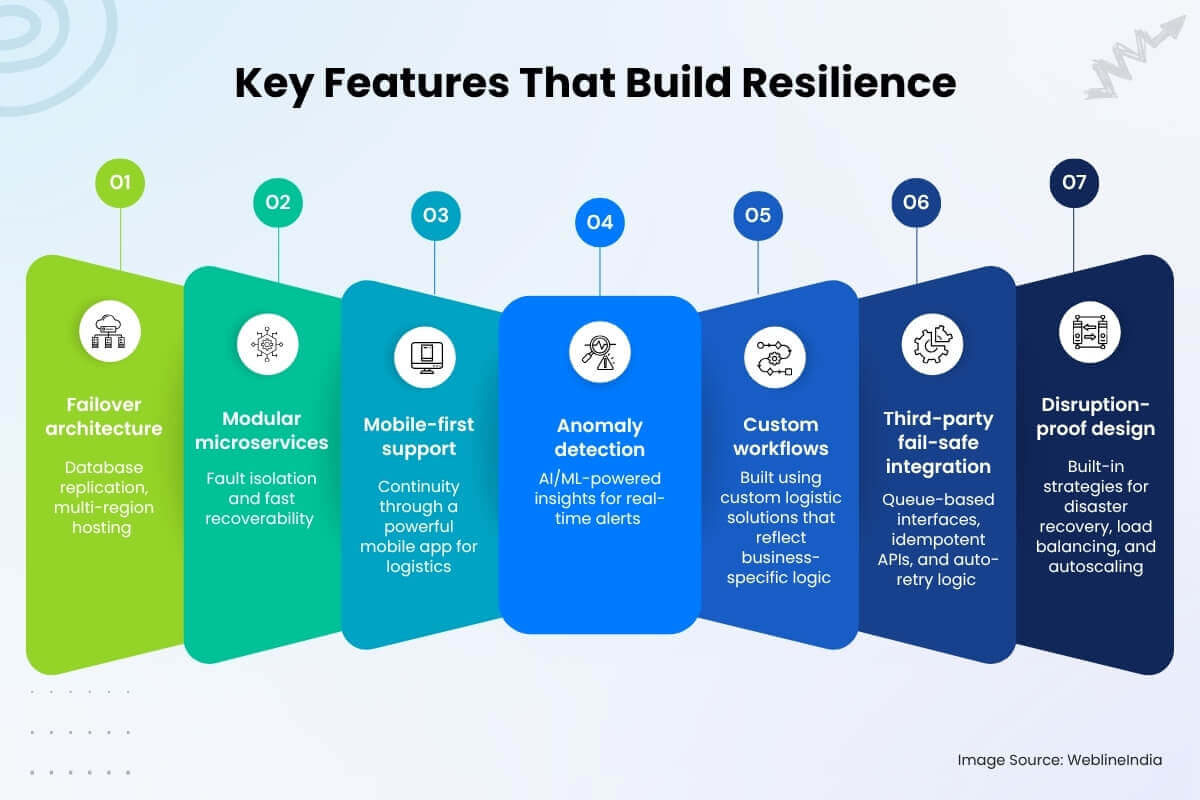
1. Failover architecture: Database replication, multi-region hosting
2. Modular microservices: Fault isolation and fast recoverability
3. Mobile-first support: Continuity through a powerful mobile app for logistics
4. Anomaly detection: AI/ML-powered insights for real-time alerts
5. Custom workflows: Built using custom logistic solutions that reflect business-specific logic
6. Third-party fail-safe integration: Queue-based interfaces, idempotent APIs, and auto-retry logic
7. Disruption-proof design: Built-in strategies for disaster recovery, load balancing, and autoscaling
This approach ensures that your logistics solution doesn’t just survive a disruption—it adapts and thrives during it.
Why WeblineIndia Is the Right Partner for Logistics IT Solutions
WeblineIndia is a top IT agency that specializes in developing resilient, scalable, and performance-driven technology solutions for logistics. Whether you need a tailor-made mobile app for logistics, fully integrated custom logistics solutions, or a modular logistics solution capable of handling disruptions, WeblineIndia brings domain expertise and reliable delivery.
Partnering with WeblineIndia provides:
- Expert remote developers with hands-on logistics experience
- A trusted offshore IT agency model for scalable, cost-effective delivery
- Experience in both greenfield software development and brownfield software development
- End-to-end services: UI/UX, cloud architecture, API integrations, mobile app development, and ongoing support
- Optional integration of AI agents, agentic solutions, and ML capabilities for predictive and autonomous decision-making
If you’re looking to outsource or need dependable outsourcing software development, hire remote developers who can help you get future-proof logistics operations with precision-engineered systems.
Social Hashtags
#LogisticsTech #SupplyChainSolutions #ITforLogistics #CustomLogisticsSoftware #MobileAppForLogistics #OutsourceLogisticsIT #SmartLogistics #AIinLogistics #LogisticsResilience
Want scalable IT solutions for logistics that work? Let’s build yours together.
Frequently Asked Questions
Globally Recognized for Unmatched Quality and Reliability




Testimonials: Hear It Straight From Our Global Clients
Our development processes delivers dynamic solutions to tackle business challenges, optimize costs, and drive digital transformation. Expert-backed solutions enhance client retention and online presence, with proven success stories highlighting real-world problem-solving through innovative applications. Our esteemed Worldwide clients just experienced it.
Awards and Recognitions
While delighted clients are our greatest motivation, industry recognition holds significant value. WeblineIndia has consistently led in technology, with awards and accolades reaffirming our excellence.

OA500 Global Outsourcing Firms 2025, by Outsource Accelerator

Top Software Development Company, by GoodFirms

BEST FINTECH PRODUCT SOLUTION COMPANY - 2022, by GESIA

Awarded as - TOP APP DEVELOPMENT COMPANY IN INDIA of the YEAR 2020, by SoftwareSuggest