Comprehensive Software Development Guide 2026: Process, Cost, Trends & Best Practices
This guide walks you through how software development looks in 2026, from planning and costs to teams, tools, security and real business use cases. It reads like a practical roadmap for builders and leaders alike. Stick around and read the full article for details.

Listen to the podcast :
Technologies of all kinds are undergoing rapid transformation in history. Driven by Generative AI, ubiquitous cloud computing services, and the necessity for hyper-automation, the practice of software development in 2026 is fundamentally different from just a few years ago. This shift demands a guide that moves beyond traditional methodologies (like simple Agile or Waterfall) and addresses the future-ready strategies, costs, and talent required to build intelligent, scalable, and secure applications.
This is an all-in-one, comprehensive guide you need to read to understand, plan, and execute successful software projects that leverage the power of 2026 technology. It is a roadmap for business leaders, product owners, and aspiring technologists alike.
Planning a software product for 2026 and not sure where to start really matter?
What is Software Development in 2026?
Software development in 2026 is no longer just the process of writing and deploying code. It has matured into a strategic business discipline focused on leveraging intelligent systems, automated processes, and distributed cloud infrastructures to create seamless digital products that drive measurable business outcomes. The modern definition is intrinsically linked to automation, security, and data governance.
Evolution of software development till 2026
Software development has moved through distinct eras:
- Early Days (Pre-2000s): Focused on mainframe systems, physical infrastructure, and the rigid Waterfall methodology.
- The Internet Boom (2000s-2010s): Shift to web applications, the rise of Agile, and virtual machines (VMs).
- The Cloud Era (2010s-2020s): Dominance of Cloud-Native architecture, DevOps practices, and microservices for speed and scale.
- The Intelligent Era (2025 and Beyond): Characterized by AI-assisted coding, Serverless systems, extreme automation, and a primary focus on security and ethical data use.
Impact of AI, Automation, Cloud maturity, Low-code and Microservices
The modern scope of development is defined by disruptive forces:
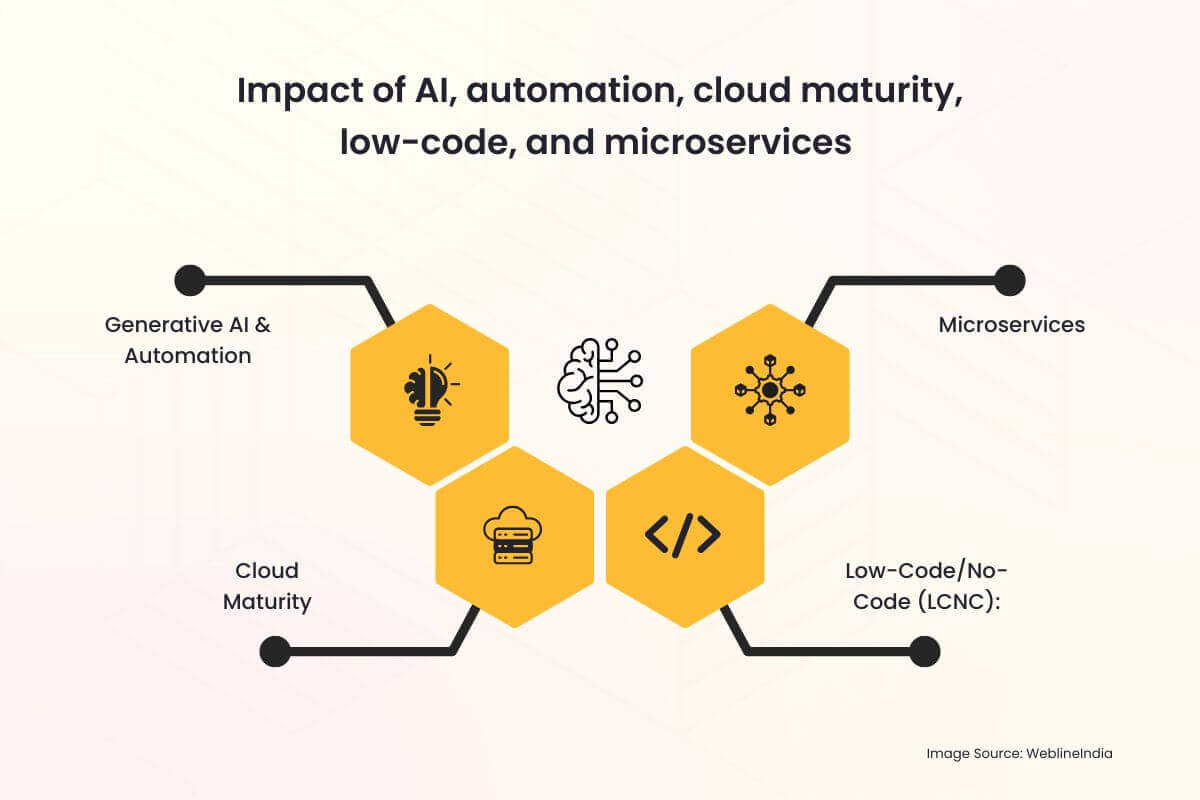
- Generative AI & Automation: AI is moving from being a feature in the software to being a key tool for building it. AI coding assistants (like Copilot) automate boilerplate code, shifting the developer’s role toward architecture, verification, and prompt engineering. Autonomous testing and CI/CD pipelines automate the deployment process end-to-end.
- Cloud Maturity: The market has moved beyond IaaS (Infrastructure-as-a-Service) to Serverless and Platform Engineering, allowing development teams to focus purely on code logic rather than infrastructure management.
- Low-Code/No-Code (LCNC): These platforms enable “citizen developers” to rapidly build internal applications, changing the custom development workload to focus only on mission-critical, highly specialized systems.
- Microservices: This architectural style remains dominant for large systems, ensuring enhanced scalability, resilience, and independent deployment cycles.
Growing role of Security, Compliance & Data Governance
In 2026, security is a non-negotiable core requirement, not an afterthought:
- Security-First Mindset: The rise of DevSecOps mandates security controls and automated vulnerability scanning at every stage of the SDLC.
- Global Compliance: Developers must build systems compliant with rapidly evolving global regulations, such as the EU AI Act, and data privacy laws (like GDPR and India’s DPDP), especially concerning data residency and ethical AI use.
- Data Governance: Given the reliance on large datasets for AI applications, rigorous governance is required to manage data quality, ownership, and accessibility.
Custom vs Off-the-shelf comparison: Updated 2026
The decision to build custom software or buy an existing solution is now more complex:
| Feature | Custom Software (2026 View) | Off-the-Shelf (SaaS/COTS) |
| Strategy | Core Business Differentiator: Used when the software is the competitive advantage (e.g., a proprietary AI engine). | Support/Commodity Function: Used for non-core needs (e.g., email, standard HR management). |
| Integrations | Built to integrate perfectly with existing legacy systems and unique business processes. | Requires conforming your business process to the tool’s defined APIs or functions. |
| Cost Model | High initial cost, lower long-term operational cost efficiency via automation. | Low initial cost, high and continuous subscription cost that scales with users. |
| Flexibility | 100% control over features, tech stack, and future roadmap. | Limited by the vendor’s roadmap and update cycle. |
Why Businesses Need Software Development in 2026?
In the year 2026, software development is no longer a supportive IT function. It is the primary engine for competitive advantage. Companies that do not invest in custom, intelligent solutions risk being rapidly outpaced by competitors leveraging new technologies. The need for custom software now relates directly to core business survival and growth.
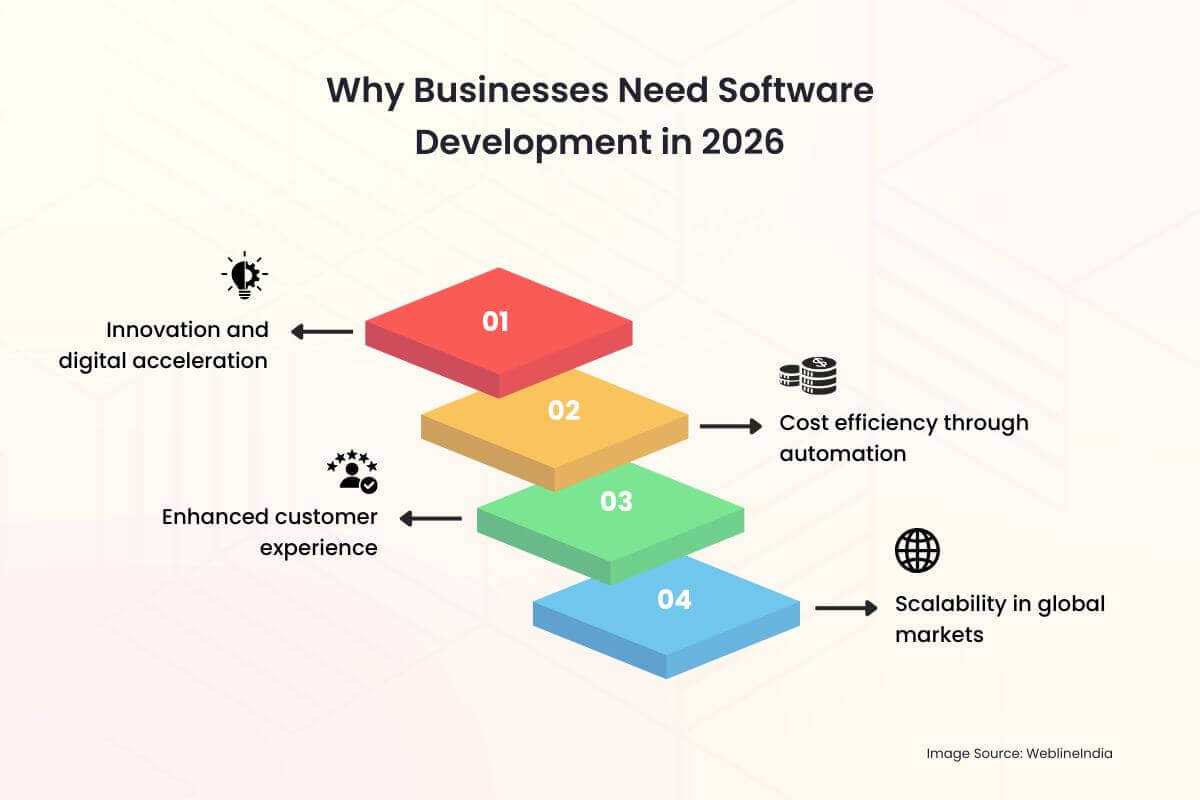
Innovation and Digital Acceleration
Custom software is the key enabler of genuine innovation. Off-the-shelf products provide basic functionality, but a tailored solution can integrate unique business logic, proprietary algorithms, or specialized machine learning models that the competition cannot replicate. This ability to embed intellectual property (IP) directly into the operating model drives significant digital acceleration. Custom development allows for faster pivoting and integration of emerging technologies, ensuring the business stays ahead of market demands.
Cost Efficiency through Automation
A primary financial driver for custom software in 2026 is cost reduction achieved through deep hyper-automation. While initial development requires investment, the final product eliminates manual, repetitive tasks across various departments, from finance to logistics.
- Intelligent Process Automation (IPA): Systems are built to handle complex decision-making, minimizing human error and latency.
- Integration Optimization: Custom APIs and interfaces connect disparate systems seamlessly, reducing the need for costly manual data transfer or reconciliation.
The long-term effect is a substantial reduction in operational expenditure (OpEx).
Enhanced Customer Experience
Today’s customers expect highly personalized, immediate, and omnichannel interactions. Custom software development allows businesses to build a unified platform that integrates all customer touchpoints, resulting in a superior Customer Experience (CX).
- Predictive Personalization: Using custom AI/ML models, systems analyze user data to offer highly relevant product suggestions or services in real time.
- Seamless Journeys: Development focuses on creating low-friction interfaces, such as Progressive Web Apps (PWAs) or serverless mobile backends, ensuring speed and reliability across all devices. This directly translates to higher customer retention and loyalty.
Scalability in Global Markets
To compete globally, software must be designed to scale effortlessly. Modern custom development is founded on Cloud-Native principles and microservices architecture.
- Elasticity: Utilizing cloud providers, custom applications can automatically scale resources up during peak demand and scale down during low-usage periods. This elasticity is far more cost-effective than managing fixed, on-premises infrastructure.
- Global Distribution: Solutions are deployed across multiple regions using Containerization (e.g., Docker, Kubernetes), ensuring low latency for users anywhere in the world and simplifying regulatory compliance across borders.
Real examples of 2026 use cases: AI apps, IoT systems, SaaS, industry apps
| Use Case | Business Requirement | Technical Approach |
| AI-Powered Customer Service | Reduce agent workload and provide instant resolution for 70% of queries. | Integration of a custom LLM (Large Language Model) trained on proprietary company knowledge via a specialized API. |
| Smart Manufacturing (IoT) | Real-time monitoring of machine performance to predict and prevent failures. | Deployment of Edge Computing devices and a centralized cloud platform for high-velocity data ingestion and analytics. |
| B2B SaaS Platform | Offer a specialized subscription tool for a niche market with a unique data visualization need. | Multi-tenant architecture built on Serverless functions to maintain cost efficiency while ensuring data isolation for all clients. |
| Fintech Platform | Achieve instant cross-border payments with high security and regulatory compliance. | Development utilizing Blockchain or Distributed Ledger Technology (DLT) with embedded DevSecOps practices for security clearance. |
Turn modern software ideas into real, working products with a team that’s done it for years.
The Software Product Strategy Before Development Starts
Before any code is written, the most critical work is defining the product strategy. Building software without a clear strategy is a common cause of project failure and significant budget waste. For a successful 2026 project, strategic alignment must be established first.
Market Validation & Minimum Viable Product (MVP) Strategy
The initial concept for custom software must be validated by the market. This phase ensures that the solution addresses a real, documented user pain point, rather than just an internal assumption.

- Design Sprints and Prototypes: Techniques like the Design Sprint are used to quickly answer critical business questions through design, prototyping, and testing ideas with real users in a short, fixed period. This saves months of development time.
- Minimum Viable Product (MVP): The MVP is the version of a new product that allows a team to collect the maximum amount of validated learning about customers with the least effort. The focus is on core functionality—what is the single most important thing the product must do? The MVP is a learning tool, not a limited product.
- Feasibility Check: This involves technical assessment to ensure the concept can be built using the selected technology stack and within reasonable cost constraints.
The Strategic Decision: Build vs Buy vs Subscribe
Businesses no longer face a simple Build vs. Buy choice; the proliferation of specialized SaaS tools adds the Subscribe option. This decision must be strategic, based on where the software fits in the company’s competitive landscape.
| Decision | Best Use Case | Risk Profile |
| Build (Custom) | Used for the core differentiating product or service that provides a competitive edge (e.g., a proprietary AI pricing engine). | Higher upfront cost and maintenance responsibility; requires specialized in-house or outsourced talent. |
| Buy (Off-the-Shelf) | Used for a non-core function where the business process is standard (e.g., standard accounting software or basic CRM). | Lower flexibility; business must adapt its process to the software’s capabilities. |
| Subscribe (SaaS) | Used for services that are complex but standardized across the industry (e.g., email marketing platforms, complex HR systems). | Reliance on the vendor’s service level agreement (SLA) and data security policies; recurrent OpEx cost. |
Defining Success through Product-Market Fit and North Star Metrics
Success must be quantified before development begins. This moves beyond simply delivering the features on time to ensuring the software provides genuine value.
- Product-Market Fit (PMF): PMF is achieved when the product successfully satisfies a specific market need. It is often measured qualitatively through user feedback and quantitatively by high retention rates and strong organic growth.
- North Star Metric (NSM): The NSM is the single most important rate or measure that indicates the value your product provides to your customers.
- Example: For a collaboration tool, the NSM might be “Daily Active Teams Using X Feature.”
- This metric ensures the entire development and product team is aligned on a singular goal that drives sustainable business growth.
- Leading and Lagging Indicators: The team must track leading indicators (e.g., feature usage frequency) to predict the lagging indicator (the NSM).
Types of Software Development – Updated list 2026
The software development ecosystem is constantly expanding, creating specialized branches that cater to specific platforms and user needs. Understanding these types is essential for selecting the right talent and technology. The following categories are prominent in 2026, driven by cloud and intelligence.
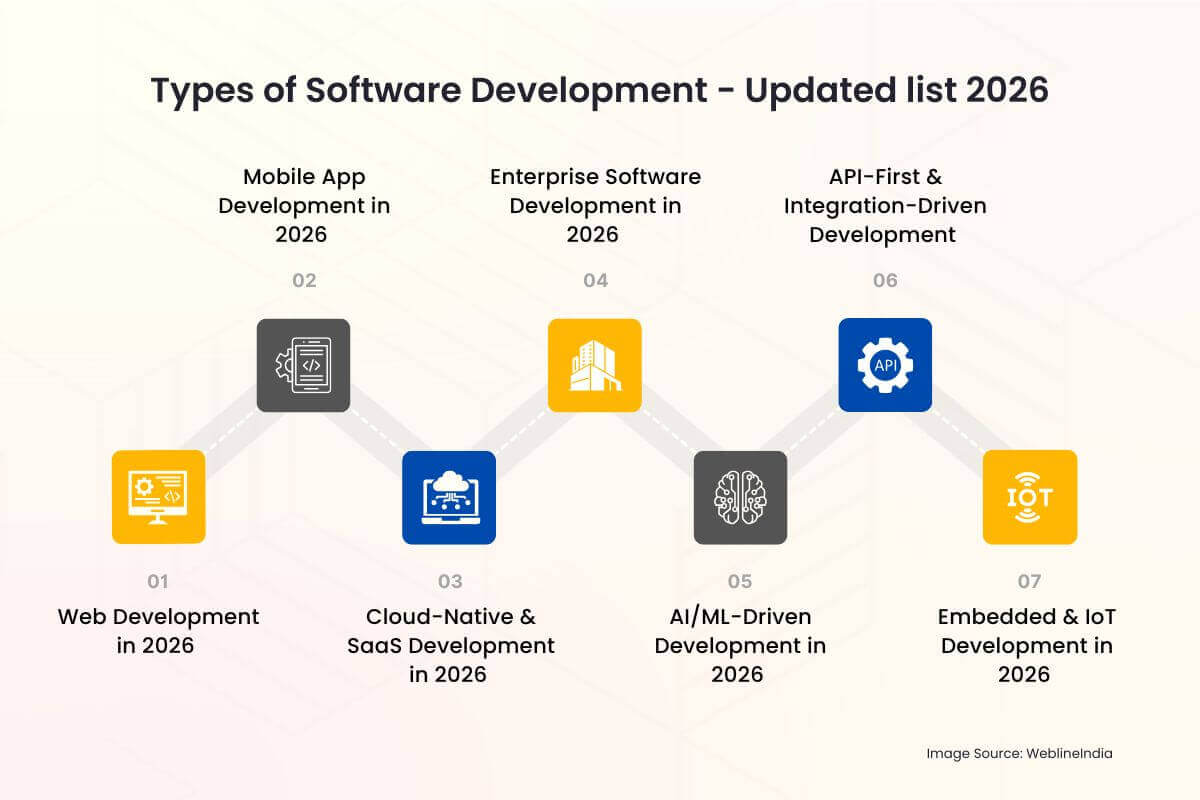
Web Development in 2026
Web development is the creation of applications accessed via a standard web browser. Modern web development is fast, modular, and performance-focused.
- JAMStack Architecture: This approach uses JavaScript, APIs, and Markup. It promotes high security and superior performance by pre-rendering sites and serving them directly from a CDN (Content Delivery Network), minimizing reliance on traditional web servers.
- Headless CMS: The content management system (CMS) is decoupled from the presentation layer (frontend). This allows a single content repository to feed multiple outputs, such as websites, mobile apps, and IoT screens, via APIs.
- Progressive Web Apps (PWAs): These are web applications that use modern browser capabilities to deliver an app-like user experience, including offline access and push notification system, directly through the browser.
Mobile App Development in 2026
Mobile development focuses on creating applications for smartphones and tablets. The market heavily favors solutions that can target both major operating systems simultaneously.
- Cross-Platform Dominance: Frameworks like Flutter and React Native allow a single codebase to be used to build native-quality apps for iOS and Android. This drastically reduces development time and cost compared to native development (Swift/Kotlin).
- AI Apps: Many new mobile applications integrate on-device or cloud-based AI features, such as real-time image recognition, natural language processing, or personalized user feeds. Edge computing is used to process sensitive data locally on the device.
Cloud-Native & SaaS Development in 2026
This type focuses on building applications specifically to take advantage of the cloud computing model.
- Cloud-Native: Applications are built using Microservices, packaged in Containers (like Docker), managed by orchestrators (like Kubernetes), and use services from providers (AWS, Azure, Google Cloud). This ensures maximum scalability and resilience.
- SaaS (Software as a Service): This involves developing multi-tenant software that is centrally hosted and licensed to customers on a subscription basis. Robust security and multi-tenancy architecture are key features.
Enterprise Software Development in 2026
Enterprise software development targets large organizations with complex, specific business requirements, often integrating with legacy systems.
- Custom ERP and CRM: Building tailored enterprise resource planning (ERP) or customer relationship management (CRM) systems that perfectly map to unique organizational processes.
- Legacy Integration: A significant component involves building API gateways and middleware to ensure seamless, secure communication between modern cloud applications and older, existing systems.
AI/ML-Driven Development in 2026
This specialization is dedicated to building intelligent applications where the core value is derived from data processing and predictive models.
- Data Pipeline Engineering: Setting up reliable ETL (Extract, Transform, Load) pipelines to feed clean, structured data into models.
- Model Deployment (MLOps): Managing the lifecycle of machine learning models, including training, testing, deployment, and continuous monitoring and retraining in production environments.
API-First & Integration-Driven Development
This approach treats the API (Application Programming Interface) as the primary product. The user interface is secondary.
- Robust Public APIs: Development focuses on creating powerful, well-documented, and secure APIs that allow third parties to easily integrate and build new services on top of the platform.
- Microservices Communication: APIs are the backbone for inter-service communication in complex, distributed systems.
Embedded & IoT Development in 2026
This involves creating software for non-traditional computing devices, ranging from medical sensors to industrial machines and smart home devices.
- Resource Constraints: Development must manage code size, power consumption, and processing capacity on devices with limited resources.
- Security at the Edge: Given the physical security risks of remote devices, robust encryption and remote update mechanisms are essential to prevent unauthorized access and protect data integrity.
Discover which development model aligns with your growth, users, and technology roadmap.
Low-Code/No-Code (LCNC) Platforms: A Strategic Enterprise Asset
This section addresses the strategic use of platforms that minimize traditional coding.
The Rise of the Citizen Developer
The LCNC model empowers business analysts and non-technical staff to quickly create functional applications or workflows. This allows professional developers to focus their efforts on complex, core-differentiating products.
- Speed and Agility: LCNC platforms enable rapid prototyping and deployment of internal tools, solving immediate departmental needs without waiting for centralized IT resources.
- Focus on Business Logic: Citizen Developers primarily focus on the business rules and workflow configuration, using drag-and-drop interfaces rather than writing code syntax.
LCNC vs Custom Development: A Hybrid Strategy
In 2026, the best approach is often a hybrid model, not pure LCNC or pure custom code.
- LCNC Use: Ideal for simple data collection, internal dashboards, and basic workflow automation (e.g., HR request forms).
- Custom Use: Required for proprietary algorithms, high-performance transactional systems, and deep integration with legacy systems where off-the-shelf APIs are insufficient.
- The Bridge: Professional development teams can use LCNC platforms to handle the easy 80% of an application while building complex, custom components as reusable microservices that plug into the LCNC platform’s back end.
Governance: Taming Shadow IT and Ensuring Security
The rapid growth of LCNC introduces the risk of Shadow IT—systems created and managed outside of central IT control—leading to security and compliance gaps.
- Centralized Platform Management: IT must govern the LCNC platforms themselves, defining which users can access the tools and setting up standardized security templates.
- Data Security and Access Control: Rules must be established to prevent LCNC applications from accessing sensitive or restricted data sets. All LCNC applications must adhere to the organization’s data governance policies, including API security standards.
Software Development Lifecycle (SDLC) in 2026: The Modern 7-Stage Process
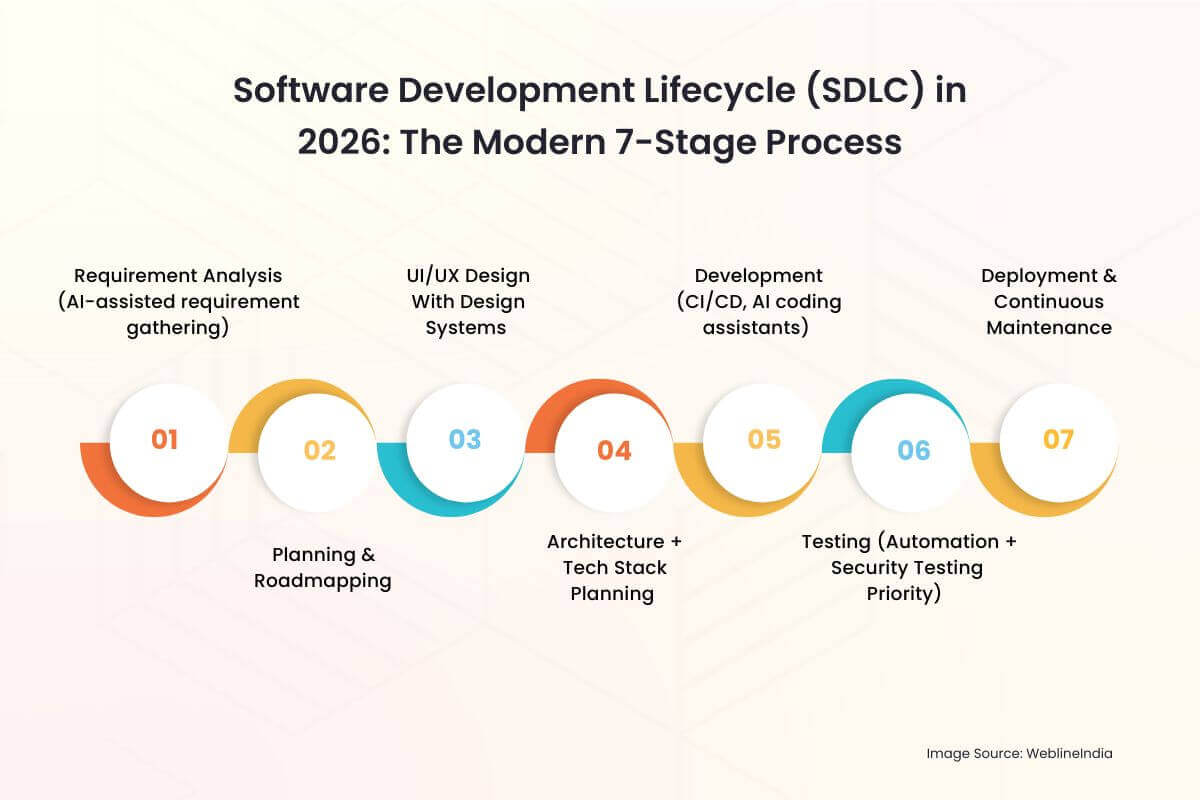
The Software Development Lifecycle (SDLC) is the framework that defines tasks and deliverables at each stage of a software project. In 2026, the SDLC is not a rigid, linear process (like the old Waterfall) but a dynamic, iterative cycle integrated with CI/CD (Continuous Integration/Continuous Deployment) and enhanced by intelligence and automation.
1. Requirement Analysis (AI-assisted requirement gathering)
This stage involves defining the software’s goals, features, and functionality. It is the crucial first step for setting the project scope.
- Stakeholder Workshops: Collecting inputs from business users, product owners, and end-users.
- User Story Mapping: Creating detailed user stories that describe a feature from an end-user perspective (“As a [user], I want [goal], so that [reason]”).
- AI-Assisted Gathering: AI tools are now used to analyze massive amounts of existing customer feedback, support tickets, and market data to identify unstated user needs and prioritize features, leading to more accurate requirements.
2. Planning & Roadmapping
The planning phase translates requirements into a working project plan, defining resources, timelines, and costs.
- Risk Assessment: Identifying potential technical, schedule, and budgetary risks early in the process.
- Technology & Resource Allocation: Deciding the team structure, budget, and project management tools.
- Roadmapping: Creating a visual timeline (the roadmap) that outlines when major features or versions (like the MVP) will be delivered. This aligns technical delivery with business goals.
3. UI/UX Design With Design Systems
This stage focuses on the user interface (UI) and user experience (UX), ensuring the application is intuitive, accessible, and visually appealing. But, here it is interesting to learn about the evolution of system designs.
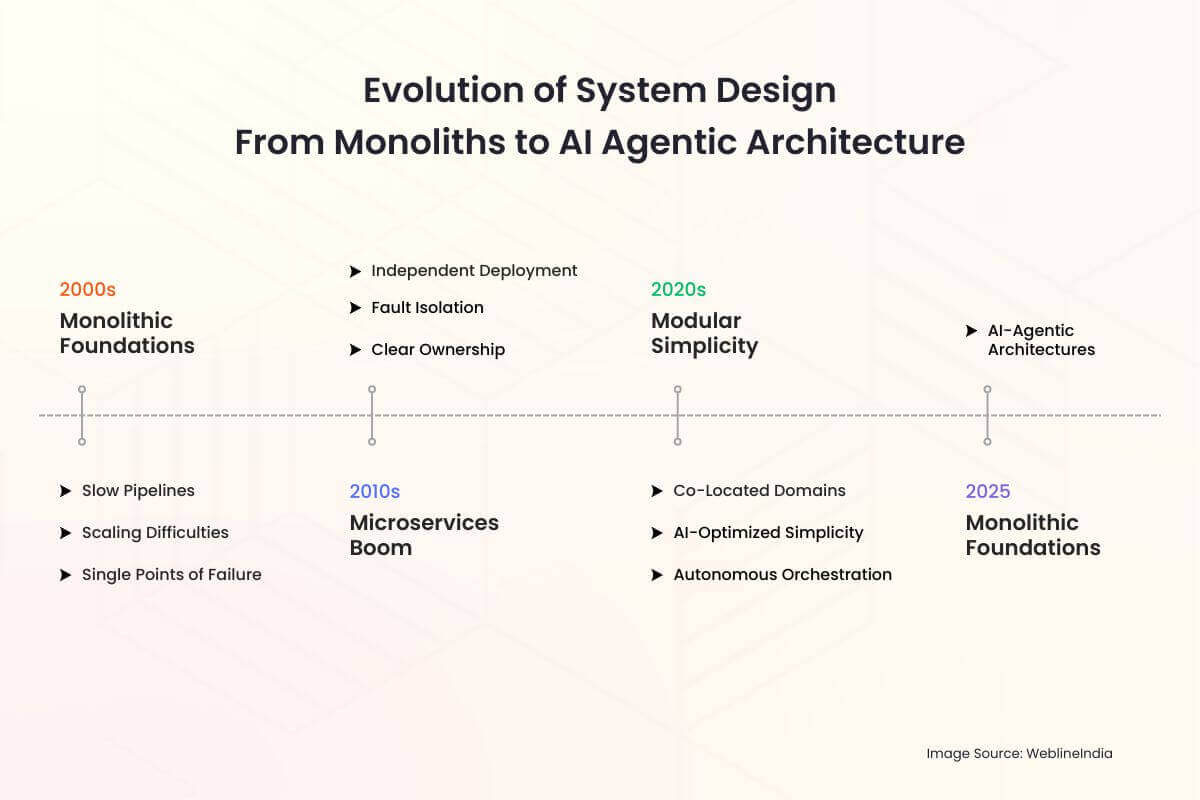
System design has undergone a remarkable transformation, beginning with the monolithic foundations of the 2000s that featured slow pipelines, scaling challenges, and single points of failure. In the 2010s, the rise of microservices introduced independent deployment, fault isolation, and clearer ownership structures.
The 2020s brought a shift toward modular simplicity, emphasizing tightly integrated modules, well-defined internal boundaries, and unified deployment strategies. In 2025, a new paradigm emerged with AI-agentic architectures, where systems are built around co-located domains, streamlined for AI-driven efficiency, and capable of orchestrating themselves with minimal human intervention.
This evolution reflects the increasing complexity and intelligence of modern systems, requiring engineers to adapt their skills to meet the demands of AI integration and large-scale data environments.
Back to UI UX design service with design systems, three factors are essential.
- Wireframes and Prototypes: Creating low-fidelity sketches and interactive models to test functionality flow before development.
- Design Systems: Using a standardized set of reusable components, guidelines, and patterns (e.g., buttons, forms, colors). This ensures consistency, speeds up development, and improves product quality across platforms.
- Accessibility and Inclusive Design: Prioritizing design principles that ensure the application can be used by people with diverse abilities, adhering to standards like WCAG.
4. Architecture + Tech Stack Planning
This is the technical blueprint stage, where the high-level structure and core technologies are chosen.
- Architectural Pattern: Selecting the appropriate structure, such as Microservices for complex, scalable systems, or Monolith for simpler applications.
- Technology Stack: Finalizing the programming languages, frameworks (e.g., Node.js, React), databases (e.g., SQL, NoSQL), and cloud services to be used.
- Security Architecture: Designing the security layers, encryption standards, and authentication mechanisms from the ground up, following a “Shift Left” security approach.
5. Development (CI/CD, AI coding assistants)
The code is written and modularly built according to the architecture plan. This stage is now highly automated.
- Continuous Integration (CI): Developers commit code frequently (multiple times a day). Automated tools merge and test the new code to prevent integration conflicts.
- AI Coding Assistants: Tools like GitHub Copilot are used by developers to auto-complete code, suggest functions, and even generate entire blocks of boilerplate code, significantly boosting developer productivity.
- Code Review: Rigorous review of code by peer developers to maintain quality, ensure adherence to standards, and catch logic flaws.
6. Testing (Automation + Security Testing Priority)
Quality assurance (QA) ensures the software is bug-free, performs well, and is secure before release.
- Test Automation: Reliance on automated testing frameworks for unit, integration, and end-to-end (E2E) testing. This replaces time-consuming manual checks, enabling faster release cycles.
- Security Testing Priority: This includes SAST (Static Application Security Testing) and DAST (Dynamic Application Security Testing) integrated into the CI/CD pipeline, making DevSecOps mandatory.
- Performance Testing: Stress testing the application to ensure it can handle expected peak loads and maintain acceptable response times.
7. Deployment & Continuous Maintenance
The final, continuous stage where the application is released to the users and supported afterward.
- Continuous Deployment (CD): Once automated tests pass, the validated code is automatically deployed to the production environment without human intervention, ensuring rapid feature delivery.
- Monitoring and Logging: Implementing Observability tools to continuously track application health, performance, and user usage patterns in real-time.
- Continuous Maintenance: Addressing bugs, applying security patches, and rolling out new features based on user feedback and business priorities, restarting the SDLC cycle.
Need the right tech stack, cost clarity, and a delivery plan that actually works?
Software Development Methodologies in 2026
Software methodologies define how development teams organize their work and collaborate. The choice of methodology is vital for project success and client satisfaction.

Agile (Still No. 1 choice)
Agile remains the dominant philosophy. It is an iterative approach where solutions evolve through the collaborative effort of self-organizing cross-functional teams and their customers.
- Core Principle: Delivering working software frequently, focusing on collaboration, and responding to change over following a rigid plan.
- Adaptability: Its flexibility makes it ideal for complex projects where requirements are likely to change during development.
Scrum vs Kanban
These are the two most popular frameworks for implementing the Agile philosophy.
- Scrum: Best for projects with frequent deliveries and clear goals. It uses fixed, short iterations called Sprints (usually 2-4 weeks) with defined roles (Scrum Master, Product Owner) and ceremonies (Daily Standups, Retrospectives).
- Kanban: Best for maintenance, operations, or continuous workflow where work arrives unpredictably. It focuses on limiting WIP (Work In Progress) and visualizing the workflow on a board to maximize flow efficiency.
DevOps for speed & automation
DevOps is a cultural and professional movement that stresses communication, collaboration, and integration between software developers (Dev) and IT operations (Ops).
- Automation Focus: DevOps accelerates the delivery cycle by automating infrastructure provisioning, testing, deployment, and monitoring, directly supporting CI/CD.
- Key Enabler: It is essential for managing Cloud-Native and Microservices architectures, ensuring reliability and high frequency of releases.
Waterfall for regulated industries
The sequential, linear Waterfall model is generally discouraged for modern projects. However, it still holds utility in highly regulated environments.
- Use Case: Ideal when requirements are fixed, fully known upfront, and regulatory approval mandates comprehensive documentation at each stage (e.g., certain defense or medical device software).
Hybrid models emerging in 2026
To achieve the best of both worlds, many organizations adopt tailored, mixed approaches.
- Wagile: Combining the upfront planning of Waterfall for architecture design with the iterative execution of Agile.
- DevSecOps: The mandatory integration of security practices into the DevOps pipeline, ensuring security is automated, not manual.
Cost of Software Development in 2026
Budgeting for custom software is more than calculating developer salaries. It is a strategic exercise that forecasts the Total Cost of Ownership (TCO), factoring in long-term maintenance, security, and cloud infrastructure. Businesses planning intelligent applications must also evaluate the AI software development cost in 2026, which includes model training, dataset preparation, MLOps infrastructure, and AI integration with existing systems. Rushing the cost estimate will almost always result in expensive project overruns later.
Software Development Cost Factors in 2026
The final price of a custom software project is determined by several core variables:
- Complexity: The single largest factor. Simple apps (MVP) with basic features cost significantly less than complex enterprise systems that require AI/ML integration, real-time data processing, and custom security protocols.
- Platform Choice: Building a single web application costs less than building a native mobile app for both iOS and Android. Choosing cross-platform solutions like Flutter can reduce this cost by 30-40%.
- Tech Stack: Niche or highly advanced technologies, such as Blockchain or specialized Big Data tools, require senior developers who command higher hourly rates. Using common, open-source stacks can be more cost-efficient.
- Developer Location: Labor costs vary dramatically across the globe. Outsourcing to regions like India or Eastern Europe offers significant cost arbitrage while maintaining high quality.
- Integrations: Connecting the new software with existing internal systems (like ERP or CRM) and third-party services (like payment gateways) adds complexity, effort, and often involves recurring licensing fees.
- Maintenance Cost: This is the predictable post-launch expense for upkeep, security, and updates. A good rule is to budget 15-20% of the initial development cost annually for maintenance.
Curious how much your software project could cost in 2026? Estimate your budget based on complexity, platform, and features.
Updated Software Development Cost in 2026: Price Benchmarks
While a project estimate is always based on specific hours and rates, the industry sees general ranges based on complexity. These figures represent the full development cost, typically covering design, development, and testing.
| Project Scope | Estimated Cost Range (USD) | Estimated Timeline | Key Characteristics |
| Small Apps / MVP | $25,000 – $70,000 | 2–4 months | Core features only, simple UI, basic backend, proof of concept. |
| Mid-Level Solutions | $70,000 – $200,000 | 4–9 months | Custom UI/UX, database integration, user roles, payment gateways, one or two third-party APIs. |
| Enterprise Systems | $200,000 – $500,000+ | 9–18+ months | Multiple system integrations, complex security/compliance (e.g., HIPAA), and custom microservices architecture. |
| AI-Powered Systems | $300,000 – $1,000,000+ | 12–24+ months | Includes research and development (R&D), large dataset preparation, custom MLOps pipelines, and advanced predictive analytics. |
Hidden Costs Businesses Ignore
Initial quotes often only cover direct labor, overlooking several indirect costs that can lead to budget overruns if not planned for:
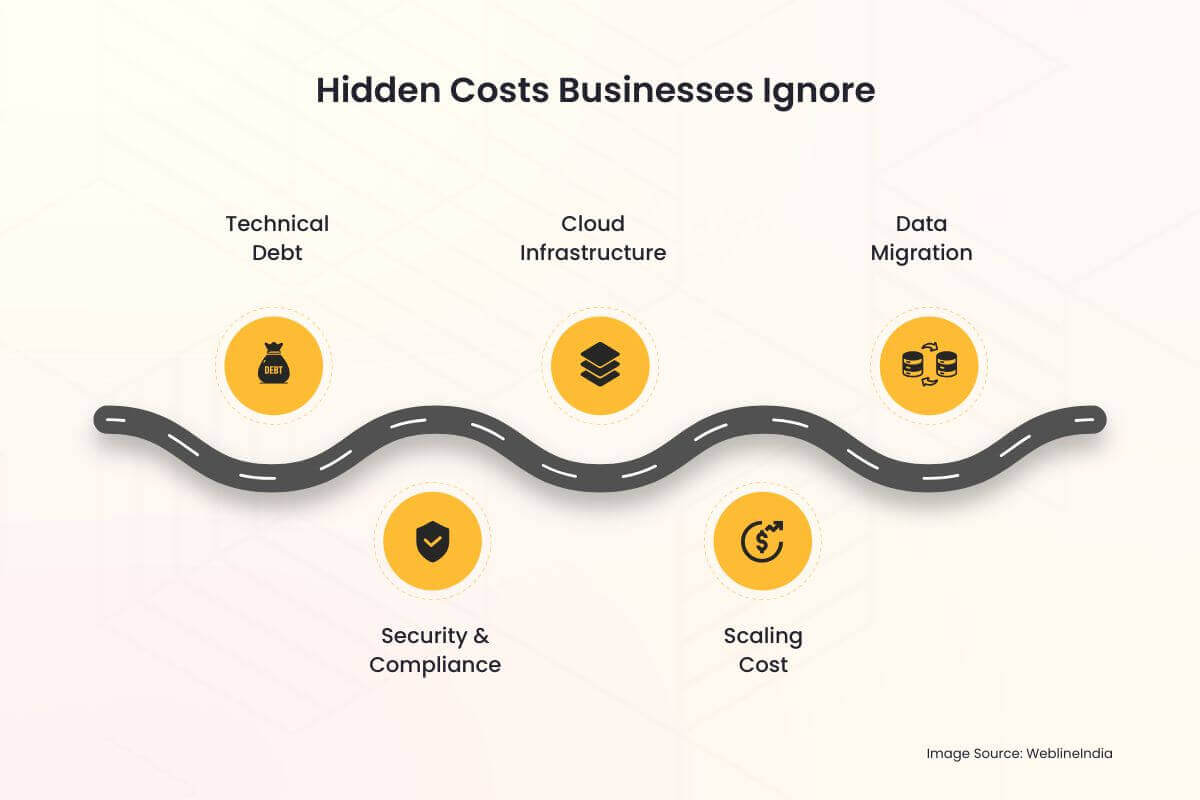
- Technical Debt: This is the cost incurred later by taking shortcuts during development to meet deadlines quickly. It results in poor code quality, which becomes very expensive to fix or refactor when adding new features or scaling.
- Security & Compliance: Achieving industry-specific compliance (e.g., PCI DSS for payments, GDPR for data) requires specialized audits, legal consulting, and significant development work on security features like multi-factor authentication and data encryption.
- Cloud Infrastructure: The monthly fees for hosting the application on cloud services (AWS, Azure, Google Cloud), database fees, and fees for scaling resources based on user traffic. These costs are ongoing.
- Scaling Cost: If the application becomes very successful, the cost to re-architect it from a small, monolithic system to a globally distributed, high-volume microservices platform is substantial. Scaling must be planned into the initial architecture.
- Data Migration: The effort required to move data securely and accurately from old, legacy systems to the new platform. This process is complex and resource-intensive.
Choosing the Right Tech Stack in 2026
The Tech Stack — the combination of programming languages, frameworks, and tools used to build and run the application — is the foundation of the software. The right choice affects performance, scalability, development speed and long-term maintenance cost.
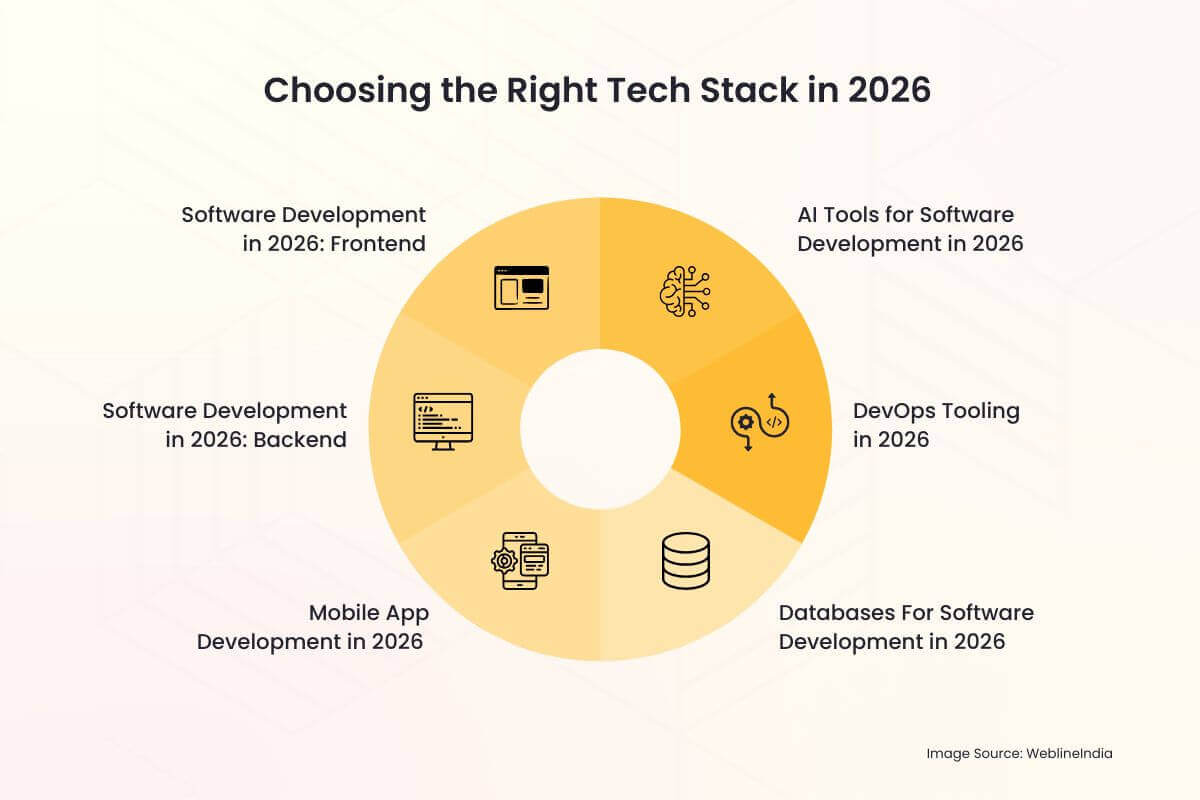
Software Development in 2026: Frontend
The frontend is the visible part of the application that users interact with.
- React (and Next.js): Dominant for building fast, scalable user interfaces. Next.js adds capabilities like server-side rendering and static site generation, which greatly improves performance and SEO.
- Vue.js: A progressive framework that is often easier to learn, favored for smaller to mid-sized projects.
- Angular: A comprehensive framework, often favored for large-scale enterprise applications due to its structure and mature ecosystem.
Software Development in 2026: Backend
The backend is the server-side, database and application logic that powers the frontend.
- Node.js: Excellent for high-speed, real-time applications (like chat or streaming) and microservices due to its non-blocking I/O model.
- .NET (C#): A robust, mature framework from Microsoft, often used for enterprise systems requiring high security and performance.
- Java: Reliable, highly scalable, and platform-independent, widely used in finance and large enterprise systems.
- Python: The language of choice for AI/ML, data science, and backend scripting due to its readability and massive library ecosystem (e.g., Django, Flask).
Mobile App Development in 2026
The choice here determines whether the app is built once for all devices or separately for each.
- Flutter (Google) & React Native (Meta): These cross-platform frameworks are the dominant modern choice, allowing developers to target both iOS and Android from a single codebase, saving time and cost.
- Swift/Kotlin: Used for native development, offering maximum performance and access to all device features, but requiring two separate development teams/streams.
Databases For Software Development in 2026
The database choice depends on the type and volume of data being handled.
- SQL (PostgreSQL, MySQL): Best for applications that require structured data, complex transactions, and high data integrity (e.g., finance, inventory).
- NoSQL (MongoDB, Cassandra): Best for flexible, high-volume data like user profiles, content management, or data that needs rapid horizontal scaling.
- Vector Databases: An emerging type, essential for managing and retrieving high-dimensional data used in Generative AI and similarity search applications.
DevOps Tooling in 2026
These tools are not code but the infrastructure that enables rapid, automated deployment.
- Docker: Used for containerization, that is, packaging the application and its environment into a single unit, ensuring it runs the same way everywhere.
- Kubernetes: An orchestration tool used to manage and scale large numbers of containers automatically in the cloud.
- CI/CD Tools (Jenkins, GitLab CI): Automate the testing and deployment pipeline, making continuous releases possible.
AI Tools for Software Development in 2026
These tools accelerate development and manage intelligent systems.
- AI Coding Assistants: Tools that help developers write code faster by suggesting lines, checking syntax, and generating boilerplate code.
- MLOps Platforms: Tools necessary for the deployment, monitoring, and continuous retraining of machine learning models in a production environment.
Is your existing tech stack making or breaking your product’s long-term success?
Software Development Team Structure in 2026
The complexity of modern software, driven by microservices and AI, requires specialized teams. A successful 2026 project relies on a multi-disciplinary team with clear roles, often spanning different geographical locations and employment models.
Key Roles & Responsibilities
Modern teams are typically cross-functional and self-organizing, meaning they possess all the skills necessary to take a feature from idea to production.

- Product Owner (PO): The single point of authority for defining the product backlog and prioritizing features. They represent the voice of the customer and the business goals.
- Project Manager (PM): Responsible for budget, timeline, and managing project resources and communication. Ensures the project remains aligned with the initial plan.
- Software Architects: Design the high-level structure (architecture) of the system, including the choice of tech stack, communication protocols, and security standards. They ensure the system is scalable and maintainable.
- Frontend/Backend Devs: The core development team. Frontend developers build the user interface (UI) using frameworks like React. Backend developers build the server-side logic, APIs, and database interaction.
- Mobile Devs: Specialize in developing applications for iOS and Android, often using cross-platform tools like Flutter or React Native.
- QA Engineers (Quality Assurance): Responsible for ensuring the software is free of bugs and meets quality requirements. They design, execute, and automate test cases (unit, integration, E2E).
- DevOps Engineers: Bridge the gap between development and operations. They manage the CI/CD pipeline, infrastructure as code (IaC), monitoring, and cloud resource management (e.g., Kubernetes).
- AI/ML Engineers: Design, train, and deploy machine learning models. They work closely with data scientists to integrate intelligent features into the application.
Engagement Models for Software Development in 2026
Businesses choose an engagement model based on their need for control, cost efficiency, and internal resource availability.
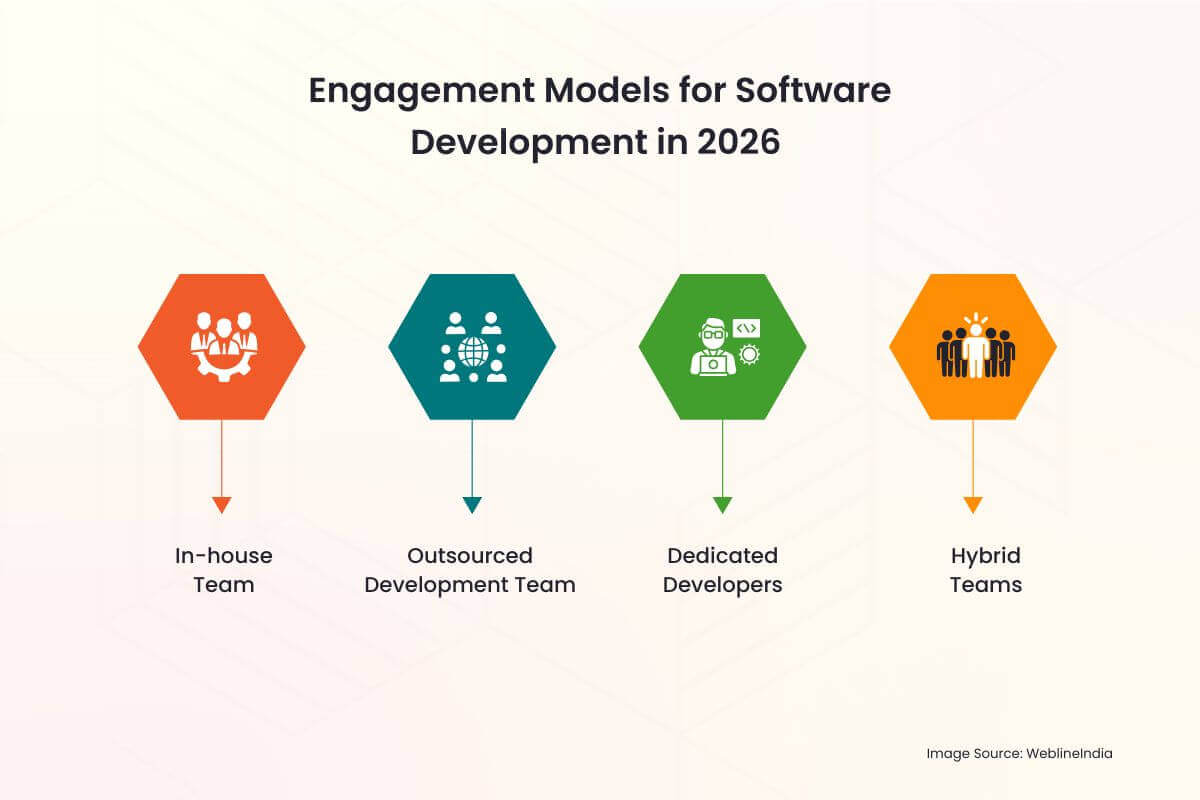
- In-house Team: Employees hired directly by the company. Offers maximum control and cultural fit, but high fixed cost and difficulty in scaling up quickly.
- Outsourced Development Team: Hiring an entire external company (a vendor) to manage and execute the project end-to-end. Best for fixed-scope projects or filling major expertise gaps.
- Dedicated Developers: Hiring specific developers from a vendor who work exclusively for the client under the client’s direct management and process. Offers flexibility and cost efficiency while maintaining control over the daily workflow.
- Hybrid Teams: The most common model in 2026. Combines a small in-house team (for product ownership and core architecture) with dedicated outsourced specialists (for development, QA, or niche AI/ML expertise).
The Evolving Role of the Software Developer in the AI Era
The rapid advancement of Generative AI Technology is changing the work of every role on the team. The developer’s function is shifting away from repetitive coding toward higher-level, creative problem-solving.
Beyond Coding: The Rise of the AI-Collaborator
AI tools are becoming highly proficient at writing boilerplate code, unit tests, and routine functions. The modern developer acts as an AI-Collaborator.
- Shifting Skills to Prompt Engineering and Verification: The developer’s value moves to asking the right questions (prompt engineering) to guide the AI and, more critically, verifying the correctness, security, and performance of the code generated by the AI.
- Code Curation: Developers spend more time reviewing, integrating, and maintaining AI-generated code snippets rather than typing every line manually.
Mandatory Skills: Data Literacy, Security, and Ethical AI
The skills required for modern development now extend beyond traditional software engineering principles.
- Data Literacy: Understanding data sources, data pipelines, and how data is consumed by AI/ML models is crucial for effective feature integration.
- Security-First Mindset: Given the increasing attack surface of distributed systems, proficiency in DevSecOps tools and a focus on security vulnerability detection is a baseline requirement.
- Ethical AI: Understanding and mitigating issues like algorithmic bias, ensuring fairness, and guaranteeing transparency in AI-driven features is a mandatory, non-technical skill.
From Developer to Platform and System Architect
As routine tasks become automated, the highest-value work involves designing and managing complex systems.
- Focus on Connecting Complex, Distributed Systems: Developers are increasingly responsible for designing the APIs and integration layers that allow microservices, cloud functions, and external vendor systems to communicate reliably.
- Platform Engineering: A growing specialization focused on building and maintaining the internal toolchains and platforms that allow other development teams to deploy applications quickly and safely. This ensures consistency and governance across the organization.
Work with a development partner trusted by global businesses for complex software projects.
Best Practices for Successful Software Development in 2026
To achieve high-quality, long-lasting software in the modern environment, development teams must adopt practices that prioritize speed, security, and long-term sustainability. These are the mandatory standards for professional development in 2026.
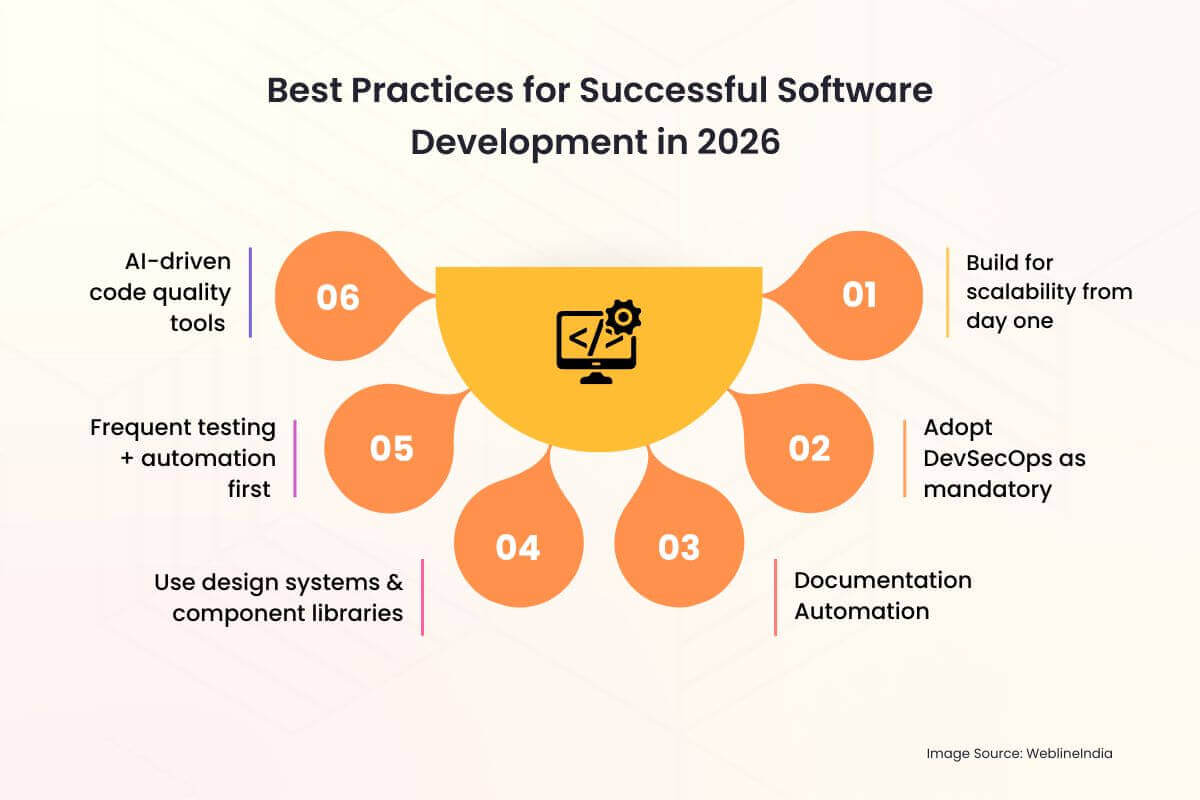
Build for scalability from day one
Building for scale means designing the architecture not for the current user base, but for the planned user base three years in the future.
- Cloud-Native Architecture: Adopt Microservices and Serverless functions. This architectural model allows components of the application to be scaled, updated, and deployed independently, preventing one failing service from crashing the entire system.
- Database Choice: Use a database that supports horizontal scaling (e.g., sharding or NoSQL databases like MongoDB) rather than relying on vertical scaling (simply adding more power to a single server).
- Infrastructure as Code (IaC): Use tools like Terraform or CloudFormation to manage and provision infrastructure. This ensures that environments (development, staging, production) are identical, which reduces deployment risk and makes scaling predictable.
Adopt DevSecOps as mandatory
Security cannot be separate from development; it must be embedded in the pipeline. DevSecOps is the culture and practice that automates the integration of security at every phase.
- Shift Left Security: Security checks are performed as early as possible. This includes Static Application Security Testing (SAST) tools running on the developer’s local machine before code is committed.
- Automated Security Scanning: Integrating tools into the CI/CD pipeline to automatically scan code, libraries, and open-source dependencies for known vulnerabilities. This prevents insecure code from ever reaching the production environment.
- Threat Modeling: Performing formal risk assessments early in the SDLC design phase to identify potential attack vectors before coding begins.
Documentation Automation
High-quality documentation is critical for maintenance, especially with high developer turnover. However, documentation should be treated as a by-product of the code, not a separate manual task.
- API Documentation: Tools are used to automatically generate API specifications (like OpenAPI/Swagger) directly from the codebase.
- Code Comments and Standards: Enforcing strict, standardized commenting protocols so documentation can be easily extracted.
- Knowledge Repository: Maintaining a single source of truth for all architectural decisions, stored in a searchable system like a wiki or centralized platform.
Use design systems & component libraries
Consistency and efficiency in the user interface are achieved through standardization.
- Reusable Components: Using component libraries (e.g., Material UI, Ant Design) ensures that all design elements, such as buttons, navigation bars, and forms, look and function identically across the application.
- Faster Development: Development teams can rapidly assemble features using pre-approved components instead of building UI elements from scratch every time.
Frequent testing + automation first
Quality Assurance (QA) relies heavily on speed and coverage. Manual testing is reserved only for complex, exploratory scenarios.
- High Test Coverage: Aiming for a high percentage coverage of the code base with automated unit tests and integration tests.
- Continuous Testing: Testing is automated and runs immediately after every code commit (CI), providing instant feedback to the developer on whether the change introduced a bug.
AI-driven code quality tools
AI is now integrated directly into developer workflows to improve quality immediately.
- Code Refactoring Suggestions: Tools analyze code patterns and recommend ways to simplify, optimize, or fix common anti-patterns before they become technical debt.
- Automatic Test Generation: AI assistants can review code and automatically generate initial test cases, further accelerating the testing phase.
Data-Driven Development & Observability
Once software is in production, understanding its performance requires more than basic monitoring. Observability provides the necessary deep context to quickly diagnose and fix issues, turning operational data into development insights.
Monitoring vs. Observability: Why Context is Key
- Monitoring: Asks the question: “Is the system working?” It relies on pre-defined metrics and dashboards (e.g., CPU utilization, memory usage). It tells you that something is broken.
- Observability: Asks the question: “Why is the system broken?” It allows you to explore the system’s internal state based on the data it outputs. It tells you exactly where and why the failure occurred.
- Defining Logs, Metrics, and Traces: Observability relies on these three pillars:
- Logs: Timestamped records of discrete events (e.g., “User logged in,” “Error in database query”).
- Metrics: Numerical measurements collected over time (e.g., CPU usage, error rate, request latency).
- Traces: End-to-end views of a single user request as it moves through all the Microservices in a distributed system, essential for complex architectures.
Leveraging Data for Continuous Improvement
The data collected via observability tools is a vital feedback loop for the product team.
- Implementing A/B Testing and Feature Flags: Feature flags allow developers to turn features on or off without redeploying code. This is used to run A/B tests, showing different versions of a feature to different user segments, and using metrics to determine which version performs better against the North Star Metric.
- Real-time User Analytics: Monitoring user journeys and session data to find bottlenecks, dropped conversions, or unexpected behavior, informing the next development sprint.
Service Level Objectives (SLOs) and Error Budget
Reliability must be treated as a measurable and financial feature, not just a hope. This is a core practice of Site Reliability Engineering (SRE).
- Service Level Objective (SLO): An internal target that defines the desired level of reliability or performance (e.g., 99.9% uptime for the login page, 95% of API requests should respond in under 300ms).
- Service Level Indicator (SLI): The actual measurement of the service’s performance (e.g., successful API responses / total requests).
- Error Budget: The amount of time or number of failures the service can endure while still meeting its SLO. It is the opposite of the SLO. For a 99.9% uptime SLO, the error budget is 0.1% of the time.
- Prioritization Framework: If the team uses up the error budget too quickly, development focus must immediately shift from new features to reliability and performance improvements. This framework creates a healthy tension between innovation speed and system stability.
Challenges in Software Development in 2026 (With Solutions)
Even with advanced tools and methodologies, modern software development faces significant headwinds. Recognizing these challenges early is the first step toward effective mitigation and risk management.
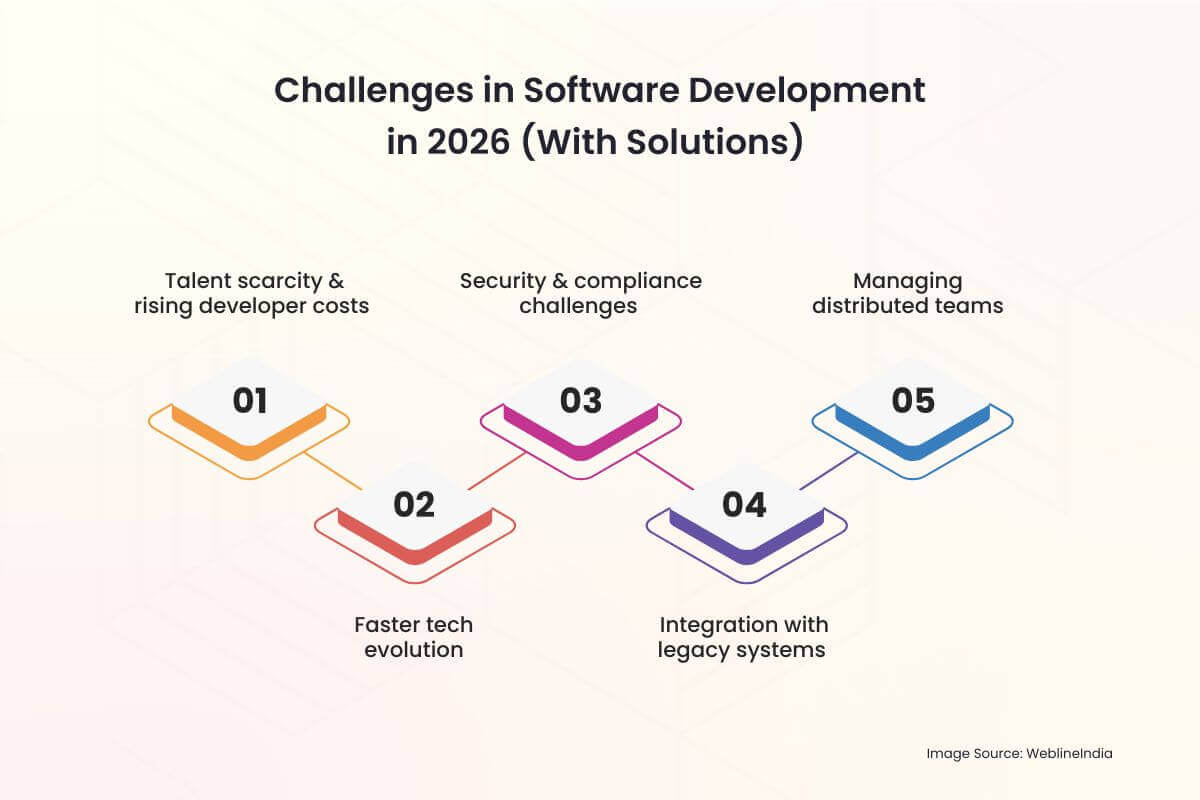
Talent Scarcity & Rising Developer Costs
The demand for specialized skills, especially in AI/ML, DevSecOps, and Platform Engineering, far outpaces the available supply.
- The Challenge: Companies struggle to hire and retain expert developers, leading to salary inflation and delays in projects requiring niche knowledge.
- The Solution: Adopt flexible outsourcing models (like dedicated teams) to access a global talent pool. Invest in continuous internal training and leverage AI coding assistants to augment the productivity of existing, mid-level developers.
Faster Tech Evolution
New frameworks, libraries and cloud services are released continuously, leading to the rapid obsolescence of skills and existing systems.
- The Challenge: Maintaining competitiveness requires constant updating of the tech stack, which can be costly and disruptive, increasing the risk of technical debt.
- The Solution: Focus on developing core business logic independent of specific frameworks. Use Microservices and APIs to create modular systems that allow individual components to be updated or replaced without affecting the entire application.
Security & Compliance Challenges
The complexity of modern, distributed architectures (like microservices) creates a larger attack surface, while global regulations are becoming stricter.
- The Challenge: Ensuring full compliance with regulations like the EU AI Act or various data residency laws, and preventing sophisticated cyber threats.
- The Solution: Mandate DevSecOps practices. Automate security audits within the CI/CD pipeline. Design all systems with Privacy by Design principles, ensuring security is never an afterthought.
Integration with Legacy Systems
Most large organizations run on a core of older, legacy systems that are essential but difficult to modify or communicate with.
- The Challenge: Modernizing the application while ensuring reliable, secure communication with these outdated, monolithic backends.
- The Solution: Build API gateways as a translation layer between the new application and the legacy systems. This allows the legacy system to remain operational while isolating the modern architecture from its complexities and vulnerabilities.
Managing Distributed Teams
In the post-2025 era, teams are rarely co-located. Managing developers across time zones and diverse cultural backgrounds is standard practice.
- The Challenge: Maintaining consistent communication, alignment on processes, and a cohesive team culture across disparate locations and time zones.
- The Solution: Implement asynchronous communication protocols and robust documentation automation. Standardize project management and DevOps tooling so all team members use the same processes and have access to the same real-time information.
Ready to overcome software development challenges for your business with confidence?
Governance & Compliance: Building Software in a Regulated World
For any business targeting global or sensitive markets, proactive Governance is a strategic asset. In 2026, compliance requirements affect design, development, and deployment.
The EU AI Act and its Global Impact
The European Union’s comprehensive AI legislation is setting a global standard for how intelligent systems are developed and used.
- Key Requirement: The Act requires classifying AI systems into risk categories (e.g., unacceptable, high-risk, low-risk). High-risk systems (like those used in critical infrastructure) require rigorous testing, data quality checks, and transparency before deployment.
- Global Effect: Companies everywhere must adhere to these standards if their products are offered to customers in the EU, making compliance necessary for international scale.
Data Privacy by Design and Data Residency Requirements
Modern software must incorporate privacy protection from the initial design phase.
- Privacy by Design (PbD): The principle that data protection and privacy measures must be embedded into the system’s architecture, rather than being added later. This includes data minimization and pseudonymization.
- Data Residency: Many jurisdictions require customer data to be stored and processed within specific geographical borders. Cloud-native solutions must be designed with multi-region deployment capabilities to satisfy these legal requirements.
Integrating Automated Compliance into the SDLC
Manual compliance checks are too slow for the continuous delivery pace of modern software.
- Policy-as-Code: Writing compliance rules (for example, “no unencrypted databases”) as code that is automatically checked by the CI/CD pipeline. This ensures mandatory standards are enforced on every code commit.
- Automated Audit Trails: Building automated logging features that track system access and data changes, providing a comprehensive, non-repudiable audit trail required by regulators.
Real-World Examples & Case Studies in Software Development in 2026
Theory is only proven by successful execution. These anonymized case studies illustrate how modern DevSecOps, AI integration, and Cloud-Native strategies translate into high-value business outcomes in 2026.
AI-enabled CRM
A medium-sized e-commerce development company needed to improve customer retention without increasing its sales team size.
- Solution: Custom-built an AI/ML model integrated into their existing CRM via a new API layer. The model analyzed purchase history, sentiment, and support tickets.
- Outcome: The system automatically identified customers at high risk of churning, giving sales agents specific, predictive talking points. Customer retention improved by 32% within six months, a direct return on the R&D investment.
Enterprise automation system
A large logistics firm needed to automate the complex, manual process of cargo routing and scheduling across its global network, traditionally handled via spreadsheets.
- Solution: Developed a Cloud-Native microservices platform using Kubernetes for orchestration. The system incorporated optimization algorithms and automatically integrated with legacy accounting and warehouse management systems via a dedicated API Gateway.
- Outcome: Reduced time spent on manual route planning from hours to minutes, eliminating human error and cutting operational costs by 18% annually through fuel and labor efficiency.
Fintech platform
A startup required a new payment gateway that could handle high-velocity transactions, meet global PCI DSS compliance, and be 100% reliable.
- Solution: Built a high-availability, Serverless architecture utilizing public cloud functions. Implemented DevSecOps practices with automated SAST/DAST security scans running on every code commit.
- Outcome: Achieved a five-nines (99.999) uptime, critical for a financial service. The architecture allowed them to scale rapidly into three new geographic markets in under one year.
Mobile super-app
A travel company wanted to consolidate all its services, such as booking, check-in, loyalty, and in-destination guidance, into a single application.
- Solution: Developed a single cross-platform apps using Flutter. The app uses a unified Headless CMS to serve content across all modules and leverages cloud services to minimize on-device processing.
- Outcome: Increased average customer usage time by 2.8 times. The single codebase significantly reduced maintenance costs compared to managing two separate native apps.
SaaS analytics platform
A marketing agency needed a sophisticated analytics tool to track competitor performance in real time for its clients.
- Solution: Built a multi-tenant SaaS platform using Python for data scraping and a highly scalable NoSQL database for rapid data storage. Automated CI/CD pipelines enabled weekly feature releases.
- Outcome: The speed and unique data visualization features allowed the agency to differentiate its service, resulting in a 28% increase in premium client subscriptions for the platform.
Intellectual Property (IP) & Code Ownership in Development
The code and data you create or commission represent valuable Intellectual Property (IP). Protecting this asset is a critical legal and commercial concern, especially when engaging external teams.
Securing Your Assets: Work-for-Hire Agreements
Whenever you hire an external developer, agency, or contractor, clear contractual language is essential to ensure you own the code.
- Key Requirement: The contract must explicitly state that all software, documentation, and source code created under the agreement are considered “work-for-hire” and that full ownership, including copyrights and all commercial rights, is transferred exclusively to your company upon final payment.
- Confidentiality: Mandatory inclusion of NDAs (Non-Disclosure Agreements) to protect proprietary business information and trade secrets shared during the project.
Legal Challenges of AI-Generated Code Ownership
The use of AI coding assistants (like Copilot) introduces ambiguity regarding ownership in 2026.
- The Problem: If an AI assistant generates code that closely resembles existing open-source code, legal liability or licensing issues could arise. Traditional IP laws are still catching up to this technology.
- Mitigation: Your development contracts must require developers to disclose the use of AI tools and verify that any AI-generated code is either novel or compliant with the licenses of its source materials.
Navigating Open-Source Licenses and Compliance
Almost all modern software uses open-source components, which come with specific usage rules (licenses).
- License Management: Teams must use automated tools to track every open-source library used and ensure its license (e.g., MIT, GPL, Apache) is compatible with the project’s commercial goals.
- Compliance Risk: Failing to comply with open-source licenses, particularly those requiring the release of your own source code (copyleft licenses), can lead to costly legal disputes.
Outsourcing Software Development in 2026: A Complete Guide
Outsourcing is a strategic necessity for accessing talent and managing costs, and it has evolved from a transactional relationship to a partnership model in 2026.
Why is outsourcing increasing in 2026
- Access to Niche Talent: Outsourcing provides immediate access to scarce experts (AI/ML Engineers, Platform Engineers) without the long hiring process.
- Cost Efficiency: Significant labor cost savings compared to high-cost Western markets.
- Scalability and Speed: Ability to rapidly scale the team size up or down based on project phase, accelerating time-to-market for products.
Best regions to hire developers
Top regions combine high technical skills with favorable cost structures.
- Key Hubs: Regions across Eastern Europe (Ukraine, Poland), and Asia (India, Vietnam, Philippines) are preferred for their vast talent pools and strong English proficiency.
- India as the leading outsourcing hub: India remains the world’s largest outsourcing market due to its massive pool of English-speaking, technically proficient graduates, mature vendor ecosystems, and strong focus on quality certifications. Renowned companies like WeblineIndia attract clients worldwide because of their RelyShore Model.
How to evaluate vendors
Choosing a reliable outsourcing partner requires diligence beyond just hourly rates.
- Experience and Portfolio: Look for experience in your specific domain (e.g., Fintech, IoT) and the required tech stack.
- Process Transparency: Demand clear processes for communication, project management (Agile/Scrum), and CI/CD visibility.
- Security and IP Policy: Verify the vendor’s data security certifications (e.g., ISO) and their contractual agreement on IP ownership.
Engagement models & pricing
- Fixed Price: Best for small projects with clearly defined, stable requirements (low risk for client).
- Time and Material (T&M): Best for large, flexible projects where requirements are expected to change frequently (Agile projects). The client pays for the actual hours spent.
- Dedicated Team: The optimal 2026 model, providing dedicated resources that integrate into the client’s internal processes for maximum control and efficiency.
Future Trends Shaping Software Development Beyond 2026
The next waves of innovation will fundamentally redefine how applications are created and consumed.
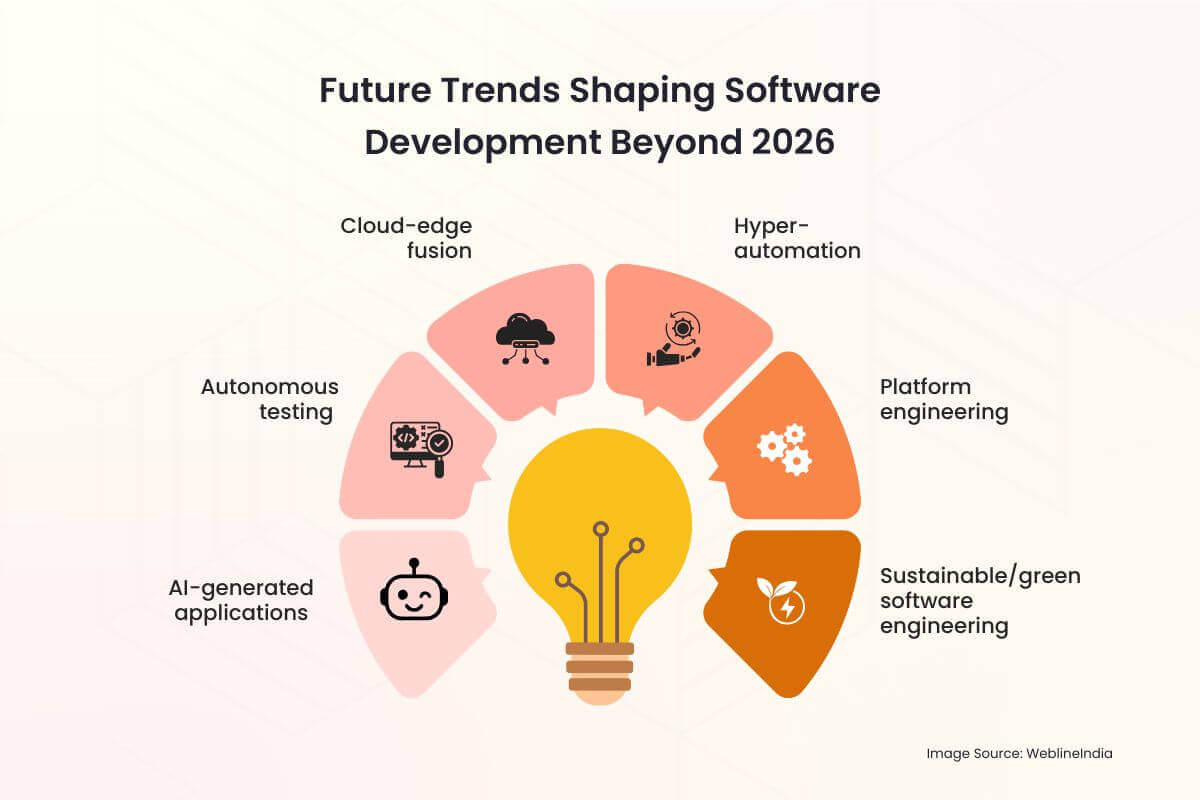
AI-generated applications
Moving beyond code assistance, the future involves AI models generating entire, functional applications from high-level, natural language prompts. This will shift the developer role entirely to oversight and refinement.
Autonomous testing
Testing will become nearly $100\%$ automated, with AI systems designing, executing, and reporting tests without human intervention, leading to faster, error-free deployments.
Cloud-edge fusion
The gap between massive centralized clouds and small, local Edge Computing devices will vanish. Data processing will occur seamlessly across this continuum, enabling faster AI decisions in real-time environments (e.g., smart factories).
Hyper-automation
An expansion of automation beyond IT to every corner of the business, using a combination of RPA (Robotic Process Automation), AI, and low-code tools to create interconnected, self-managing enterprise systems.
Platform engineering
The internal teams responsible for providing self-service tools and platforms to development teams will become central. This specialization is key to governing the complexity of microservices and cloud infrastructure.
Sustainable/green software engineering
Developers will be mandated to optimize code for energy efficiency. Architectural choices will favor lower power consumption (e.g., certain programming languages and Serverless architectures) to reduce the cloud’s carbon footprint.
How WeblineIndia Can Help You Build Future-Ready Software in 2026
WeblineIndia offers the expertise and strategic partnership required to navigate the complex 2026 technology landscape and build competitive, high-value custom solutions. Our dedicated teams specialize in Cloud-Native architectures, AI/ML integration, DevSecOps implementation, and cross-platform mobile development (Flutter/React Native).
The shift from simply writing code to architecting intelligent, secure, and scalable systems is complete. Success in the 2026 market demands a strategic focus on Product-Market Fit, the integration of AI/ML, and a commitment to rigorous DevSecOps practices. Building custom software is the ultimate pathway to true digital differentiation and operational efficiency. Contact WeblineIndia now, and live your dream.
Social Hashtags
#SoftwareDevelopmentGuide #CustomSoftwareDevelopment #SoftwareEngineering #ApplicationDevelopment #SoftwareDevelopment2026 #TechTrends2026 #GenerativeAI #SaaSDevelopment #EnterpriseSoftware
Partner with our senior-level dedicated developers to seamlessly extend your in-house team’s capacity and expertise.
Visit our service pages for detailed information on Mobile App Development and Custom Enterprise Solutions.
Frequently Asked Questions
Globally Recognized for Unmatched Quality and Reliability




Testimonials: Hear It Straight From Our Global Clients
Our development processes delivers dynamic solutions to tackle business challenges, optimize costs, and drive digital transformation. Expert-backed solutions enhance client retention and online presence, with proven success stories highlighting real-world problem-solving through innovative applications. Our esteemed Worldwide clients just experienced it.
Awards and Recognitions
While delighted clients are our greatest motivation, industry recognition holds significant value. WeblineIndia has consistently led in technology, with awards and accolades reaffirming our excellence.
OA500 Global Outsourcing Firms 2025, by Outsource Accelerator
Top Software Development Company, by GoodFirms

BEST FINTECH PRODUCT SOLUTION COMPANY - 2022, by GESIA
Awarded as - TOP APP DEVELOPMENT COMPANY IN INDIA of the YEAR 2020, by SoftwareSuggest