Custom Software Development Price and Software Developer Hourly Rate Worldwide
A detailed look at software development costs in 2026 explains how global developer rates, project complexity, team roles and hidden expenses shape the final budget. It also compares regions and models like offshore or hybrid. Read the full article to understand where your project fits.

Listen to the podcast :
The year 2026 has fundamentally rewritten the rules of engagement for enterprise technology, affecting a custom software development price. We are no longer in an era where software is a supportive back-office function; it is now the primary engine of competitive advantage. As a result, the global software development ecosystem has seen an explosive expansion. Gartner reports the market projection of custom software development price to reach a staggering 6.15 trillion dollars in 2026. This growth is fueled by a massive shift toward intelligent, AI-native platforms and the urgent need for legacy modernization.
It is essential to note here that for modern enterprises, the old model of building software in a single, local geographic office is rapidly becoming obsolete. The rise of distributed engineering models has allowed businesses to tap into a borderless talent pool, but it has also introduced a complex web of financial and operational variables. Decision-makers today face intense pressure to balance three critical pillars: cost efficiency, development speed and uncompromising engineering quality.
Do you want a clear estimate of global software development costs and developer hourly rates for your next project?
Navigating these variables requires more than just a surface-level understanding of the software developer’s hourly rate. It demands a deep dive into how different regions operate, how emerging technologies like AI-assisted coding impact productivity and how specialized partners can accelerate innovation. Distributed development is just more than saving money; it is a strategic necessity for staying agile in a fast-moving global market.
At WeblineIndia, we have spent decades helping enterprises navigate these exact complexities. As a renowned IT agency, we specialize in delivering professional mobile and web app development services that bridge the gap between high-level engineering standards and an optimized custom software development price.
This comprehensive analysis will provide a clear roadmap for businesses looking to master their software investments in 2026.
We will explore:
- Custom software development price benchmarks across major global regions.
- Timeline trends that define the journey from a simple MVP to a full-scale enterprise platform.
- Hidden costs that frequently derail even the most well-planned budgets.
- Strategic frameworks for choosing the right development partner to ensure long-term success by keeping the software developer hourly rate in mind.
It is essential to understand the nuances of the global market; your business can transform software development from a significant expense into a high-yield investment.
The Global Software Application Development Landscape
Other than Gartner research mentioned previously, a report on Research and Markets mentions that the global market for application development software is forecasted to grow steadily, rising from USD 178.53 billion in 2025 to USD 202.62 billion in 2026.
Analysts anticipate this upward trajectory will continue to make the sector reach approximately USD 432.43 billion by 2032. This expansion is driven by a strong double-digit compound annual growth rate (CAGR), underscoring the increasing demand for platforms and tools that support rapid, secure and scalable application creation and deployment.
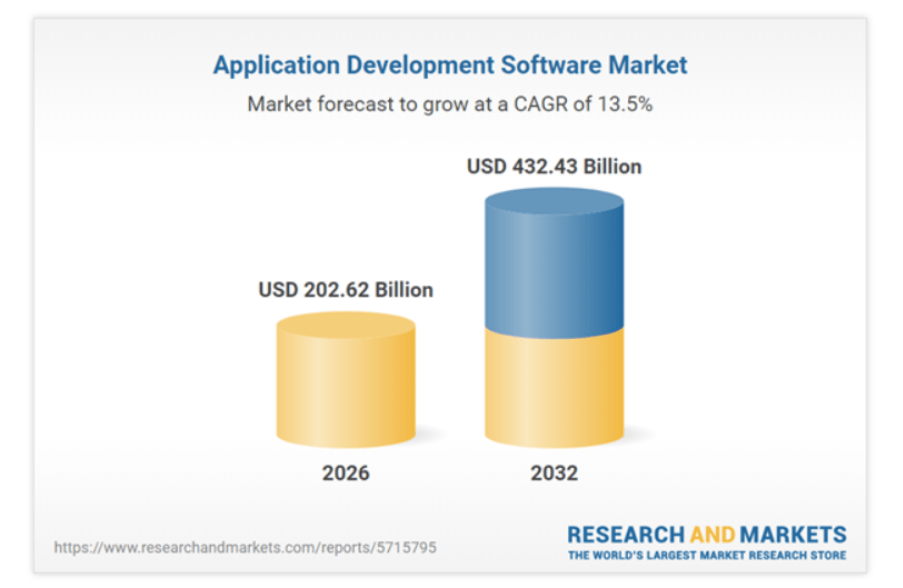
Source: Research and Markets
The architecture of how software is built has undergone a radical transformation. In 2026, the traditional concept of a centralized engineering hub has been replaced by a borderless network of expertise. This shift is not merely a trend but a fundamental response to the dual challenges of a global talent shortage and the relentless pace of digital innovation at an affordable custom software development cost.
The Shift Toward Distributed Engineering Teams
The remote-first development model is no longer an emergency measure; it is the industry standard. Enterprises have realized that limiting their search for engineering talent to a fifty-mile radius of their physical office is a significant strategic bottleneck. Embracing distributed teams at affordable software developer hourly rates, companies gain immediate access to specialized skills (such as AI-native architecture, blockchain security and edge computing) that might be scarce or prohibitively expensive in their local markets.
Furthermore, the adoption of offshore software development has matured. It is no longer viewed solely through the lens of cost-cutting in custom software development price. Instead, it is seen as a way to achieve high-velocity development. With teams spread across the globe, the sun never sets on a project. A feature can be designed in London, coded in India and tested in New York. It can effectively compress the development lifecycle and accelerate time-to-market.
Why Location Still Matters in Software Development
While talent is global, geography still dictates the economic and operational framework of a project. Several factors keep location at the center of the decision-making process:
- Cost of Engineering Talent: There remains a stark contrast in software developer hourly rates between regions, driven by local economic conditions and the cost of living. A senior developer in San Francisco and one in Ahmedabad may possess identical technical prowess, but the economic environment allows the latter to offer their expertise at a fraction of the cost.
- Infrastructure and Operational Costs: The maturity of a local tech ecosystem (ranging from reliable high-speed internet to stable power grids and supportive government policies) directly impacts project stability.
- Time Zone Collaboration: While asynchronous work is possible, real-time collaboration is often essential for complex enterprise projects. Choosing a location that offers a significant overlap with your home office can reduce friction and prevent communication delays.
Global Demand for Custom Software Development
The demand for bespoke software solutions is reaching record highs as enterprises move beyond off-the-shelf products to seek true differentiation. Several key drivers are fueling this surge:
- Pervasive Digital Transformation: Companies are no longer just digitizing paper processes; they are rebuilding their entire business models around data and automation. This requires highly customized software that can integrate seamlessly with legacy systems while remaining future-proof.
- The Rise of SaaS and Cloud Platforms: As businesses shift away from on-premise hardware, the demand for scalable, multi-tenant cloud applications has skyrocketed. Building these platforms requires deep expertise in microservices and cloud-native security.
- Enterprise-Grade Intelligence: Every modern application is now expected to be intelligent. Whether it is predictive analytics in a fintech app or automated diagnostic tools in healthcare, the integration of AI is driving a new wave of custom development projects.
WeblineIndia sits at the heart of this landscape. As a premier IT agency with a global reach, we understand that successful development is about more than just writing code; it is about navigating these global dynamics to provide the best possible outcome for our clients at the best custom software development price.
We offer the scale of a global talent pool with the reliability and standards of a top-tier consultancy, ensuring that your enterprise software is built to lead, not just to function.
Discover the most cost-efficient regions and choose the right development strategy for your business.
Key Factors That Influence Software Development Costs
Calculating the custom software development price in 2026 is an exercise in managing multiple moving parts. Gone are the days when a simple feature list dictated the price. Today, the cost is a reflection of global economic shifts, the complexity of integrated intelligence and the specific composition of the engineering team. To build an accurate budget, enterprises must look beyond the surface and analyze these core drivers.
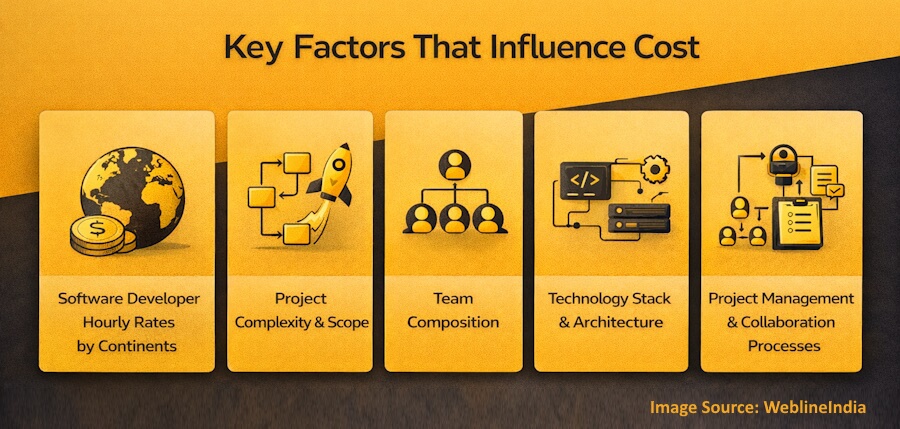
Software Developer Hourly Rate by Continents
The single most significant variable in any custom software development price is the software developer hourly rate. Hourly rates for developers are not uniform; they are heavily influenced by the local cost of living and the maturity of the regional tech ecosystem. In North America or Western Europe, you are paying for proximity and a specific type of product innovation culture, which can drive rates up to 150 dollars or 250 dollars per hour.
In contrast, regions like India have cultivated a massive, high-quality talent pool that allows for a much more optimized cost structure. Hiring developers in India might offer the same technical proficiency as their counterpart in London, but at a custom software development price that is 60% to 70% lower. This geographical arbitrage is why smart enterprises often leverage offshore models to stretch their R&D budgets further without sacrificing the quality of the code.
Project Complexity and Scope
The nature of the application itself dictates the volume of hours required. A simple mobile app with a few screens and a basic backend is a far cry from a multi-tenant enterprise platform.
- Simple Applications: These typically involve basic user authentication, a standard database and a straightforward UI.
- Enterprise Platforms: These require robust security protocols, complex data workflows and the ability to handle high concurrency.
- Integration Requirements: Custom software development price scales quickly when an app needs to talk to third-party services: think payment gateways, CRM systems like Salesforce or legacy ERP software. Each integration requires custom API work and rigorous testing to ensure data integrity.
- Security and Compliance: For industries like fintech or healthcare, the custom software development price includes meeting stringent standards such as GDPR, HIPAA or SOC2. Building for compliance adds layers of encryption, audit trails and security-first architecture.
Team Composition
The custom software development price is also a function of how many specialized roles are involved. A balanced enterprise-grade team typically includes:
- Product Manager: To align the development with business goals.
- UI/UX Designers: To ensure the interface is intuitive and accessible.
- Frontend and Backend Developers: To build the visible and invisible layers of the software.
- QA Engineers: To perform manual and automated testing, ensuring a bug-free release.
- DevOps Specialists: To manage cloud infrastructure, CI/CD pipelines and server security.
Technology Stack and Architecture
The choice of trending technologies impact both the immediate custom software development price and the long-term total cost of ownership.
- Modern Stacks: Using popular, well-supported frameworks like React for frontend or Node.js for backend can keep costs lower because the talent is more available.
- Advanced Architectures: Shifting from a monolithic structure to microservices or serverless computing can increase initial development time but drastically reduce long-term maintenance and scaling custom software development prices.
- AI-Powered Platforms: Integrating Large Language Models (LLMs) or custom machine learning models introduces additional costs for specialized talent and cloud-based GPU processing.
Project Management and Collaboration Processes
The methodology used to build the software can affect the custom software development price. In 2026, Agile is the dominant approach for most web and mobile projects. It focuses on iterative cycles (sprints), allowing for frequent feedback and course correction. While Agile helps prevent the costly mistake of building features that users do not want, it requires active involvement from the business side.
On the other hand, the Waterfall approach is still used for highly regulated projects where the scope is fixed and documentation is paramount. However, the lack of flexibility in the waterfall model often leads to a high custom software development price, if a requirement changes late in the cycle.
At WeblineIndia, we simplify this complex equation for our clients. We combine a deep understanding of modern technology stacks with a team structure that balances a custom software development price and high-level expertise. Utilizing an optimized offshore model, we provide the enterprise-grade engineering you expect at a price point that makes sense for your bottom line.
Want to compare worldwide developer hourly rates before starting your project?
Global Custom Software Development Prices Benchmarks by Continents
In the current global market, custom software development prices are not just numbers on a spreadsheet; they are reflections of regional economic maturity, educational infrastructure and local demand. To understand this, we must dissect these regions with precision, looking at the nuances that drive their specific price points and value propositions.
North America: Premium Development Market
North America remains the most expensive territory for custom software development prices in 2026. This region is characterized by a high concentration of senior architectural talent and a culture of aggressive product innovation.
- Average Developer Rates: Software developer hourly rates typically range from 120 dollars to 250 dollars. For specialized roles involving AI-native development or cybersecurity, these rates can easily exceed 300 dollars per hour.
- Strengths: The primary advantage here is the proximity to the world’s leading tech hubs like Silicon Valley, New York and Toronto. Teams in this region excel at high-level product strategy, complex cloud-native architectures and rapid scaling. There is a deep-rooted understanding of the North American consumer market, which can be invaluable for customer-facing applications.
- Challenges: The software developer hourly rate is the most obvious barrier. Beyond the hourly rates, companies face intense competition for talent, leading to high turnover and expensive recruitment cycles. For many small-to-mid-sized enterprises, building a full team locally is financially unsustainable.
- Typical Project Cost Range: A basic Startup MVP often starts at 150,000 dollars, while complex enterprise platforms frequently require budgets exceeding 1,000,000 dollars for the initial build.
Western Europe: High Quality but Expensive
Western Europe offers a middle ground between the extreme software developer hourly rate of North America and the efficiency of emerging markets, but it still leans heavily toward the premium end.
- Major Hubs: The United Kingdom, Germany, France and the Netherlands lead the way, with emerging tech scenes in Sweden and Switzerland.
- Average Developer Rates: Software developer hourly rate generally falls between 90 dollars and 180 dollars per hour.
- Advantages: This region is known for its rigorous engineering standards and strict adherence to data privacy regulations like GDPR. For enterprises operating within the European Union, the legal and cultural alignment makes collaboration seamless.
- Challenges: High operational costs and a complex labor market make it difficult for companies to scale teams quickly. Additionally, the high cost of living in cities like London or Berlin keeps the baseline for engineering salaries high.
Eastern Europe: Balanced Cost and Technical Expertise
For over a decade, Eastern Europe has been a favorite for nearshore development for Western companies.
- Popular Countries: Poland, Romania and the Czech Republic have established themselves as powerhouse IT hubs.
- Average Developer Rates: You can expect software developer hourly rates between 40 dollars and 90 dollars per hour.
- Strengths: The region boasts a very strong STEM education system, producing engineers with deep mathematical and technical foundations. There is a high level of English proficiency and a work culture that mirrors Western standards.
- Limitations: As demand has spiked, rates in countries like Poland have begun to climb, narrowing the cost-savings gap. Additionally, the talent pool, while highly skilled, is significantly smaller than what is available in Asia.
Latin America: Growing Nearshore Development Market
Latin America has seen a surge in investment as North American enterprises seek time-zone alignment without the domestic price tag.
- Popular Countries: Brazil, Mexico, Argentina and Colombia are the primary players.
- Average Developer Rates: Software developer hourly rates range from 50 dollars to 60 dollars per hour.
- Advantages: The minimal time-zone difference with the United States is the biggest draw, allowing for real-time collaboration during standard business hours.
- Challenges: While the senior talent is excellent, the mid-level and junior talent pools are still maturing, which can lead to variability in project quality if the vendor is not carefully vetted.
Asia: The Largest Global Software Development Hub
Asia, specifically India, continues to dominate the global outsourcing market by offering an unparalleled combination of scale and terrific competitive software developer hourly rates.
- Major Destinations: India stands at the forefront, followed by Vietnam and the Philippines.
- Average Developer Rates: Software developer hourly rates remain highly competitive, typically ranging from 20 dollars to 60 dollars per hour.
- Strengths: The sheer volume of developers is the defining characteristic. India alone produces over a million engineering graduates annually. This allows enterprises to scale teams of 50 or 100 developers in a matter of weeks, something that is nearly impossible in any other region. Furthermore, the maturity of the Indian IT industry means that processes for quality assurance, project management and global communication are highly refined.
- Strategic Value: For an enterprise project, the cost-to-quality ratio in Asia is often the highest in the world. Benefits from this region enable a business to often secure a senior team of five engineers for the same price as a single senior developer in the United States.
Software Development Timeline Benchmarks
Understanding the timeline of a software project is just as critical as managing its custom software development price. In 2026, the speed of delivery has become a competitive metric, but it must be balanced against the necessity of building a stable, secure foundation. Timelines are no longer static; they fluctuate based on the adoption of AI-assisted engineering, the complexity of the integration ecosystem and the chosen development model.
Typical Timeline for MVP Development
The Minimum Viable Product (MVP) remains the gold standard for testing business hypotheses with real users while minimizing initial investment. However, the definition of an MVP has evolved. In 2026, an MVP is expected to be polished, intelligent and highly functional.
- Simple MVP (8–12 weeks): These projects focus on a single core value proposition. They usually include basic user authentication, one or two primary features and a clean but standard UI. The development phase is streamlined, often utilizing pre-built components or low-code frameworks for non-essential modules.
- Medium Complexity MVP (12–16 weeks): This category includes SaaS platforms or marketplaces that require more sophisticated backend logic. Expect to see multiple user roles, basic third-party integrations (such as Stripe for payments) and a more tailored user experience.
- Advanced SaaS MVP (4–6 months): For enterprises entering a competitive space, an MVP might need to include AI-powered features, real-time data processing or rigorous security compliance from day one. These requirements extend the discovery and testing phases significantly.
Factors affecting MVP development speed
- Feature Scope: Every additional feature adds a layer of testing and potential technical debt.
- UI/UX Design Complexity: Custom animations and high-fidelity branding require more design-to-development handoff time.
- Integrations: Connecting to external legacy systems or niche APIs can add weeks to the timeline due to debugging and security validation.
Full Product Development Timelines
Once an MVP is validated, the transition to a full-scale product involves hardening the architecture and expanding the feature set. This stage is where the long-term viability of the software is established.
- Web Applications (4–8 months): Most business-grade web applications fall into this range. This includes building out comprehensive admin dashboards, advanced reporting tools and deep integrations with existing business workflows.
- Mobile Applications (4–9 months): Building for both iOS and Android—even with cross-platform frameworks like Flutter or React Native—requires significant time for platform-specific optimization and App Store/Play Store approval processes.
- SaaS Platforms (6–12 months): A mature SaaS product requires multi-tenant architecture, robust subscription management and extensive API documentation for third-party developers.
- Enterprise Software (9–18 months): These are large-scale systems designed to support thousands of concurrent users. They often involve complex permission structures and high-availability infrastructure.
Enterprise Digital Transformation Projects
Digital transformation is not a single product launch but a systemic overhaul of how an organization uses technology. These projects are the most complex, with high custom software development prices requiring the longest time commitments.
- Timeline (12–24 months): Transformation initiatives are rarely completed in less than a year due to the sheer volume of data and the number of stakeholders involved.
- Legacy System Migration: Moving decades-old data from on-premise servers to the cloud is a meticulous process. It involves mapping old data schemas to modern ones without disrupting daily operations.
- Cloud Infrastructure Modernization: Shifting from monolithic code to a microservices architecture allows for better scalability but requires a complete rethink of the system’s DNA.
- Enterprise Integrations: Ensuring that the new software communicates perfectly with established ERPs (like SAP) or CRMs (like Salesforce) is often the most time-consuming part of the transformation journey.
Businesses can avoid the common pitfall of rushing to market with a fragile product by setting realistic benchmarks. Success in 2026 is reserved for those who plan for the long haul while maintaining the agility to pivot when necessary.
Planning a global software project and unsure about the budget?
Global Software Development Cost Benchmarks by Countries
In the current fiscal year of 2026, general regional averages are no longer sufficient for precise budgeting. Instead, enterprises are looking at specific national hubs that have carved out distinct niches in the global IT economy.
The custom software development price or software developer hourly rate in the United States is vastly different from that of one in Poland or India, even if they are working on the same technology stack. Analyzing these famous IT-producing countries, businesses can make data-driven decisions on where to anchor their engineering efforts.
United States: The High-End Strategic Hub
The United States continues to be the highest in custom software development price, primarily serving as the architectural and strategic heart of global technology.
- Average Developer Rates: Standard software developer hourly rate for senior engineers in major hubs like San Francisco, New York or Seattle ranges from 150 dollars to 300 dollars per hour.
- Market Dynamics: Hiring in the US is often reserved for high-level product strategy, core intellectual property development or projects requiring immediate on-site collaboration. The software developer hourly rate reflects not only the high salary but also the significant payroll taxes and benefits associated with domestic employment.
- Typical Project Cost: A robust custom software development price for an enterprise built entirely with US talent can easily reach 1,000,000 dollars to 2,500,000 dollars for the initial version.
United Kingdom: The Fintech and Enterprise Leader
The UK remains a dominant player in the European market, particularly for industries requiring deep compliance and financial expertise.
- Average Developer Rates: Software developer hourly rates generally fluctuate between 100 dollars and 180 dollars.
- Market Dynamics: London is a global leader in Fintech and cybersecurity. While the custom software development prices are lower than in the US, the UK is still a premium market. Businesses often use UK-based teams for projects that must adhere to strict Bank of England or FCA standards.
- Typical Project Cost: A custom financial application or complex enterprise tool often falls within the 500,000 dollars to 1,200,000 dollars range.
Poland: The Technical Powerhouse of Europe
Poland has established itself as the premier destination for high-quality engineering within the European Union, offering a perfect custom software development price between Western quality and Eastern efficiency.
- Average Developer Rates: Mid-to-senior software developer hourly rate typically falls between 45 dollars and 90 dollars per hour.
- Market Dynamics: Polish engineers are world-renowned for their proficiency in Java, Python and C++. The country offers a stable business environment, full EU legal compliance and a work culture that aligns perfectly with both North American and European enterprises.
- Typical Project Cost: A custom software development price for a complex web or mobile application developed in Poland usually ranges from 150,000 dollars to 350,000 dollars.
India: The Global Scale and Efficiency Leader
India remains the undisputed leader in global software development due to its massive scale, mature infrastructure and unmatched cost-to-quality ratio.
- Average Developer Rates: Senior engineering talent is available at rates between 25 dollars and 60 dollars per hour, making it the most cost-effective of the major IT-producing nations.
- Market Dynamics: Beyond the lower software developer hourly rates, India provides a massive advantage in scalability. Whether an enterprise needs five developers or five hundred, the Indian talent pool can fulfill those requirements faster than any other country. The industry here has also shifted significantly toward modern stacks, including AI-native development and high-end cloud orchestration.
- Typical Project Cost: A full-scale custom software development price for a B2B SaaS platform or enterprise mobile app can be delivered for 80,000 dollars to 180,000 dollars, providing a massive budget advantage.
Mexico: The Nearshore Choice for the Americas
Mexico has seen a surge in demand as US-based companies seek to eliminate time-zone friction while still bringing down a custom software development price.
- Average Developer Rates: Software developer hourly rate ranges from 35 dollars to 75 dollars per hour.
- Market Dynamics: The biggest draw is the geographic proximity. Mexican teams work in the same time zones as their US clients. It enables seamless Agile ceremonies and real-time collaboration. Hence, it makes Mexico an ideal choice for fast-paced, iterative projects.
- Typical Project Cost: A typical nearshore custom software development price in Mexico might range between 120,000 dollars and 250,000 dollars.
Vietnam: The Rising Challenger in Emerging Tech
Vietnam is rapidly becoming a top choice for startups and tech-forward enterprises looking for the next wave of cost-efficient engineering talent.
- Average Developer Rates: A software developer hourly rate is highly competitive, typically between 20 dollars and 45 dollars.
- Market Dynamics: With strong government backing for digital initiatives, Vietnam is carving out a niche in mobile app development and emerging technologies like blockchain and AI. The talent is young, highly motivated and increasingly proficient in global engineering standards.
- Typical Project Cost: Early-stage MVPs or mobile applications are frequently developed in Vietnam for 50,000 dollars to 120,000 dollars.
Comparative Summary Table
| Country | Core Strength | Avg. Senior Rate (USD) | Relative Cost Index |
| USA | Innovation & Strategy | 150 – 300 | 100% (Baseline) |
| UK | Fintech & Compliance | 100 – 180 | 65% |
| Poland | Backend & EU Standards | 45 – 90 | 35% |
| Mexico | Time Zone Alignment | 35 – 75 | 30% |
| India | Scale & Cost-Efficiency | 25 – 60 | 20% |
| Vietnam | Mobile & Emerging Tech | 20 – 45 | 18% |
Hidden Costs Businesses Often Overlook
When AI is booming everywhere, many enterprise leaders fall into the trap of focusing solely on the sticker price of development hours. However, a software project is a living ecosystem with ongoing requirements.
Research indicates that approximately 70% of software projects exceed their initial budgets, often by a margin of 25% to 45%. These overruns are rarely due to a lack of effort but rather a failure to account for the secondary custom software development prices that accumulate beneath the surface.
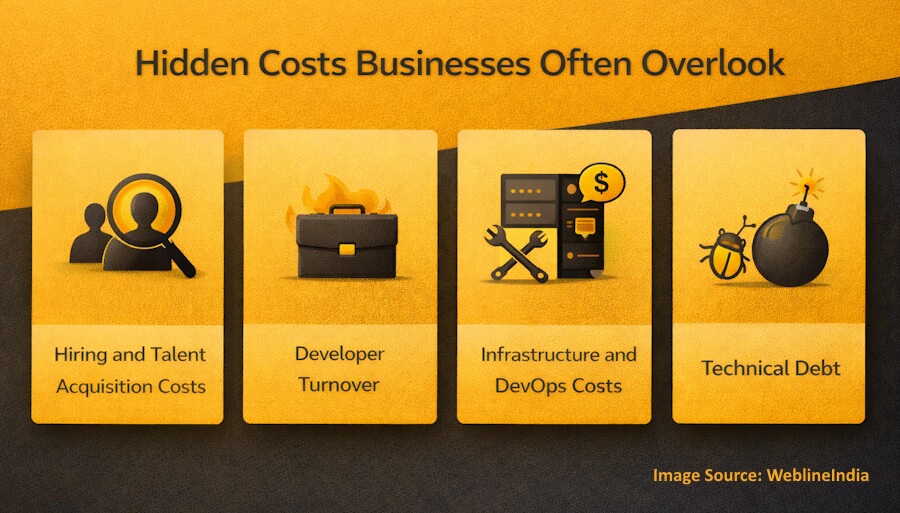
Hiring and Talent Acquisition Costs
Building an in-house team is an expensive and time-consuming endeavor. In the high-demand markets of the US and Western Europe, the cost of recruiting a single senior engineer can reach 20,000 to 50,000 dollars when accounting for:
- Internal HR Overhead: The time spent by recruitment teams and senior management screening hundreds of candidates.
- Onboarding Time: A new developer typically takes 45 to 60 days to reach full productivity. During this period, the company is paying full salary for about 50% of the actual output as the hire learns the codebase and internal workflows.
- Subscription and Tooling Fees: Modern recruitment requires expensive ATS (Applicant Tracking Systems) and sourcing platforms, which can cost 400 to 1,000 dollars per user per month.
Developer Turnover
The tech industry remains one of the most volatile sectors regarding employee retention. High attrition rates in competitive markets pose a severe financial risk:
- Lost Intellectual Property: When a key developer leaves mid-project, they take crucial institutional knowledge with them. This often leads to delays as new hires must spend weeks deciphering undocumented logic.
- Replacement Costs: Replacing a specialized developer can cost up to 1.5 to 2 times their annual salary when you factor in search fees, signing bonuses and lost momentum.
- Knowledge Transfer Friction: Every time a team member is replaced, the existing team must divert hours away from feature development to train the newcomer, effectively slowing down the entire sprint.
Infrastructure and DevOps Costs
As applications move toward cloud-native and microservices-based architectures, the custom software development price of keeping the lights on has become more complex.
- Cloud Hosting Tiers: While a development environment might only cost 500 dollars a month, a high-traffic production environment with auto-scaling and redundancy can easily jump to 5,000 or 10,000 dollars per month.
- CI/CD Pipelines: Automated deployment and testing systems require constant maintenance. DevOps engineers must ensure that these pipelines are secure and efficient, which adds a layer of specialized labor cost.
- Monitoring and Alerting: Tools for real-time performance monitoring and security auditing are essential for enterprise-grade apps, but they come with significant per-node or per-user licensing fees.
Technical Debt
Perhaps the most dangerous hidden cost is technical debt. The future cost of rework is caused by choosing an easy, short-term solution over a better, long-term approach.
- Architectural Debt: If the foundation of the software is not designed for scalability, future updates will become increasingly expensive and slow.
- The Cost of Interest: Much like financial debt, technical debt carries interest. For every month a suboptimal piece of code remains in production, it makes future features harder to implement. Some studies suggest that for every million lines of code, businesses spend over 300,000 dollars annually just on remediation.
- Rushed Development: When deadlines are prioritized over code quality, the resulting bugs and performance issues can lead to post-launch support costs that equal 30% to 50% of the original development budget.
Shifting perspective from the initial build cost to the Total Cost of Ownership (TCO), businesses can make more sustainable decisions. Recognizing these hidden financial drains early allows for the creation of a realistic contingency budget (usually 15% to 20% of the total custom software development price), ensuring that the project remains viable long after the first line of code is written.
Offshore vs Onshore vs Hybrid Development Models
In 2026, the question is no longer whether to outsource, but which structural model best serves the specific needs of an enterprise. Each approach, such as onshore, offshore and hybrid, comes with its own set of economic and operational trade-offs in the overall custom software development price. Choosing the wrong model can lead to friction and budget overruns, while the right choice can significantly accelerate a company’s digital roadmap.
Onshore Development
Onshore development involves partnering with a team located within the same country as your business operations. This model is often favored by enterprises where proximity and immediate communication are the top priorities.
Advantages
- Local Communication: There are no time zone barriers. Teams can hold real-time workshops and same-day feedback sessions without the need for midnight calls.
- Easier Collaboration: Shared cultural references and native language proficiency reduce the risk of misinterpretation during the discovery and requirements-gathering phases.
- Regulatory Alignment: For industries like government, defense or highly regulated healthcare, staying onshore ensures that all data handling and labor practices strictly adhere to domestic laws and data residency requirements.
Disadvantages
- Highest Custom Software Development Prices: This is the most expensive model due to domestic wage standards, high payroll taxes and local infrastructure overhead.
- Limited Talent Pool: Businesses are restricted to the local labor market, which in 2026 is seeing intense competition for specialized skills like AI-native architecture and high-end DevOps.
Offshore Development
Offshore development means working with a partner in a distant country, typically one with a significant cost-to-labor advantage, such as India or Vietnam.
Advantages
- Significant Cost Savings: Software developer hourly rates are typically 60% to 80% lower than onshore alternatives, allowing enterprises to either reduce their budget or build more features for the same investment.
- Access to Global Engineering Talent: Offshore hubs offer massive, concentrated pools of developers. Finding a team with niche expertise (such as blockchain security or specific machine learning frameworks) is often faster and easier offshore.
- Faster Team Scalability: Because of the sheer volume of developers in these regions, a partner can often ramp up a team of ten engineers in a few weeks. It is the process that might take months locally.
Challenges
- Time Zone Coordination: A 10-to-12-hour time difference requires a structured approach to communication. While it enables a follow-the-sun model (where work continues while the home office sleeps), it can delay urgent decision-making if not managed correctly.
- Communication Management: Success offshore depends on high-quality documentation and clearly defined acceptance criteria to bridge the gap in physical proximity.
Hybrid Development Model
The hybrid model is rapidly becoming the gold standard for global enterprises in 2026. This approach combines a local presence with a distributed engineering workforce.
Common Structure
- Onshore Leadership: A product manager or lead architect remains local, acting as the primary point of contact for stakeholders. They manage the strategy, define the high-level roadmap and handle the most sensitive security and architecture decisions.
- Offshore Execution: The heavy lifting (coding, automated testing and backend development) is handled by the offshore team on a specific software developer hourly rate. Hence, you can leverage the custom software development price and scale advantages of that region.
Benefits
- Balanced Cost and Control: Enterprises get the strategic oversight and ease of communication of an onshore partner but retain the significant custom software development price savings of offshore delivery.
- Improved Collaboration: The onshore lead filters out communication friction before it reaches the development team, ensuring that sprints remain focused and productive.
- Resilient Delivery: Distributing the workforce, the project is less vulnerable to local holidays or regional disruptions, ensuring a more consistent development velocity.
Choosing between these models requires a deep assessment of your project’s complexity, the volatility of your requirements and your internal capacity for management. For many businesses, the hybrid model offers the most sustainable path to high-quality software at a competitive custom software development price.
Looking for skilled developers at competitive worldwide rates?
Why India Has Become a Global Software Development Leader
In 2026, the global conversation around software development inevitably centers on India. While many nations have built reputable IT sectors, India has achieved a level of scale, maturity and a competitive custom software development price that makes it the primary engine for the world’s digital economy.
For enterprises ranging from high-growth startups to the global elite, India is no longer just an alternative; it is the strategic cornerstone for modern engineering.
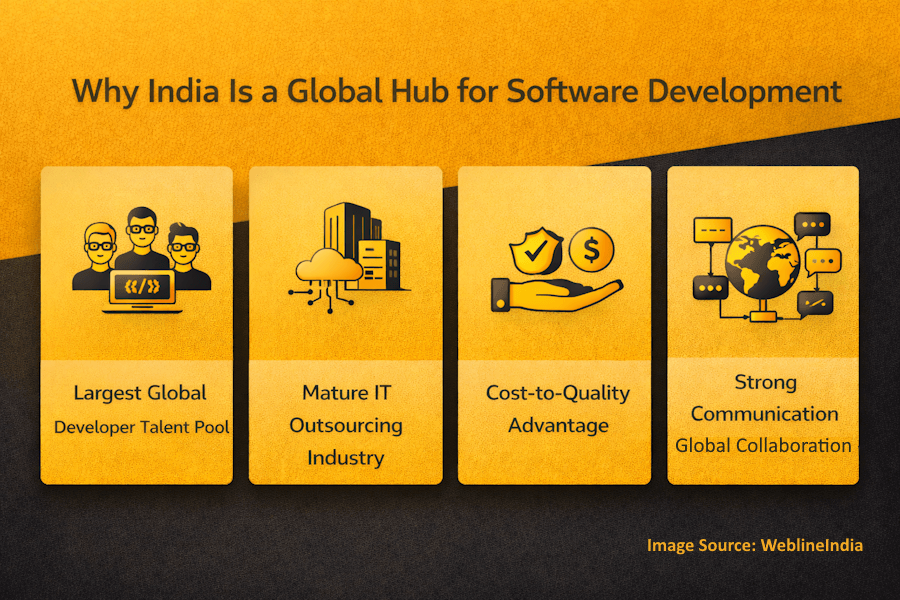
Largest Global Developer Talent Pool
The sheer volume of technical human capital in India is unmatched by any other nation. As of 2026, the country is home to an estimated 5.5 million to 6 million active software professionals at a very competitive software developer hourly rate.
- Massive STEM Output: India produces between 2.5 million and 3 million STEM graduates every year. This consistent influx of fresh talent ensures that the ecosystem remains vibrant and that newer technologies are adopted at lightning speed.
- A Hub for High-End Engineering: While India was once known for basic maintenance tasks, the 2026 landscape tells a different story. The country has pivoted toward high-value segments, with a 40% year-over-year increase in hiring for AI and Machine Learning roles.
- Global Capability Centers (GCCs): Over 1,600 global corporations now have their own R&D hubs in India. This means that the Indian workforce is daily engaged in building core products for the world’s most successful companies, constantly refining their expertise in global enterprise standards.
Mature IT Outsourcing Industry
With over four decades of history in serving international clients, India’s IT industry has moved past the learning curve and into a phase of total optimization.
- Established Frameworks: Whether it is Agile, Scrum or DevOps, Indian agencies have institutionalized these methodologies. Processes for security, testing and delivery are built into the DNA of the industry, minimizing the risk for global partners.
- Infrastructure Resilience: Major IT hubs like Bengaluru, Pune and Ahmedabad have developed world-class infrastructure. This includes not just high-speed connectivity but also a legal and business environment designed to protect international intellectual property and ensure 24/7 operations.
Cost-to-Quality Advantage
The economic argument for choosing India remains as compelling as ever, but the focus has shifted from low custom software development price to high value.
- Competitive Pricing: Enterprises can still expect to save on custom software development price between 40% and 60% compared to onshore teams in the US or UK. However, these savings now buy access to senior architects and specialized developers who are experts in modern stacks like React, Node.js and cloud-native architectures.
- Engineering Standards: The myth that lower cost equals lower quality has been thoroughly debunked. In 2026, Indian developers are at the forefront of the GitHub and Stack Overflow communities. They contribute significantly to open-source projects and set the pace for global coding standards.
Strong Communication and Global Collaboration
One of India’s most significant advantages over other emerging markets like Vietnam or China is its deep-rooted proficiency in English and its cultural alignment with Western business practices.
- World’s Largest English-Speaking Workforce: English is the primary language of the Indian IT industry, ensuring that documentation, requirements and real-time stand-up meetings happen without the friction of translation.
- Cultural Adaptability: Having worked with North American and European clients for decades, Indian teams understand the nuances of global corporate culture. They are proactive in communication and are comfortable with the transparency and accountability required in modern software projects.
India’s rise to the top of the IT world is the result of a deliberate, decades-long investment in education, infrastructure and a service-oriented mindset. For any business looking to build scalable, high-quality software in 2026, the Indian market offers a combination of speed, cost and talent that is simply unavailable anywhere else.
How to Choose the Right Software Development Partner
In the fast-evolving tech climate of 2026, choosing a software development partner is no longer just about finding someone who can write code. With the emergence of agentic AI and more stringent global data laws, the criteria for a successful partnership have shifted toward strategic alignment, technical maturity and operational transparency.
A poor choice does not just waste money; it creates technical debt that can stifle an enterprise for years.
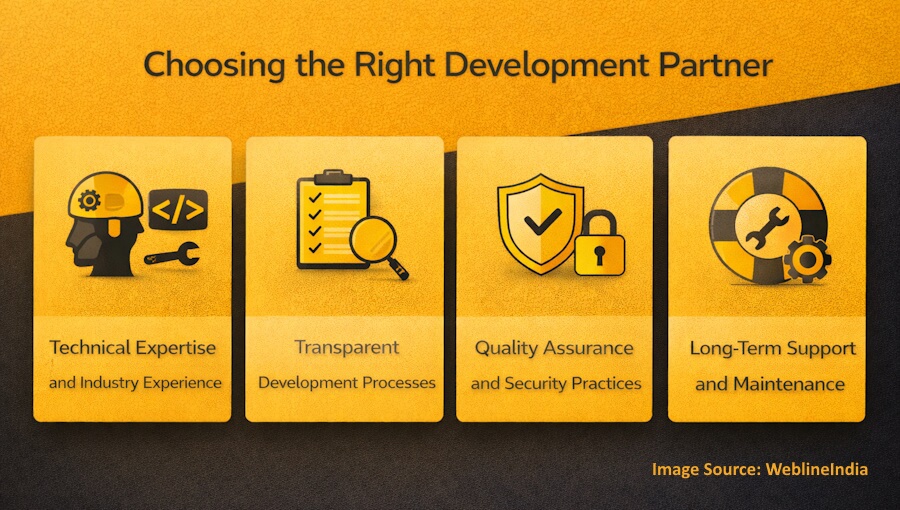
Technical Expertise and Industry Experience
The first filter for any partner should be their proven depth in modern technology stacks. In 2026, generalists are less valuable than specialists who understand the nuances of scalable architecture.
- Modern Technology Stacks: Your partner should demonstrate mastery in cloud-native development (AWS, Azure, Google Cloud), microservices and AI integration. Ask for proof of reusable components and internal knowledge bases that show they are not starting from scratch with every project.
- Industry Fluency: Technical skill is only half the battle. A partner who understands the specific regulatory and operational realities of your industry—be it fintech, healthcare or logistics—will make better product decisions. They should already be familiar with your industry’s common use cases and typical integration hurdles.
- Architecture and Scalability: Evaluate whether the partner has a history of building systems that grow. A mature engineering team will prioritize a clean foundation that stays stable even as customer demand triples or quadruples.
Transparent Development Processes
Transparency is the antidote to the uncertainty often associated with offshore or distributed development. If a vendor cannot explain their delivery method in one sentence, it is a significant red flag.
- Agile Methodology: Ensure the partner utilizes an iterative approach with clearly defined sprints. This allows for frequent feedback and ensures that the project remains aligned with your business goals as they evolve.
- Sprint Planning and Updates: A reliable partner provides full visibility into progress. You should have access to their project management tools (like Jira or ClickUp) and participate in regular sprint demos.
- Predictability Metrics: Look for teams that track and report on metrics: deployment frequency, lead time for changes, change failure rate and time to restore service. These are the industry-standard indicators of high-performing engineering teams.
Quality Assurance and Security Practices
In 2026, security is not a feature; it is a foundational requirement. High-profile data breaches and new regulations like the EU Cyber Resilience Act have raised the stakes for every software product.
- Security-First Development: The partner should treat security as a basic need that is built into the code from day one. Ask about their secure coding standards and their approach to protecting data at rest and in transit.
- Automated Testing: Manual testing alone is insufficient for modern enterprise apps. Your partner should implement a robust automated testing suite—including unit tests, integration tests and end-to-end testing—to ensure that new features do not break existing functionality.
- Compliance Standards: Depending on your market, your partner must be ready to help you navigate GDPR, HIPAA or the NIST AI Risk Management Framework. They should be able to articulate how their development process supports these compliance requirements.
Long-Term Support and Maintenance
Software is never truly finished. The launch is simply the beginning of its lifecycle. A partner who only focuses on the initial build is setting you up for failure.
- Post-Launch Support: Ensure there is a clear agreement for ongoing bug fixes and performance monitoring. The first few months after launch are critical for identifying edge cases that only appear with real-world usage.
- Continuous Improvement: Technology moves fast. Your partner should be a long-term advisor who can help you integrate new AI capabilities or migrate to more efficient cloud infrastructure as the landscape changes.
- Handover and Ownership: A professional agency ensures that you are not locked into their services. They should provide high-quality documentation, clear handover notes and total ownership of the source code, allowing your internal team or another partner to take over if necessary.
Choosing the right partner requires a move away from the obsession with the lowest hourly rate. Instead, focus on Time to Value: how quickly and reliably a partner can transform your requirements into a high-quality, secure and scalable digital product.
Why Businesses Partner with WeblineIndia for Custom Software Development
Selecting a development partner is a decision that impacts the trajectory of an enterprise for years. In a global market saturated with options, WeblineIndia has distinguished itself as a reliable pillar of engineering excellence for over 26 years. As a renowned IT agency, we have delivered more than 3,600 projects to 825-plus clients across 25 countries, consistently bridging the gap between ambitious business goals and technical reality.
Enterprise-Grade Engineering Expertise
At WeblineIndia, we believe that software should be a strategic asset, not just a line of code. Our engineering approach is rooted in providing robust architecture and scalable cloud solutions that handle the demands of modern enterprises.
- Robust Architecture: We specialize in microservices and serverless architectures that allow your platform to grow without the burden of technical debt.
- High-Performance Applications: Whether it is a web platform or a mobile app, we optimize for speed, security and concurrency, ensuring your users have a seamless experience even during peak traffic.
- Scalable Cloud Solutions: Leveraging AWS, Azure and Google Cloud, we build future-ready infrastructure that adapts to your evolving business needs.
US-Level Development Standards at Offshore Pricing
We offer our global clientele a unique value proposition: the quality and professionalism of a top-tier US consultancy combined with the economic advantages of an offshore model. We call this our RelyShoreSM model. It is our brainchild and our mainstay, focused on being a reliable offshore partner rather than just another outsourcing vendor.
Clients benefit from:
- Global Engineering Quality: Our processes are ISO certified and we adhere to the same rigorous standards you would expect from a premium local agency.
- Significant Cost Optimization: Benefitting from our development centers in India, we help enterprises save up to 60% on custom software development prices. This allows our partners to reinvest their capital into marketing, sales and further innovation.
- Security and Compliance: We prioritize data protection, employing powerful encryption and stringent protocols to ensure that your sensitive information remains secure and compliant with global regulations.
Expertise Across Modern Technologies
Our team of 165-plus pre-vetted developers stays at the absolute forefront of the technological curve. We do not just follow trends; we master them to provide you with a competitive edge.
- Next-Gen AI & ML: We have been building intelligent software long before it became a global buzzword. From generative AI and smart assistants to predictive analytics and recommendation engines, we infuse intelligence into every solution.
- Web and Mobile Mastery: Our portfolio spans native iOS and Android development, as well as cross-platform frameworks like Flutter and React Native. On the web, we excel in React, Angular, Node.js and Java, catering to everything from sleek startups to complex ERP systems.
- SaaS and eCommerce: We specialize in multi-tenant SaaS platforms and headless eCommerce architectures that offer omnichannel experiences and robust API integrations.
Flexible Engagement Models
We recognize that every enterprise has unique operational needs. To accommodate this, we offer highly adaptable engagement models designed to fit your specific timeline and custom software development price.
- Dedicated Development Teams: Based on the software developer hourly rate, we offer a hand-picked team of experts for your project. We offer full control, direct communication and deep integration with your internal processes.
- Project-Based Delivery: Ideal for well-defined scopes or MVPs, where we handle everything from planning and design to final deployment with guaranteed deliverables at affordable custom software development prices.
- Staff Augmentation: Quickly fill skill gaps in your existing team with our pre-vetted specialists who follow your workflows and report directly to your managers.
Experience Working with Global Clients
Our legacy is built on the success of our clients. We have spent over two and a half decades serving:
- Startups: Helping them build fast-to-market MVPs and scale into major players.
- Growing Technology Companies: Providing the specialized talent needed to accelerate product roadmaps.
- Enterprises across Industries: From Fintech and Healthcare to Retail and Logistics, we deliver bespoke solutions that solve complex operational challenges.
When you partner with WeblineIndia, you are not just offered a competitive software developer hourly rate; you are gaining a strategic engineering partner committed to your long-term success. Our goal is to transform your software development from a challenge into a powerful lever for growth.
Future Trends in Global Software Development
As we move through 2026, the software landscape is being redefined by a shift from merely building applications to orchestrating intelligent ecosystems. For enterprises, staying competitive means more than just having a digital presence; it requires adopting a forward-looking technological roadmap.
AI-Assisted and AI-First Development
AI is no longer just a feature; it is the foundation. In 2026, over 80% of enterprises will have adopted Generative AI solutions. We have moved from simple code suggestions to Generative and then Agentic AI, where task-specific agents handle repetitive debugging and testing. This shift allows human developers to focus on high-level architecture while AI-native challengers begin to redefine market speed.
Remote-First and Hybrid Engineering
Distributed teams are now the global norm, supported by Cloud-Native systems that enable seamless hybrid work models. Roughly 98% of organizations have adopted a multi-cloud approach, using platforms like AWS, Azure and Google Cloud simultaneously to ensure resilience and avoid vendor lock-in.
Cloud-Native and Composable Architecture
Modern software is built from the ground up specifically for the cloud. This involves:
- Microservices and Containers: Utilizing Docker and Kubernetes to ensure applications are portable and independently scalable.
- Serverless Computing: Reducing infrastructure management costs while improving real-time performance.
- Modular (Composable) ERPs: Allowing enterprises to scale instantly and roll out updates with zero downtime.
Advanced Security and Automation
With the rise of sophisticated digital threats, Secure-by-Design delivery is a business requirement. Security is now integrated into the development lifecycle from day one through DevSecOps, ensuring that every new feature undergoes real-time security checks without slowing down the release cycle.
Finding the Right Balance with WeblineIndia
Navigating the complexities of global software development in 2026 requires a delicate balance of cost, quality and speed. As this analysis has shown, the geographic location of your engineering team remains one of the most significant variables in your project’s success and its final price tag.
While premium markets like the US offer strategic proximity, offshore hubs (specifically India) have evolved into high-end engineering powerhouses. Enjoy these global talent pools and achieve significant cost efficiencies in custom software development prices. You often save between 50% and 70% without compromising on the technical standards required by modern global markets.
The key takeaway is that offshore development is no longer just a cost-saving software developer hourly rate; it is a strategic advantage. It provides the scalability and speed-to-market necessary to compete in an AI-driven world. Partnering with an experienced agency like WeblineIndia ensures that your business can navigate these global benchmarks successfully, turning complex technical requirements into high-quality, secure and scalable digital solutions.
Social Hashtags
#CustomSoftwareDevelopment #SoftwareDevelopmentCost #ITOutsourcing #OffshoreDevelopment #DigitalTransformation #SaaSDevelopment #TechTalent
Need help choosing the right offshore or hybrid development model and pricing benchmarks?
Frequently Asked Questions
Globally Recognized for Unmatched Quality and Reliability




Testimonials: Hear It Straight From Our Global Clients
Our development processes delivers dynamic solutions to tackle business challenges, optimize costs, and drive digital transformation. Expert-backed solutions enhance client retention and online presence, with proven success stories highlighting real-world problem-solving through innovative applications. Our esteemed Worldwide clients just experienced it.
Awards and Recognitions
While delighted clients are our greatest motivation, industry recognition holds significant value. WeblineIndia has consistently led in technology, with awards and accolades reaffirming our excellence.

OA500 Global Outsourcing Firms 2025, by Outsource Accelerator

Top Software Development Company, by GoodFirms

BEST FINTECH PRODUCT SOLUTION COMPANY - 2022, by GESIA

Awarded as - TOP APP DEVELOPMENT COMPANY IN INDIA of the YEAR 2020, by SoftwareSuggest