The Feature Factory Trap: Why Your Mobile App Development Team’s Strategy Is Killing Your ROI
Many apps lose money when teams keep adding features users do not need. This article shows how lean planning, usage checks, and clear business goals help teams build simpler apps that users actually enjoy. Read the full article to learn how to protect your app ROI.


 ChatGPT
  Perplexity
 The global mobile application market size, according to Grandview Research, was estimated at US$ 252.89 billion in 2023 and is likely to reach US$ 626.39 billion by 2030. This will witness a CAGR of 14.3% between 2024 and 2030. The stakes for digital products have never been higher. Yet, a silent epidemic is draining budgets across the tech landscape: the Feature Factory trap.
According to recent industry reports, users have over 80 apps on average. And, nearly 60% of those applications remain unused in any given month. Many enterprises for their businesses believe that more features mean more value. But the reality is different. Excessive development often leads to the death of the app by a thousand cuts. When you outsource app development or manage an internal team, success cannot be measured by the volume of code shipped but by what outcomes are achieved.
The feature factory is a term that describes a state wherein mobile app development team is focused solely on getting new features without measuring their actual effects or relevance to the end customer or user. It is a treadmill of production where the shipped button is the only metric of success. If your mobile app development strategy is centered on a checklist rather than a value-driven roadmap, you aren’t building a product; you are accumulating technical and financial debt.
Origins of the Production Grind and the Psychology of More
The Feature Factory is rarely the result of incompetence. More often, it is the result of well-intentioned teams trying to prove their worth. When you hire mobile app developers, especially in an offshore model, there is a natural pressure to show activity. Activity is easy to see; value is harder to measure.
The Performance vs. Impact Bias
Leadership often celebrates a completed sprint or a shipped update as a win. This is the output bias. However, if those features do not improve retention, increase average order value, or solve a specific user friction point, they are simply hidden costs of mobile app development. An outcome-oriented team asks: What behavior are we trying to change? An output-oriented team asks: How many Jira tickets did we close this week?
The Mirror-Image Competitive Pressure
Many enterprises fall into the trap of feature parity. They look at a competitor and decide they need every single bell and whistle that the competitor has. This reactive mobile app development strategy ignores the fact that the competitor might be failing or that their users might actually find those features distracting.
Absence of Purpose-Driven Culture
When there is no clear North Star metric in place, offshore mobile app developers might prefer technical excellence over functional simplicity. Without a product manager who is empowered to say no, the app becomes a graveyard of good ideas that nobody uses.
Is your app roadmap packed with features but short on ROI?
The Invisible Financial Drain of Excessive Functionality
Overbuilding doesn’t just waste your initial investment; it creates a compounding debt that lingers for the life of the product. Every line of code added increases the scope of ongoing software maintenance services, including testing and updates required for every new iOS or Android release.
Post-launch maintenance typically ranges from 15% to 25% of your initial development investment annually. Every unused feature you build today adds to this maintenance tax for years to come.
When you outsource app development, you must account for the following hidden drains on your ROI:
- Regression Testing Complexity: The more features you have, the more extensive your qa testing services need to be to verify new updates and ensure they don’t negatively affect existing functionality.
- User Cognitive Load: A messy UI ends up in choice paralysis. When a user is bombarded with a lot of options, they often select the easiest one: deleting the app.
- Infrastructure Bloat: More features mean more API calls, along with tremendous data storage, and above all, higher cloud costs.
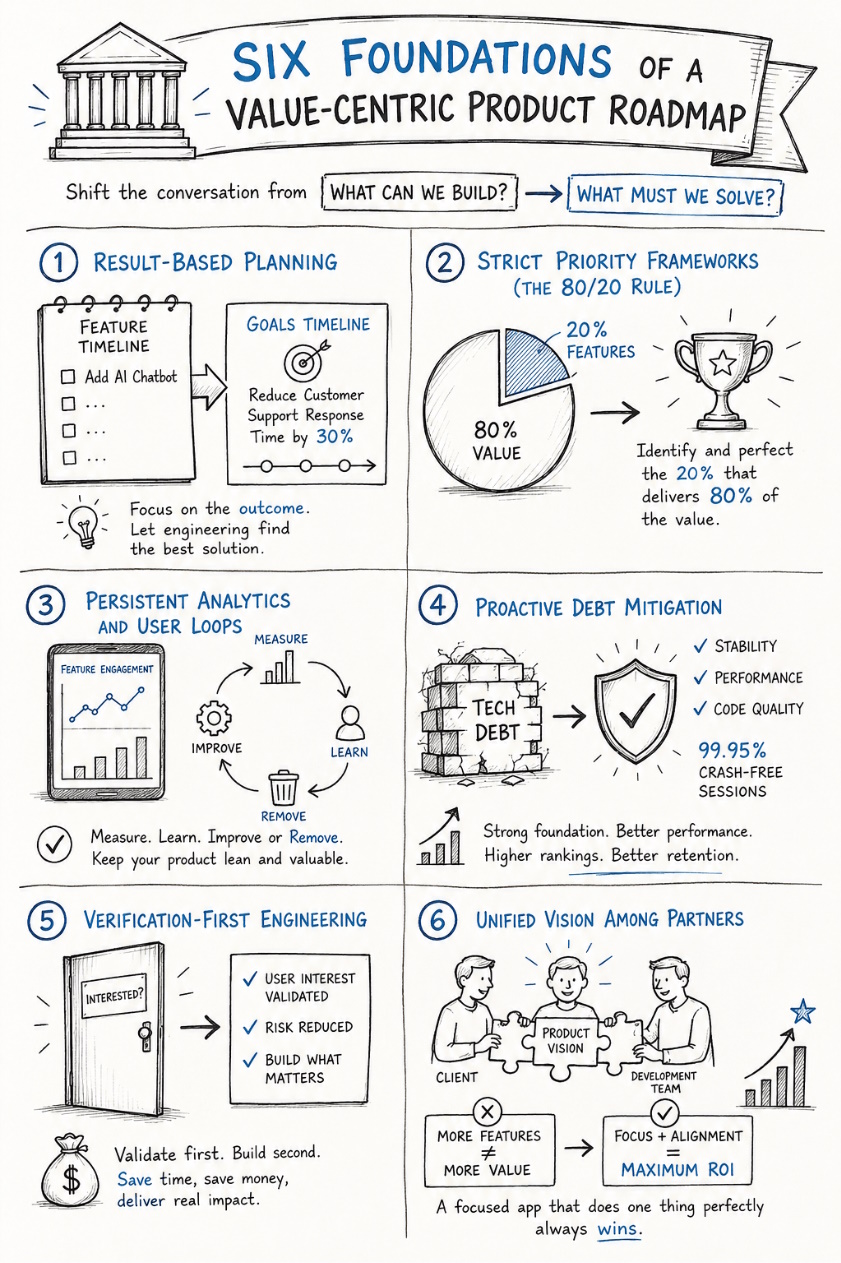
Six Foundations of a Value-Centric Product Roadmap
To escape the factory, you need to shift the conversation from What can we build? to What must we solve? Here are the core factors that define a value-driven strategy:
1. Result-Based Planning
Instead of a timeline of features, your roadmap should be a timeline of goals. For example, instead of Add AI Chatbot, the goal should be Reduce Customer Support Response Time by 30%, which allows the engineering team to find the best technical solution to the workflow. Sometimes, the solution isn’t a new feature at all, but an improvement to an existing one.
2. Strict Priority Frameworks (The 80/20 Rule)
Data consistently reveal that 80% of a typical app’s value comes from 20% of its features. You can surely identify and perfect that 20% to get rid of complexity and bring down maintenance costs. This is the heart of a lean software development approach.
3. Persistent Analytics and User Loops
Don’t wait for a Big Bang release. Use data analytics services to understand which features are actually being used and where engagement remains low. If a feature has low engagement after 90 days, your strategy should include a plan to either improve it or—more importantly—remove it. Removing dead code is one of the most effective ways to increase the long-term ROI of your project.
4. Proactive Debt Mitigation
A feature factory environment often ignores code quality in the race to meet deadlines. This leads to fragility. High-performing teams prioritize stability and performance metrics, which include a 99.95% crash-free session rate. This also proves to influence App Store rankings and user retention as compared to a big list of features.
5. Verification-First Engineering
You should use prototypes, painted door tests, or focused mvp development services to validate an idea before committing to a full-scale build of a complex feature. It will help you see whether users actually have the appetite for it. This can save thousands of dollars in unnecessary development and ensure your offshore mobile app developers always work on high-impact tasks.
6. Unified Vision Among Partners
One of the primary reasons for the Feature Factory traps is misaligned scopes. Clients often equate more work with more value. You must educate stakeholders on the value of a lean product. A focused app that does one thing perfectly is always more profitable than a Swiss Army knife app that does ten things poorly.
Are unused features quietly draining your mobile app budget?
Systems for High-Efficiency Digital Engineering
When you hire mobile app developers, you should look for a team that understands the difference between a technical requirement and a business objective. A strategic partner will audit your feature list and ask: Is this a must-have for the launch, or is this a distraction?
| Framework/Model | Primary Objective | Impact on Product ROI |
| Lean Startup | Build-Measure-Learn | Stops the production of unwanted features |
| Agile/Scrum | Iterative Delivery | Enables pivots based on real market data |
| DevSecOps | Automation & Safety | Lowers long-term repair and security costs |
| UX Research | User Centricity | Guarantees the UI drives usage, not confusion |
Cultivating a Landscape for Profitable Evolution
Escaping the production grind requires a cultural shift within the organization. It starts with leadership prioritizing quality over quantity.
Executive Support for Quality
Management must stop asking When will it be done? And start asking What did we learn? By setting goals based on user engagement and revenue per user, you permit your team to focus on what actually matters.
Developer Integration into Business Logic
Your offshore mobile app developers should be treated as product partners, not just code executors. When developers get the business objectives of what they are making, they are more likely to suggest simpler and better methods to achieve the same goal.
Transparent Usage Audits
Implementing transparent reporting that tracks feature adoption is also essential. If you observe that a newly induced feature is only being used by a fraction of your users, it is a sign to stop, re-evaluate, and then move on to the next item in the backlog.
Emerging Patterns in High-Return Development
As organizations invest in digital transformation services, mobile development is increasingly advancing toward hyper-personalization and modularity. Today, companies look at super apps with modular micro-service product instead of building massive apps. Enterprises feel that such an approach will provide instant value without the bloat.
AI Personalization Layers
AI allows applications to display only those features that are relevant rather than adding more buttons. Ultimately, the goal is to satisfy a specific user at a specific time. This reduces Feature Factory noise while increasing the app’s perceived value.
Privacy-Centric Engineering
In 2026 and beyond, security is a feature in itself; hence, enterprises invest in robust data protection protocols. Industry experts opine that it is a better use of any budget than adding multiple social sharing integrations. Users value their data safety more than minor cosmetic updates.
Rapid Prototyping via Alternative Tools
Global enterprises use low-code tools to validate feature ideas before moving proven concepts into custom software development services for full implementation. This ensures that only proven strategies and theories make it into the core codebase.
WeblineIndia is Your Ally in Smart Mobile Engineering
You can remain worry-free about your project’s direction. Partner with WeblineIndia today as we treat your product’s ROI as our primary metric of success. We ensure that every feature we build is a step toward market leadership.
We stand out by adopting strategic thinking and transforming it into each layer of our services:
- Perfect synchronization with business objectives and North Star metrics.
- Lean engineering protocols to prioritize validated learning over guessed execution.
- Expert analysis to identify and remove technical debt before it becomes a big concern.
- A focus on UX/UI that prioritizes clarity and conversion rather than clutter.
At WeblineIndia, we understand that clients’ budgets are finite and their market window is narrow. Hence, we build apps that are business assets with our next gen mobile app development services. We do it by acting as a strategic consultant that protects your ROI from the Feature Factory trap.
Social Hashtags
#MobileAppDevelopment #AppDevelopment #ProductStrategy #AppROI #LeanDevelopment #FeatureCreep #UXDesign #DigitalTransformation
Looking to build an app focused on real user needs, not feature overload?
Frequently Asked Questions
Globally Recognized for Unmatched Quality and Reliability




Testimonials: Hear It Straight From Our Global Clients
Our development processes delivers dynamic solutions to tackle business challenges, optimize costs, and drive digital transformation. Expert-backed solutions enhance client retention and online presence, with proven success stories highlighting real-world problem-solving through innovative applications. Our esteemed Worldwide clients just experienced it.
Awards and Recognitions
While delighted clients are our greatest motivation, industry recognition holds significant value. WeblineIndia has consistently led in technology, with awards and accolades reaffirming our excellence.

OA500 Global Outsourcing Firms 2025, by Outsource Accelerator

Top Software Development Company, by GoodFirms

BEST FINTECH PRODUCT SOLUTION COMPANY - 2022, by GESIA

Awarded as - TOP APP DEVELOPMENT COMPANY IN INDIA of the YEAR 2020, by SoftwareSuggest